What Is the Difference Between HBM3E and HBM4? What Do They Mean for Micron and AI Servers?





The difference between HBM3E and HBM4 is not simply that “the newer generation is faster.” HBM3E is the high-bandwidth memory specification currently being widely adopted by AI GPUs and AI servers. It mainly addresses the memory capacity and bandwidth bottlenecks in today’s large-model training and inference workloads. HBM4, by contrast, is a platform-level upgrade for next-generation AI accelerators, with key changes including a wider 2048-bit interface, higher per-stack bandwidth, larger capacity, more complex packaging, and deeper customer co-design. For you, understanding this transition helps clarify Micron’s opportunities in the AI memory cycle and why AI servers are increasingly constrained by memory bandwidth, power, and advanced packaging.
Key Takeaways
- HBM3E is the current AI server workhorse, while HBM4 targets next-generation platforms.
- HBM4’s key upgrades are a wider interface, higher bandwidth, and larger capacity.
- AI server bottlenecks are shifting from pure compute to memory, packaging, and power coordination.
- Micron’s opportunity depends on HBM3E ramp-up, HBM4 qualification, and a richer high-end DRAM mix.
- HBM upgrades do not guarantee stock gains; yield, pricing, competition, and valuation still matter.
What Is the Core Difference Between HBM3E and HBM4?
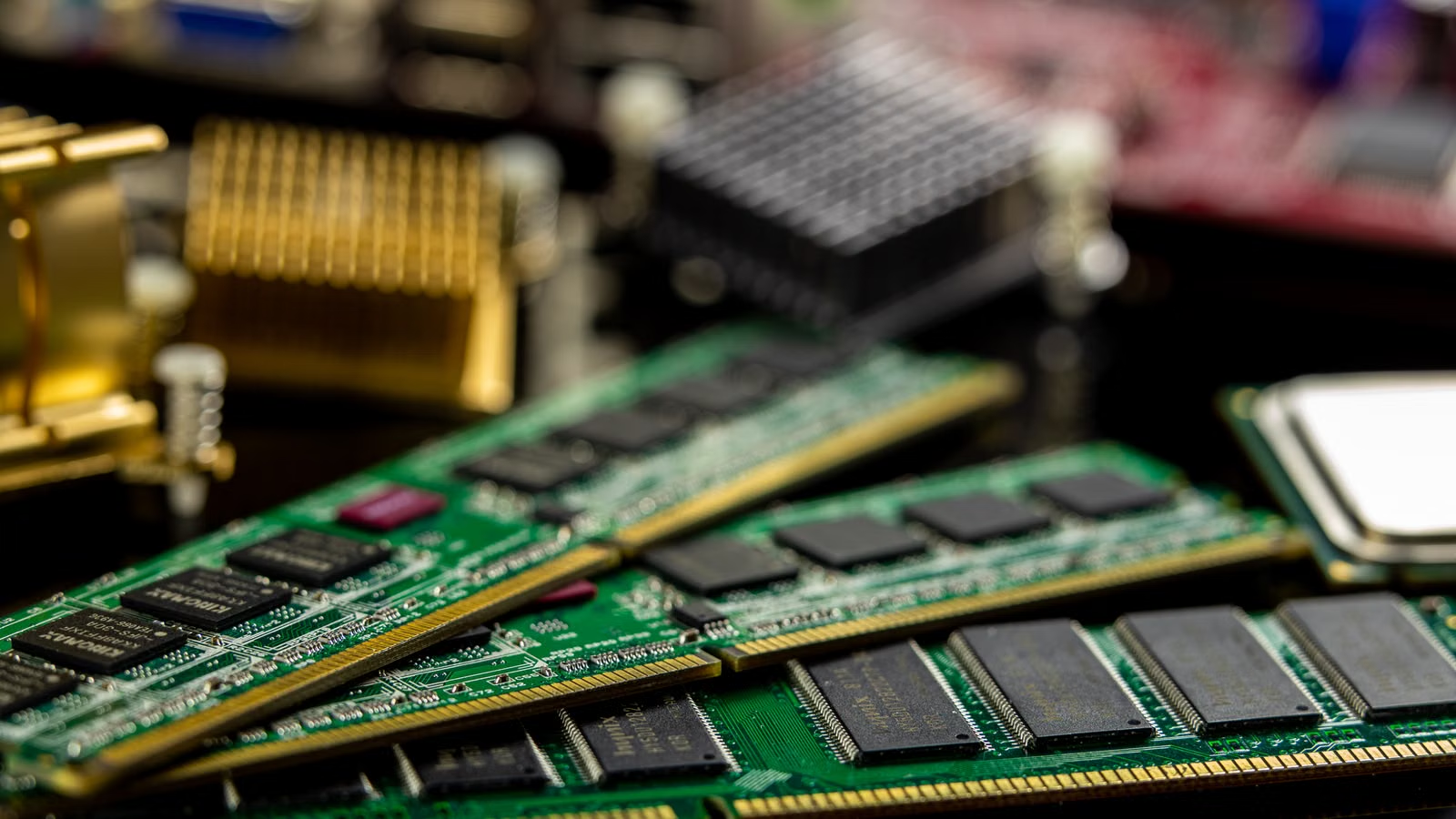
HBM3E is more like the “performance-enhanced mainstream option” in the current AI server cycle, while HBM4 is the “memory architecture upgrade” for the next generation of AI platforms. If you only look at the generation names, it is easy to assume that HBM4 is just a faster version of HBM3E. In reality, the real differences lie in interface width, channel count, stacking capability, and system design. According to the JEDEC HBM4 standard, HBM4 supports a 2048-bit interface, transfer speeds of up to 8Gb/s, and increases the number of independent channels per stack from 16 in HBM3 to 32.
The value of HBM comes from placing memory closer to compute. Traditional server memory usually connects to CPUs or accelerators through a longer data path. HBM uses 2.5D packaging, silicon interposers, through-silicon vias, and stacked DRAM layers to place a large amount of memory next to an AI GPU or AI accelerator. The goal is not merely to increase capacity, but to move model weights, activations, KV cache, and training data into compute units more quickly, reducing the waiting time caused by data movement.
HBM3E focuses on improving bandwidth, capacity, and power efficiency on top of HBM3. For example, Micron HBM3E is available in 24GB 8-high and 36GB 12-high configurations, with per-stack bandwidth above 1.2TB/s. It is suited for AI GPU platforms that are already in production and deployment, solving the question of how today’s servers can host larger models, run faster, and keep power consumption under control.
HBM4 goes one step further. It does not simply make each memory stack faster. Instead, it requires next-generation GPUs, memory controllers, packaging substrates, and system interconnects to be redesigned together. In other words, HBM4 commercialization is usually tied to the roadmap of next-generation AI accelerators, rather than acting as a drop-in replacement like a standard memory module.
| Comparison Dimension | HBM3E | HBM4 | What It Means for Your Analysis |
|---|---|---|---|
| Product positioning | Current enhanced mainstream option | Next-generation standard | Watch platform adoption timing |
| Core change | Higher bandwidth and capacity | Wider interface and more channels | Not just a speed upgrade |
| Main use case | Current AI GPUs and servers | Next-generation AI/HPC platforms | Impacts server refresh cycles |
| Industry difficulty | High yield and stacking requirements | Higher packaging and validation barriers | Affects supply elasticity |
| Investment signal | Shipments, pricing, gross margin | Qualification, mass production, customer platforms | Determines monetization timing |
Summary: The difference between HBM3E and HBM4 should not be simplified as “old specification versus new specification.” HBM3E is a core memory specification in the current AI server expansion cycle, already carrying the bandwidth and capacity pressure of large-model training and inference. HBM4 is the key step in redesigning memory systems for the next generation of AI platforms. To evaluate their value, you need to look at technical specifications, platform qualification, production timing, and packaging capacity together, rather than focusing only on peak bandwidth.
How Do HBM3E and HBM4 Compare in Specifications? Bandwidth, Capacity, Power, and Packaging Matter Most
The most direct differences between HBM3E and HBM4 are per-stack bandwidth, interface width, capacity, stack height, and power efficiency. HBM3E already meets the large-scale deployment needs of today’s high-end AI GPUs. HBM4, meanwhile, pushes each HBM stack’s data supply capability even higher through a 2048-bit interface, higher pin speed, and more channels. For AI servers, this means larger models, longer contexts, and higher-concurrency inference can receive more sufficient memory bandwidth.
Based on public specifications, HBM3E is already far ahead of traditional DRAM and GDDR-type memory. NVIDIA H200 features 141GB of HBM3e with memory bandwidth of 4.8TB/s, and NVIDIA positions it as a Hopper architecture upgrade for generative AI and large language models. In the Blackwell Ultra generation, NVIDIA Blackwell Ultra can support 288GB of HBM3e per GPU, showing that HBM3E remains a key configuration in current high-end platforms rather than a temporary transition product.
HBM4’s improvement is more aggressive. Micron has disclosed that its HBM4 36GB 12H, designed for NVIDIA Vera Rubin, delivers more than 2.8TB/s of per-stack bandwidth and better power efficiency than HBM3E with the same capacity and stack height. Samsung has also disclosed that Samsung HBM4 uses a 4nm logic base die and emphasizes stable transfer speeds of 11.7Gbps, showing that HBM4 has entered the core battlefield of memory vendor competition.
| Metric | HBM3E | HBM4 | Impact on AI Servers |
|---|---|---|---|
| Interface width | Extension of HBM3 architecture | 2048-bit | Wider data path per stack |
| Per-stack bandwidth | Micron: above 1.2TB/s | Micron: above 2.8TB/s | Reduces memory bandwidth bottlenecks |
| Common capacity | 24GB, 36GB | 36GB, 48GB and higher | Supports larger models and KV cache |
| Channel count | HBM3 architecture extension | 32 independent channels | Stronger parallel access capability |
| Packaging difficulty | Already high | Even higher | Affects yield, cost, and delivery |
Higher bandwidth does not automatically mean lower cost. HBM4 requires a more complex base die, more precise stacking, stricter signal integrity, stronger thermal design, and more dependence on advanced packaging resources. For cloud customers, the real concerns are cost per token, throughput, rack-level power, and delivery timing. For memory vendors, the real challenge is to manufacture high-specification products reliably and pass validation on customer platforms.
Summary: HBM4’s specification advantages are clear: wider interface, higher bandwidth, more channels, and larger capacity headroom. But HBM4’s value should not be judged only by peak numbers. AI servers need stable mass production, controllable power consumption, adequate yield, and full system-platform compatibility. HBM3E remains the key memory specification in current mainstream AI servers, while HBM4 represents the performance ceiling and supply-chain barrier of next-generation platforms.
Why Are AI Servers Increasingly Dependent on HBM? From Training to Inference and Long Context

AI servers are becoming more dependent on HBM because the bottleneck in large models is no longer just GPU compute. Training requires fast access to weights, activations, gradients, and optimizer states. Inference requires frequent access to model weights and KV cache. Long-context processing, multimodal inputs, and high-concurrency requests further amplify memory pressure. HBM3E addresses the memory bandwidth needs of current platforms, while HBM4 is built for larger models and higher throughput in the next generation.
In training, GPUs must continuously feed data into matrix compute units. If memory bandwidth cannot keep up, compute units wait, and even very high theoretical compute power cannot be fully utilized. In large-scale distributed training, memory capacity and bandwidth affect batch size, communication frequency, gradient synchronization efficiency, and whether data must be frequently transferred across GPUs. The value of HBM is to reduce the problem of data movement slowing down computation.
In inference, the importance of HBM is even more direct. Long context increases KV cache usage as input length and concurrent requests rise. If an AI service needs to process many user requests at the same time, how much context cache a single GPU can hold and how quickly it can read model weights both affect tokens per second and user waiting time. The NVIDIA Rubin platform describes Rubin GPU’s 288GB of HBM4, Vera CPU’s LPDDR5X, and NVLink-C2C coherent memory within the same system architecture, showing that next-generation AI servers are moving from single-chip performance toward system-level memory coordination.
HBM mainly affects the following parts of AI servers:
- Model weight read speed
- Long-context KV cache capacity
- High-concurrency inference throughput
- Data movement efficiency during training
- GPU utilization and idle time
- Rack-level power, cooling, and deployment density
- Cost per token and cloud customer TCO
HBM also affects the energy profile of AI data centers. If higher bandwidth also brings higher power consumption, server cooling and electricity costs rise with it. If power efficiency improves meaningfully, the energy burden per computing task may decline. As a result, memory-chip competition is no longer only about DRAM pricing. It is now tied to AI compute costs, rack density, and data center power planning.
Summary: AI servers rely on HBM because large-model training and inference are increasingly hitting the “memory wall.” GPUs can provide enormous compute capability, but model weights, cache, and intermediate results must be moved quickly into compute units. HBM3E gives current AI platforms higher memory capacity and bandwidth, while HBM4 raises the ceiling further for long-context, multimodal, and high-concurrency inference. Future AI server competition will increasingly be a combined contest of compute, memory, networking, power, and packaging.
What Does HBM4 Mean for Micron? The Opportunity Lies in Customer Qualification, Capacity, and Margins
For Micron, HBM4 is not just another new memory product. It is a test of whether Micron can gain a higher-value position in the AI server supply chain. Commodity DRAM is more exposed to pricing cycles, while HBM depends more on customer co-design, platform qualification, advanced packaging, and long-term supply capability. If Micron can continue from HBM3E ramp-up into mainstream HBM4 platforms, it may improve its product mix, revenue quality, and gross margin potential.
Micron has not historically been the largest DRAM share leader, but it has gained more attention in the HBM3E era. The reason is that HBM is not a low-end, highly standardized memory product. It requires deep coordination with GPU vendors, packaging partners, and cloud customers. Once a product passes key customer qualification, replacement costs, validation cycles, and supply stability can deepen the customer relationship. For Micron, HBM3E ramp-up is the first step into the AI memory cycle; HBM4 is the key test for next-generation platform competition.
The opportunity has three main dimensions. First, HBM has higher value per unit than commodity DRAM, which can improve the product mix. Second, if AI server demand continues to grow, HBM supply may remain relatively tight. Third, once HBM4 is tied to next-generation GPU platforms, memory vendors are not merely selling memory; they are participating in platform design.
The risks are also clear. Leading HBM4 specifications do not guarantee share. There is a time gap between product sampling, qualification, mass production, and revenue recognition. SK hynix has long held a first-mover advantage in HBM, and Reuters’ coverage of SK hynix HBM shows that HBM has reshaped the competitive landscape among Korean memory vendors. Samsung is also accelerating in HBM4 and HBM4E, so competition will not end with one generation of product announcements.
| Observation Area | Positive Meaning for Micron | Key Risk to Watch |
|---|---|---|
| HBM3E shipments | Higher AI memory revenue | Price decline or customer switching |
| HBM4 qualification | Entry into next-generation platforms | Qualification delays or weaker-than-expected share |
| Capacity expansion | More exposure to high-end DRAM demand | Excessive CapEx and depreciation pressure |
| Gross margin | Improved product mix | Competition may compress premium pricing |
| Customer concentration | Deeper AI platform relationships | Higher dependence on a small number of customers |
For investors, Micron’s HBM story should not be reduced to “whether it has HBM4.” The more important questions are: Is HBM revenue increasing as a share of total revenue? Is gross margin improving with it? Is capital spending under control? Are customer orders stable enough? Is the commodity DRAM inventory cycle still dragging on valuation? These indicators together determine whether HBM can meaningfully change Micron’s cyclical profile.
Summary: The core opportunity HBM4 gives Micron is the chance to move from a traditional memory cycle into the high-value AI memory supply chain. But opportunity does not equal guaranteed return. Micron still needs to prove that it can produce reliably, pass key customer qualifications, control costs, and convert HBM shipments into revenue, gross margin, and cash flow improvement. Analyzing Micron requires looking at technology, customers, capacity, financials, and valuation together, rather than reacting only to HBM4 headlines.
How Will HBM4 Change the AI Server Supply Chain? GPU, Packaging, Memory, and Data Centers Will Move Together
HBM4 will extend its impact from memory chips to the entire AI server supply chain. HBM4 is not a general-purpose component inserted into a motherboard. It is co-designed with GPUs, base dies, silicon interposers, 2.5D packaging, testing, cooling, and full server systems. Next-generation AI server competition will increasingly depend on who can secure advanced nodes, HBM supply, CoWoS-like packaging capacity, and data center delivery capability at the same time.
From the GPU design perspective, HBM4 requires deeper compute-memory coordination. A wider interface means more complex package routing, greater signal integrity challenges, and more difficult power management. AI accelerator vendors must balance compute units, memory controllers, chip-to-chip interconnects, and package layouts. If HBM4’s higher bandwidth is not fully utilized by the software stack, scheduling system, and network interconnect, peak bandwidth may not fully translate into real-world throughput.
From the packaging supply-chain perspective, HBM4 will continue to amplify advanced packaging bottlenecks. TrendForce’s coverage of TSMC CoWoS notes rapid expansion in CoWoS advanced packaging capacity driven by AI demand. This shows that HBM supply depends not only on DRAM wafers, but also on interposers, substrates, packaging, testing, and final system delivery. ASE and other OSAT providers are also expanding AI-related advanced packaging and testing capacity, and Reuters’ report on ASE capacity reflects this trend.
HBM4 may drive changes across the following parts of the supply chain:
- Memory vendors: HBM yield, stack height, shipment timing
- GPU vendors: memory controllers, interconnects, and platform architecture
- Foundries: base dies, logic dies, advanced-node capacity
- Packaging companies: 2.5D packaging, interposers, and testing capability
- Server vendors: cooling, power delivery, and rack density
- Cloud customers: procurement cycles, delivery capacity, and cost per inference
Data center procurement logic will also change. Cloud customers will not only compare GPU peak compute. They will also look at how many tokens can be processed per watt, how many accelerators can fit in a single rack, whether liquid cooling is mature, and whether supply timelines are reliable. If HBM4 improves throughput but adds packaging or power pressure, overall server TCO can still be constrained.
Summary: HBM4 is not an isolated memory upgrade. It is a signal that AI server system competition is entering a new stage. It will influence GPU design, advanced packaging, full server systems, cooling, power, and cloud procurement timing. For supply-chain companies, opportunities extend beyond DRAM into packaging, testing, substrates, liquid cooling, and power infrastructure. For investors, tracking HBM4 means looking not only at Micron, but also at NVIDIA, AMD, SK hynix, Samsung, TSMC, and server ODM coordination.
How Should Ordinary Investors Evaluate the Investment Value and Risks of the HBM3E-to-HBM4 Transition?
Ordinary investors should not equate the transition from HBM3E to HBM4 with automatic stock price gains. A more disciplined framework has three steps: first, check whether the technology turns into customer qualification and volume orders; second, check whether those orders turn into revenue, gross margin, and cash flow; third, check whether valuation has already priced in optimistic expectations. HBM is one of the key AI server beneficiaries, but it is still affected by pricing cycles, competition, capital spending, and customer concentration.
The first step is to determine whether the technology is truly being commercialized. Product announcements, samples, customer qualification, volume shipments, and revenue recognition are different stages. HBM4 specifications matter, but what matters more is whether the product enters mainstream AI GPU platforms, whether supply becomes stable, and whether it appears in financial results as high-value revenue. For a memory company like Micron, investors need to distinguish between “technology news” and “financial contribution.”
The second step is to assess whether revenue can become profit. HBM has higher unit value, but manufacturing costs are also high. It involves high-stack packaging, advanced packaging, testing, and yield ramp-up. If yields are unstable, or if capital expenditure and depreciation rise too quickly, higher revenue may not immediately translate into strong free cash flow. The memory industry has historically shown a pattern where valuations expand when expectations rise and compress when prices weaken. HBM may improve the structure, but it is unlikely to fully eliminate cyclicality.
The third step is to evaluate whether valuation has already reflected expectations. Popular AI memory stocks often trade ahead of future orders, future gross margins, and future platform share. When the market has already priced in successful HBM4 adoption, tight supply, and margin improvement, any delay in mass production, weaker-than-expected customer share, or memory price weakness can trigger volatility.
| Key Question | What to Watch | Common Misconception |
|---|---|---|
| Is HBM4 really landing? | Customer qualification, volume production, platform adoption | Looking only at launch specifications |
| Is Micron benefiting? | HBM revenue, gross margin, orders | Looking only at the AI concept |
| Is the memory cycle improving? | Long-term contracts, pricing, inventory | Believing HBM eliminates cyclicality |
| Is valuation reasonable? | Earnings expectations and stock price gains | Assuming better technology always means higher stock prices |
| Are risks manageable? | CapEx, competition, customer concentration | Ignoring downside cycles |
If you follow Micron, NVIDIA, AI servers, or semiconductor ETFs, you also need to consider trading execution costs in addition to technology roadmaps. U.S. stock trading costs usually include more than commissions. They may also include platform fees, external institutional fees, transaction activity fees, fractional-share order costs, and FX costs. Eligible users can review Biya U.S. stock trading fees: Biya charges zero U.S. stock trading commission, while platform fees, external institutional fees, and other charges are subject to the fee center and order page. Public market information and fee structures are for pre-trade reference only and do not constitute investment advice. Service availability depends on the user’s location, identity verification result, platform rules, and applicable laws and regulations.
Summary: The transition from HBM3E to HBM4 is worth tracking, but investment analysis must return to commercialization and valuation. Technical leadership must be verified through customer qualification, stable production, and financial reporting. Revenue growth still depends on yield, pricing, cost, and capital expenditure. Stock performance is influenced by expectation gaps. HBM is an important variable in the AI server supply chain, but ordinary investors should still evaluate it together with risk tolerance, portfolio structure, trading costs, and market cycles.
If you continue to follow HBM3E, HBM4, Micron, NVIDIA, AI servers, and the semiconductor supply chain, technical announcements alone are not enough. You also need to observe earnings reports, orders, stock volatility, FX changes, and trading costs within the same framework. You can use Biya to follow relevant U.S. and Hong Kong stocks, and use U.S. stock information to track public-market information on semiconductor, AI server, and memory supply-chain companies. If your region is eligible for the relevant services, you can also download App to review multi-asset trading, billing records, and fee details. Before trading, you should still check platform rules, order pages, local regulatory requirements, and your own risk tolerance. No technology trend should be treated as a guaranteed return.
FAQ
Which Is More Suitable for Current AI Servers, HBM3E or HBM4?
HBM3E is more suitable for AI servers that are already in mass production and large-scale deployment. HBM4 is better suited for next-generation AI accelerator platforms. It can provide higher bandwidth and capacity, but its ramp-up depends on GPU platforms, customer qualification, packaging capacity, and full-system delivery timelines.
Will HBM4 Quickly Replace HBM3E?
HBM4 will not immediately replace HBM3E. Existing platforms such as H200 and Blackwell still rely heavily on HBM3E, and server buyers also consider cost, supply, and compatibility. HBM4 is more likely to enter next-generation high-end AI platforms first before gradually increasing its share.
Is HBM4 Definitely Positive for Micron Stock?
HBM4 is an important opportunity for Micron, but it does not mean the stock price will definitely rise. Investors still need to watch HBM revenue share, customer share, yield, gross margin, capital expenditure, and valuation. Any trading decision should be based on risk tolerance and publicly disclosed information.
Why Does AI Inference Need More HBM Than Before?
AI inference needs more HBM because long-context processing, multimodal inputs, and high-concurrency requests consume large amounts of KV cache and memory bandwidth. Larger HBM capacity and higher bandwidth can help improve inference throughput and reduce waiting time, but results also depend on software optimization and system architecture.
What Is the Biggest Challenge in HBM4 Mass Production?
The biggest challenge in HBM4 mass production is not only the DRAM chip itself. It also includes TSV stacking, the base die, 2.5D packaging, testing, cooling, and customer qualification. Product specifications are only the first step; stable yield, large-scale delivery, and platform compatibility determine commercial value.
How Can Ordinary Investors Track Changes in the HBM Supply Chain?
Ordinary investors can track four types of signals: HBM production progress from Micron, SK hynix, and Samsung; AI GPU roadmaps from NVIDIA and AMD; advanced packaging capacity from companies such as TSMC; and AI server capital expenditure from cloud customers. Before trading, they should also check fee structures and platform rules.
*This article is provided for general information purposes and does not constitute legal, tax or other professional advice from BiyaPay or its subsidiaries and its affiliates, and it is not intended as a substitute for obtaining advice from a financial advisor or any other professional.
We make no representations, warranties or warranties, express or implied, as to the accuracy, completeness or timeliness of the contents of this publication.
Related Blogs of

What Are NOR Flash, SLC NAND, and EEPROM? Why They Help Explain Hong Kong-Listed Memory-Related Stocks


Why Does AI Compute Growth Drive Storage Demand? The Difference Between Training, Inference, and Data Retention


What Is the Relationship Between ASMPT 0522.HK and HBM? The Role of Advanced Packaging Equipment in the AI Memory Supply Chain


How Should SSDs and HDDs Work Together in AI Data Centers? Performance, Capacity, Cost, and Hot vs. Cold Data Compared

Choose Country or Region to Read Local Blog
 Australia
 Austria
 Belgium
 Canada
 Cyprus
 Czech Republic
 Denmark
 Estonia
 Finland
 France
 Germany
 Greece
 Hong Kong
 India
India Indonesia
 Ireland
 Italy
Italy Japan
Japan Latvia
 Lithuania
 Luxembourg
 Malaysia
 Malta
Malta Morocco
 Nepal
Nepal Netherlands
 New Zealand
 Norway
 Pakistan
 Philippines
 Poland
 Portugal
 Romania
 Singapore
 Slovakia
 Slovenia
 South Africa
 South Korea
 Spain
Spain Sweden
 Thailand
 The United States
 Turkey
 United Arab Emirates
 United Kingdom
 Vietnam
Contact Us




BIYA GLOBAL LLC is registered with the Financial Crimes Enforcement Network (FinCEN), an agency under the U.S. Department of the Treasury, as a Money Services Business (MSB), with registration number 31000218637349, and regulated by the Financial Crimes Enforcement Network (FinCEN).
BIYA GLOBAL LIMITED is a registered Financial Service Provider (FSP) in New Zealand, with registration number FSP1007221, and is also a registered member of the Financial Services Complaints Limited (FSCL), an independent dispute resolution scheme in New Zealand.