- More
- Download
The End of the Global Price Parity Era: How to Use Fiat Currency Exchange Rate Differences Between Countries for Risk-Free Arbitrage Wealth Management?





Image Source: unsplash
The end of the global price parity era brings you unprecedented new arbitrage opportunities. You can achieve risk-free arbitrage by capturing short-term differences in fiat currency exchange rates across different countries. The core of exchange rate difference arbitrage lies in identifying price discrepancies for the same asset in different currency markets. Recently, cross-border arbitrage opportunities have become more evident, primarily due to persistent and economically significant violations of CIP (Covered Interest Parity). The table below shows relevant statistical information:
| Evidence Type | Description |
|---|---|
| CIP Violation | Short-term CIP violation phenomena |
| Economic Significance | The scale of CIP violations is economically significant |
| Exploitation Duration | The duration of violations is long enough to allow traders to exploit them |
You do not need a professional background to participate. As long as you maintain keen insight into market changes and adjust strategies promptly, you have the opportunity to capture arbitrage dividends.
Key Takeaways
- The end of the global price parity era has brought new arbitrage opportunities, where exchange rate differences can be used to achieve risk-free profits.
- Participating in exchange rate difference arbitrage does not require a professional background; you only need to maintain keen observation of market changes and quick reactions.
- Successful arbitrage requires strict conditions, including simultaneous transaction execution, no transaction costs, and market inefficiencies.
- Choosing reliable platforms and tools is crucial; platforms like BiyaPay provide multi-currency scheduling and real-time exchange rate monitoring.
- Continuous learning and risk management are key to successful arbitrage; setting stop-loss orders and controlling position sizes can reduce risks.
The End of the Global Price Parity Era and Arbitrage Opportunities

Image Source: unsplash
Principles of Exchange Rate Difference Arbitrage
You can discover that the end of the global price parity era has not only changed the pricing methods for goods and assets but also made exchange rate differences a new arbitrage opportunity. Deglobalization of global supply chains, intensified competition, wage convergence, as well as political pressures and restrictions on management control, have gradually eroded onshore cost advantages. The complexity of manufacturing assets and the maturity of local ecosystems determine the speed at which offshoring decisions are reversed. Nearshoring is gradually becoming an alternative, with global supply chains slowly transitioning to regional supply chains. Emerging technologies and sustainability factors are also continuously influencing the development boundaries of global supply chains.
You can utilize the basic principles of exchange rate difference arbitrage by identifying brief price deviations between different currencies to perform risk-free arbitrage. The table below shows the theoretical explanation and definition of exchange rate difference arbitrage:
| Evidence Type | Content |
|---|---|
| Theoretical Explanation | In financial markets, currency arbitrage is the act of using exchange rate inconsistencies to obtain risk-free profits. This includes identifying cycles of currency conversions where the product of exchange rates exceeds 1. |
| Definition | Arbitrage trading exploits moments of brief price deviations between different markets or instruments. The core idea is to find the same asset trading at different prices in different places, then simultaneously buy and sell to obtain guaranteed profits. |
You can perform triangular currency arbitrage by converting between three currencies to capture net gains from exchange rate differences. You can also utilize covered interest arbitrage, converting low-yield USD funds into other higher-yield currencies to obtain additional profits.
Conditions for Achieving Risk-Free Arbitrage
To achieve risk-free arbitrage, you must meet a series of strict conditions. The table below summarizes the main conditions and explanations:
| Condition | Description |
|---|---|
| Triangular Arbitrage Opportunity | If there is a clear triangular arbitrage opportunity, traders must act quickly, otherwise potential immediate gains may disappear before all positions are established. |
| Simultaneous Transaction Execution | Transactions must be executed at the same time to ensure risk-free arbitrage. |
| No Transaction Costs | There should be no fees during the transaction process to maximize profits. |
| Market Inefficiency | There must be exploitable market inefficiencies to profit from exchange rate differences. |
| High-Frequency Trading Technology | Using high-frequency trading techniques and real-time data is key to capturing fleeting opportunities. |
| Tradable Quotes for Relevant Interest Rates and Exchange Rates | Simultaneous tradable quotes are required to determine if an arbitrage opportunity exists. |
| Fast Execution | Price differences may disappear in seconds, so fast execution is crucial. |
| Reliable Trading Platform | Traders must have access to fast and reliable trading platforms to exploit these opportunities. |
You also need to pay attention to challenges such as transaction costs, financing constraints, and behavioral factors. Brokerage fees or bid-ask spreads may erode arbitrage profits, and financing constraints can affect fund allocation capabilities. The risk from noise traders may also cause hesitation when identifying price imbalances. You should always monitor monetary policies and economic indicators of various countries to capture arbitrage timing brought by exchange rate changes. The end of the global price parity era gives you the opportunity to seize risk-free arbitrage opportunities from exchange rate differences through keen insight and quick response.
Operation Process
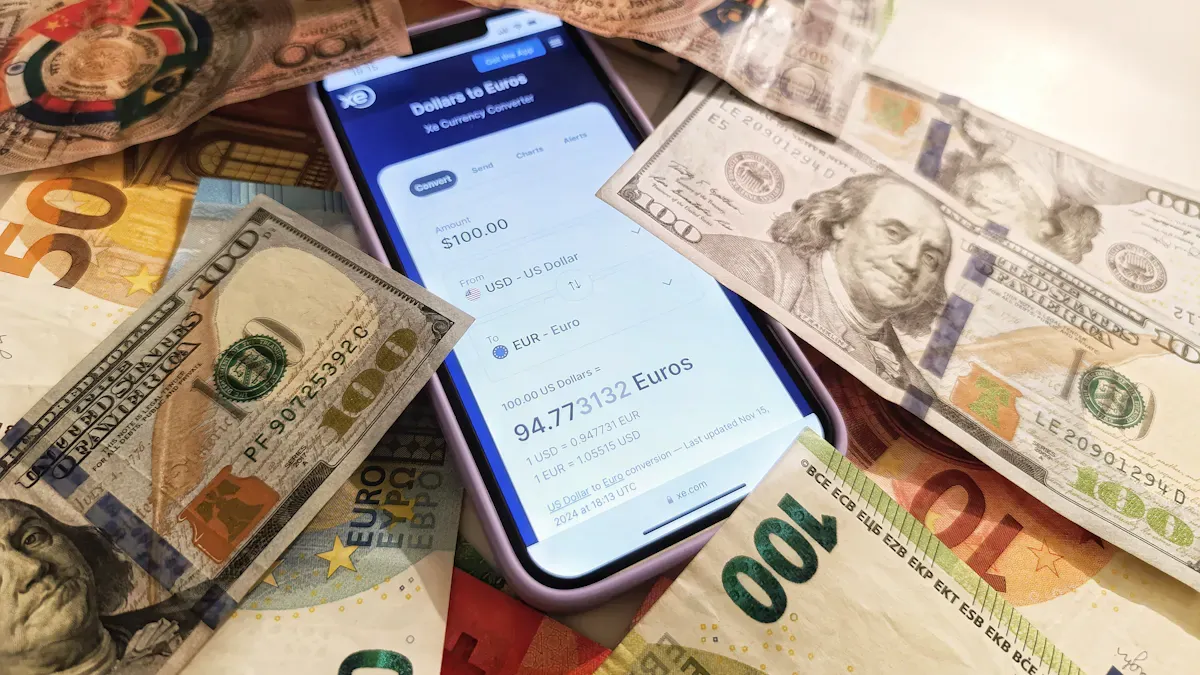
Image Source: pexels
Fund Preparation and Cross-Border Transfer
To conduct exchange rate difference arbitrage, you first need to prepare sufficient funds and ensure smooth cross-border transfer of funds. In the fund preparation stage, you should assess your liquidity needs and reasonably allocate major currencies such as USD and HKD. When transferring cross-border, choosing compliant and secure channels is crucial. BiyaPay, as a global payment and exchange platform, supports real-time exchange of multiple currencies including USD, HKD, and USDT, suitable for Chinese-speaking users for fund scheduling. You can transfer funds from a U.S. bank account to a Hong Kong licensed bank account via BiyaPay, or directly exchange into USDT for global circulation.
During the cross-border fund transfer process, you must pay attention to legal and regulatory requirements. Relevant authorities conduct risk assessments in the cross-border payment field, identifying risks faced by active payment service providers. Authorities review existing regulatory, supervisory, and management systems to ensure they can address all key risks and coordinate consistently with relevant authorities. Regulatory systems aim to promote consumer protection and address potential harms to users. You must ensure the legality of fund sources and clarity of purposes to avoid fund freezing or legal penalties due to compliance issues.
Platform and Tool Selection
To efficiently execute exchange rate difference arbitrage, you must choose reliable platforms and tools. BiyaPay supports global payments, real-time exchange between fiat and cryptocurrencies, USDT to USD/HKD, funding support for U.S. and Hong Kong stocks, as well as cryptocurrency trading services. You can use BiyaPay for multi-currency fund scheduling and real-time exchange rate monitoring to improve arbitrage efficiency.
If your priority is to verify whether a spread is actually tradable before taking action, it helps to first use the BiyaPay official website and its exchange-rate comparison tool to cross-check live quotes, conversion costs, and net proceeds across currencies. BiyaPay itself is a multi-asset trading wallet covering cross-border payments, stock investing, spot and contract trading for digital assets, and fund management. In this context, the value of the tool is not to generate trading advice, but to make exchange rates, fees, and transfer paths more transparent so you can reduce execution errors caused by misreading the spread.
There are other platforms available in the market. The table below compares the features and advantages of mainstream arbitrage platforms:
| Platform | Features | Comparative Advantages |
|---|---|---|
| BiyaPay | Global payments, real-time fiat and crypto exchange, Hong Kong/U.S. stock funding support, USDT to USD/HKD | One-stop fund scheduling, suitable for Chinese-speaking users |
| Altrady | Multi-exchange connection, intelligent trading automation, real-time price alerts, fast execution | Integrated platform, suitable for advanced traders |
| eToro | Ease of use, social trading features, broad asset coverage | Ideal choice for multi-asset arbitrage |
| Gemini | Secure environment, strong compliance, simple account setup | Suitable for institutional-level trading |
| Coinbase | User-friendly interface, strong security, suitable for beginners | Best choice for beginner arbitrage trading |
| Westernpips | Comprehensive platform, supports multiple arbitrage strategies | Suitable for mature traders with capital |
| SharpTrader | 11 integrated strategies, connects multiple exchanges | Ideal choice for professional traders and developers |
| HFT Arbitrage | Clean interface, stable performance, suitable for traders with limited budgets | Cost-effective choice |
When selecting platforms, you also need to focus on security and reliability. The table below shows security features of some platforms:
| Platform | Security Features |
|---|---|
| Bitsgap | 2048-bit encryption, IP whitelist for API connections, read-only API access options. Bitsgap does not require withdrawal permissions, ensuring user control over funds. |
| 3Commas | History of phishing incidents; platform strengthened security protocols; users need to carefully configure API permissions. |
| Pionex | Limited to Pionex ecosystem; user experiences vary, some praise support and smooth operations, others report withdrawal delays and communication issues. |
You should prioritize platforms with strong compliance, fund security guarantees, and real-time data support. In the context of the end of the global price parity era, BiyaPay provides multi-currency fund scheduling and real-time exchange rate monitoring for Chinese-speaking users, enhancing the flexibility and security of arbitrage operations.
Arbitrage Trading Steps
To successfully complete exchange rate difference arbitrage transactions, you need to strictly follow the steps. The following is the standard process:
- Find pricing mismatches. You monitor real-time exchange rates in different currency markets through platforms to discover price differences for the same asset in USD, HKD, USDT, and other markets.
- Determine transaction size to cover trading costs. You evaluate platform fees, exchange costs, ensuring arbitrage profits exceed transaction fees.
- Successfully execute the order sequence before the spread closes. You quickly place orders, using BiyaPay or other efficient platforms to complete fund exchange and transfer.
- Identify pricing inconsistencies. You continuously monitor market dynamics to capture brief exchange rate deviations.
- Execute trades in three currency pairs. You perform triangular arbitrage between USD, HKD, and USDT, realizing profits from exchange rate differences.
- Realize profits. After completing all transactions, calculate net gains and ensure safe return of funds.
Triangular arbitrage is a method of trading by exploiting price inconsistencies between three currency pairs. You can identify arbitrage opportunities by monitoring exchange rates between different currencies and realize profits through a series of transactions. You need to maintain keen insight into market dynamics, respond quickly to price changes, and avoid arbitrage opportunities disappearing due to delays.
During the operation process, you need to avoid common mistakes:
- Lack of research: Failing to conduct detailed analysis may lead to unwise trading decisions.
- Misjudging execution speed: Delayed response may turn potential gains into nothing.
- Ignoring transaction costs: Trading fees and commissions may erode profits.
- Poor risk management: Failure to hedge positions may expose you to significant risks during market volatility.
- Limited diversification: Concentration in a few trades or markets increases risk.
- Data quality issues: Relying on outdated or inaccurate market data may lead to decision errors.
- Compliance issues: Ignoring legal requirements may result in legal penalties.
- Emotional trading: Emotional reactions to market changes may lead to hasty and unprofitable trades.
- Technical over-reliance: Over-relying on trading algorithms without understanding their underlying mechanisms poses risks.
You should continuously learn market knowledge, improve trading skills, and ensure every step complies with compliance requirements and risk control standards.
Profit Realization and Fund Repatriation
After completing arbitrage transactions, you need to safely repatriate profits to the original account. BiyaPay supports multi-currency fund repatriation including USD, HKD, and USDT, making it convenient for you to transfer profits back to U.S. bank accounts or Hong Kong licensed bank accounts. You can choose to exchange profits into USD or continue holding USDT for the next round of arbitrage operations.
In the profit realization stage, you need to pay attention to tax reporting and compliance requirements. Arbitrage profits in the U.S. market must follow relevant tax provisions. The table below shows the main tax treatment methods:
| Tax Provision | Description |
|---|---|
| Section 1256 Election | Traders can notify tax advisors before the trading year begins to elect Section 1256 treatment. |
| Functional Currency | Each taxpayer and almost every separate business entity is treated as operating in one primary currency (called the “functional currency”). |
| Recognition of Gains and Losses | Special rules provide when taxpayers recognize gains and losses related to non-functional currencies. |
| 60/40 Rule | Allows qualified traders to tax 60% of profits at preferential long-term capital gains rates (0-20%) and 40% at ordinary income rates (10-37%). |
| Default Treatment | Forex trading defaults to Section 988 treatment, with all profits taxed as ordinary income. |
You should consult professional tax advisors based on your situation to reasonably report arbitrage profits and avoid impacting fund security due to tax issues. The end of the global price parity era brings you new arbitrage opportunities, but you must ensure that fund flows, profit realization, and tax reporting all comply with local laws and regulatory requirements.
Case Studies
Exchange Rate Difference Arbitrage Case
You can perform exchange rate difference arbitrage between USD and HKD through the BiyaPay platform. Suppose you hold 10,000 USD in a U.S. bank account. You discover a brief deviation between the USD to HKD exchange rate on the BiyaPay platform and the real-time rate at a Hong Kong licensed bank. You exchange USD to HKD via BiyaPay, then exchange back to USD at a better rate at the Hong Kong bank. In this way, you achieve risk-free arbitrage within minutes, gaining approximately 50-200 USD in profit. Throughout the process, fund flows are efficient, transaction costs are low, and risks are controllable.
The table below shows quantitative results from a typical exchange rate difference arbitrage case:
| Result Description | Value |
|---|---|
| Annual Volatility Reduction | 52.23% |
| Maximum Drawdown Reduction | 44.77% |
| Average Position Reduction | 30.09% |
| Average Herfindahl-Hirschman Index Reduction | 83.12% |
You can also observe that event-related exchange rate dynamics exhibit strong cross-return synchronicity, while high-frequency co-spectral changes depend on the direction of your speculative positions.
Analysis of Key Operation Nodes
In arbitrage trading, you need to grasp several key operation nodes:
- Strategic planning: You should formulate fund scheduling and trading strategies in advance to ensure every step aligns with arbitrage logic.
- Understanding procedural rules: You need to be familiar with platform rules and trading processes to avoid fund losses due to operational errors.
- Effective communication: When communicating with platform customer service or banks, clearly express needs to ensure timely fund arrival.
- Case investigation: Investigate market conditions and exchange rate fluctuations before trading to reduce later costs and risks.
- Financial status assessment: Understand your own fund situation and priorities, reasonably allocate funds to improve arbitrage efficiency.
In successful arbitrage transactions, key decision points such as strategy formulation, process understanding, and communication efficiency directly affect final returns. Through advance investigation and planning, you can reduce legal and expert fees, making the entire arbitrage process more controllable and advantageous.
You also need to pay attention to technical characteristics of different platforms. For example, Ethereum's proposed proposer-builder separation turns arbitrage into closed-bid auctions, Solana's lack of mempool makes it sensitive to latency, optimistic networks' low fees incentivize spam strategies, and Starknet's slower zero-knowledge proof generation time makes its atomic arbitrage environment less efficient than other platforms. You should select appropriate platforms based on your needs to improve operational success rates.
The end of the global price parity era gives you the opportunity to capture long-term dividends from exchange rate difference arbitrage through keen insight and efficient execution.
Risk Warnings
Exchange Rate Fluctuation Risk
When conducting exchange rate difference arbitrage, you must be vigilant about multiple risks brought by exchange rate fluctuations. During transactions, exchange rates may change between initiation and settlement, leading to increased costs or reduced returns. For example, a U.S. company encountering euro appreciation during payment periods will see significantly higher actual expenditures. You will also face counterparty risk, where the other party to the transaction fails to fulfill financial obligations. Execution risk is equally noteworthy; partial transaction failures may cause losses. Liquidity risk also deserves attention—if additional margin is required but funds are insufficient, the arbitrage plan may be forced to terminate.
- Counterparty risk: The other party to the transaction fails to fulfill financial obligations.
- Transaction risk: Exchange rate fluctuations cause cost changes.
- Execution risk: Transactions not completed as expected.
- Liquidity risk: Insufficient funds affect operations.
Policy and Platform Risks
You need to pay attention to the impact of policy changes and platform mechanisms on arbitrage opportunities. In efficient markets, arbitrage opportunities usually disappear within five minutes. The law of one price requires assets with identical cash flows to trade at the same price, with arbitrage space only existing upon violation. Covered interest parity conditions indicate that net returns from borrowing in one currency and investing in another, after hedging exchange rate risk, should be zero, implying limited arbitrage opportunities. During financial crises, policy changes and market conditions significantly affect arbitrage activities, especially in federal funds and repo markets. Higher capital ratios affect banks' balance sheet expansion capabilities; high repo demand increases failed trades; market liquidity fluctuates under policy influence.
- Arbitrage opportunities disappear quickly.
- Law of one price and covered interest parity limit arbitrage space.
- Policy changes affect market liquidity and arbitrage efficiency.
Risk Mitigation Suggestions
You can enhance risk management capabilities through various tools and resources. AI-driven systems can collect and process market and price data in real time, using machine learning models to find arbitrage opportunities and improve risk control. Multi-account management systems help you avoid purchase restrictions, expand subscription scales, and improve arbitrage efficiency. Automated trading tools provide real-time data analysis, strategy calibration, and risk management protocols, supporting various algorithmic modules including momentum strategies and volatility arbitrage. You should combine these tools, continuously monitor market dynamics, optimize trading strategies, and reduce risk exposure.
| Tool/Resource | Function Description |
|---|---|
| AI-driven systems | Real-time collection and processing of market and price data, improving risk control. |
| Multi-account management systems | Avoid purchase restrictions, expand subscription scales, improve arbitrage efficiency. |
| Automated trading tools | Real-time data analysis, strategy calibration, and risk management, supporting multiple algorithmic modules. |
You need to maintain information acuity, adjust strategies promptly, and reasonably utilize technological tools to achieve stable arbitrage in complex market environments.
Target Audience and Outlook
Suitable Investors for Participation
If you have the following characteristics, you are more suitable for participating in exchange rate difference arbitrage:
- You possess certain international financial knowledge and can understand exchange rate mechanisms and arbitrage logic.
- You have strong risk identification and management capabilities to cope with exchange rate fluctuations and policy changes.
- You have cross-border fund scheduling capabilities and can flexibly use multi-currency accounts such as USD, HKD, and USDT.
- You are familiar with mainstream trading platforms and can operate efficiently while responding promptly to market changes.
- You have strong information sensitivity to quickly capture market arbitrage opportunities.
- You possess certain financial strength to cover transaction costs and diversify risks.
If you are a high-net-worth individual, professional investor, or business owner with cross-border business needs, you will more easily capture the dividends of exchange rate difference arbitrage. Ordinary investors can also gradually improve participation capabilities through learning and practice.
Future Trends in Arbitrage Strategies
You need to pay attention to changes in the global economic environment and exchange rate mechanisms. In the future, the flexibility of exchange rate formation mechanisms will increase, and markets' resilience to external shocks will strengthen. Fixed exchange rate regimes and highly institutionally controlled exchange rate mechanisms are prone to causing market prices to deviate from theoretical equilibrium levels, increasing arbitrage opportunities. Exchange rate flexibility helps markets self-correct, and arbitrage space may shrink accordingly.
- No-arbitrage forward interest rate parity (CIRP) will continue to ensure the no-arbitrage characteristics of forward rates.
- Uncovered interest rate parity (UIRP) and forward rate parity theories will influence the effectiveness of arbitrage strategies.
- International Fisher Effect (IFE) and Purchasing Power Parity (PPP) theories will become important references for arbitrage decisions.
- Currency depreciation helps companies obtain more cash flow and profits, promoting innovation and productivity improvement.
You also need to note that experts believe arbitrage opportunities are subject to structural constraints, mainly stemming from market semantic heterogeneity and lack of cross-platform shared event identities. In the long term, price divergences are mostly structural, and arbitrage opportunities may not be sustainable.
| Evidence Type | Content |
|---|---|
| Structural Constraints | Arbitrage opportunities in prediction markets are subject to structural constraints, mainly due to semantic heterogeneity and lack of shared event identities across platforms. |
| Price Divergences | Price divergences are primarily structural rather than transient, indicating that arbitrage opportunities may not be sustainable in the long term. |
| Legal Violations | Prediction markets violate the law of price consistency for reasons beyond transaction costs, delays, or liquidity. |
You should continuously improve your capabilities, pay attention to dynamic changes in theory and markets, and flexibly adjust arbitrage strategies to capture long-term opportunities after the end of the global price parity era.
You can achieve wealth management goals through exchange rate difference arbitrage. The end of the global price parity era brings you new opportunities. You need to participate rationally while always focusing on risk management. You should assess foreign exchange risk exposure, identify activities involving foreign currencies, and calculate risk amounts. You can reduce risks through diversified investment portfolios. You should set stop-loss orders, control position sizes, use leverage cautiously, monitor global market dynamics, and follow clear trading plans. You should flexibly adjust strategies based on your actual situation. In the future, exchange rate difference arbitrage will still face long-term challenges and opportunities; you need to continue learning and adapting to market changes.
- Set stop-loss orders to limit potential losses
- Control position sizes to avoid excessive exposure
- Diversify investment portfolios to reduce risks
- Monitor global market dynamics
FAQ
How much starting capital is needed for exchange rate difference arbitrage?
You can flexibly choose the starting amount based on your financial strength. Some platforms support operations as low as a few hundred dollars. The more sufficient the funds, the greater the arbitrage opportunities and profit potential.
How to ensure safe and compliant cross-border fund transfers?
You need to choose compliant payment channels and ensure legal fund sources. Platforms like BiyaPay provide multi-currency scheduling services for Chinese-speaking users. You should pay attention to regulatory policies in various countries to avoid fund freezing risks.
How to control risks during arbitrage trading?
You can set stop-loss orders and control position sizes. Continuously monitor market dynamics and adjust strategies promptly. Automated trading tools and AI systems help improve risk management efficiency.
Is exchange rate difference arbitrage suitable for ordinary investors?
You do not need a professional background to participate. As long as you master the basic operation process, pay attention to market changes, and reasonably allocate funds, you have the opportunity to obtain stable returns.
How to repatriate profits to a U.S. bank account?
You can exchange profits into USD through the platform and directly repatriate them to your U.S. bank account. Some platforms support real-time exchange and fund repatriation, making it convenient for you to manage funds and report taxes.
*This article is provided for general information purposes and does not constitute legal, tax or other professional advice from BiyaPay or its subsidiaries and its affiliates, and it is not intended as a substitute for obtaining advice from a financial advisor or any other professional.
We make no representations, warranties or warranties, express or implied, as to the accuracy, completeness or timeliness of the contents of this publication.
Related Blogs of

Under the IBM Shock, Which Has the Highest Enterprise IT Budget Exposure: NOW, CRM, ADBE, or ORCL? A Risk Ranking


Where Will IBM Stock Go After Q2 Earnings? Three Scenarios Based on Revenue, Red Hat, and Free Cash Flow


ASML Q2 2026 Earnings Analysis: What Signals Did Orders, EUV Demand, and Full-Year Guidance Release?


What Does ASML’s Guidance Upgrade Mean for TSMC, Nvidia, and U.S. Semiconductor Equipment Stocks?
Choose Country or Region to Read Local Blog
 Australia
 Austria
 Belgium
 Canada
 Cyprus
 Czech Republic
 Denmark
 Estonia
 Finland
 France
 Germany
 Greece
 Hong Kong
 India
India Indonesia
 Ireland
 Italy
Italy Japan
Japan Latvia
 Lithuania
 Luxembourg
 Malaysia
 Malta
Malta Morocco
 Nepal
Nepal Netherlands
 New Zealand
 Norway
 Pakistan
 Philippines
 Poland
 Portugal
 Romania
 Singapore
 Slovakia
 Slovenia
 South Africa
 South Korea
 Spain
Spain Sweden
 Thailand
 United States
 Turkey
 United Arab Emirates
 United Kingdom
 Vietnam
Contact Us



