Cross-Border Medical Tourism Fund Security: Strategies for Compliant Batch Settlement and Payment of Large Medical Bills During Treatment in the US





Image Source: unsplash
During cross-border medical tourism, you need to address the challenge of how to compliantly settle large medical bills in batches and make payments smoothly. You can reduce fund circulation risks through batch settlement, installment payments, negotiation with U.S. hospitals, and selection of compliant payment channels. In recent years, the popularity of digital payment solutions, virtual cards, and integrated platforms has significantly improved the security and convenience of fund payments. Understanding China’s foreign exchange policies in advance and reasonably planning fund arrangements helps safeguard your funds and avoid unnecessary compliance risks.
Key Takeaways
- Understand China’s foreign exchange policy: individuals can convert up to USD 50,000 per year; amounts exceeding this require medical proof for additional settlement approval.
- Communicate with U.S. hospitals to confirm payment details, provide legitimate identity information and fund sources, and avoid payment delays.
- Prepare all required materials for settlement and payment in advance to ensure complete documentation, improve bank approval rates, and prevent delays due to missing documents.
- Choose formal banks and compliant payment channels, avoid unknown third-party platforms, ensure fund security, and reduce fraud risks.
- Reasonably plan payment schedules, utilize installment plans and credit cards to ease the financial pressure of one-time payments, and ensure bills are settled on time.
Compliance Requirements for Fund Settlement in Cross-Border Medical Tourism

Image Source: pexels
Key Points of China’s Foreign Exchange Policy
During cross-border medical tourism, you must comply with mainland China’s foreign exchange administration policies. Mainland China imposes clear limits on foreign exchange settlement and cross-border transfers for individuals and enterprises. Individuals can conveniently convert up to USD 50,000 per year; if medical bills exceed this amount, you can apply for additional settlement by providing medical proof and other materials to the bank. The bank will assist you in completing large-amount settlement based on your actual needs and relevant supporting documents. The table below shows the main amount restrictions:
| Category | Limit Amount (USD) |
|---|---|
| Cash Transactions | ≥10,000 |
| Enterprise Transfers | ≥200,000 |
| Domestic Individual Transfers | ≥100,000 |
| Cross-Border Individual Transfers | ≥10,000 |
You need to prepare valid ID proof, medical bills, hospital payment notices, and other materials; the bank will review your application to ensure compliant use of funds. For legitimate needs such as medical expenses, banks will generally approve large-amount settlements if documents are complete. Mainland China’s policy emphasizes transparency of fund purposes to prevent flows to unknown or illegal channels.
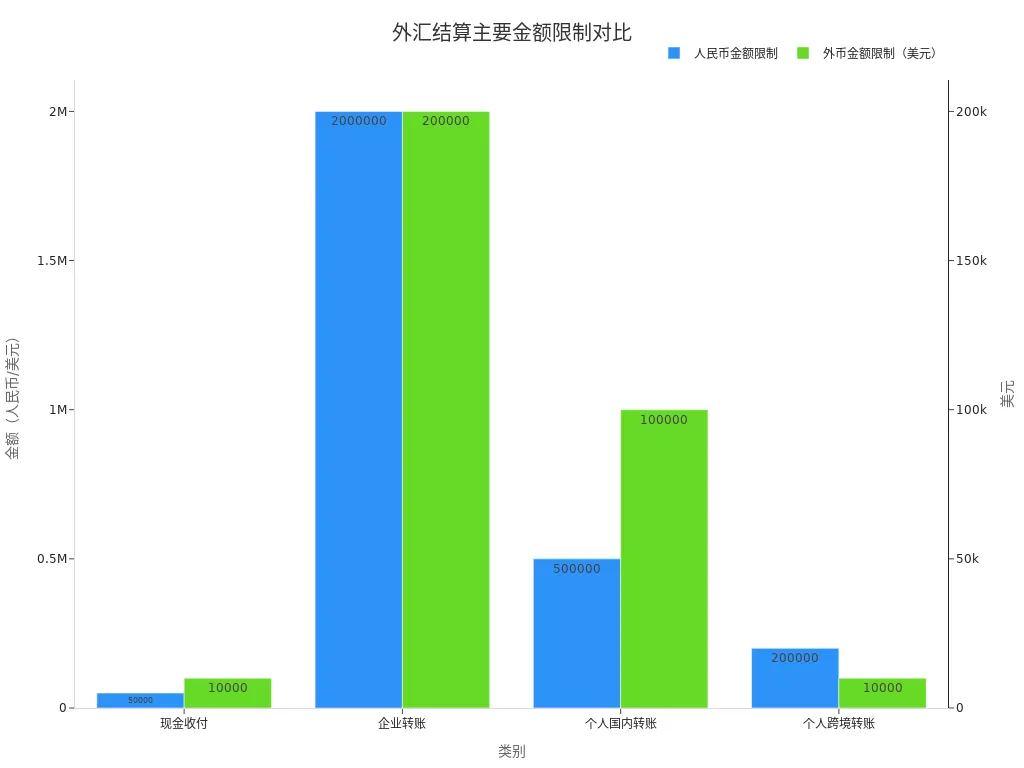
When handling large-amount settlement, it is recommended to communicate with the bank in advance, understand the required materials and procedures, and avoid delays due to incomplete documents or policy misunderstandings.
U.S. Medical Institution Payment Rules
When accepting international medical payments, U.S. hospitals typically require you to provide detailed identity information and explanation of fund sources. You need to submit valid ID proof and declare that the payment is for medical expenses. U.S. medical institutions have strict anti-money laundering compliance requirements for large cash payments; single-day cash payments of USD 10,000 or more require the hospital to file a Currency Transaction Report (CTR) with regulators. In addition, hospitals will clearly disclose the fee structure and exchange rates to ensure no hidden charges. The table below summarizes common payment rules of U.S. hospitals:
| Rule/Requirement | Description |
|---|---|
| Identification Requirement | Transfers ≥ USD 3,000 require valid ID proof; some states require it for smaller amounts |
| Anti-Money Laundering Compliance | Single-day cash payments ≥ USD 10,000 require Currency Transaction Report (CTR) |
| Transparent Fees and Exchange Rates | Provide detailed fee and exchange rate information with no hidden charges |
| Error Resolution and Cancellation | Errors can be reported within 180 days; transfers can be canceled within 30 minutes |
| Secure and Compliant Payment Process | Provide hospital or beneficiary account information and declare payment purpose as medical expenses |
When paying medical bills, you must ensure the funds are from legitimate sources and the payment process is transparent. U.S. hospitals generally accept bank wire transfers, credit cards, medical loans, and other payment methods. You can choose the most suitable payment channel based on your fund arrangements.
It is recommended to communicate with the hospital’s finance department before remitting to confirm receiving account information, detailed fees, and exchange rates, avoiding payment failures or delays due to inaccurate information.
Compliance Risks and Prevention
During the fund settlement and payment process for cross-border medical tourism, you need to focus on preventing the following compliance risks:
- Unclear fund purpose or incomplete materials leading to bank rejection or delayed processing of settlement.
- Exceeding the annual foreign exchange convenience limit without timely supplementing medical proof and other materials, affecting fund circulation.
- Failure to submit identity information or fund source explanation as required by U.S. hospitals, resulting in rejection of payment by the hospital.
- Information errors during remittance that are not reported or canceled in time, causing fund losses.
- Using non-regular channels or third-party platforms, exposing funds to security and fraud risks.
You can effectively prevent risks through the following measures:
- Prepare all settlement and payment materials in advance, including ID proof, medical bills, hospital payment notices, etc.
- Proactively communicate with banks and hospitals to understand the latest policies and procedures and ensure compliant operations.
- Choose formal bank channels for settlement and remittance, avoiding unknown third-party platforms.
- Retain all settlement and payment vouchers for subsequent tracing and fund verification.
- Monitor policy changes in mainland China and the U.S. and adjust fund arrangements in a timely manner.
Compliant operations not only protect your fund security but also provide a solid foundation for smooth cross-border medical tourism. Only by planning ahead and strictly complying with policies can you effectively avoid fund circulation risks.
Batch Settlement Process and Operations
Material Preparation and Bank Procedures
When handling fund settlement for cross-border medical tourism, you first need to prepare complete materials. Banks typically require valid ID proof, medical bills issued by U.S. hospitals, payment notices, and relevant medical certificates. You can communicate with licensed Hong Kong banks in advance to understand the specific material list and review standards. The bank will review materials based on your actual needs to ensure compliant fund use. You need to translate all documents into English and have them notarized or certified to improve review efficiency. After bank approval, they will assist you in completing foreign exchange purchase and remittance operations. The entire process is as follows:
- Prepare ID proof, medical bills, payment notices, and other materials
- Translate and certify materials
- Bank reviews materials
- Complete foreign exchange purchase and remittance
It is recommended to schedule an appointment with the bank in advance to avoid delays during peak periods.
Settlement Limits and Timing Arrangements
Mainland China imposes clear annual limits on individual foreign exchange settlement. Individuals can conveniently convert up to USD 50,000 per year. If medical bills exceed this limit, providing corresponding medical proof allows the bank to assist in exceeding the limit. The table below shows relevant policies:
| Type | Limit |
|---|---|
| Annual Individual Foreign Exchange Settlement Limit | USD 50,000 |
| Foreign Exchange Purchase Limit for Medical Purposes | No limit, only proof required |
You can reasonably arrange batch settlement timing based on the medical bill amount. For large bills, it is recommended to handle multiple batches, remitting to the U.S. hospital account promptly after each settlement. Banks typically complete review and settlement within 1–3 business days, depending on document completeness and bank processing efficiency.
Common Settlement Issues and Countermeasures
During actual operations, you may encounter issues such as incomplete materials, limit restrictions, or remittance delays. Common issues and countermeasures are as follows:
- Incomplete materials: promptly supplement hospital certificates, payment notices, and other documents to ensure completeness.
- Limit restrictions: provide detailed medical proof to apply for exceeding the annual limit.
- Remittance delays: schedule in advance, choose efficient bank channels, and monitor remittance progress.
- Information errors: double-check receiving account information to avoid losses due to incorrect entries.
During the fund settlement process for cross-border medical tourism, maintain communication with banks and hospitals, promptly report issues, and seek solutions. Reasonable planning of the settlement process helps ensure fund security and smooth payments.
Batch Payment Strategies for Large Bills

Image Source: unsplash
Negotiating Installment Payments with U.S. Hospitals
When facing high medical bills during cross-border medical tourism, you can proactively negotiate installment payment plans with U.S. hospitals. Many hospitals offer flexible payment plans for international patients to relieve the financial pressure of one-time payments. During negotiation, you can adopt the following strategies:
- Request a structured installment payment plan, clearly specifying the amount and repayment period per installment.
- Raise objections to specific charges on the bill and request detailed explanations or verification from the hospital.
- Directly explain your financial situation to seek understanding and appropriate reductions from the hospital.
- Review the detailed bill, identify and point out inaccurate or duplicate charges, and request adjustments.
- Ask the hospital to reduce the outstanding balance on the total bill appropriately to ease the burden.
You should prepare relevant supporting documents in advance, such as income proof and asset status explanations, to improve negotiation success rates. Some hospitals also provide certain fee reductions or deferred payment policies based on the patient’s actual situation. Maintaining good communication with the hospital’s finance department helps secure more reasonable installment arrangements.
Developing Remittance and Payment Plans
When developing remittance and payment plans for large medical bills, you must ensure every step complies with U.S. and mainland China regulations. First, prepare all necessary identity and fund source documents to meet anti-money laundering (AML) and know-your-customer (KYC) compliance requirements. You can contact licensed Hong Kong banks or professional cross-border payment providers to initiate the remittance process, strictly submitting recipient information and related materials as required to ensure accuracy.
In actual operations, carefully verify remittance details, including exchange rates, handling fees, and total amounts to avoid delays or losses due to errors. Arrange batch remittances according to the hospital’s installment bill schedule, follow up promptly after each remittance to confirm receipt by the hospital, and properly retain all remittance transaction records, including receipts, confirmation emails, and documents provided by the service provider for subsequent verification and tracing.
In multi-stage payment scenarios, beyond compliance itself, you also need to consider execution efficiency and the suitability of payment tools for each transaction. For example, in common U.S. hospital payment situations such as online billing or pre-authorized charges, you can use a virtual card via BiyaPay Virtual Card Application to reduce cross-border payment failures or limit issues. At the same time, you may use its exchange rate comparison tool to estimate costs at different settlement stages, and complete transfers through its remittance service. This combination is more suitable for long-cycle and variable medical billing scenarios, while helping maintain a clear and compliant fund flow structure.
Compliance is critical during overseas remittances. You must adhere to identity verification, fund source proof, and relevant reporting requirements to avoid transaction blocks or legal risks due to non-standard procedures. You can leverage global payment and receipt platforms such as BiyaPay, utilizing its international remittance, real-time fiat and digital currency conversion, USDT to USD or HKD conversion, and other functions to improve fund circulation efficiency and meet multi-currency payment needs. BiyaPay also supports U.S. stock, Hong Kong stock trading deposits/withdrawals, and digital currency trading services, providing Chinese-speaking users with diversified fund management tools to flexibly address large bill payment challenges in cross-border medical tourism.
Credit Cards and Medical Loans as Emergency Options
When paying U.S. medical expenses, you can consider credit cards or medical loans as emergency solutions. These methods can help resolve short-term funding pressure but also carry certain risks. The table below compares the main advantages and risks of credit cards and medical loans:
| Advantages | Risks |
|---|---|
| Can finance medical expenses | High interest rates |
| Can be used at participating medical institutions | Deferred interest |
| Understand loan terms; debt repaid at end of loan period | May be upsold additional services |
| Suitable for single procedures or medical expenses | May miss financial assistance |
| Limited choice of medical providers | Potentially higher medical costs |
When choosing credit cards or medical loans, carefully review the terms, focusing on interest rates, repayment periods, and potential additional fees. Some U.S. hospitals partner with financial institutions to offer medical loan products specifically for international patients. You can flexibly combine multiple payment methods based on your needs to ensure timely bill settlement and avoid extra burdens from overdue payments.
Advantages of Choosing Public or Nonprofit Hospitals
When engaging in cross-border medical tourism, prioritizing public or nonprofit hospitals in the U.S. often provides more transparent and reasonable fee structures. Public hospitals are government-regulated with open fee structures, and some nonprofit hospitals offer special assistance programs for financially disadvantaged patients. Before applying for medical services, proactively inquire about the hospital’s financial aid policies to determine eligibility for fee reductions or installment support.
Nonprofit hospitals typically have dedicated international patient service departments to assist with documentation, arrange payment plans, and provide multilingual communication support. When selecting a hospital, comprehensively consider medical quality, fee structure, and payment convenience, reasonably plan the overall budget, and reduce fund circulation risks.
During cross-border medical tourism, reasonably utilizing batch settlement, installment payments, credit cards/loans, and other diversified tools—combined with compliant global payment platforms and professional financial services—can effectively ensure fund security and successfully complete payment of large medical bills.
Common Challenges and Solutions in Cross-Border Medical Tourism
Solutions for Limited Settlement Quotas
When handling settlement for large medical bills, you often face the issue of the annual individual foreign exchange quota limit. Mainland China stipulates a convenient annual settlement limit of USD 50,000 per person, but actual medical expenses frequently far exceed this amount. You can overcome the restriction through the following methods:
- Prepare detailed medical bills, hospital payment notices, and diagnostic certificates to apply to the bank for special medical-purpose settlement.
- Choose compliant channels such as licensed Hong Kong banks to handle batch settlement and remittance, ensuring clear flow of each fund transfer.
- Proactively communicate with the bank to understand the latest policies, schedule appointments in advance, and reduce waiting time.
Note that all materials must be authentic and complete; large-amount settlement can only proceed after bank approval—never attempt to circumvent regulation or use non-regular channels.
Incomplete Materials and Supplement Procedures
Incomplete materials are a common reason for blocked settlement or remittance during cross-border medical tourism. Banks and U.S. hospitals typically require ID proof, medical bills, payment notices, fund source explanations, and other documents. If materials are missing, you can:
- Promptly contact the hospital or relevant institutions to obtain supplementary certificates.
- Translate all Chinese materials into English and have them certified to improve review efficiency.
- Proactively communicate with the bank to obtain a list of missing items and submit supplements in batches to avoid repeated rejections from incomplete submissions.
Establish a material checklist and verify each item to ensure completeness and improve settlement and remittance approval rates.
Remittance Delays and Handling Suggestions
In actual operations, remittance delays may arise from various causes. Common reasons include:
- Coding errors leading to claim denials or delays
- Untimely insurance verification information
- Slow prior authorization processes
- Incomplete claim materials
- Lack of regular follow-up
- Unclear patient billing information
You can take the following measures to address them:
- Train relevant personnel to ensure all coding is accurate
- Complete insurance information verification before services
- Proactively manage prior authorization processes
- Submit complete claim materials
- Establish a regular follow-up system to track remittance status at any time
- Maintain communication with the hospital’s finance department to clarify insurance coverage and out-of-pocket expenses
Closely monitor the progress of each remittance; if delays occur, promptly communicate with the bank and hospital to identify causes and remedy them.
Understanding U.S. Medical Costs and Budget Planning
Before cross-border medical tourism, you must fully understand the average costs of major medical procedures in the U.S. and reasonably plan your budget. The table below shows average U.S. costs for some common medical procedures:
| Medical Procedure | Average U.S. Cost | Average Cost in Comparable Countries |
|---|---|---|
| Inpatient Appendectomy | $44,149 | $24,847 |
| Cesarean Section | Higher | Lower |
| Coronary Artery Bypass Graft (CABG) | $44,149 | $24,847 |
| Coronary Angioplasty | 2.9 times | Lower |
| Cholecystectomy | 1.4–3.4 times | Lower |
| Knee Replacement | Higher | Lower |
| Hip Replacement | Higher | 38% lower |
You should also note that international patients often face insufficient insurance coverage, high out-of-pocket costs, long wait times, and limited access to providers. Communicate with the hospital in advance to clarify all fee details, develop a detailed budget based on your financial situation, and avoid treatment disruptions due to cost overruns.
During cross-border medical tourism, only by identifying challenges early and proactively addressing them can you ensure smooth fund circulation and successfully complete your medical plan.
Fund Security and Risk Prevention
Compliant Channels and Fraud Prevention
Choosing compliant channels is critical during the fund payment process for cross-border medical tourism. Mainland China residents can handle large medical bill payments through licensed Hong Kong banks, international remittance platforms, and other formal channels. Different channels vary in fee structure, speed, and payment methods; select reasonably based on actual needs. The table below compares several mainstream channels:
| Provider | Best Use | Fee Structure | Payment Methods | Speed (Estimated) |
|---|---|---|---|---|
| Panda Remit | Mobile wallets and competitive rates | Low fixed fee + tight forex spread | Alipay, WeChat, UnionPay, bank card | Minutes to 1 day |
| Wise | Transparency and mid-market rates | Variable percentage fee | Alipay, WeChat, UnionPay | 1–2 days |
| Western Union | Cash pickup availability | Higher forex markup | Cash, bank account, Alipay | Minutes (cash) to days |
| Remitly | Speed options (fast vs. economy) | Tiered fees based on speed | Alipay, WeChat, bank deposit | Minutes to 3 days |
| U.S. Banks (SWIFT) | Very large transfers (>50k+) | High wire fees + forex markup | Bank wire | 3–5 business days |
When selecting channels, prioritize fund security and compliance and avoid unknown third-party platforms. Preventing medical payment fraud is equally important; common risks include provider fraud, phantom billing, identity fraud, and payments for unprovided services. You can enhance prevention through the following measures:
- Medical service providers should receive ethics training to improve professional ethics.
- Hospitals should improve hiring processes to ensure employee trustworthiness.
- You can actively participate in service monitoring and verify bill details.
- Increase your awareness of medical fraud and remain vigilant about unusual charges.
Retaining Vouchers and Subsequent Tracing
During cross-border payments, be sure to retain all settlement, remittance, and payment vouchers, including bank receipts, hospital bills, email confirmations, and related documents. These vouchers not only aid subsequent fund tracing but also provide strong evidence in case of disputes. Establish both electronic and paper archives, back them up regularly, and ensure information completeness. If bill disputes or payment anomalies arise, vouchers can assist in communicating with banks, hospitals, and regulators to quickly locate and resolve issues.
Understanding Fund Protection Policies in Advance
When planning cross-border medical fund flows, understand relevant fund protection policies in mainland China and the U.S. in advance. Financial institutions typically implement enhanced due diligence for high-risk clients or transactions and adopt multi-layered cybersecurity measures to ensure fund security. Pay attention to anti-money laundering (AML) and counter-terrorism financing (CFT) laws and regulations, and choose channels that work closely with regulators. Technological advances such as machine learning and artificial intelligence are widely used in anomaly transaction detection, further reducing fraud risks. Only by fully understanding policies and reasonably planning fund arrangements can you effectively avoid compliance risks and ensure smooth medical tourism.
In cross-border medical tourism, only by planning fund arrangements in advance, proactively communicating bill details with U.S. hospitals, and choosing formal channels such as licensed Hong Kong banks can you effectively avoid compliance risks. Continuously monitor policy changes in mainland China and the U.S., conduct due diligence, and ensure all transactions are legal and compliant. You can combine bank wire transfers, virtual cards, and other payment methods to improve payment efficiency and security while reducing hidden fees and fraud risks. Retain all vouchers for subsequent tracing to ensure fund security and successfully complete your medical plan.
FAQ
How to exceed the mainland China individual annual settlement limit?
You can prepare detailed medical bills and hospital payment notices to apply to the bank for special medical-purpose settlement. After bank approval, you are allowed to settle and pay large medical expenses in batches.
What materials are most critical when paying U.S. hospital bills?
You need to provide valid ID proof, medical bills, hospital payment notices, and fund source explanations. It is recommended to translate all materials into English and have them certified to improve review efficiency.
How to handle remittance delays?
Contact the bank and hospital finance department immediately to check remittance progress and account information. Promptly supplement missing materials and retain all communication and transaction vouchers for subsequent tracing.
How to prevent fraud risks in cross-border medical payments?
Choose licensed Hong Kong banks or international compliant platforms for remittances and avoid unknown third-party channels. Verify receiving account information and retain all payment vouchers to enhance fund security.
*This article is provided for general information purposes and does not constitute legal, tax or other professional advice from BiyaPay or its subsidiaries and its affiliates, and it is not intended as a substitute for obtaining advice from a financial advisor or any other professional.
We make no representations, warranties or warranties, express or implied, as to the accuracy, completeness or timeliness of the contents of this publication.
Related Blogs of

Why Check Trading Costs Before Buying a Hot U.S. Stock Like SpaceX?


What Time Does the U.S. Stock Market Open? Pre-Market, After-Hours, Funding, and Fee Guide

How to Read a U.S. Stock Trading Statement? A Line-by-Line Explanation of Commissions, Platform Fees, and Pass-Through Fees

What Is the Difference in Trading Fees When Buying 1, 10, or 100 Shares of U.S. Stocks?
Choose Country or Region to Read Local Blog
 Australia
 Austria
 Belgium
 Canada
 Cyprus
 Czech Republic
 Denmark
 Estonia
 Finland
 France
 Germany
 Greece
 Hong Kong
 India
India Indonesia
 Ireland
 Italy
Italy Japan
Japan Latvia
 Lithuania
 Luxembourg
 Malaysia
 Malta
Malta Morocco
 Nepal
Nepal Netherlands
 New Zealand
 Norway
 Pakistan
 Philippines
 Poland
 Portugal
 Romania
 Singapore
 Slovakia
 Slovenia
 South Africa
 South Korea
 Spain
Spain Sweden
 Thailand
 The United States
 Turkey
 United Arab Emirates
 United Kingdom
 Vietnam
Contact Us




BIYA GLOBAL LLC is registered with the Financial Crimes Enforcement Network (FinCEN), an agency under the U.S. Department of the Treasury, as a Money Services Business (MSB), with registration number 31000218637349, and regulated by the Financial Crimes Enforcement Network (FinCEN).
BIYA GLOBAL LIMITED is a registered Financial Service Provider (FSP) in New Zealand, with registration number FSP1007221, and is also a registered member of the Financial Services Complaints Limited (FSCL), an independent dispute resolution scheme in New Zealand.