Hidden Spread Traps in Crypto-to-Fiat Conversion Fees: How High Are the Concealed Exchange Rate Differences Really?





Image Source: unsplash
Do you really understand the full cost of converting virtual currency to fiat? On the surface, you may only pay attention to the handling fee, but during actual operations, the hidden exchange rate spread can also significantly increase your expenses. Many platforms use opaque exchange rate settings, causing you to bear higher costs without realizing it. You need to clearly understand how these fees are generated, learn to identify and avoid potential risks, in order to protect your interests to the greatest extent.
Key Takeaways
- Understand handling fees and hidden exchange rate spreads to avoid bearing high hidden costs when converting virtual currency to fiat.
- Choose transparent platforms like Biyapay, ensuring all fees are clearly displayed before the transaction, reducing overall costs.
- Use limit orders instead of market orders to significantly reduce transaction fees, with particularly noticeable effects on centralized exchanges.
- Regularly verify the received amount against the estimated value, promptly adjust platform selection and operation strategies to ensure fund safety.
- Pay attention to legal and security risks, choose platforms with strong compliance and guaranteed fund security to avoid potential losses.
Analysis of Handling Fees and Exchange Rate Spreads

Image Source: pexels
Types of Handling Fees
During the process of converting virtual currency to fiat, you often encounter various types of handling fees. Different platforms adopt different fee structures, resulting in significant differences in actual costs. You need to understand the specific manifestations and calculation methods of each fee type to accurately assess the total cost. The table below summarizes common handling fee types and their descriptions on mainstream platforms:
| Fee Type | Description | Example |
|---|---|---|
| Conversion Fee | Percentage or fixed fee displayed by the platform, the most intuitive fee type. | Coinbase Commerce: 1% |
| Spread Markup | The difference between buy and sell prices, usually not shown in the fee schedule. | Coinbase: 0.5% - 2% |
| Withdrawal and Bank Transfer Fees | Fees incurred when withdrawing funds after converting cryptocurrency to fiat. | Coinbase: $25 (US wire transfer) |
| Currency Conversion and Intermediary Bank Fees | Additional fees for cross-border transactions, usually including bank currency conversion fees and intermediary fees. | Hong Kong licensed banks typically charge 2%-4% |
In actual operations, you will also encounter the following fees:
- Network fees: paid to blockchain miners or validators, varying with blockchain congestion.
- Service markup: additional markup added by the platform on cryptocurrency prices as part of its revenue.
- Spread: the difference between buy and sell prices of cryptocurrency on the platform, directly affecting your total cost.
- Payment method fees: additional fees that may arise depending on the chosen payment option (such as credit card, bank transfer, etc.).
Taking Biyapay as an example, you can find that its fee structure is more transparent. During the process of converting virtual currency to fiat on Biyapay, conversion fees and withdrawal fees are clearly labeled, avoiding hidden markups. Compared to Coinbase, Biyapay has clear advantages in spread markups and bank transfer fees, especially suitable for Chinese-speaking users conducting large-amount fund conversions.
Impact of Hidden Exchange Rate Spreads
When focusing on handling fees, you often overlook the hidden exchange rate spreads. Platforms usually manipulate the conversion exchange rates by adjusting buy and sell prices, quietly increasing your actual costs. When converting virtual currency to fiat on platforms like Coinbase, you may encounter spread markups of 0.5% to 2%, which are not directly displayed in the fee schedule. When withdrawing to a bank account, you also need to bear additional currency conversion and intermediary bank fees, with Hong Kong licensed banks typically charging 2%-4% conversion fees.
If you choose Biyapay for virtual currency to fiat conversion, you can significantly reduce spread costs. Biyapay adopts real-time market exchange rates with open transparency, avoiding hidden markups. During large-amount conversions, the actual received amount is closer to the market price, reducing unnecessary losses. You need to note that some platforms use complex exchange rate mechanisms and opaque fee structures, causing the actual received amount to be far lower than expected. Before operating, be sure to calculate all fees, including handling fees, exchange rate spreads, withdrawal fees, and bank conversion fees, to make rational choices.
You can refer to the table below to understand the specific fee structures of platforms like Coinbase:
| Fee Type | Fee Details |
|---|---|
| Automatic Clearing House | Free |
| Wire Transfer (USD) | $25 per withdrawal |
| SEPA (EUR) | Free |
| SWIFT (GBP) | $1 per withdrawal |
| Trading Fees (Initial) | Maker: 0.60%, Taker: 1.20% |
| Trading Fees (High Volume) | Maker: 0.00%, Taker: 0.05% |
| Futures Trading Minimum Fee | $0.20 per trade |
| Liquidation Fee | 0.80% per trade |
When choosing a platform, be sure to focus on exchange rate spreads and withdrawal fees. Biyapay helps you avoid hidden costs through an open and transparent fee model, improving fund security and receipt efficiency. If you ignore exchange rate spreads, you may bear high hidden fees during the virtual currency to fiat conversion process, affecting fund planning and returns.
If you want to estimate the real conversion cost before making the exchange, you can first use BiyaPay’s exchange-rate comparison tool to review projected outcomes across different currencies and paths, then check the related service information on the official website to judge whether the total cost is acceptable. As a multi-asset wallet, BiyaPay covers cross-border remittance, fund management, and broader multi-asset scenarios, so this kind of tool works well as a pre-trade cost-checking entry point, helping you separate the visible fee from the actual payout difference.
Platforms and Fee Models for Crypto-to-Fiat Conversion
Exchange Fee Structures
When choosing a platform for converting virtual currency to fiat, you will first encounter centralized exchanges (CEX) and decentralized exchanges (DEX). The fee structures of different types of platforms vary significantly. You can intuitively understand through the table below:
| Type | Centralized Exchange (CEX) | Decentralized Exchange (DEX) |
|---|---|---|
| Trading Fees | Fixed rate or decreasing with trading volume; Coinbase charges 0.50% for $10,000 orders, 0.18% for $1,000,000 orders | Based on blockchain protocol; Uniswap and other ERC-20 DEX have higher fees, while Layer 2 DEX like Loopring have very low fees |
| Withdrawal Fees | Most platforms charge withdrawal fees, some charge deposit fees | Usually no deposit or withdrawal fees |
| Other Fees | May include deposit fees, hidden spreads | More transparent fee structure, competing with CEX platforms |
When operating on mainstream platforms like Binance and Coinbase, “taker” fees are commonly higher than “maker” fees, and large-volume trades enjoy lower rates. Some platforms like Robinhood advertise 0% trading fees on the surface but actually profit through spreads or market rebates. When converting virtual currency to fiat on Biyapay, you can obtain open and transparent rates and real-time market exchange rates, avoiding hidden fees and making the received amount more controllable. You need to note that some platforms have complex fee structures, and actual costs are often higher than surface rates. Be sure to read the platform terms in detail and calculate fees at every step.
OTC and C2C Costs
If you choose OTC or C2C methods for converting virtual currency to fiat, the fee structure differs from exchanges. OTC is suitable for large-amount transactions, with fast processing and high privacy, but price negotiation may lead to worse exchange rates. C2C trading focuses on peer-to-peer matching, with highly flexible fees suitable for varied needs. You can refer to the table below:
| Platform Type | Fee Type | Fee Range |
|---|---|---|
| C2C Trading | Trading Fee | Approximately 0.05% to 0.15% |
| C2C Trading | Withdrawal Fee | Approximately $0.50 |
| Bitcoin ATM | Trading Fee | 5% to 15% |
| OTC Trading | Price Negotiation | Larger exchange rate differences |
When using Biyapay’s OTC service, the platform matches based on real-time market exchange rates and publicly displays all fees, helping you avoid hidden costs due to information asymmetry. When trading on C2C platforms, pay attention to counterparty credibility and platform protection mechanisms to avoid losses caused by opaque handling fees and exchange rate spreads. By regularly analyzing fees and comparing quotes from different platforms, choose platforms with transparent pricing to reduce overall costs.
Tip: When reading platform terms, be sure to pay attention to all fee details and exchange rate adjustment mechanisms, understand the fee structure, and regularly check statements to effectively identify and avoid hidden fees.
Platform Cost Comparison
Real Case Analysis
When choosing a platform for converting virtual currency to fiat, the actual cost differences often far exceed surface rates. Taking Coinbase, Binance, and Biyapay as examples, the three show significant differences in fee structures and received amounts. You can intuitively compare through the table below:
| Platform | Deposit Fee | Trading Fee | Withdrawal Fee | Total Fee |
|---|---|---|---|---|
| Coinbase | 3.99% ($39.90) | 1.49% ($14.90) | - | $54.80 |
| Binance | Free | 0.1% ($1) | $5-10 | $6-11 |
| Biyapay | Free | 0.2% ($2) | $5 | $7 |
You can see that Biyapay has clear advantages in fee transparency and total cost. Biyapay adopts real-time market exchange rates, with all fees clearly displayed before the transaction, avoiding hidden markups. When conducting large-amount virtual currency to fiat operations on Biyapay, the actual total fees paid are far lower than those of Coinbase and some mainstream exchanges.
If you choose Coinbase, in addition to the trading fees and deposit fees displayed in advertisements, you also need to bear high spread markups and possible withdrawal fees. In actual operations, Coinbase’s total fees may reach 4-5%, while Biyapay keeps overall fees within 1%. When operating on Binance, although surface fees are lower, attention should still be paid to blockchain network fees and fiat withdrawal handling fees during the withdrawal process.
You can refer to the bar chart below to visually understand the total fee differences between Coinbase and Binance in the virtual currency to fiat conversion process:
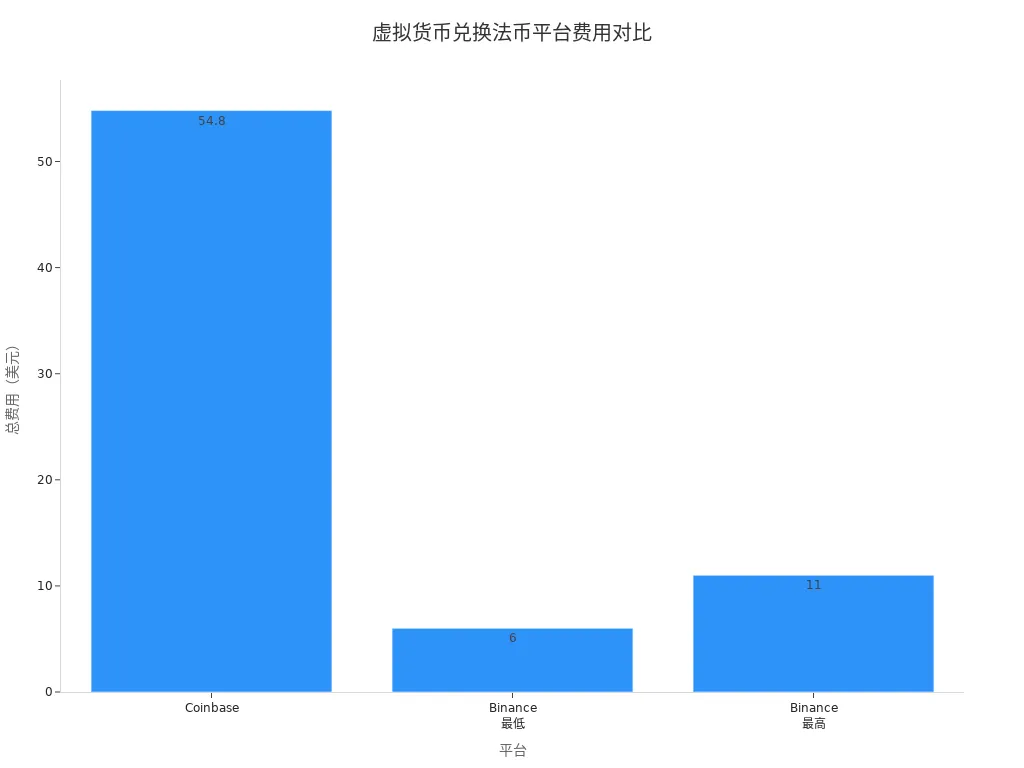
In actual operations, you also need to pay attention to hidden fees. Many platforms only display trading fees of 0.1% to 0.5% in advertisements, but the actual total costs you bear are far higher than surface rates. Hidden fees include spread markups, inflated withdrawal fees, currency conversion markups, and execution delay costs. For example, Coinbase’s spread fees are usually between 0.5% and 2%, and network fees and multi-hop conversions further increase costs. If not carefully calculated, the actual received amount may shrink significantly.
Tip: When choosing a platform, be sure to check the fee details of all steps, especially hidden fees and exchange rate markups. By comparing actual received amounts across different platforms, you can find the optimal solution.
Differences in Received Amounts
When focusing on handling fees, you should pay more attention to the final received amount. The fee structures and exchange rate mechanisms of different platforms directly determine how much fiat you ultimately receive. Taking Biyapay, Coinbase, and PayPal as examples, the differences in received amounts are mainly reflected in the following aspects:
- Biyapay adopts real-time market exchange rates with an open and transparent fee structure. During large-amount conversions, the actual received amount is close to the market price, with almost no exchange rate loss.
- Coinbase has hidden fees of 1-5%, including spread markups, exchange rate markups, and inflated network fees. During operations, the actual received amount is often lower than expected.
- PayPal’s currency conversion fees are usually 3% or 4%, and the exchange rate is not the mid-market rate. If receiving funds through PayPal, the final received amount will be significantly reduced due to exchange rate markups and conversion fees.
You can understand the causes of received amount differences through the following points:
- Advertised trading fees (visible): usually 0.1% to 0.5%, but only a small part of the total cost.
- Spread markup (hidden): usually adds 0.5% to 3% per transaction, directly affecting the received amount.
- Inflated withdrawal fees (hidden): some platforms charge withdrawal fees far higher than actual blockchain costs.
- Currency conversion markup (hidden): exchange rates 2-4% worse than mid-market prices, leading to reduced received amounts.
- Execution delay costs (hidden): price slippage further reduces received amounts during market volatility.
When converting virtual currency to fiat on Biyapay, the platform locks real-time market exchange rates, with all fees clear at a glance. You can estimate the received amount in advance and avoid losses due to information asymmetry. When operating on platforms like Coinbase or PayPal, pay special attention to exchange rate spreads and hidden fees to avoid impacts on fund arrangements due to reduced received amounts.
If you need cross-border remittance, it is recommended to prioritize digital remittance platforms. The cost of digital remittance is far lower than traditional banks, with faster receipt speeds. When withdrawing fiat through Hong Kong licensed banks, you usually need to bear 2%-4% currency conversion fees. When choosing a platform, comprehensively consider fee structure, receipt efficiency, and fund security, prioritizing platforms with transparent fees and open exchange rates.
Conclusion: In the process of converting virtual currency to fiat, only by fully calculating all fees can you truly grasp the received amount. You should regularly compare actual received data from different platforms, choose the optimal solution, and improve fund utilization efficiency.
Risk and Trap Warnings

Image Source: unsplash
Handling Fee and Exchange Rate Traps
During the process of converting virtual currency to fiat, you often encounter multi-layered fee traps. Platforms not only openly charge conversion fees but may also increase your actual costs through spread markups, withdrawal fees, and currency conversion fees. The table below summarizes common fee trap types:
| Fee Layer | Description | Example |
|---|---|---|
| First Layer: Conversion Fee | Direct fees displayed by the platform | Coinbase Commerce 1%, Kraken 0.26% |
| Second Layer: Spread Markup | Hidden profit between buy and sell prices | Coinbase 0.5%-2%, PayPal 1.5%-2.3% |
| Third Layer: Withdrawal and Bank Transfer Fees | Fees for withdrawing to bank accounts | Coinbase domestic wire $25, Kraken $5 |
| Fourth Layer: Currency Conversion and Intermediary Bank Fees | Additional fees for cross-border transactions | Hong Kong licensed banks typically charge 2%-4% |
You also need to beware of the following hidden costs:
- Dynamic spreads may increase during market volatility, leading to additional losses.
- Weekend pricing mechanisms may cause you to bear higher spreads.
- Small-amount transactions often face higher fixed fees.
- Large-amount transactions through OTC channels may have more unfavorable fee structures.
You can avoid traps by identifying the following red flags:
| Red Flag | Description |
|---|---|
| Opaque fees and terms | Incomplete disclosure of fees and terms, or displayed only after deposit |
| Customer service contacts via personal chat accounts | Customer service requires switching to private chat and refuses official channels |
| Fake or repetitive reviews | Templated evaluations with no credible history |
| Unclear custody and withdrawal processes | Platform unable to explain asset custody and withdrawal processes |
| Frequent address or account changes | Deposit instructions and wallet addresses change frequently |
Tip: Before operating, carefully read the platform’s fee explanations, check fee details for all steps, and avoid bearing high hidden costs due to information asymmetry.
Legal and Security Risks
When converting virtual currency to fiat, you also need to pay attention to legal and security risks. The decentralization and anonymity of virtual currency make it a high-incidence area for fraud and criminal activities. You may face the following main risks:
- Cyber attack risks: platforms may suffer distributed denial-of-service attacks, leading to inability to trade normally, with unclear liability for losses.
- Asset theft risks: stolen virtual currency can be quickly converted to cash, increasing the possibility of criminal activities.
- Legal compliance risks: regulations on virtual currency are unclear in some countries and regions, and stricter laws may be introduced in the future, increasing compliance costs and affecting conversion fees.
- Money laundering and fraud risks: virtual currency transactions are prone to money laundering and fraud due to anonymity; federal governments have strengthened regulation, and more criminal laws will intervene in the future.
When choosing a platform, prioritize those with strong compliance, transparent fees, and guaranteed fund security. Also pay attention to currency conversion policies of financial institutions like Hong Kong licensed banks to avoid additional costs due to regulatory changes.
Suggestions for Reducing Costs and Avoiding Pitfalls
Platform Selection Tips
When choosing a platform for converting virtual currency to fiat, prioritize those with transparent fee structures, multi-currency support, and high receipt efficiency. The following suggestions can help you effectively reduce overall costs:
- Use limit orders instead of market orders, which can usually reduce transaction fees by 50% or more, especially effective on centralized exchanges.
- Holding platform native tokens (such as BNB, KCS) can obtain 20% to 60% handling fee discounts, significantly saving costs for long-term trading users.
- Consolidate withdrawal operations to reduce fixed fees from multiple small withdrawals and improve fund utilization.
- Choose low-fee networks (such as TRON, Solana, Polygon) for on-chain transfers, with single network fees as low as a few cents.
- Fully understand all hidden fees to avoid overlooking actual costs due to seemingly low surface rates.
- Make full use of platform comparison tools and online reviews, prioritizing platforms with publicly disclosed fee structures. You can find that Biyapay is highly transparent in fee display and exchange rate mechanisms, with all fees detailed before the transaction, helping you conduct accurate budgeting and risk control.
Cost Calculation Methods
When calculating the total cost of converting virtual currency to fiat, adopt a systematic approach to ensure all related fees are included:
- Choose low-fee platforms, prioritizing services like Biyapay, GODEX, etc., with total fees below 1% to avoid actual cost increases due to hidden fees.
- Before trading, add advertised fees to actual spreads to calculate real costs, and beware of “0% fee” platforms profiting through exchange rate spreads.
- Use limit orders to reduce taker fees and improve transaction cost-effectiveness.
- Consolidate multiple small transactions into single large operations to reduce network and withdrawal fees.
- Choose cost-effective blockchain networks to avoid high Ethereum gas fees.
- Utilize real-time exchange rate tools and fee calculators, such as Anycoin and other multi-platform aggregators, to obtain the market’s optimal exchange rates and fee information, improving decision accuracy.
- Regularly review received amounts against estimates and promptly adjust platform selection and operation strategies.
Through the above methods, you can systematically reduce the total cost of converting virtual currency to fiat, avoid risks from information asymmetry and fee opacity, and ensure fund security and maximum returns.
When converting virtual currency to fiat, you must pay attention to handling fees and hidden exchange rate spreads for every transaction. Fee differences across platforms and payment methods are significant, and network demand fluctuations also affect total costs. You should choose platforms with transparent fees, reasonably arrange transaction timing, and avoid fund losses due to hidden costs. Only by knowing the costs, making rational choices, and effectively avoiding pitfalls can you secure your assets.
- Each transaction incurs small fees, with significant long-term accumulation effects
- Choosing transparent platforms and appropriate payment methods helps reduce overall costs
FAQ
How to calculate the total cost when converting virtual currency to fiat?
You need to add up all the platform-displayed handling fees, hidden exchange rate spreads, withdrawal fees, and bank conversion fees. It is recommended to use USD as a unified pricing unit for easy comparison of actual costs across different platforms.
Why is the received amount often lower than expected?
During the conversion process, you will encounter exchange rate markups, spread markups, and bank conversion fees. Platforms usually do not disclose all fees in advance, leading to reduced actual received amounts.
How to identify a platform’s hidden fees?
You can carefully read the platform’s fee explanations, focusing on exchange rate mechanisms and withdrawal processes. It is recommended to check USD amount changes before and after transactions and adjust operation strategies promptly upon discovering opaque fees.
What fees are involved when converting virtual currency to fiat through Hong Kong licensed banks?
When withdrawing fiat through Hong Kong licensed banks, you usually need to bear 2%-4% currency conversion fees. Some banks also charge intermediary fees, specifically priced in USD.
What advantages does Biyapay have in terms of fee transparency?
When operating on Biyapay, the platform publicly displays all fees and real-time market exchange rates. You can estimate the received amount in advance and avoid fund losses due to information asymmetry.
*This article is provided for general information purposes and does not constitute legal, tax or other professional advice from BiyaPay or its subsidiaries and its affiliates, and it is not intended as a substitute for obtaining advice from a financial advisor or any other professional.
We make no representations, warranties or warranties, express or implied, as to the accuracy, completeness or timeliness of the contents of this publication.
Related Blogs of

How to Prepare Overseas Accounts: Opening, FX, Receiving Payments, and Investment Funding in One Guide


3D Secure and Billing Address for AI Subscriptions: How to Reduce Card Declines

What Are After-Hours Pricing and After-Hours Odd-Lot Trading? Rules, Fees, and Use Cases


Choose Country or Region to Read Local Blog
 Australia
 Austria
 Belgium
 Canada
 Cyprus
 Czech Republic
 Denmark
 Estonia
 Finland
 France
 Germany
 Greece
 Hong Kong
 India
India Indonesia
 Ireland
 Italy
Italy Japan
Japan Latvia
 Lithuania
 Luxembourg
 Malaysia
 Malta
Malta Morocco
 Nepal
Nepal Netherlands
 New Zealand
 Norway
 Pakistan
 Philippines
 Poland
 Portugal
 Romania
 Singapore
 Slovakia
 Slovenia
 South Africa
 South Korea
 Spain
Spain Sweden
 Thailand
 The United States
 Turkey
 United Arab Emirates
 United Kingdom
 Vietnam
Contact Us




BIYA GLOBAL LLC is registered with the Financial Crimes Enforcement Network (FinCEN), an agency under the U.S. Department of the Treasury, as a Money Services Business (MSB), with registration number 31000218637349, and regulated by the Financial Crimes Enforcement Network (FinCEN).
BIYA GLOBAL LIMITED is a registered Financial Service Provider (FSP) in New Zealand, with registration number FSP1007221, and is also a registered member of the Financial Services Complaints Limited (FSCL), an independent dispute resolution scheme in New Zealand.