Avoid Rip-offs The Smartest Places for Currency Exchange in London




Image Source: pexels
You want to exchange currency in London and get the best rates. The smartest move for most cash is using your debit card at bank ATMs. This gives you access to excellent exchange rates for your currency. London is very card-friendly; cash made up only 12% of UK payments in 2023. You will not need much physical currency. Planning to exchange currency before you arrive in London is an option, but not always the best one.
Before you walk into any bureau, it helps to separate the “headline offer” from the amount you actually receive. Many “0% commission” desks simply price their profit into the rate, so the only reliable comparison is to check live rates and calculate the effective conversion you get. Doing that once—before you’re standing at a counter—usually prevents the most common rip-offs.
If you want a quick way to sanity-check GBP conversions, you can use the BiyaPay website and its free exchange rate converter & comparison tool to view live rates and compare outcomes in one place. And if you’re planning broader cross-border money handling around the trip, BiyaPay also keeps related actions within the same ecosystem, such as remittance and reference resources in the event center. As a multi-asset trading wallet, it’s mainly useful here as a practical bridge from “check the rate” → “compare” → “execute,” without turning the exchange decision into guesswork.
Important Tip: Never exchange your money at airports or hotels. Their convenience comes with poor rates and high fees.
Key Takeaways
- Use your debit card at bank ATMs for cash. This gives you the best exchange rates.
- Always choose to pay in local currency (GBP) when using your card. Do not choose your home currency (USD).
- Avoid exchanging money at airports, hotels, or tourist spots. They offer bad rates.
- For larger cash exchanges, use trusted bureaus like Thomas Exchange Global. You can also use Marks and Spencer or the Post Office.
- Do not bring much cash to London. The city uses cards a lot. £50 to £100 is enough for small needs.
Best Places to Exchange Currency in London
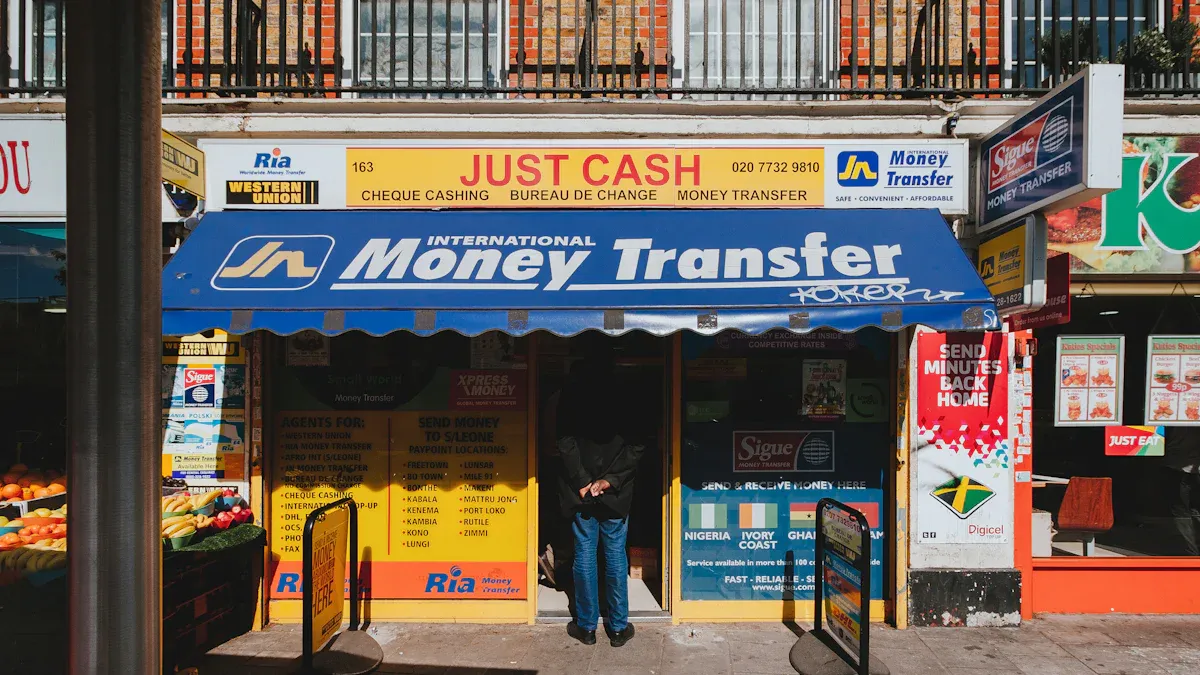
Image Source: unsplash
While using cards and ATMs is best for daily spending, you might need to exchange a larger sum of cash. This could be for a specific large purchase or simply for peace of mind. When you need to exchange currency in cash, your goal is to find a reputable currency exchange office that offers a rate close to the official market rate. These are the best places to exchange currency for larger amounts in London.
Finding the Best Exchange Rates in London
Understanding exchange rates is your first step to avoiding rip-offs. The financial world runs on the “interbank rate,” which is the true, fair rate banks use to trade currency with each other. Any rate you get as a consumer will be slightly worse than this. The key is to minimize that difference.
- The interbank rate is the midpoint between the buy and sell prices of a currency on the global market.
- Banks and exchange services add a markup or margin to this rate. This is their profit.
- Tourist rates, especially for cash, almost always include these hidden markups, even if they advertise “0% commission.”
Your mission is to find the service with the smallest markup. Before you go to a specific location, check their live rates online and compare them to the current interbank rate (a quick search for “USD to GBP” will show you). This will reveal where to get the best exchange rates. The best exchange rates in London are always found away from tourist traps.
Top-Rated Exchange Bureaus
For the best exchange rates in London, you should visit a specialist foreign exchange provider. These businesses focus solely on currency and typically offer much better rates than banks or travel agencies. They are excellent locations for where to exchange money.
Thomas Exchange Global is a name you will hear often. It has built a strong reputation across London for its competitive rates and transparency.
Customers consistently praise the company for its fair deals and straightforward service. Many reviews highlight that ‘there were no hidden fees,’ which is a major factor when you exchange currency. They are known for reliable service with no commission fees on top of the exchange rate.
ACE-FX is another popular currency exchange office. It also advertises a “no commission” model.
| Fee Type | ACE-FX | Industry Average |
|---|---|---|
| Commission Model | No commission | Varies widely |
| Overnight Interest | Not disclosed | 2% - 5% |
While ACE-FX offers competitive rates, some find their fee structure less transparent than others. The lack of clear information on all potential costs means you should be diligent. Always confirm the final amount of currency you will receive before handing over your money.
Other highly-rated options for foreign exchange include Victoria Street FX and Currency Online Group. The latter receives exceptional reviews, with customers praising its professionalism and excellent rates. Many note the unique, personalized service as a major plus.
Surprising High-Street Options
You do not always need to find a specialist currency exchange office. Some of the best places to exchange currency are hiding in plain sight on the main shopping streets of London. These are great options for where to exchange money conveniently.
- Marks and Spencer (M&S): Many larger M&S department stores have their own
currency exchange office. They are a trusted high-street brand and are surprisingly competitive with their foreign exchange rates. They offer a reliable and accessible option if you are already out shopping. - The Post Office: The Post Office is another excellent choice for where to exchange money. With thousands of branches, it is one of the most accessible options. They offer good rates on a wide range of currency and often have a “0% commission” policy. Their widespread presence makes them a dependable choice.
When deciding where to exchange money, comparing the live rates from these high-street options against the specialist bureaus will help you secure the best deal for your currency.
How to Exchange Currency with Cards & ATMs
Image Source: unsplash
Using your bank cards is the most efficient and cost-effective way to handle your money in London. This method gives you access to the best available foreign exchange rates because it leverages the interbank rate, which is the rate banks use to trade currency with each other. While bureaus add a significant markup, your bank’s rate will be much closer to this official figure.
Using Debit Cards for Cash in London
Your home debit card is your key to getting pounds sterling (GBP) directly from local ATMs. This is often the cheapest way to get physical currency. However, you must do your homework before you leave. Contact your bank and ask about its fee structure for international use. You need to know two key things:
- Foreign Transaction Fees: A percentage (often 1-3%) charged by your bank for any transaction made in a foreign currency.
- ATM Operator Fees: A flat fee charged by your bank or the local ATM owner for using the machine.
The best way to avoid these fees is to see if your bank has a partnership with a UK bank. The Global ATM Alliance is a network of major banks that lets customers use partner ATMs abroad without extra fees.
For example, Bank of America partners with Barclays in the United Kingdom. If you have a Bank of America account, you can use Barclays ATMs across London and the UK to make withdrawals without paying the non-Bank of America $5 usage fee or the ATM operator fee.
Checking for these partnerships before your trip can save you a significant amount of money.
The Dynamic Currency Conversion (DCC) Trap
When you use your card at an ATM or a shop in London, you may see a screen asking if you want to be charged in your home currency (USD) or the local currency (GBP). This is called Dynamic Currency Conversion (DCC). It may seem helpful, but it is a trap designed to make you pay more.
Always, without exception, choose to be charged in the local currency (GBP).
If you choose your home currency, the merchant’s bank or ATM provider will perform the conversion for you. They will use their own unfavorable exchange rates, which are much worse than the rates your own bank provides. The UK has regulations (the UK CBPR) that require providers to be transparent about these currency conversion charges, but the simplest rule is to always decline the offer and select GBP. This single choice ensures you get the better foreign exchange rate from your bank.
Debit vs. Credit Cards for Cash
The difference between using a debit and a credit card for cash is huge. You should use your debit card for ATM withdrawals and save your credit card for purchases.
Using a credit card at an ATM is treated as a cash advance, which is essentially a short-term loan. This is a very expensive way to exchange currency. You will face several costs:
- A high cash-advance fee, which is either a flat amount or a percentage of the withdrawal.
- Interest charges that begin to accrue immediately from the moment you get the cash. There is no grace period as there is with purchases.
- A currency conversion fee, typically 1% to 3% of the total amount.
It is best to avoid using credit cards for cash unless it is an absolute emergency and your debit card is not an option. For planned cash needs, your debit card is the smarter and cheaper tool for getting the best exchange rates in London from local ATMs.
Places to Avoid for Currency Exchange
Knowing where to exchange money is important. Knowing where not to exchange money is crucial for protecting your travel budget. Some places offer convenience at a very high price. You should avoid these locations in London to get the best value for your currency.
Airports and Train Stations
You will see currency exchange desks immediately after you land at Heathrow or pull into King’s Cross Station. You should walk right past them. These locations are the absolute worst places where to exchange money. They have a captive audience of tired travelers and face little competition. This allows them to offer poor exchange rates and charge high fees. Think of it as a “convenience tax.” You pay extra just because it is easy. A currency exchange office in an airport knows you might feel you have no other option.
Tourist Hotspots and Hotel Desks
You will find many currency exchange offices near major attractions like the Tower of London or Piccadilly Circus. Your hotel concierge might also offer to exchange currency for you. Avoid these options. Like airports, these services target tourists who are unprepared. A currency exchange office in a prime tourist spot pays high rent and passes that cost on to you through terrible rates. They count on you choosing convenience over value. These are not the places where to exchange money if you want a fair deal.
The “0% Commission” Myth
Many bureaus advertise “0% Commission” or “No Fees” in big, bold letters. This sounds like a great deal, but it is often a marketing trick. No business gives away a service for free. This is a key detail for anyone looking where to exchange money in London.
These services make their profit through the exchange rate margin. This is the difference between the real market rate and the less favorable rate they offer you. This margin is a hidden fee built directly into the foreign exchange transaction.
A currency exchange office simply buys currency at one price and sells it to you at a worse one to make its profit. Always question the final rates you are offered. A good currency exchange office will be transparent. To see how this works, look at how much currency you actually get for your dollars.
| Amount (USD) | Converted to (GBP) |
|---|---|
| 500 | 372.13 |
| 100 | 74.43 |
| 1000 | 744.27 |
The table shows an example using the mid-market rate. A “0% commission” offer will likely give you far fewer pounds for your dollars because their rate is much worse.
Exchanging Money Before You Travel
You might feel tempted to get your pounds before you even pack your bags. While this can offer peace of mind, it is rarely the most economical choice. Planning ahead is smart, but where you exchange your currency matters most.
Getting Pounds in the U.S.
You can order British pounds from your local bank in the U.S., but you will pay for the convenience. Banks like Bank of America use an “all-in pricing” model for foreign currency. This means their profit and other charges are built into the poor exchange rates they offer you. The rate you get will be less favorable than the one the bank itself receives. Other institutions, like Chase Bank, require you to visit a branch just to learn about their specific transaction fees and rates. This lack of transparency makes it difficult to know if you are getting a fair deal on your currency.
Smart Tip: If you must get cash beforehand, order only a very small amount. Save the bulk of your currency exchange for when you arrive in London.
How Much Cash to Bring on Arrival
London is a largely cashless city, so you do not need a thick wallet. Bringing a small amount of cash, perhaps £50 to £100, is a good strategy. This gives you enough money for immediate small expenses upon arrival, like a coffee or a snack, without carrying a large risk. It also prepares you for specific cash-friendly situations.
For example, you will find that many of London’s famous black cabs prefer cash.
- At least 20% of cabs display signs indicating they accept cards but would rather have cash.
- Drivers often prefer cash payments even when their card readers are working.
- Paying with cash might even get you a small discount, as some drivers will round the fare down.
Having a little bit of local currency on hand ensures you can handle these small transactions smoothly from the moment you land.
You can now handle your money confidently in London. Smart choices will save you from rip-offs. For a financially savvy trip, follow this simple checklist.
London Money Checklist
- Use low-fee cards for most purchases. Cards like the Schwab Bank Investor Checking or Capital One 360 have no foreign transaction fees.
- Use bank ATMs for cash. Always choose to be charged in local currency (GBP).
- For larger currency exchanges, visit a trusted bureau like Thomas Exchange Global.
- Never exchange currency at airports or hotels.
Enjoy your trip to London!
FAQ
What is the single best way to get money in London?
Using your debit card at a local bank’s ATM is the smartest choice. This method gives you access to the best exchange rates. You should check with your home bank about foreign transaction fees before you travel to London.
Is “0% commission” a real deal?
No, it is usually a marketing tactic. Bureaus offering this deal build their profit into a poor exchange rate. You will receive fewer pounds for your dollars. Always compare the final amount you will get, not the advertised commission.
Should I pay in USD or GBP with my card?
You must always choose to pay in the local currency, pounds (GBP). Selecting your home currency (USD) activates Dynamic Currency Conversion (DCC). This process uses a bad exchange rate set by the merchant, costing you more money.
Quick Tip: Always select GBP at card machines and ATMs to secure the better exchange rate from your own bank.
How much cash should I have when I arrive?
You do not need much cash. London is very card-friendly. Bringing a small amount, like £50 to £100, is a good idea. This covers small initial costs like a coffee or a cash-preferred black cab ride.
*This article is provided for general information purposes and does not constitute legal, tax or other professional advice from BiyaPay or its subsidiaries and its affiliates, and it is not intended as a substitute for obtaining advice from a financial advisor or any other professional.
We make no representations, warranties or warranties, express or implied, as to the accuracy, completeness or timeliness of the contents of this publication.
Related Blogs of

How Should You View Seagate’s HAMR Technology? Nearline HDD Capacity Upgrades and the Supply-Demand Cycle


HBM/DRAM, NAND, and HDD in AI Storage: A Comparison of Elasticity, Cycles, and Risks


How to View HBM Advanced Packaging Equipment Stocks? ASMPT’s Opportunities and Cyclical Risks


How to Read Pure Storage and NetApp Earnings? ARR, Cloud Revenue, Gross Margin, and Cash Flow Metrics
Choose Country or Region to Read Local Blog
 Australia
 Austria
 Belgium
 Canada
 Cyprus
 Czech Republic
 Denmark
 Estonia
 Finland
 France
 Germany
 Greece
 Hong Kong
 India
India Indonesia
 Ireland
 Italy
Italy Japan
Japan Latvia
 Lithuania
 Luxembourg
 Malaysia
 Malta
Malta Morocco
 Nepal
Nepal Netherlands
 New Zealand
 Norway
 Pakistan
 Philippines
 Poland
 Portugal
 Romania
 Singapore
 Slovakia
 Slovenia
 South Africa
 South Korea
 Spain
Spain Sweden
 Thailand
 The United States
 Turkey
 United Arab Emirates
 United Kingdom
 Vietnam
Contact Us




BIYA GLOBAL LLC is registered with the Financial Crimes Enforcement Network (FinCEN), an agency under the U.S. Department of the Treasury, as a Money Services Business (MSB), with registration number 31000218637349, and regulated by the Financial Crimes Enforcement Network (FinCEN).
BIYA GLOBAL LIMITED is a registered Financial Service Provider (FSP) in New Zealand, with registration number FSP1007221, and is also a registered member of the Financial Services Complaints Limited (FSCL), an independent dispute resolution scheme in New Zealand.