Cross-Border Team Collaboration in Developing OpenClaw: Using Cryptocurrency to Allocate Options and Compensation





Image Source: pexels
In cross-border team collaboration, you often encounter challenges with options and compensation allocation. Cryptocurrency offers a brand-new solution. You can use blockchain technology to make the entire transaction process traceable, improving financial transparency. The higher the level of technical preparation, the clearer your transaction management becomes. After training, team members can efficiently manage the allocation process. Cybersecurity measures ensure the reliability of digital records, while compliance requirements drive standardization of data governance. Strong support from senior management turns transparency into part of the corporate culture. You will receive practical operational suggestions and gain an in-depth understanding of innovative applications of cryptocurrency in collaborative development.
Core Key Points
- Cryptocurrency can enhance financial transparency in cross-border teams, ensuring every member’s contribution is fairly recorded.
- Using smart contracts enables automatic execution of options and compensation allocation, keeping the process open and tamper-proof.
- Choosing the right cryptocurrency and tools can optimize exchange rates and handling fees, improving fund circulation efficiency.
- Establishing a scientific contribution evaluation system ensures fair resource allocation and boosts team member motivation.
- Regular training and communication mechanisms help team members better integrate, improving collaboration efficiency and satisfaction.
OpenClaw and Cross-Border Team Collaboration
Project Overview and Objectives
The OpenClaw project you are involved in aims to build a globally collaborative open-source platform. The project goal is to drive efficient development through innovative technology and improve transparency in incentive and compensation allocation for team members. On this platform, you can experience the collision of diverse cultures and the fusion of technologies. OpenClaw emphasizes a cryptocurrency-based allocation mechanism to ensure every member’s contribution is fairly recorded and rewarded.
Team Skills and Geographic Distribution
You will find that OpenClaw team members are distributed across multiple regions worldwide. Each region possesses unique technical strengths. The table below shows the team’s geographic distribution and respective core competencies:
| Country | Strength Description |
|---|---|
| Philippines | Best overall offshore value |
| India | Largest pool of integrated focused talent |
| Eastern Europe | Strongest depth in AI architecture |
| Latin America | Best nearshore choice for US startups |
| United States | Highest technical ceiling |
You can flexibly allocate resources based on project needs and fully leverage the professional capabilities of talent in each region. Team members form an efficient knowledge-sharing network through remote collaboration.
Collaboration Mechanisms and Communication
In cross-border team collaboration, communication and coordination mechanisms are critical. OpenClaw adopts multi-layered collaboration and protection measures to ensure smooth and secure information flow. You can refer to the table below to understand the main mechanisms:
| Collaboration Layer | Protection Layer |
|---|---|
| Inter-agent coordination | Security scanning |
| Collective intelligence & matching | Prompt injection protection |
| MCP integration | Local approval system |
| Joint protocols & structured communication | Vulnerability scanning |
You achieve efficient collaboration through structured communication and joint protocols. Security scanning and local approval systems provide stable protection for the project. In actual operations, you can select appropriate communication tools and processes based on team size and needs to improve overall efficiency.
Cryptocurrency Allocation Mechanism

Image Source: pexels
Options and Compensation Design
When designing options and compensation allocation for cross-border team collaboration, you can adopt a synthetic equity model. Synthetic equity allows you to provide team members with economic benefits tied to company performance without actually transferring shares. You can issue restricted tokens on the blockchain to directly link synthetic equity to project outcomes, incentivizing members without diluting existing shareholder equity. The table below shows common cryptocurrency options and compensation allocation models:
| Allocation Model | Main Features | Applicable Scenarios |
|---|---|---|
| Synthetic Equity | Economic benefits without voting rights, based on blockchain restricted tokens | Controlling equity structure, team incentives |
| Traditional Equity | Actual share transfer, requires compliance review | Local teams, clear legal environment |
| Performance Tokens | Dynamic allocation based on contribution, automated settlement | Open-source projects, flexible incentives |
You can choose the appropriate allocation method based on team structure and project needs. Synthetic equity is particularly suitable for scenarios that require incentivizing members globally while maintaining company control. You can also combine performance tokens to dynamically reflect each member’s actual contribution, improving the fairness and transparency of incentives.
Tip: When designing the allocation mechanism, you should fully consider the geographic distribution of team members, legal compliance requirements, and the sustainability of incentives to avoid team conflicts or legal risks caused by improper allocation methods.
Smart Contract Automatic Execution
You can use smart contracts to achieve automatic allocation of options and compensation. Smart contracts, based on blockchain technology, can automatically execute preset rules, ensuring the allocation process is open, transparent, and tamper-proof. When selecting the technical architecture, you need to weigh the advantages and disadvantages of different blockchain solutions. The table below compares common blockchain architectures and their performance in allocation systems:
| Blockchain Architecture | Advantages | Disadvantages |
|---|---|---|
| Private Ethereum Consortium Blockchain | Reduces complexity and improves efficiency | Poor transparency, risk of data theft |
| P2P Network | Monitors and visualizes data changes | Difficult to replicate data, performance degradation |
| Edge Computing | Effectively stores financial data | Difficult to handle intensive computation, reduced service quality |
| ICN | Enhances block transaction security | Insufficient flexible authorization, difficult privacy protection |
| NHIS | Reduces commercial costs | Data theft and poor management |
| CBDM | Improves enterprise efficiency | Insufficient transparency, long communication time |
| Smart Contracts | Improves throughput and latency | High implementation cost, low performance |
| Point-to-Point | High integrity results | Difficult to handle privacy issues, insufficient secure storage |
In actual deployment, you can combine smart contracts with consortium chains to ensure both automated allocation and data security and compliance. You should also regularly audit smart contract code to prevent potential vulnerabilities from affecting allocation security. For team members incentivized with US stocks or Hong Kong stocks, you can use platforms such as BiyaPay to achieve real-time conversion between digital currency and USD or HKD, simplifying the fund flow process.
Exchange Rate and Fee Optimization
When allocating cryptocurrency compensation, you often face issues of exchange rate fluctuations and high fees. You can adopt the following strategies to optimize the allocation process:
- Prioritize widely accepted and highly liquid convertible currencies such as USD, EUR, JPY, and GBP to ensure stability in cross-border transactions and ease of fund repatriation.
- Avoid using currencies with restricted capital flows, as they may cause delays or complicate settlement processes.
- Cautiously explore mainstream digital currencies such as Bitcoin and Ethereum as settlement tools, but pay attention to compliance and volatility risks in different jurisdictions.
- Leverage global collection & payment platforms such as BiyaPay that support real-time conversion between USDT and USD/HKD to reduce cross-border transfer fees and improve fund arrival speed. BiyaPay also supports funding and withdrawal for US stocks and Hong Kong stocks, facilitating diversified compensation settlement methods for global team members.
If team members are spread across different countries and settlement zones, compensation planning should cover more than the on-chain transfer itself. It is also useful to think ahead about fiat conversion and cross-border payout efficiency. You can first review the fund-management side through the BiyaPay website, then use its exchange rate converter to check real-time conversion costs between USDT and currencies such as USD or HKD. If actual member payouts are needed afterward, its remittance service can also be used when planning the settlement path.
As a multi-asset wallet, BiyaPay is better suited here as a supporting layer on the funding side of cross-border compensation distribution, covering payment, trading, and fund-management scenarios. It also operates with relevant compliance registrations in jurisdictions including the United States and New Zealand. The point is not to replace your allocation rules, but to keep conversion, transfer, and recordkeeping within a clearer operational flow.
Tip: When optimizing exchange rates and fees, you should continuously monitor changes in regulatory policies across countries, reasonably avoid compliance risks, and ensure the compliance and efficiency of the allocation process.
Through scientific design of options and compensation models, automatic execution via smart contracts, and optimization of exchange rates and fees, you can significantly improve incentive efficiency and allocation transparency in cross-border team collaboration, providing a solid incentive foundation for global project development.
Allocation Process and Technical Implementation
Contribution Evaluation
In cross-border team collaboration, you must establish a scientific contribution evaluation system to achieve fair allocation of options and compensation. You can adopt multi-dimensional contribution measurement methods, combining indicators such as code commits, documentation completeness, and project management participation to form quantitative standards.
Many studies show that fair contribution measurement methods provide a reasonable basis for resource allocation among team members and help build a healthy and sustainable collaboration ecosystem. You will find that team members are highly sensitive to the allocation of effort costs, and fairness directly affects incentive effectiveness.
You can refer to the following common practices:
- Use methods such as Leave-One-Out and Shapley values to quantify each member’s actual contribution and ensure fairness in allocation results.
- Combine automated tools to track multi-dimensional outputs such as code, documentation, and testing in real time, reducing bias from subjective judgment.
- Regularly organize team retrospective meetings to collect feedback from team members on contribution evaluation and continuously optimize the evaluation system.
Through scientific contribution evaluation, you can not only boost team member motivation but also provide a data foundation for subsequent allocation rule formulation and smart contract execution.
Allocation Rules and Smart Contracts
When formulating allocation rules, you need to balance diverse team backgrounds, legal compliance, and technical feasibility. Smart contracts provide you with an automated, transparent, and tamper-proof allocation mechanism. You can use contribution evaluation results as input, preset parameters such as allocation ratios, vesting conditions, and vesting periods, and deploy them on a blockchain platform for automatic execution.
In actual operations, you often encounter the following technical challenges:
| Technical Challenge | Description |
|---|---|
| Jurisdictional Issues | Difficult to determine applicable jurisdiction, especially in cross-border teams, leading to complexity in contract enforcement and dispute resolution. |
| Compliance | Must comply with anti-money laundering (AML) and know-your-customer (KYC) regulations; compliance is a major challenge. |
| Data Privacy | Blockchain transparency makes it difficult to protect personal data in compliance with privacy laws. |
| Intellectual Property | Must ensure protection of intellectual property for digital assets to avoid legal disputes. |
| Liability | Determining liability for breaches becomes complex in self-executing, decentralized systems without a central authority. |
| Smart Contract Governance | Once deployed, modifying smart contract code is difficult; governance issues need urgent resolution. |
| Interoperability | Compatibility issues between different blockchain platforms affect overall system efficiency. |
| International Trade | Application of smart contracts in cross-border transactions must comply with international trade laws and regulations. |
| Insurance | Effectiveness and enforceability of automated insurance policies need to be ensured. |
| Dispute Resolution | Traditional dispute resolution mechanisms may no longer be effective in self-executing, decentralized systems. |
When addressing these challenges, you can prioritize mature blockchain platforms and work with professional legal advisors to ensure the compliance and enforceability of allocation rules. You can also improve the flexibility and security of smart contracts through multi-signature mechanisms and off-chain governance solutions.
In specific implementation, you can use platforms such as BiyaPay to support real-time conversion between USDT and USD/HKD, meeting the settlement needs of different members and reducing the complexity of cross-border transfers.
Compensation Settlement Process
After completing contribution evaluation and allocation rule setting, you need to efficiently and securely complete compensation settlement. You can refer to the following standard process:
- Confirm the types of cryptocurrency accepted by team members to ensure all participants can receive payments smoothly.
- Obtain and verify each member’s wallet address to avoid fund loss due to incorrect addresses.
- Automatically calculate the payable amount based on smart contracts and trigger transfer instructions.
- Use global collection & payment platforms such as BiyaPay to complete real-time settlement in USDT, USD, or HKD, ensuring fast fund arrival.
- Record all settlement data for subsequent auditing and compliance checks.
Throughout the settlement process, you should continuously monitor changes in regulatory policies across countries and adjust settlement methods promptly to ensure compliance and security of fund flows. You can also regularly optimize the settlement process to improve team collaboration efficiency and enhance members’ incentive experience.
Advantages and Challenges of Cross-Border Team Collaboration

Image Source: unsplash
Improved Transparency and Trust
In cross-border team collaboration, you often face issues of insufficient trust and transparency. Blockchain technology provides you with an effective solution. You can use decentralization and traceability to ensure every compensation allocation is open and transparent. Blockchain can protect data from third-party interference and improve organizational efficiency. You can also enhance trust among team members through tamper-proof transaction records.
- Blockchain technology offers decentralization, transparency, and traceability, helping to build trust.
- Blockchain provides data protection and authentication, improving organizational efficiency and trust.
- Tamper-proof transaction evidence increases the trust foundation of global supply chain systems.
Efficiency and Incentive Enhancement
After adopting a cryptocurrency allocation mechanism, you will see significant improvements in team operational efficiency and member motivation levels. You can refer to the table below to understand specific performance improvements:
| Metric | Before Value | After Value | Improvement Percentage |
|---|---|---|---|
| Employee Turnover Rate | 25% | 5% | 80% |
| Recruitment Time | 45 days | 14 days | 69% |
| Internal Mobility | 30% | 70% | 133% |
| Employee Satisfaction with HR | 60% | 95% | 58% |
You can also intuitively understand the improvement in team performance brought by the cryptocurrency allocation mechanism through the bar chart below:
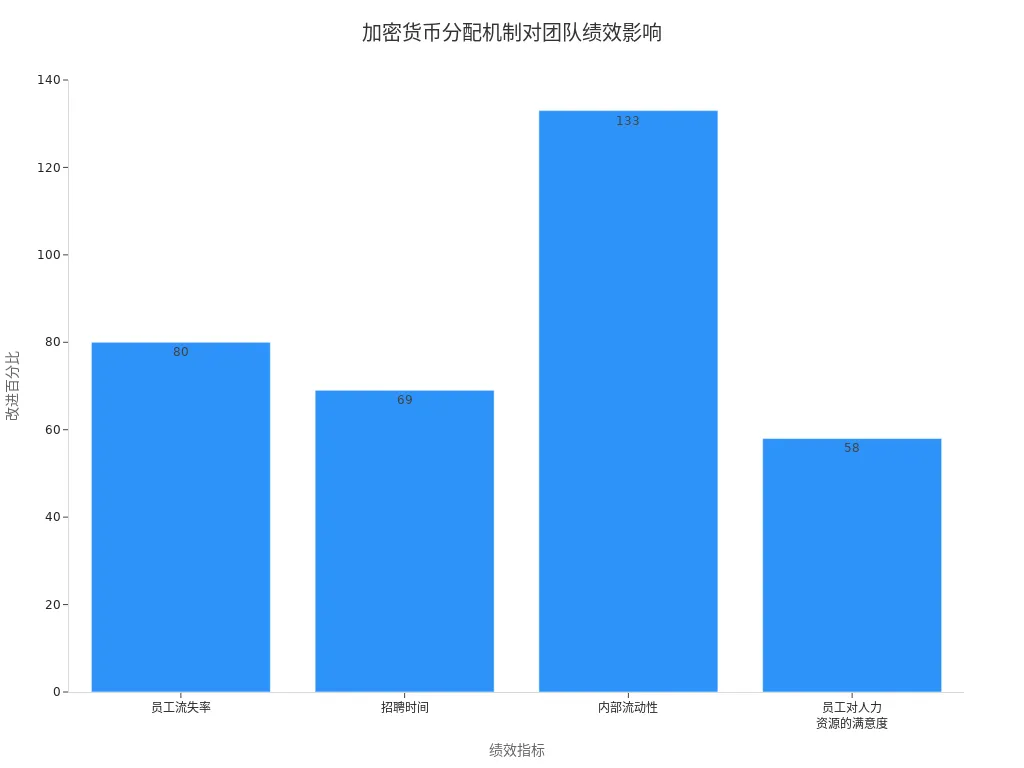
You will find that employee turnover rate drops significantly, recruitment efficiency improves, internal mobility increases, and satisfaction rises markedly. These data indicate that the cryptocurrency allocation mechanism can effectively motivate team members and optimize collaboration processes.
Legal Compliance and Risks
When implementing a cryptocurrency allocation mechanism, you must pay attention to legal compliance and risks. Governments worldwide continue to strengthen regulation of cryptocurrency, and compliance demands are constantly increasing. You need to handle global tax forms to ensure tax compliance. Anti-money laundering regulations require you to take measures to prevent illegal funds from flowing in.
- Governments strengthen regulation, increasing compliance demands.
- Global tax form processing ensures tax compliance.
- Anti-money laundering regulations require companies to implement compliance measures to prevent illegal funds from being converted into legitimate income.
You also need to monitor risks such as cryptocurrency price volatility and differences in team understanding. You can reduce legal risks and ensure the stability and security of team collaboration through professional legal advisors and compliance tools.
Operational Recommendations and Best Practices
Tool and Cryptocurrency Selection
When selecting allocation tools and cryptocurrencies, prioritize automation, compliance, and global applicability. Global collection & payment platforms such as BiyaPay provide real-time conversion services between USDT and USD/HKD, supporting multi-currency settlement to meet the needs of members in different regions. You can also refer to the table below to understand the functions of commonly used tools:
| Tool | Function Description |
|---|---|
| LiquiFi | Plans employee token allocation and budget/forecasting, automates vesting and grants setup, supports security, compliance, tax, and financial reporting. |
When selecting cryptocurrencies, focus on the following criteria:
- Convenience of currency conversion, prioritizing solutions that can be automatically converted to fiat to simplify tax and payment processes.
- Payment flexibility, allowing members to choose their preferred payment currency to improve team satisfaction.
- Global and local compliance, ensuring tools and platforms meet laws and tax requirements in each country.
Formulation of Allocation Rules
When formulating allocation rules, ensure they are open and transparent for easy understanding and execution by team members. Research shows that teams can significantly improve satisfaction and collaboration performance by establishing team charters and setting clear expectations. You can adopt the following suggestions:
- Clearly define contribution evaluation standards to ensure fair allocation basis.
- Set vesting periods and vesting conditions to guarantee long-term incentive effects.
- Regularly review and optimize allocation rules, responding promptly to team feedback.
Team Training and Communication
In driving cross-border team collaboration, systematic training and communication mechanisms are critical. You should understand company processes and documentation requirements during the preparation phase, help members integrate through welcome activities on the first day, align goals and promote team integration within the first 30 days, strengthen collaboration and skill enhancement after 60 days, and conduct achievement evaluation and future planning after 90 days. In addition, you need to:
- Align with internal stakeholders such as finance and legal to understand the business logic of crypto payroll.
- Conduct small-scale pilots to test employee needs and vendor capabilities.
- Provide clear and easy-to-understand educational resources to help members master secure payment processes.
- Understand tax obligations and currency conversion rules in each region, establish internal control measures, and reduce organizational risks.
Through the cryptocurrency allocation mechanism, you can significantly improve transparency and efficiency in cross-border team collaboration. In actual operations, focus on compliance, data security, and team communication. You can explore innovative allocation methods and continuously optimize incentive effects. Blockchain technology shows tremendous potential for future global collaborative projects:
- Blockchain provides security and transparency, promoting intermediary-free collaboration.
- Decentralized control enhances system reliability.
- Immutability of smart contracts improves trust.
- Blockchain improves efficiency in medical data management and cross-border cooperation.
- Future scalability and education promotion will lower adoption barriers.
FAQ
How to ensure the cryptocurrency allocation mechanism complies with legal requirements in various countries?
You should regularly consult professional legal advisors, monitor regulatory developments in each country, strictly implement anti-money laundering and tax declaration processes, and ensure the allocation mechanism meets legal compliance standards globally.
How do team members choose and receive cryptocurrency compensation?
You can select mainstream cryptocurrencies such as USDT or USD based on individual needs. You need to provide a valid wallet address, and the platform will automatically complete settlement to ensure funds arrive securely.
How to adjust rules after smart contract deployment?
You can use multi-signature mechanisms or off-chain governance solutions and preset change processes in advance. You should fully communicate rule adjustments with the team beforehand to ensure all members are informed and agree.
How to evaluate the actual contribution of team members?
You can combine multi-dimensional data such as code commits, documentation completeness, and project management, use automated tools and regular retrospective meetings to ensure the contribution evaluation is scientific, fair, and transparent.
How does the cryptocurrency allocation mechanism reduce team turnover rate?
Through open and transparent allocation processes and immediate incentives, you can enhance members’ sense of belonging and satisfaction. You can effectively improve team stability and reduce the loss of high-skilled talent.
*This article is provided for general information purposes and does not constitute legal, tax or other professional advice from BiyaPay or its subsidiaries and its affiliates, and it is not intended as a substitute for obtaining advice from a financial advisor or any other professional.
We make no representations, warranties or warranties, express or implied, as to the accuracy, completeness or timeliness of the contents of this publication.
Related Blogs of

Why Is HDD Supply and Demand Tightening? AI Data Centers, Long-Term Agreements, and Western Digital/Seagate Pricing Power


What Are NOR Flash, SLC NAND, and EEPROM? Why They Help Explain Hong Kong-Listed Memory-Related Stocks


How Should SSDs and HDDs Work Together in AI Data Centers? Performance, Capacity, Cost, and Hot vs. Cold Data Compared


What Is the Relationship Between ASMPT 0522.HK and HBM? The Role of Advanced Packaging Equipment in the AI Memory Supply Chain

Choose Country or Region to Read Local Blog
 Australia
 Austria
 Belgium
 Canada
 Cyprus
 Czech Republic
 Denmark
 Estonia
 Finland
 France
 Germany
 Greece
 Hong Kong
 India
India Indonesia
 Ireland
 Italy
Italy Japan
Japan Latvia
 Lithuania
 Luxembourg
 Malaysia
 Malta
Malta Morocco
 Nepal
Nepal Netherlands
 New Zealand
 Norway
 Pakistan
 Philippines
 Poland
 Portugal
 Romania
 Singapore
 Slovakia
 Slovenia
 South Africa
 South Korea
 Spain
Spain Sweden
 Thailand
 The United States
 Turkey
 United Arab Emirates
 United Kingdom
 Vietnam
Contact Us




BIYA GLOBAL LLC is registered with the Financial Crimes Enforcement Network (FinCEN), an agency under the U.S. Department of the Treasury, as a Money Services Business (MSB), with registration number 31000218637349, and regulated by the Financial Crimes Enforcement Network (FinCEN).
BIYA GLOBAL LIMITED is a registered Financial Service Provider (FSP) in New Zealand, with registration number FSP1007221, and is also a registered member of the Financial Services Complaints Limited (FSCL), an independent dispute resolution scheme in New Zealand.