How Can Domestic Users Buy Stocks of Compute Power Suppliers Related to Anthropic/OpenAI?




Image Source: unsplash
You can purchase stocks of compute power suppliers related to Anthropic or OpenAI through Hong Kong/US stock brokerage platforms, which is a convenient and practical method. Investing in these companies allows you to capture the core segments of the AI industry chain. Many domestic users are paying attention to algorithm and system efficiency, changes in the global supply chain landscape, and the shadow supply chain phenomenon. The table below summarizes the main investment motivations and focus areas:
| Motivation/Focus Area | Description |
|---|---|
| Focus on Algorithm and System Efficiency | Paying attention to algorithm efficiency helps enhance global competitiveness, especially in the context of Huawei catching up to Nvidia. |
| Fragmentation of the Global Supply Chain | The supply chain may split into two ecosystems dominated by the United States and China. |
| Shadow Supply Chain Phenomenon | After export controls, issues with gray markets and shadow supply chains have intensified. |
Core Key Points
- Through Hong Kong/US stock brokerage platforms, domestic users can conveniently purchase stocks of compute power suppliers related to Anthropic and OpenAI.
- Direct investment is suitable for experienced users, allowing independent selection of targets and pursuit of high returns, but requires market analysis capabilities.
- Indirect investment such as ETFs and funds is suitable for users with lower risk tolerance, enabling risk diversification and simplified management processes.
- Focus on core companies in AI infrastructure, such as Nvidia, Microsoft, etc., evaluate their market position and financial performance, and formulate investment strategies.
- When investing, pay attention to risks such as policies, taxation, and market competition, ensure compliance, and reasonably plan the investment portfolio.
Investment Channels for Domestic Users
Image Source: pexels
Mainland China users can invest in compute power supplier stocks in the US market through securities firms or online trading platforms. You can choose direct investment methods or participate in the growth of related companies through indirect investment methods. Understanding the characteristics of different channels helps you formulate reasonable investment strategies based on your own needs.
Direct Investment Method
You can directly purchase stocks of compute power suppliers on US stock brokerage platforms. For example, companies such as Nvidia, AMD, Microsoft, Google, and Amazon are all listed in the US market. Mainland China users usually choose Hong Kong/US stock brokerage platforms such as Futu, Tiger Brokers, and Huatai International to open accounts. You need to prepare materials such as ID card and bank card, and you can operate after completing real-name authentication.
For fund deposits and withdrawals, BiyaPay provides global payment collection and international remittance services for Chinese-speaking users. You can achieve real-time exchange between fiat currency and digital currency through BiyaPay, support USDT exchange to USD or HKD, and provide deposit/withdrawal support for US stocks and Hong Kong stocks trading. This allows you to flexibly manage funds and avoid high handling fees and exchange rate fluctuation risks associated with traditional bank wire transfers. All fund operations are denominated in USD, making it convenient for you to invest in the US market.
If you care more about efficiency and transparency in the actual funding process, it also makes sense to do a quick comparison before moving money. For example, you can review available cross-border funding paths on the BiyaPay official website, then use its fiat exchange rate comparison tool to check real-time pricing and conversion costs when exchanging USDT into USD or HKD, so you can better judge which route fits a later US stock or ETF purchase.
From a product-positioning perspective, BiyaPay is better understood as a multi-asset trading wallet that covers cross-border payments, fund management, US and Hong Kong stock trading, and digital asset conversion, while operating with relevant financial registrations in jurisdictions such as the United States and New Zealand. For users handling exchange, deposits and withdrawals, and cross-market allocation at the same time, tools like this work better as execution support rather than a substitute for broker selection and investment research.
The direct investment method is suitable for users who want to independently select targets and pursue high returns. You can adjust holdings in a timely manner based on corporate financial reports and industry developments. It should be noted that direct investment requires you to have certain market analysis capabilities and bear the risks brought by individual stock fluctuations.
Indirect Investment Method
If you want to diversify risks or simplify operations, you can choose indirect investment methods. ETFs and funds provide convenient investment channels for mainland China users. You can purchase ETF or fund products related to AI infrastructure through brokerage platforms. For example:
- KraneShares Emerging Markets Consumer Technology ETF (KEMQ): This product focuses on technology and internet companies in Asia and other emerging markets, covering upstream and downstream companies in the AI industry chain.
- KraneShares SSE STAR Market 50 Index ETF (KSTR): Focuses on the top 50 companies in China’s STAR market, covering fields such as information technology, biomedicine, and new energy, indirectly participating in the growth of compute power suppliers.
In addition, the Global X Artificial Intelligence & Technology ETF has an average annual return of 16.6%, with a rise of nearly 23% in the past year. The ROBO Global Robotics & Automation Index ETF has an average annual return of about 8.4%, with a rise of about 15.6% in the past year. However, the returns of AI-themed ETFs usually cannot match the potential returns of direct stock investments in major AI infrastructure companies, because ETFs hold diversified stocks while industry profits are concentrated in a few leading companies.
You can complete deposits and withdrawals for US stock ETFs or funds through BiyaPay, with funds denominated in USD and support for digital currency exchange. The indirect investment method is suitable for users who want to reduce risks and simplify management processes. You do not need to frequently follow individual stock developments, but only need to periodically evaluate fund performance.
Tip: The direct investment method is suitable for experienced users pursuing high returns, while the indirect investment method is suitable for users with lower risk tolerance who want to diversify investments. You can choose the appropriate channel based on your own fund size, investment goals, and risk tolerance.
Related Compute Power Suppliers
Image Source: unsplash
When investing in the compute power supply chain related to Anthropic and OpenAI, you need to focus on core companies in the entire AI infrastructure ecosystem. You can conduct in-depth understanding and screening from three dimensions: chips and hardware, cloud services and infrastructure, and other beneficiary companies.
Chip and Hardware Suppliers
You can regard chip and hardware suppliers as the underlying driving force of the AI industry chain. Nvidia and AMD provide high-performance GPUs and acceleration chips for global AI training and inference. Nvidia not only provides compute power support for top AI companies such as OpenAI and Anthropic, but also forms industry barriers through its CUDA ecosystem. AMD is gradually expanding its share in the AI server market with its cost-effectiveness and open architecture.
You can also pay attention to companies such as Coherent, Lumentum, and Nokia. These companies provide optical modules, communication equipment, and underlying hardware for data centers and AI servers, indirectly benefiting from the explosion in AI compute power demand. The table below shows some hardware companies benefiting from the growth in AI infrastructure demand:
| Stock Ticker | Company Name |
|---|---|
| NVDA | Nvidia |
| AMD | Advanced Micro Devices |
| COHR | Coherent |
| LUM | Lumentum |
| NOK | Nokia |
When selecting investment targets, you can combine the company’s technological barriers, market share, and financial report performance to evaluate its core position in the AI industry chain.
Cloud Services and Infrastructure
Cloud service and infrastructure suppliers provide compute resources and data storage for AI large model training and inference. You can focus on companies such as Microsoft, Google, Amazon, and Oracle. These companies not only provide cloud computing resources for AI companies such as OpenAI and Anthropic, but also bind cooperation relationships through strategic investments and long-term contracts.
Microsoft is an important investor and partner of OpenAI. You can see that Microsoft provides large-scale compute power support for OpenAI through the Azure cloud platform and deeply participates in its product ecosystem. Google has become the main infrastructure provider for Anthropic, providing cloud services and TPU chips for its AI training, development, and deployment. According to public information, Anthropic will obtain up to 1 million TPU chips before 2026, with overall processing capacity exceeding 1 gigawatt. Google provides billions of dollars in hardware and cloud service credits for this, and Anthropic commits to long-term infrastructure expenditures.
Oracle signed a $300 billion, five-year cloud computing agreement with OpenAI, which will begin in 2027 and is one of the largest technology transactions in history. This agreement ensures that OpenAI obtains powerful computing capabilities in the next five years, further consolidating Oracle’s position in the AI infrastructure market. You can quickly understand the main cloud service contract information through the table below:
| Contracting Party | Contract Amount | Contract Term | Start Year | Main Content |
|---|---|---|---|---|
| Oracle | $300 billion | 5 years | 2027 | OpenAI cloud computing and infrastructure support |
| Billions of dollars | Multiple years | 2024 | Anthropic cloud services and TPU chip support |
When investing in cloud service and infrastructure suppliers, you need to pay attention to the contract scale, cooperation depth, and technological advantages with leading AI companies.
Other Beneficiary Companies
In addition to chip and cloud service giants, other companies in the AI infrastructure chain are also worth your attention. Companies such as Modine Manufacturing, Akamai Technologies, Dropbox, Zscaler, and Five9 provide key technologies and services in areas such as data center cooling, content delivery, security, cloud storage, and intelligent contact centers. The continuous growth in AI compute power demand drives the performance and stock price performance of these companies.
The table below lists some companies benefiting from the growth in AI infrastructure demand and their latest market performance:
| Stock Ticker | Company Name | Latest Price (USD) | Latest Change (USD) |
|---|---|---|---|
| MOD | Modine Manufacturing | N/A | N/A |
| AKAM | Akamai Technologies | 100.845 | 3.282466 |
| DBX | Dropbox | 25.675 | 2.864583 |
| ZS | Zscaler | 152.565 | 2.682057 |
| FIVN | Five9 | 17.98 | 2.91929 |
You can analyze these companies’ business structures and financial reports to determine their degree of benefit and growth potential in the AI industry chain.
Tip: When investing in companies related to AI infrastructure, you should not only pay attention to the company’s technical strength and market share, but also comprehensively evaluate investment value by combining their cooperation relationships, contract scales, and industry status with leading AI companies such as OpenAI and Anthropic.
You also need to pay attention to Anthropic’s latest valuation and financing progress. Anthropic’s current valuation reaches $380 billion, and it is expected to achieve positive cash flow in 2028. Microsoft and Google are both important investors in it. You can understand Anthropic’s latest financing situation through the following table:
| Valuation (USD) | Financing Status |
|---|---|
| $380 billion | Expected to achieve positive cash flow in 2028 |
When investing in related compute power suppliers, it is recommended to combine corporate fundamentals, industry trends, and market dynamics to formulate scientific investment strategies.
Account Opening Process for Domestic Users
Brokerage Platform Selection
When investing in compute power supplier stocks in the US market, you first need to choose a suitable Hong Kong/US stock brokerage platform. Brokerages commonly used by mainland China investors include Futu Securities, Tiger Brokers, and Huatai International. These platforms have complete compliance systems, support online account opening, and multi-currency fund management. You can compare the trading varieties, handling fees, customer service, and technical support of each platform to choose the brokerage that best suits your needs. Some platforms also provide mobile apps, making it convenient for you to manage investment accounts anytime and anywhere.
Account Opening Materials and Steps
In the account opening process, you need to prepare basic materials such as ID card, bank card, and proof of residential address. Some brokerages may require additional tax information or filling out the W-8BEN form. The account opening process usually includes the following steps:
- Submit personal information and identity authentication materials online.
- Perform facial recognition or video witnessing to ensure account security.
- Bind bank card and verify source of funds.
- Wait for brokerage review; trading permissions will be granted after approval.
The entire process is generally completed within 1-3 working days. You need to ensure that the submitted materials are true and valid to avoid delays in review due to inconsistent information.
Fund Threshold
Most Hong Kong/US stock brokerages have low account opening fund thresholds for mainland China users. Some platforms support zero-threshold account opening, while others require an initial deposit of no less than 100 USD. You should understand in detail the minimum fund requirements and related fees of each platform before depositing funds. Fund deposits can be completed through bank wire transfers, third-party payments, or digital currency exchanges. You need to pay attention to fund arrival time, exchange rate fluctuations, and handling fees, and reasonably arrange investment plans.
Fund Deposit and Withdrawal Methods
Common Channels
You can complete fund deposit and withdrawal operations through multiple channels. Mainland China users usually choose bank wire transfers, third-party payment platforms, or digital currency exchange methods. For bank wire transfers, it is recommended to prioritize licensed banks in Hong Kong for more efficient and compliant fund flows. Some users choose BiyaPay for global payment collection and international remittances, supporting real-time exchange between fiat and digital currencies, with USDT exchangeable to USD or HKD, suitable for deposit/withdrawal in US stock and Hong Kong stock trading. BiyaPay provides flexible fund management for Chinese-speaking users, avoiding high handling fees and exchange rate fluctuation risks of traditional bank wire transfers.
Compliance Requirements
In the process of cross-border fund transfers, you must comply with relevant laws and regulations. Mainland China users need to pay attention to foreign exchange control policies and ensure the legality of fund sources. Data controllers need to complete cybersecurity reviews, obtain certifications or sign standard contractual clauses, and submit relevant reports. You must obtain notification and explicit consent from data subjects, conduct PIIA assessments, and ensure that data processing activities comply with PIPL regulatory standards. Fund deposit and withdrawal operations must comply with local regulatory requirements to avoid compliance risks.
- Cybersecurity review
- Obtain certification from certification bodies
- Sign standard contractual clauses and submit reports
- Obtain explicit consent from data subjects
- Complete PIIA assessment
Fees and Security
In the process of fund deposit and withdrawal, you need to pay attention to the fee structure and account security. Bank wire transfers usually charge fixed handling fees, while third-party payments and digital currency exchange platforms may have exchange rate spreads and service fees. BiyaPay supports real-time exchange, with fees denominated in USD, making it convenient for you to reasonably plan investment costs. Fund investments involve management fees and operating expenses, as follows:
| Fee Type | Description |
|---|---|
| Management Fee | Fees charged by fund managers, calculated as a percentage of the fund’s average net asset value, paid monthly. |
| Operating Expenses | Including legal fees, audit fees, custody fees, taxes, brokerage commissions, etc., allocated by fund category. |
You should adopt account protection measures, learn security knowledge, and prevent fraud risks. Brokerage platforms and payment institutions usually have security knowledge centers to help you enhance fund security awareness. It is recommended to choose compliant channels for fund deposit and withdrawal operations to ensure fund security and information protection.
Investment Risks and Compliance
Policies and Taxation
When investing in AI infrastructure stocks in the US market, you must pay high attention to policy and tax risks. The main policy risks faced by mainland China investors include legal uncertainty, data privacy, changes in judicial independence, and adjustments to the tax environment. The table below summarizes these risk types and their specific contents:
| Risk Type | Specific Content |
|---|---|
| Legal Uncertainty | Due to the National Security Law (NSL) and new national security legislation (SNSO), arbitrary enforcement and increased economic risks may occur. |
| Data Privacy Risk | Investors face concerns about data privacy, transparency, and access to business information. |
| Decline in Judicial Independence | Hong Kong’s judicial independence is eroded, which may affect investor confidence and decision-making. |
| Tax Environment | Although Hong Kong’s tax system is favorable (no capital gains tax and low corporate tax rate), changes in the political environment may affect the overall investment climate. |
You also need to pay attention to the impact of foreign exchange policy changes on the repatriation of investment returns. The Foreign Exchange Administration has gradually relaxed restrictions on foreign direct investment and cross-border capital account transactions, allowing foreign-invested enterprises to use foreign currency profits generated in China for domestic reinvestment. Nevertheless, market frictions still exist, such as insufficient coordination of access schemes, complex local infrastructure, limited investment tools, and imperfect post-transaction processes, which may affect your fund flows and investment efficiency.
Profitability and Market Competition
When selecting AI infrastructure suppliers, you must pay attention to the company’s profitability and market competition landscape. The AI infrastructure market is expanding rapidly, and it is expected that by 2029, the hyperscale data center market size will reach $1.4 trillion. By 2027, global IT investment related to AI will reach $521 billion, showing the high importance companies attach to AI infrastructure. AI infrastructure has become a new asset class, attracting the attention of large institutional investors. You need to analyze the company’s financial reports, market share, technological barriers, and industry status to judge its sustainable profitability in fierce competition.
Information Disclosure
When investing in companies related to AI infrastructure, you must pay attention to the transparency and compliance of information disclosure. Major companies disclose specific contextual details to avoid merely listing AI as a capability. Companies need to disclose material risks related to AI, such as dependence on third-party providers and potential algorithm biases. You should pay attention to whether companies accurately describe AI capabilities, avoiding “AI washing” or exaggerating technical strength. Companies also need to clearly distinguish current AI capabilities from future predictions, collect strong evidence to support their AI technology performance claims, and describe the current market environment, regulatory situation, and industry trends. You can judge the completeness and transparency of corporate information disclosure by analyzing annual reports, prospectuses, and official announcements, reducing investment decision risks.
As a mainland China user, when investing in Hong Kong/US stock AI infrastructure companies, be sure to scientifically assess risks by combining multiple dimensions such as policies, taxation, profitability, and information disclosure to protect your own rights and interests.
Convenient Investment Solutions
ETFs and Funds
You can conveniently participate in the growth of AI infrastructure and compute power suppliers through indirect investment methods such as ETFs and mutual funds. These products usually cover multiple AI-related companies, helping you diversify the volatility risk brought by single stocks. Taking the US stock market as an example, the performance of some popular AI-themed ETFs and mutual funds is as follows:
| Fund Name | Type | Annual Return | Expense Ratio |
|---|---|---|---|
| Global X Artificial Intelligence & Technology ETF | ETF | 16.6% | 0.68% |
| iShares A.I. Innovation & Technology Active ETF | ETF | N/A | 0.55% |
| ROBO Global Robotics & Automation ETF | ETF | 8.4% | 0.95% |
| Fidelity Select Technology Portfolio | Mutual Fund | 13.44% | N/A |
| T. Rowe Price Global Technology Fund | Mutual Fund | 16.40% | N/A |
You can purchase the above products through mainstream Hong Kong/US stock brokerage platforms. BiyaPay provides services such as global payment collection and international remittances, real-time exchange between fiat and digital currencies, and USDT exchange to USD or HKD for Chinese-speaking users, making it convenient for you to efficiently complete deposits and withdrawals for US stock ETFs or funds, with funds denominated in USD to reduce exchange rate fluctuation and handling fee risks.
Pros and Cons of Solutions
When choosing ETFs, funds, or direct stock investments, you should fully compare the advantages and disadvantages of different methods. The table below summarizes the characteristics of the main investment methods:
| Investment Method | Advantages | Disadvantages |
|---|---|---|
| Exchange-Traded Fund ETF | Low cost, efficient risk diversification, tradable at any time, flexible management. | Need to understand the scope of investment targets, some leveraged ETFs have additional risks. |
| Mutual Fund | Managed by professional fund managers, suitable for investors unwilling to actively manage, diverse portfolios. | Higher active management fees, less trading flexibility than ETFs. |
| Direct Stock Investment | Independent selection of targets, high return elasticity, suitable for experienced investors. | Concentrated risk, requires strong market analysis capabilities, high volatility. |
ETFs and funds are suitable for Chinese/mainland China users who want to diversify risks and simplify management processes. Direct investment is more suitable for investors with professional knowledge pursuing high returns. You can flexibly choose the appropriate solution based on your own fund size, risk preference, and investment goals.
When investing in AI infrastructure supplier stocks, you should follow a scientific process, emphasizing compliance and risk prevention. It is recommended to start with small-amount trials, diversified allocation, attention to policy environment, use of professional tools, and regular reviews. The table below shows asset allocation ratios for different investment strategies in AI infrastructure-related stocks, making it convenient for you to choose according to your own risk preference:
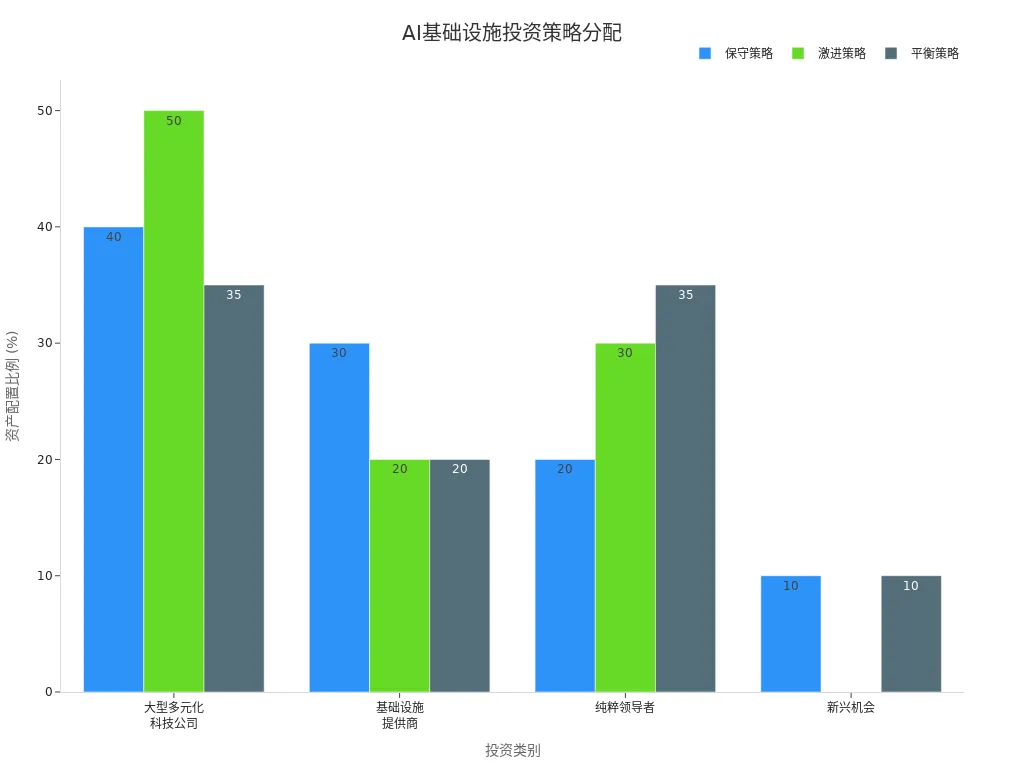
You need to continuously monitor market changes, reasonably plan investment portfolios, rationally respond to valuation fluctuations and geopolitical risks, and ensure steady and sustainable investment decisions.
FAQ
How to Choose a Suitable Hong Kong/US Stock Brokerage Platform?
You can compare based on factors such as trading varieties, handling fees, customer service, and technical support. It is recommended to prioritize large platforms with good compliance and reputation to ensure fund security and trading experience.
What Are the Main Risks in Investing in AI Compute Power Supplier Stocks?
You need to pay attention to multiple risks such as policy changes, foreign exchange controls, tax compliance, corporate profitability, and market competition. It is recommended to regularly evaluate the investment portfolio and adjust strategies in a timely manner.
What Compliance Requirements Are There for Fund Deposits and Withdrawals?
You must comply with relevant laws and regulations to ensure the legality of fund sources. Cross-border fund flows need to pay attention to foreign exchange policies, choose compliant channels, and avoid legal risks caused by irregular operations.
What Methods Can Be Used to Achieve Deposits and Withdrawals for US Stocks or Hong Kong Stocks?
You can choose methods such as bank wire transfers, third-party payments, or digital currency exchanges. Some service providers support USDT exchange to USD or HKD to meet deposit/withdrawal needs for US stock and Hong Kong stock trading.
What Is the Difference Between Investing in ETFs and Directly Buying Stocks?
ETFs diversify risks and are convenient to manage, suitable for users who want to simplify operations. Direct stock purchases offer greater elasticity but concentrated risks. You can choose the investment method based on your own needs and risk preference.
*This article is provided for general information purposes and does not constitute legal, tax or other professional advice from BiyaPay or its subsidiaries and its affiliates, and it is not intended as a substitute for obtaining advice from a financial advisor or any other professional.
We make no representations, warranties or warranties, express or implied, as to the accuracy, completeness or timeliness of the contents of this publication.
Related Blogs of

What Is the Difference Between HBM3E and HBM4? What Do They Mean for Micron and AI Servers?


What Is the Difference Between DRAM Contract Price and Spot Price? Which Indicator Should Investors Watch?

How Should SSDs and HDDs Work Together in AI Data Centers? Performance, Capacity, Cost, and Hot vs. Cold Data Compared


Is SMIC 0981.HK a Memory Chip Stock? The Relationship Between Foundry Manufacturing and the Memory Supply Chain

Choose Country or Region to Read Local Blog
 Australia
 Austria
 Belgium
 Canada
 Cyprus
 Czech Republic
 Denmark
 Estonia
 Finland
 France
 Germany
 Greece
 Hong Kong
 India
India Indonesia
 Ireland
 Italy
Italy Japan
Japan Latvia
 Lithuania
 Luxembourg
 Malaysia
 Malta
Malta Morocco
 Nepal
Nepal Netherlands
 New Zealand
 Norway
 Pakistan
 Philippines
 Poland
 Portugal
 Romania
 Singapore
 Slovakia
 Slovenia
 South Africa
 South Korea
 Spain
Spain Sweden
 Thailand
 The United States
 Turkey
 United Arab Emirates
 United Kingdom
 Vietnam
Contact Us




BIYA GLOBAL LLC is registered with the Financial Crimes Enforcement Network (FinCEN), an agency under the U.S. Department of the Treasury, as a Money Services Business (MSB), with registration number 31000218637349, and regulated by the Financial Crimes Enforcement Network (FinCEN).
BIYA GLOBAL LIMITED is a registered Financial Service Provider (FSP) in New Zealand, with registration number FSP1007221, and is also a registered member of the Financial Services Complaints Limited (FSCL), an independent dispute resolution scheme in New Zealand.