U.S. Election Year and AI Regulation Policies: In-Depth Forecast of Impact on Related Tech Stock Trends





Image Source: pexels
Policy uncertainty brought by U.S. election years and adjustments in AI regulation policies have become core variables affecting tech stock trends. Investors are highly attentive to the transmission mechanisms of policy changes on market structure. Certain tech sectors are more susceptible to policy influence, leading to fluctuations in market expectations. Rational analysis helps identify potential opportunities and risks.
In policy-driven market conditions like this, many investors track stock information, funding routes, and currency-conversion costs together before adjusting positions. Platforms such as BiyaPay, positioned as a multi-asset trading wallet covering cross-border payments, investing, and fund management scenarios, can be used alongside this kind of policy analysis through its stock lookup function for checking related tech stocks.
If cross-currency allocation is involved, its exchange rate and converter tool can also help compare conversion costs across different fiat currencies. BiyaPay also supports international remittance services and operates with relevant compliance registrations in jurisdictions including the United States and New Zealand; it does not offer AI that identifies market signals or makes trading decisions on the user’s behalf, so investment judgment should still rely on the investor’s own research.
Key Takeaways
- U.S. election years introduce policy uncertainty that impacts tech stock performance. Investors need to monitor policy changes and adjust investment strategies promptly.
- Democrats and Republicans show significant differences in AI regulation policies. Democrats tend to favor stronger regulation, while Republicans advocate for reduced regulation, affecting market expectations.
- Policy expectations directly influence tech stock valuations. Looser policies reduce compliance costs and boost corporate profits, while tighter policies increase costs and lead to valuation declines.
- Sector rotation strategies perform well during periods of policy uncertainty. Dynamically adjusting asset allocation helps diversify risk and improve portfolio returns.
- Investors should combine short-term and long-term strategies, focus on the innovation capabilities and market applications of AI companies, ensure portfolio diversification, and reduce risk.
U.S. Election Year and Tech Policy

Image Source: pexels
Party Positions and Their Impact on AI Regulation
During U.S. election years, the divergence between major parties on AI regulation policies becomes a focal point for the market.
- Democrats tend to favor active regulation, emphasizing ethical safeguards and promoting the development of AI technology within safe and fair frameworks.
- Republicans advocate for minimal regulation, placing greater emphasis on economic growth and innovation vitality, and stress reducing policy barriers.
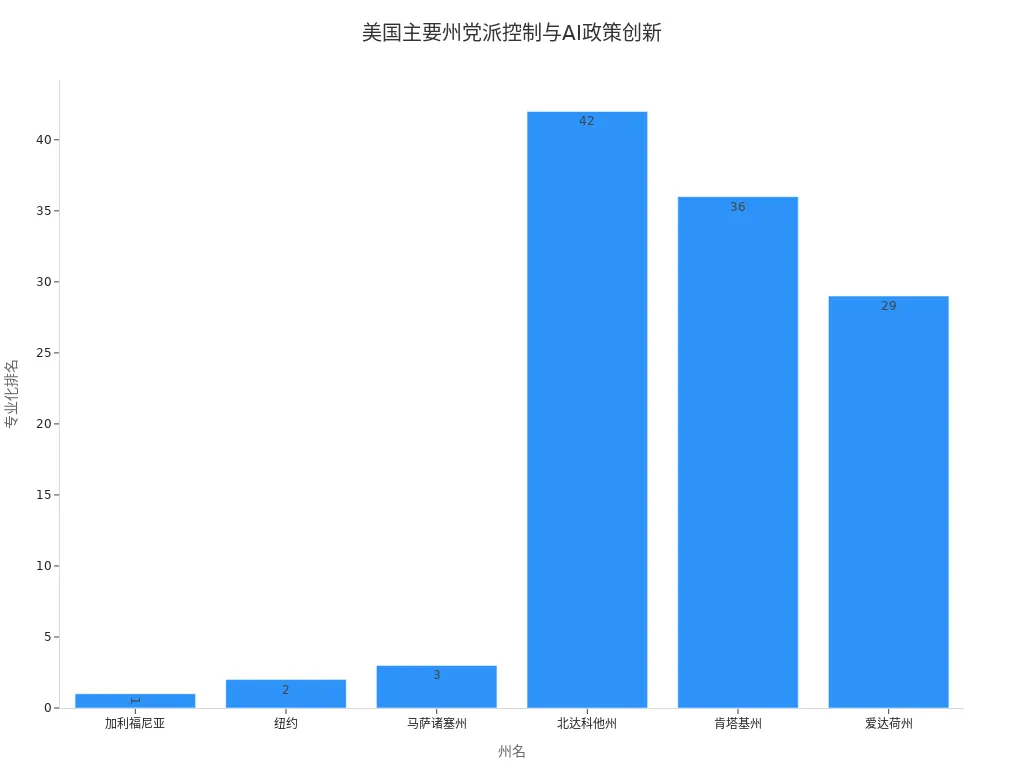
Historical data shows that party control has a significant impact on AI policy innovation. The table below illustrates AI policy innovation across states with different party control:
| State | Party Control | Professionalization Ranking | Number of AI Policy Innovations |
|---|---|---|---|
| California | Democratic control | 1 | High |
| New York | Democratic control | 2 | High |
| Massachusetts | Democratic control | 3 | High |
| North Dakota | Republican control | 42 | 1 |
| Kentucky | Republican control | 36 | 1 |
| Idaho | Republican control | 29 | 1 |
In states with high professionalization rankings, Democrats have driven more AI policy innovations. In contrast, states with lower professionalization and Republican control have limited numbers of AI-related legislation.
Policy Uncertainty and Market Sentiment
U.S. election years bring uncertainty about policy direction, directly affecting compliance costs for tech companies and market expectations. When facing potential regulatory changes, investors often exhibit cautious sentiment. Policy adjustments may force companies to increase compliance spending, impacting profit expectations. Changes in market expectations regarding regulatory intensity can trigger valuation fluctuations in tech stocks, with AI-related companies being particularly sensitive.
Election Outcomes and Regulatory Direction
Past U.S. election results have had profound impacts on AI regulation policies. The table below summarizes major policy changes in recent years:
| Date | Policy Change Description |
|---|---|
| 2024 | After Donald Trump returned to the White House, AI policy focus shifted toward countering China’s technology while reducing the over-regulation of the Biden administration. |
| February 2019 | Trump signed an executive order creating the American AI Initiative to promote AI R&D and application while balancing civil liberties and national security. |
| November 2020 | OMB issued a memorandum guiding federal agencies to reduce barriers to AI development and encourage non-regulatory approaches. |
| 2024 | The Republican platform pledged to repeal Biden’s executive order and promote AI innovation, reflecting a major shift in policy direction. |
Looking ahead to the 2024 U.S. election year, if Republicans win, it is expected they will repeal the Biden administration’s AI executive order, move toward looser regulatory policies, integrate AI policy with energy policy, and strengthen AI’s role in geopolitics. These changes will profoundly affect the strategic layout and market performance of tech companies.
AI Regulatory Trends and Market Landscape
Recent Developments in AI Regulation Policies
From 2023 to 2024, the United States continued to advance AI regulatory policy innovation. Regulatory focus has centered on generative AI content, risk management, and corporate compliance. The table below summarizes major recent regulations:
| Regulation Name | Main Content | Impact |
|---|---|---|
| TAKE IT DOWN Act | Requires platforms to remove AI-generated non-consensual intimate images within 48 hours and strengthens criminal penalties. | Grants FTC enforcement power and increases platform compliance pressure. |
| NIST AI Risk Management Framework | Encourages companies to assess and mitigate AI risks and provides best practice guidelines. | Widely adopted and improves industry self-regulation standards. |
| NIST Generative AI Profile | Proposes over 400 recommendations addressing generative AI risks across the AI lifecycle. | Guides companies in improving generative AI management processes. |
The U.S. regulatory system mainly relies on soft law and voluntary compliance, lacking a unified federal law. Companies must navigate multiple state regulations, making compliance more difficult. Compared with the EU and China, U.S. regulation is more market-oriented, while the EU establishes a comprehensive framework through the AI Act and China emphasizes state-led and content regulation.
Possible Paths for Changes in Regulatory Intensity
Over the next five years, U.S. AI regulatory intensity may follow several possible paths. Regulatory dynamics are influenced by federal and state legislation, the balance between innovation and regulation, bipartisan consensus, and other factors. After a U.S. election year, policy direction may shift. For example, if the new administration emphasizes not hindering innovation, federal law may trend toward leniency, focusing on transparency and liability limitations to simplify corporate compliance processes. 2026 will be a key node for AI policy implementation, when the rollout of new rules and discussions on legal rights for autonomous systems will become focal points. Differences between U.S. and EU regulation will continue to influence the global AI market landscape.
Challenges Posed by AI Development to Tech Giants
The rapid development of AI technology is reshaping the competitive landscape among tech giants. Large tech companies face pressure from capital expenditures, with major companies’ capital spending projected to approach $1.3 trillion from 2026 to 2027. AI market competition intensifies as new entrants continuously drive innovation, and the market is no longer winner-takes-all. Competition is fierce in AI hardware and applications, with startups challenging traditional giants through process innovation and cost advantages. The barrier to training efficient AI models is lowering, promoting market diversification. Consumers and enterprise users gain more choices in AI-driven products, fostering innovation and price competition. Policy changes during U.S. election years will further influence the strategic adjustments and market performance of tech giants.
Factors Influencing Tech Stock Trends

Image Source: unsplash
Policy Expectations and Valuation Fluctuations
During U.S. election years, policy expectations become an important variable affecting tech stock valuations. Investors pay close attention to the government’s stance on AI regulation. When loose policies are expected, compliance costs for tech companies decrease, profit margins expand, and valuations rise accordingly. If policies tighten, companies must increase compliance spending, raising market doubts about future profitability and intensifying valuation volatility. Within the tech sector, AI-related companies are especially sensitive to policy changes. Investors typically adjust their holdings based on election outcomes, prioritizing companies that benefit from favorable policies. The table below shows typical impacts of policy expectation changes on tech stock valuations:
| Policy Expectation Direction | Compliance Cost Change | Market Valuation Reaction | Investor Behavior |
|---|---|---|---|
| Loose | Decrease | Rise | Increase holdings in tech sector |
| Strict | Increase | Decline | Adjust positions, shift to safe-haven assets |
Market analysts believe that policy expectations not only affect short-term valuations but also alter companies’ long-term strategies. After a U.S. election year, once regulatory direction becomes clear, tech stock valuation fluctuations tend to stabilize.
Performance of AI Leaders vs. Small- and Mid-Cap Tech Stocks
The internal structure of the tech sector is complex, with significant performance differences between AI leading companies and small- to mid-cap tech firms. Large tech companies have abundant capital and R&D capabilities, enabling them to quickly adapt to policy changes and maintain market competitiveness. Small and medium-sized enterprises face higher compliance pressure and financing difficulties; when policies tighten, profitability is constrained and stock price volatility increases. During U.S. election years, investors tend to prioritize AI leading companies and avoid risks associated with smaller firms. The following list summarizes the performance of the two types of companies under policy changes:
- AI leading companies: Sufficient capital investment, strong technological innovation capabilities, able to quickly optimize compliance processes after policy adjustments and maintain profit growth.
- Small and mid-cap tech companies: Limited resources, high proportion of compliance costs, profit pressure during policy tightening, declining market confidence, and pronounced stock price volatility.
Differentiation within the tech sector is evident. Investors need to focus on company size, innovation capability, and policy adaptability when allocating assets rationally.
Interest Rate Policy and Investment Confidence
Interest rate policy directly affects investment confidence in tech stocks. When U.S. Federal interest rates remain stable or decline, investor confidence strengthens and tech stock prices receive support. Rising interest rates exert pressure on stock valuations and profits, causing investor sentiment to become cautious. Although rates remain elevated, strong corporate earnings growth can offset some negative effects and support tech stock prices. Investors need to consider both interest rate trends and corporate earnings expectations when formulating scientific investment strategies. The following outlines the impact of interest rate policy changes on tech stocks:
- Stable or declining interest rates: Investor confidence improves and tech stock prices rise.
- Rising interest rates: Greater valuation pressure, cautious investor sentiment, and some capital flows to safe-haven assets.
- Strong earnings growth: Even with high interest rates, tech stocks still have upside potential, with earnings expectations becoming the core driver.
Market data shows that interest rate policy and corporate earnings expectations jointly determine tech stock trends. The combination of policy changes during U.S. election years and interest rate adjustments requires investors to dynamically monitor the macro environment and flexibly adjust portfolios.
Investor Response Strategies
Identifying Policy Risks and Opportunities
During U.S. election years and AI regulatory policy adjustments, investors need to proactively identify policy risks and potential opportunities. Regulatory agencies are adopting advanced analytics to promote the application of regtech tools. Investors can focus on the following key indicators:
- AI model validation and documentation requirements issued by regulators
- Practical applications of AI systems in compliance monitoring, fraud detection, and stress testing
- Dynamic adjustments to important regulations such as MiFID II and the Bank Secrecy Act
These tools and indicators help investors dynamically monitor policy changes, adjust portfolios in a timely manner, and reduce losses from sudden risks.
Asset Allocation and Sector Rotation
Sector rotation strategies demonstrate strong adaptability during periods of policy uncertainty. Research shows that systematic sector rotation strategies achieved 16.7% annualized returns over ten years, nearly double the S&P 500 index with comparable risk levels. Empirical analysis from City, University of London also indicates that long-term sector rotation strategies using positive five-factor alpha significantly outperform simple buy-and-hold strategies in Sharpe ratio. Many backtest simulations further demonstrate that sector rotation has the potential to outperform static allocation over the long term, helping investors achieve better returns amid regulatory changes.
Sector rotation strategies dynamically adjust asset allocation to enhance portfolio resilience, making them suitable for market environments with frequent policy changes during election years.
Short- and Long-Term Investment Recommendations
When formulating tech stock investment plans, investors should combine short-term and long-term perspectives. In the short term, focus on the operational efficiency and innovation capabilities of AI companies, which are expected to improve profitability during policy adjustment windows. Over the long term, invest in AI companies with high growth potential, considering the broad application of AI technology across industries and global adoption trends. Risk management is equally important; investors must closely monitor regulatory changes and market volatility, maintain portfolio diversification, and reduce concentration risk.
- Short-term strategy: Prioritize AI companies with innovation capabilities and high operational efficiency
- Long-term strategy: Allocate to leading AI companies with high growth potential and focus on industry application expansion
- Risk management: Dynamically adjust positions, ensure asset diversification, and avoid single-point risks
A multi-dimensional strategy helps investors capture opportunities amid changes in regulatory processes and environments, improving overall returns.
U.S. election years and AI regulation policies jointly determine tech stock trends. Historical data shows that different election outcomes have significant impacts on assets such as the S&P 500 and the U.S. dollar:
| Election Outcome | S&P 500 | U.S. Dollar | Tax Rates |
|---|---|---|---|
| Democratic Congress | Neutral/Upside | Decline/Neutral | Increase |
| Republican Congress | Strong Upside | Strong Upside | Decrease |
Investors need to adopt dynamic portfolio strategies to respond promptly to policy changes. Major uncertainties include policy leadership, diffusion of AI governance, and establishment of federal standards. Rational assessment of risks and opportunities helps improve investment returns.
FAQ
Why do U.S. election years have a significant impact on tech stocks?
Policy uncertainty rises during U.S. election years, and tech companies must respond to regulatory changes. Market expectations fluctuate, causing frequent adjustments in tech stock valuations. Investors need to closely monitor policy developments.
What direct impacts do AI regulatory policy adjustments bring?
AI regulatory policy adjustments affect corporate compliance costs and innovation speed. When regulation tightens, companies must increase spending and profit margins shrink. Loose policies favor technological innovation and market expansion.
How can investors use BiyaPay for U.S. stock fund management?
BiyaPay supports global payments and collections as well as international remittances. Users can exchange USDT for USD or HKD to handle deposits and withdrawals for U.S. stock trading. The platform provides convenient capital flow services for Chinese-speaking users.
What role do interest rate policy changes play in tech stock investing?
When interest rates decline, tech stock valuations rise and investment confidence strengthens. Rising rates suppress stock performance and drive some capital toward safe-haven assets. Corporate profitability becomes a key supporting factor.
What advantages does sector rotation strategy offer during election years?
Sector rotation strategies allow dynamic asset allocation to diversify policy risk. Research shows this strategy performs excellently during periods of frequent policy changes, helping improve portfolio returns.
*This article is provided for general information purposes and does not constitute legal, tax or other professional advice from BiyaPay or its subsidiaries and its affiliates, and it is not intended as a substitute for obtaining advice from a financial advisor or any other professional.
We make no representations, warranties or warranties, express or implied, as to the accuracy, completeness or timeliness of the contents of this publication.
Related Blogs of

Can a Wise Virtual Card Pay for AI Subscriptions? Application, Limitations, and Alternatives


How to Read HKD/CNY Trends? FX Timing, Costs, and Account Choice





Choose Country or Region to Read Local Blog
 Australia
 Austria
 Belgium
 Canada
 Cyprus
 Czech Republic
 Denmark
 Estonia
 Finland
 France
 Germany
 Greece
 Hong Kong
 India
India Indonesia
 Ireland
 Italy
Italy Japan
Japan Latvia
 Lithuania
 Luxembourg
 Malaysia
 Malta
Malta Morocco
 Nepal
Nepal Netherlands
 New Zealand
 Norway
 Pakistan
 Philippines
 Poland
 Portugal
 Romania
 Singapore
 Slovakia
 Slovenia
 South Africa
 South Korea
 Spain
Spain Sweden
 Thailand
 The United States
 Turkey
 United Arab Emirates
 United Kingdom
 Vietnam
Contact Us




BIYA GLOBAL LLC is registered with the Financial Crimes Enforcement Network (FinCEN), an agency under the U.S. Department of the Treasury, as a Money Services Business (MSB), with registration number 31000218637349, and regulated by the Financial Crimes Enforcement Network (FinCEN).
BIYA GLOBAL LIMITED is a registered Financial Service Provider (FSP) in New Zealand, with registration number FSP1007221, and is also a registered member of the Financial Services Complaints Limited (FSCL), an independent dispute resolution scheme in New Zealand.