PayPal vs Block (SQ): Investment Value of Payment Processing Companies During the Major Tournament





Image Source: unsplash
Do you want to know the investment value of PayPal and Block (SQ) during the major tournament? Payment processing companies performed strongly in the U.S. market. PayPal revenue grew 7.3% to $8.42 billion, with total payment volume reaching $310 billion and GAAP net income exceeding $4 billion. Block revenue grew 2.3%, gross profit increased 18.3%, but it remains in a net loss position. PayPal has higher operating margins and free cash flow, while Block relies on the Cash App and Square ecosystem to drive future growth. You can refer to the table below for a quick overview of the core financial differences:
| Metric | PayPal | Block |
|---|---|---|
| Revenue | ~$30 billion | ~$22 billion |
| Operating Margin | 15–17% | Negative |
| Gross Margin | 48% | 24% |
| Total Payment Volume | $310 billion | $45.4 billion |
PayPal is suitable for conservative investors, while Block is more appealing to those seeking high growth. During the major tournament, market volatility creates short-term arbitrage and long-term positioning opportunities.
Key Points
- PayPal is suitable for conservative investors due to its stable revenue growth and healthy financial structure, offering reliable return expectations.
- Block is more suitable for growth-oriented investors due to its strong innovation capabilities and ability to attract new users through Cash App and Bitcoin payments.
- During the major tournament, payment processing companies experience a surge in transaction volume, allowing investors to capitalize on short-term arbitrage opportunities amid market volatility.
- Pay attention to the main risks of PayPal and Block, including competitive pressure and profitability fluctuations, to reasonably assess investment value.
- Select investment targets based on your own risk tolerance—conservative investors can choose PayPal, while growth-oriented investors can focus on Block.
Industry Background of Payment Processing Companies

Image Source: pexels
Current Industry Status
You can see that payment processing companies play a central role in the U.S. financial market. In 2024, the U.S. payment processing industry reached a market size of $81 billion with an average annual growth rate of 12%. It is expected to grow to $198 billion by 2032. North America accounts for approximately 31.7% of the global payment processing solutions market. Payment processing companies drive the adoption of digital payments through continuous technological innovation, improving transaction efficiency and security. The total transaction value of the global digital payments industry is expected to reach $16.59 trillion by 2028. More than 54% of the global population owns smartphones, making mobile payments mainstream. You can refer to the table below to understand industry scale and growth trends:
| Year | Market Size (USD billion) | CAGR |
|---|---|---|
| 2024 | 81.0 | 12.00% |
| 2032 | 198.0 |
Market Changes During the Major Tournament
During the major tournament, payment processing companies experience a surge in transaction volume. Consumers prefer contactless and online payments, with the proportion of cash payments continuing to decline. Non-cash transactions have grown tenfold over the past 20 years, demonstrating the strong development of digital payment methods. You will find that market volatility increases and investors show greater interest in payment processing companies. Traditional banks face greater pressure, while agile PayTech companies redefine merchant payment services through seamless omnichannel integrated solutions. During the major tournament, automated transaction volumes rise significantly, driving further industry upgrades.
Industry Influencing Factors
You need to pay attention to several key influencing factors. Technological innovation is the main driver of industry development, with demand fueling the rise of AI-driven autonomous settlement systems and stablecoins (such as PayPal’s PYUSD). Third-party payment technological innovation in China has driven the development of the traditional financial industry, with commercial banks facing competition and substitution in payment and settlement functions, potential customers, deposit and loan services, and other areas. Research shows that third-party payments are positively correlated with the value creation capabilities of the traditional financial industry and maintain long-term stability. Payment processing companies continuously optimize financial structures and innovation capabilities to increase market share and profitability. You can see that ongoing industry innovation and market demand together shape the investment value of payment processing companies.
PayPal Investment Value

Image Source: unsplash
Financial Performance
You can see that PayPal delivered solid performance in the latest quarter. Revenue reached $8.68 billion, with adjusted earnings per share of $1.23. The company maintains high gross margins and free cash flow, with a healthy financial structure. You can refer to the table below for a quick overview of PayPal’s core financial data:
| Metric | Value |
|---|---|
| Revenue | $8.68 billion |
| Adjusted EPS | $1.23 |
PayPal continues to optimize cost control and improve profitability. In the U.S. stock market, PayPal’s financial performance provides investors with stable return expectations.
Growth Drivers
PayPal’s growth momentum comes from its diversified strategy. You can focus on the following aspects:
- Transition to a comprehensive commerce platform—PayPal is becoming a full-service commerce solutions provider.
- Buy Now, Pay Later (BNPL) transaction volume grew over 20%, with BNPL users having an average order value 80% higher.
- Partnerships with brands such as Taco Bell make PayPal and Venmo the default payment options.
- Integration of cryptocurrency payments attracts new user groups.
- Monthly active accounts grew 18%, with sustained increases in user engagement.
You can see that PayPal continuously expands its business boundaries through technological innovation and strategic partnerships, driving performance growth.
Competitive Advantages
PayPal has significant advantages among payment processing companies. You can focus on the following points:
- The PayPal brand has built consumer trust, with checkout conversion rates 28% higher than other payment methods.
- Merchant protection programs provide merchants with free fraud and risk protection, enhancing merchant confidence.
- Global regulatory advantages enable PayPal to effectively provide cross-border services and expand international markets.
- After acquiring Simility, PayPal’s fraud detection capabilities lead the industry.
- Optimized risk management and checkout processes increase merchant authorization rates by 6% above industry standards.
These advantages make PayPal a more competitive investment target when choosing payment processing companies.
Risk Factors
You need to pay attention to the main risks facing PayPal. The table below summarizes key risks and their impacts:
| Risk Factor | Impact Description |
|---|---|
| Regulatory Compliance Costs | Intensified global crackdown on financial crime increases compliance costs; PayPal may face huge fines and reputational damage. |
| Economic Pressure | Changes in economic environment may affect profitability and market demand. |
| Competition | Major competitors such as Amazon and Alibaba bring fierce competition, requiring PayPal to continue innovating. |
| Technical Adaptation Needs | PayPal must continue investing in technology to meet compliance and market changes, otherwise it may face enforcement risks. |
When investing in PayPal, you should comprehensively consider these risk factors and reasonably assess its investment value.
Block (SQ) Investment Value
Financial Performance
You can see that Block (SQ) demonstrated strong profitability in the latest financial report. Annual gross profit reached $8.96 billion with a gross margin of 42.13%. Operating margin was 8.18%, and enterprise value (EV) stood at $45.91 billion. Last quarter’s operating margin was 5.96%, and full-year operating margin was 4.3%. These figures indicate that Block has a certain profitability foundation among payment processing companies, but overall profitability remains below industry leaders. You can refer to the table below for a quick overview of Block’s core financial data:
| Metric | Latest Quarter Data |
|---|---|
| Enterprise Value (EV) | $45.91 billion |
| Annual Gross Profit | $8.96 billion |
| Gross Margin | 42.13% |
| Operating Margin | 8.18% |
Growth Drivers
You can focus on the following key growth drivers for Block:
- Expansion into international markets continues to drive transaction volume growth.
- Continuous product innovation improves user experience and attracts new customers.
- Service integration enhances ecosystem stickiness and increases customer retention.
Cash App, as the core business segment, saw gross profit grow from $1.226 billion in 2020 to $5.24 billion in 2024, with gross margin rising to 32.25%. Although growth rates have slowed, international market performance remains strong, becoming the core driver of Square business growth. You can see that Block continuously expands its business boundaries through diversified strategies and technological innovation.
Competitive Advantages
When choosing payment processing companies, you can see that Block has unique competitive advantages:
- Block integrates Bitcoin payment capabilities, allowing merchants to accept Bitcoin payments using existing Square hardware.
- The system automatically handles real-time exchange rates and transaction confirmations, simplifying technical processes.
- Merchants can choose to immediately convert Bitcoin payments to USD or hold cryptocurrency, increasing flexibility.
- Block is the first major payment processor to offer comprehensive Bitcoin acceptance at scale, enhancing merchant acquisition and retention.
These advantages keep Block ahead in digital payments and cryptocurrency, attracting more merchants and users.
Risk Factors
You need to pay attention to the main risks facing Block:
- Block’s significant investment in Bitcoin exposes it to price volatility, leading to uncertainty in investment value.
- The company’s profitability is weak, with Q3 2022 EBITDA margin at only 1.30%, far below PayPal’s 29.14%.
- High spending and fierce competition may affect Block’s growth and profitability, thereby impacting market valuation.
When investing in Block, you should comprehensively consider these risk factors and reasonably assess its investment value and future potential.
Company Comparison Analysis
Valuation and Growth Potential
When evaluating payment processing companies, valuation and growth potential are the most intuitive reference indicators. PayPal and Block (SQ) show clear valuation differences. You can directly compare the main valuation data of the two companies through the table below:
| Metric | PayPal | Block |
|---|---|---|
| Trailing P/E | 8.54 | 59.33 |
| Forward P/E | 7.95 | 13.90 |
| Price-to-Sales (P/S) | 1.30 | 1.68 |
PayPal’s P/E and P/S ratios are significantly lower than Block’s, indicating that PayPal’s stock price is more attractive relative to its earnings and revenue. You will find that PayPal’s P/E ratio is near its five-year low, reflecting the market’s relatively conservative expectations for its future growth. Block’s valuation reflects market expectations for its high growth potential but also implies higher risk.
In terms of growth potential, PayPal and Block have shown different historical performances. Block’s revenue growth rate exceeded 40% in recent years, but was mainly driven by Bitcoin-related business. PayPal’s historical growth rate is approximately 15%, relying more on optimizing its existing user base. Over the next three years, analysts expect PayPal’s average annual growth rate to be approximately 7%, slightly lower than Block’s 10–12%. However, Zacks consensus data shows that in 2025, PayPal’s sales and EPS are expected to grow 4.72% and 14.62% respectively, while Block’s sales growth is only 0.99% and EPS is expected to decline 24.04%. You can use this to judge that PayPal’s earnings growth is more stable, while Block faces greater volatility.
Innovation Capability
Innovation capability determines whether payment processing companies can continue to lead the industry. You can see that both PayPal and Block are actively driving product and service innovation. PayPal is aggressively expanding into Buy Now, Pay Later, cryptocurrency payments, and global wallet connectivity to improve user experience. You will notice that more and more merchants support PayPal’s “Buy Now, Pay Later” service in daily consumption, significantly increasing user order values. PayPal has also strengthened fraud prevention and risk control capabilities through acquisitions such as Simility.
Block is renowned for ecosystem innovation. You will find that Block’s Cash App and Square hardware provide one-stop financial services for small and micro merchants and individual users. Block was the first to achieve comprehensive Bitcoin payment integration, allowing merchants to flexibly choose settlement methods to meet diverse needs. Block also continuously expands into international markets and promotes localized product innovation. For example, Biyapay provides multi-currency settlement and cross-border payment solutions for Chinese-speaking users, meeting the actual needs of users in different regions. You can feel that Block innovates faster in digital currency and ecosystem integration, while PayPal has greater advantages in compliance and globalization.
Market Share
When choosing payment processing companies, market share directly reflects their industry position and risk resistance. PayPal currently operates in more than 200 countries worldwide, processing total payment volume of $443 billion in the second quarter, demonstrating strong global influence and stability. Although Block performs strongly in the North American market, its global market share remains lower than PayPal’s. You can see that PayPal continues to expand its share in cross-border payments and B2B, becoming the preferred choice for many international merchants.
Block relies on the Cash App and Square ecosystem to hold a leading position in the U.S. small and micro merchant market. You will find that Block continuously expands market share in innovative payment scenarios and digital currency, but its overall scale still needs to catch up with PayPal. For Chinese-speaking users, emerging payment processing companies such as Biyapay are rapidly increasing market share through localized services and multilingual support, becoming important partners for cross-border e-commerce and overseas enterprises.
Investment Attractiveness and Risks
When evaluating investment attractiveness, you need to comprehensively consider company scale, profitability, innovation speed, and risk level. PayPal, with its low valuation, stable profitability, and global layout, is the preferred choice for investors seeking steady returns. You can refer to the following points:
- PayPal stock valuation is low with a value score of A, offering strong investment attractiveness.
- The company demonstrated stable profitability and continuous innovation in the third quarter, actively investing in next-generation commerce and global wallet connectivity.
- Strong global regulatory compliance capabilities and outstanding risk resistance.
Block is more suitable for investors seeking high growth and innovation opportunities. You need to pay attention to:
- Block has fast gross profit growth and strong innovation capability, but profitability is volatile.
- Stock valuation is high with a value score of D, indicating higher investment risk.
- Faces dual challenges from Bitcoin price volatility and regulatory policy changes.
You should select investment targets based on your own risk tolerance. If you prefer stability and long-term returns, PayPal is more suitable for you. If you are willing to take higher risks in pursuit of innovation and high growth, Block may offer greater attractiveness. Currently, payment processing companies are in an industry upgrade and innovation acceleration phase—market volatility creates more investment opportunities for you, but you also need to be vigilant against competition and profitability risks.
If you plan to keep comparing payment-sector names such as PayPal and Block, a practical approach is to separate the company thesis from the funding path and verify both on their own. For example, you can use BiyaPay’s stock information lookup to review share prices, basic company data, and recent performance, then compare that with payment volume, margin profile, and ecosystem expansion to judge whether the move is driven by valuation repair or by actual growth delivery. If cross-border funding or multi-currency fund planning is also part of your process, you can use the official website to understand its cross-border payment and fund-management scenarios. As a multi-asset trading wallet, BiyaPay covers payment, trading, and asset-management use cases, and has relevant registrations and licensing disclosures in jurisdictions including the United States and New Zealand, making it a practical support tool for cross-border investing.
Investment Opportunities and Risks
Opportunities During the Major Tournament
During the major tournament, you can see payment processing companies experience transaction volume peaks. PayPal and Block benefit from increased consumer demand for contactless and online payments. You can capitalize on market volatility to seize short-term arbitrage opportunities. PayPal provides steady returns through its global layout and stable profitability. Block drives innovative payment scenarios and attracts new users through the Cash App and Square ecosystem. In the U.S. market, you will find that merchant and consumer acceptance of digital payments continues to rise. During the major tournament, payment processing companies improve market share through technological upgrades and product innovation, bringing you more investment opportunities.
Main Risks
When investing in PayPal and Block, you need to pay attention to the following main risks:
- Competition risk: You will see fierce competition in the digital payments field, with PayPal and Block both facing challenges from large tech companies and emerging payment platforms.
- Profitability issues: Both companies may face pressure on profitability due to market volatility, rising costs, or slower user growth.
- Cryptocurrency market volatility: Block’s focus on Bitcoin increases investment uncertainty, and price fluctuations may affect company performance and investor confidence.
During the investment process, you should closely monitor industry dynamics and company financial reports and adjust investment strategies in a timely manner.
Investor Recommendations
You can select investment targets based on your own risk tolerance. Conservative investors are suitable for focusing on PayPal due to its lower valuation, stable profitability, and large global market share. Growth-oriented investors can consider Block due to its strong innovation capability and rich ecosystem, but must tolerate higher volatility and risk. During the major tournament, it is recommended to diversify investments, combining short-term arbitrage with long-term positioning. You should pay attention to regulatory policy, technological innovation, and market demand changes, and reasonably assess the investment value of payment processing companies. You can seize opportunities brought by industry upgrades during market peaks while remaining vigilant against competition and profitability risks, maintaining flexible responses.
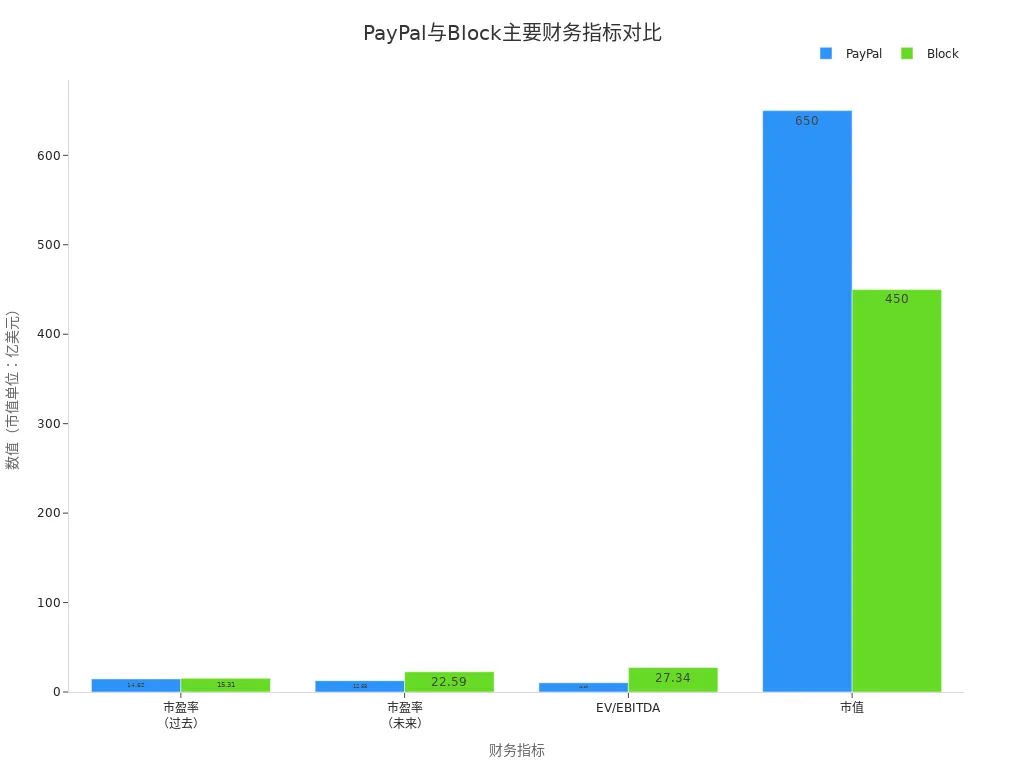
You can quickly compare the investment characteristics of the two companies during the major tournament through the table below:
| Characteristic | PayPal | Block |
|---|---|---|
| Investment Type | Stable and conservative investment | High growth potential but high volatility |
| P/E Ratio | 14.62 (trailing) and 12.68 (forward) | 15.31 (trailing) and 22.59 (forward) |
| Revenue Growth | Consistent revenue growth and expanding margins | Dependent on Bitcoin and Cash App performance |
| Risk | Suitable for risk-averse investors | High risk, influenced by macroeconomic and regulatory factors |
If you prefer steady returns, you can choose PayPal. If you pursue high growth, you can focus on Block. You should continue to monitor industry innovation and regulatory changes and flexibly adjust investment strategies.
FAQ
What Are the Main Differences Between PayPal and Block?
You can see that PayPal focuses on globalization and stable profitability, while Block emphasizes innovation and ecosystem development. PayPal is suitable for conservative investors, while Block is suitable for growth-oriented investors.
How Do Payment Processing Companies Benefit During the Major Tournament?
You will find that transaction volumes surge during the major tournament. Payment processing companies improve market share through technological upgrades and product innovation, bringing more investment opportunities.
What Are the Advantages of Biyapay for Chinese-Speaking Users?
You can experience that Biyapay provides multi-currency settlement and localized services to meet cross-border payment needs of Chinese-speaking users, improving transaction efficiency and user experience.
What Risks Should Be Noted When Investing in PayPal and Block?
You need to pay attention to competitive pressure, profitability fluctuations, and cryptocurrency market risks. Timely monitor company financial reports and industry dynamics, and adjust investment strategies rationally.
How to Choose the Right Payment Processing Company Stock for Yourself?
You can choose based on risk tolerance and investment objectives. Conservative investors are suitable for PayPal, while growth-oriented investors can focus on Block. Diversification helps reduce risk.
*This article is provided for general information purposes and does not constitute legal, tax or other professional advice from BiyaPay or its subsidiaries and its affiliates, and it is not intended as a substitute for obtaining advice from a financial advisor or any other professional.
We make no representations, warranties or warranties, express or implied, as to the accuracy, completeness or timeliness of the contents of this publication.
Related Blogs of

Shanghai Fudan vs Micron: How Are Non-Volatile Memory and the Global DRAM/HBM Leader Different?


SanDisk SNDK vs Pure Storage PSTG: The Investment Logic Difference Between Flash Chips and All-Flash Systems


Seagate STX vs NetApp NTAP: Hardware Cash Flow vs Enterprise Storage Softwareization


Micron MU vs Pure Storage PSTG: Which Is More Stable, a Memory Cycle Stock or an Enterprise Storage Subscription Model?

Choose Country or Region to Read Local Blog
 Australia
 Austria
 Belgium
 Canada
 Cyprus
 Czech Republic
 Denmark
 Estonia
 Finland
 France
 Germany
 Greece
 Hong Kong
 India
India Indonesia
 Ireland
 Italy
Italy Japan
Japan Latvia
 Lithuania
 Luxembourg
 Malaysia
 Malta
Malta Morocco
 Nepal
Nepal Netherlands
 New Zealand
 Norway
 Pakistan
 Philippines
 Poland
 Portugal
 Romania
 Singapore
 Slovakia
 Slovenia
 South Africa
 South Korea
 Spain
Spain Sweden
 Thailand
 The United States
 Turkey
 United Arab Emirates
 United Kingdom
 Vietnam
Contact Us




BIYA GLOBAL LLC is registered with the Financial Crimes Enforcement Network (FinCEN), an agency under the U.S. Department of the Treasury, as a Money Services Business (MSB), with registration number 31000218637349, and regulated by the Financial Crimes Enforcement Network (FinCEN).
BIYA GLOBAL LIMITED is a registered Financial Service Provider (FSP) in New Zealand, with registration number FSP1007221, and is also a registered member of the Financial Services Complaints Limited (FSCL), an independent dispute resolution scheme in New Zealand.