2026 World Cup Broadcast Rights Battle: Which US Stock Media Giant Is Most Worth Buying Now?





Image Source: pexels
Wall Street analysts currently favor Fox Corporation the most, primarily because it possesses strong content distribution capabilities and a mature streaming ecosystem in the World Cup broadcast rights battle. U.S. soccer popularity has risen 48%, with North American hosting driving audience expansion. Viewers are dispersed across multiple platforms, with 43% planning to watch via streaming and 87% preferring free ad-supported services. Competition among brands and platforms is intensifying, and investors continue to monitor broadcast rights strategies and user growth. The following comparison will reveal each giant’s core competitiveness and investment logic.
If you plan to track World Cup-related beneficiaries, the preparation is not only about reading reports, but also about organizing how you monitor and act on the names. Tools like BiyaPay, positioned as a multi-asset trading wallet, can work as a practical entry point here: you can first use its stock information page to compare names such as FOXA, DIS, and NFLX in one place before deciding whether a catalyst-driven position makes sense. For investors watching the sector ahead of the event, that kind of integrated workflow is often more practical than switching between multiple apps.
Key Takeaways
- Fox Corporation demonstrates strong content distribution capabilities in the World Cup broadcast rights battle, making it suitable for investor attention.
- Streaming viewership trends are rising, with 43% of viewers planning to watch events via streaming; media companies need to optimize content strategies.
- Advertising revenue is set for significant growth, with the 2026 World Cup expected to generate $2.2 billion in market revenue—investors should seize the opportunity.
- Major media companies vary in content ecosystem and user growth performance; investors need to focus on each one’s core competitiveness.
- The pre-event period and the two quarters before kickoff are the best investment windows—investors are advised to build positions early and capture peak ad spending.
World Cup Broadcast Rights Battle: US Stock Media Giants Comparison

Image Source: unsplash
Main Competitors
In the 2026 World Cup broadcast rights battle, US stock media giants are ramping up investments to seize market dominance. The main competitors include:
- NBCUniversal’s Telemundo has secured the exclusive Spanish-language broadcast rights for the 2026 World Cup. The company’s ad spending has doubled compared to 2022, indicating strong market demand. Telemundo has reached historic sponsorship agreements with major brands like Coca-Cola and McDonald’s, strengthening its commercial ecosystem.
- Fox Corporation possesses a mature content distribution capability and streaming ecosystem, covering a wide audience. Its strategy focuses on multi-platform simultaneous broadcasting to enhance user stickiness.
- Apple is actively pursuing exclusive live sports rights, relying on exclusive MLB and MLS content to create differentiated experiences.
- ESPN+ has built a diverse content ecosystem through broad sports rights coverage, including UFC, NHL, MLS, and more.
- Other streaming platforms continue to innovate viewing experiences, offering diverse sports live streams and exclusive content.
Broadcast Rights Layout
Each company’s layout in the World Cup broadcast rights battle features distinct characteristics, with content ecosystems and market performance creating clear contrasts. The table below shows the main competitors’ content strategies and features:
| Media Competitor | Main Strategy | Featured Content |
|---|---|---|
| Apple | Pursuing exclusive live rights | Exclusive MLB and MLS broadcasts |
| ESPN+ | Extensive sports rights layout | UFC, NHL, MLS live broadcasts |
| Fox | Multi-platform simultaneous broadcast | Comprehensive sports event coverage |
| Telemundo | Exclusive Spanish-language rights | World Cup events, brand sponsorships |
| Other streaming | Innovative viewing experiences | Diverse sports live content |
Fox Corporation excels in content distribution and streaming ecosystem, capable of meeting varied user needs. Telemundo attracts a large Spanish-speaking audience through exclusive language rights and strong ad resources. Apple and ESPN+ enhance platform competitiveness via exclusive and diversified sports rights. Each giant continuously optimizes strategies in the World Cup broadcast rights battle, vying for users and advertising market share.
Recommended Company In-Depth Analysis
Image Source: pexels
Broadcast Rights and Content Ecosystem
Fox Corporation demonstrates strong content ecosystem advantages in the 2026 World Cup broadcast rights battle. The company covers traditional TV, streaming, and mobile via multi-platform simultaneous broadcasting strategies, meeting needs across different age groups and viewing habits. The 2026 World Cup is expected to generate at least $2.2 billion in market and commercial rights revenue, up 23% from the Qatar World Cup. FIFA innovatively added three minutes of hydration time per match, creating 312 minutes of extra ad inventory for broadcasters and further boosting content monetization. Fox Corporation actively partners with MLS, leveraging tens of millions in marketing budgets to drive rising soccer popularity in North America. The company deeply analyzes audience insights, optimizing content distribution for Chinese-speaking users and multicultural groups while avoiding overly polished or generic marketing. With AI tools in use, Fox Corporation continuously enhances content authenticity, attracting increasingly skeptical viewers and boosting user stickiness.
Profit Model and Potential
Fox Corporation’s profit model centers on advertising revenue and subscription services. Ad-supported streaming platforms have become the primary driver for sports event investments. The company leverages high ad inventory from the World Cup broadcast rights battle to raise ad unit prices and brand exposure. Streaming platforms are increasing investments in live sports, with media companies projected to spend about $33 billion on national sports rights by 2025. Sports content drives user growth, with major events like the Super Bowl and Olympics attracting large numbers of new users. Fox Corporation collaborates with leagues to divide media rights into multiple independent packages, attracting more bidders and increasing content diversity. The company explores new distribution models blending traditional and streaming platforms to expand revenue channels. Taking Biyapay as an example, Fox Corporation offers users convenient cross-border payment experiences in payment scenarios, supporting real-time consumption during events and meeting diverse needs of Chinese-speaking users and global audiences. The company continuously optimizes ad placement and user engagement to improve overall profitability.
Finance and Valuation
Fox Corporation maintains solid performance in finance and valuation. Through diversified content layout and efficient operations, the company continuously boosts revenue and profits. Taking Meta Platforms as an example, its current P/E ratio is 29.06, slightly below the industry average of 29.58, indicating reasonable valuation. Fox Corporation holds unique content ecosystem and ad resources in the 2026 World Cup broadcast rights battle, expected to drive significant revenue growth. The company strengthens financial stability by optimizing cost structures and improving operational efficiency. Advertising revenue and subscription services continue growing, pushing up market capitalization. The company’s leading position in sports broadcast rights and content distribution provides strong support for future valuation.
| Company Name | Current P/E Ratio | Industry Average P/E Ratio | Difference |
|---|---|---|---|
| Meta Platforms | 29.06 | 29.58 | -0.52 |
Management and Strategy
Fox Corporation’s management team has rich experience and excellent execution in sports media. Senior leadership actively promotes streaming investments in live sports events, ensuring a leading position in the 2026 World Cup broadcast rights battle. Sports content serves as the main driver of user growth; management successfully renews key media rights—including NFL and UEFA events—through league partnerships. The company leverages high ad revenue and user engagement to advance sports investments. Management continuously explores new distribution models for traditional and streaming platforms, improving content reach and user experience. CBS Sports Chairman McManus drives streaming industry growth by integrating NFL games, while ESPN’s Pitaro expands audiences using Disney resources and introduces innovative programming. Fox Corporation’s management ensures ongoing leadership in the sports media market through strategic foresight and execution, capitalizing on growth opportunities from the 2026 World Cup broadcast rights battle.
Comments on Other Competitors
Strengths and Weaknesses Comparison
The U.S. media industry faces intense competition in sports event broadcasting. Disney commands a market share of 28% through multiple sports rights including NFL, NBA, NCAA, WWE, NHL, and MLB. The company builds a diverse content ecosystem via platforms like ESPN+, attracting large numbers of sports fans. Apple continues expanding its sports live business, enhancing user experience with exclusive MLB and MLS content. Paramount Skydance and Warner Bros. Discovery focus on combining traditional TV with streaming, offering broad coverage but limited innovation. Netflix, despite its large market cap, remains in the early stages of sports live broadcasting and lacks core event rights. Companies differ in content distribution, ad resources, and user growth. Biyapay provides convenient experiences in cross-border payments, especially meeting diverse needs of Chinese-speaking users and global audiences during events, serving as a key supplement to the media ecosystem.
| Media Company | Market Share | Main Sports Rights |
|---|---|---|
| Disney | 28% | NFL, NBA, NCAA, WWE, NHL, MLB, etc. |
| Other companies | N/A | N/A |
Brief Investment Value Analysis
US stock media giants continuously refine strategies in the World Cup broadcast rights battle, competing for users and ad market share. Disney has a market cap of $181.4 billion with a 1.22% dividend yield, showing steady performance. Netflix reaches $418.7 billion in market cap with strong growth potential despite no dividends. Paramount Skydance and Warner Bros. Discovery have relatively lower market caps, with dividend yields of 1.70% and 0.00% respectively. Each company holds advantages in profit models, content ecosystems, and user growth. Fox Corporation offers stronger content monetization thanks to multi-platform broadcasting and ad resources. Biyapay boosts user engagement through innovative payment experiences, supporting media companies in expanding revenue channels. The table below compares investment value for major US stock media companies:
| Company Name | Current Price | Market Capitalization | Dividend Yield |
|---|---|---|---|
| Paramount Skydance | $11.74 | $13.0 billion | 1.70% |
| Walt Disney | $102.30 | $181.4 billion | 1.22% |
| Netflix | $99.19 | $418.7 billion | 0.00% |
| Warner Bros. Discovery | $27.99 | $69.4 billion | 0.00% |
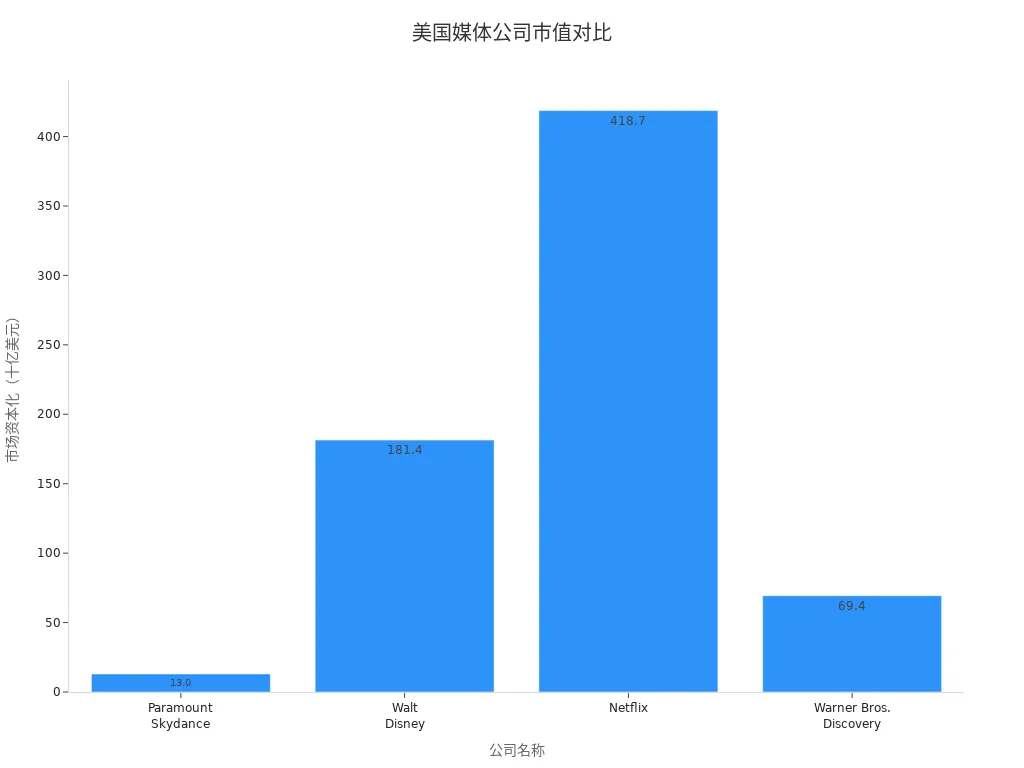
Each company continuously adjusts strategies in the World Cup broadcast rights battle, enhancing content ecosystems and user experiences. Investors should focus on core indicators like market share, profitability, and innovation, making rational decisions aligned with personal risk preferences.
Risks and Opportunities
Costs and Competition
U.S. media companies face significant cost pressures in the 2026 World Cup broadcast rights battle. Sports rights fees continue rising, requiring massive investments to secure exclusivity. Data shows U.S. sports rights spending grew from $14.64 billion in 2015 to $29.25 billion in 2025, a 105% increase, projected to reach $37 billion by 2030. Meanwhile, total TV industry revenue growth lags far behind, pushing sports rights spending as a proportion of total revenue from 8% to 14%. Advertisers must address challenges from diversified viewing platforms, quickly adjusting marketing strategies to improve ad effectiveness. Legal compliance issues may also affect media companies’ investment decisions.
| Year | Projected Payment Amount (billion USD) | Growth Rate |
|---|---|---|
| 2015 | 14.64 | - |
| 2025 | 29.25 | 105% |
| 2030 | 37.00 | - |
User Growth
During the 2026 World Cup, U.S. audience interest in soccer is expected to grow by 48%. Streaming and apps have become primary viewing channels, with 43% of users planning to watch via streaming platforms and 87% preferring free ad-supported services. Audience viewing habits are increasingly fragmented; media companies must continuously optimize content distribution, improve user experience, and maintain competitiveness. Shifts in user structure create new growth opportunities but demand stronger data analytics and content innovation.
| Statistic | Value |
|---|---|
| U.S. soccer interest growth | 48% |
| Proportion planning to watch via streaming/apps | 43% |
| Proportion planning to use free ad-supported streaming | 87% |
Industry Trends
The global sports media industry is undergoing profound transformation. The U.S. market shows strong demand for advanced sports broadcasting tech, driving increased investments. Digital transformation accelerates in Asia and Europe, with rising adoption of AR and VR. Latin America and the Middle East/Africa see growing digital content demand due to smartphone penetration and young populations. The 2026 World Cup will feature a massive yet dispersed audience scale; media companies need flexible ad strategies to adapt to fragmented habits. The industry shifts toward multi-platform, tech-driven, user-experience-focused models, with fiercer future competition.
| Region | Main Trend | Influencing Factors |
|---|---|---|
| United States | Increased advanced tech adoption | Sports culture, tech demand |
| Asia | Digital transformation and tech progress | Investment, innovation, social changes |
| Europe | AR/VR popularization | Sports culture, digital transformation |
| Latin America | Smartphone penetration, digital content demand | Young population, streaming demand |
| Middle East and Africa | Internet popularization, content demand growth | Young population, digital broadcast interest |
Investment Timing Recommendations
Valuation and Environment
The U.S. media industry enters a key investment window ahead of the 2026 World Cup broadcast rights battle. Current valuations are reasonable, with strong ad market expectations. IPG’s Magna unit forecasts global ad sales growth of 6.3% in 2026, with U.S. ad spending projected at $429 billion. U.S. co-hosting significantly boosts soccer awareness. ESPN analysts note the event will attract about 1.2 million international tourists to host cities, driving media companies’ ad revenue and user growth. The macro environment is favorable, with advertisers increasing spend and media companies optimizing content ecosystems. Investors can target companies like Fox Corporation with multi-platform broadcasting and streaming advantages, building early positions in sports content segments.
The current market environment provides a solid growth foundation for US stock media companies. Rising ad spending, evolving user structures, and content innovation have become core competitiveness factors. Investors should select companies with content distribution strengths and ad resources based on valuation and industry trends.
World Cup Milestone Layout
The 2026 World Cup milestones offer multiple opportunities for media companies. MLS is actively marketing, leveraging the event to attract more viewers. The league covers 24 major media markets across 30 teams in the U.S. and Canada. With tens of millions in marketing investment, MLS aims to maximize influence and direct benefits during the World Cup. Media companies can gradually build positions pre-event, tracking content ecosystem and ad inventory changes. Investors are recommended to increase allocations during preparation and the two quarters before kickoff, capturing peak ad spend and user growth dividends for higher returns.
- Investment timing recommendations:
- Event preparation stage (second half of 2025): Focus on ad spending and content innovation, build positions early.
- Two quarters before World Cup kickoff (first half of 2026): Ramp up investment to capture user growth and ad inventory peaks.
- During the event: Dynamically adjust holdings, monitor content distribution and user engagement.
Investors need to combine market environment, valuation levels, and event milestones to develop scientific position-building strategies and capture industry dividends from the World Cup broadcast rights battle.
Fox Corporation demonstrates multi-platform content distribution and streaming ecosystem advantages in the World Cup broadcast rights battle. The company creates significant revenue streams through collaboration with Stats Perform, boosting ad revenue and audience engagement. DAZN expands into new markets, with funded agreements showing strong commercial rationale. Investors should monitor market changes and personal risk preferences, scientifically allocating to sports media based on industry trends.
- Multi-platform simultaneous broadcasting increases user coverage
- Broadcast rights monetization drives ad revenue growth
- New market expansion brings potential returns
FAQ
Why are the 2026 World Cup broadcast rights crucial for US stock media companies?
Broadcast rights directly impact ad revenue, user growth, and brand influence. Companies boost market share and profitability through multi-platform distribution and content innovation.
What advantages does Fox Corporation have in the streaming ecosystem?
Fox Corporation integrates traditional TV with streaming to cover diverse audiences. The company optimizes content distribution strategies, improving user stickiness and ad monetization efficiency.
How do advertisers evaluate ROI for World Cup placements?
Advertisers focus on audience scale, platform coverage, and ad inventory. During the World Cup, ad unit prices rise, significantly increasing brand exposure opportunities.
What impact do changes in audience viewing habits have on media companies?
Viewers favor streaming and mobile, leading to fragmented consumption. Media companies need to adjust distribution strategies, enhance user experience, and strengthen data analytics capabilities.
Which core financial metrics should investors focus on?
Investors should monitor revenue growth, ad inventory, user activity, and market cap changes. Company profitability and content ecosystem maturity determine long-term investment value.
*This article is provided for general information purposes and does not constitute legal, tax or other professional advice from BiyaPay or its subsidiaries and its affiliates, and it is not intended as a substitute for obtaining advice from a financial advisor or any other professional.
We make no representations, warranties or warranties, express or implied, as to the accuracy, completeness or timeliness of the contents of this publication.
Related Blogs of

AI Storage Supply Chain Map: Chips, HDDs, SSDs, Packaging Equipment, and Enterprise Storage Systems


What Is the Difference Between HBM3E and HBM4? What Do They Mean for Micron and AI Servers?


Why Is HDD Supply and Demand Tightening? AI Data Centers, Long-Term Agreements, and Western Digital/Seagate Pricing Power


What Is the Relationship Between ASMPT 0522.HK and HBM? The Role of Advanced Packaging Equipment in the AI Memory Supply Chain

Choose Country or Region to Read Local Blog
 Australia
 Austria
 Belgium
 Canada
 Cyprus
 Czech Republic
 Denmark
 Estonia
 Finland
 France
 Germany
 Greece
 Hong Kong
 India
India Indonesia
 Ireland
 Italy
Italy Japan
Japan Latvia
 Lithuania
 Luxembourg
 Malaysia
 Malta
Malta Morocco
 Nepal
Nepal Netherlands
 New Zealand
 Norway
 Pakistan
 Philippines
 Poland
 Portugal
 Romania
 Singapore
 Slovakia
 Slovenia
 South Africa
 South Korea
 Spain
Spain Sweden
 Thailand
 The United States
 Turkey
 United Arab Emirates
 United Kingdom
 Vietnam
Contact Us




BIYA GLOBAL LLC is registered with the Financial Crimes Enforcement Network (FinCEN), an agency under the U.S. Department of the Treasury, as a Money Services Business (MSB), with registration number 31000218637349, and regulated by the Financial Crimes Enforcement Network (FinCEN).
BIYA GLOBAL LIMITED is a registered Financial Service Provider (FSP) in New Zealand, with registration number FSP1007221, and is also a registered member of the Financial Services Complaints Limited (FSCL), an independent dispute resolution scheme in New Zealand.