Market Futures Explained A Simple Guide for Beginners





Image Source: unsplash
You can think of a futures contract like pre-ordering a video game. You agree on a price for the futures contract today. This sets a future price for an asset. For most people doing futures trading, the goal is not to get the item. Your goal in trading this futures contract is to profit from a price change. This futures contract, like other futures contracts, has a changing price. Your trading of this futures contract in the markets depends on its price movement. This example shows how a futures contract works. We can see a futures contract through market futures live data. The futures contract is a key tool in futures trading. This futures contract is central to all futures. These futures contracts define futures markets.
Key Takeaways
- A futures contract is like a pre-order for an asset. You agree on a price today for a future date. Traders aim to profit from price changes.
- You can buy a futures contract if you think the price will go up. You can sell a futures contract if you think the price will go down. This lets you make money in different market conditions.
- Futures trading uses ‘leverage.’ This means a small amount of money controls a large contract. Leverage can make profits bigger, but it also makes losses bigger.
- People trade futures for two main reasons. They either guess future prices to make money (speculation). Or, they use futures to protect against price changes (hedging).
- Always practice trading with fake money first. This is called paper trading. It helps you learn without risking your real money.
How Futures Trading Works
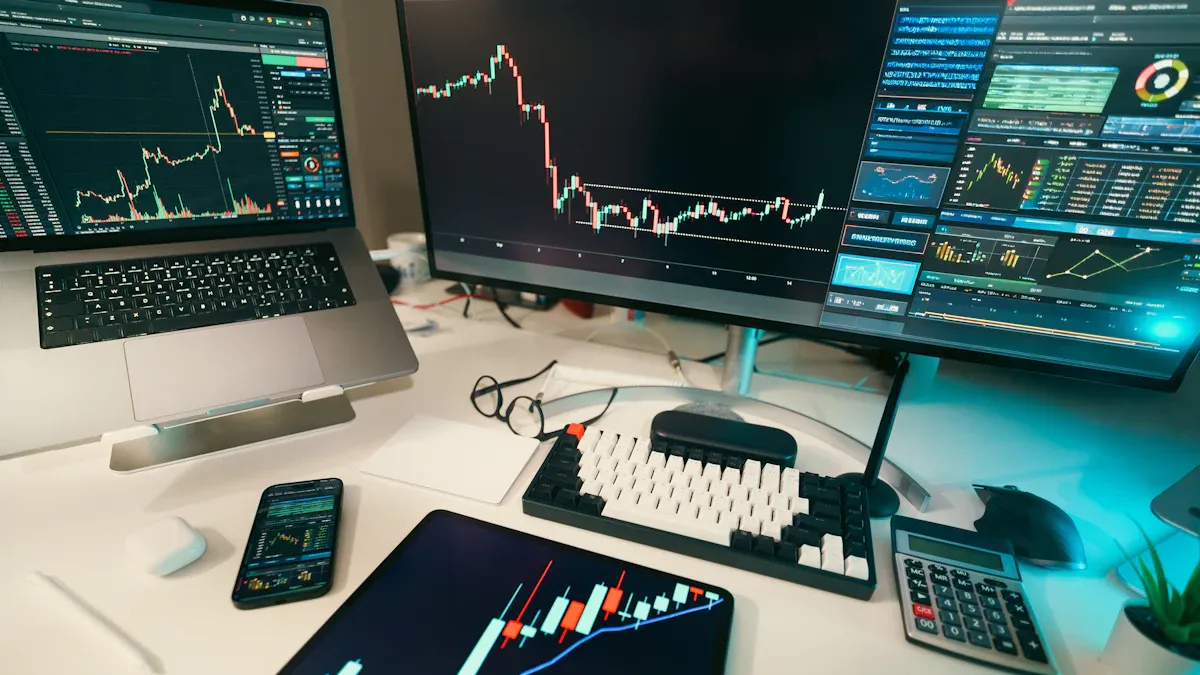
Image Source: pexels
Understanding the definition of a futures contract is the first step. Now, you need to learn the mechanics of how futures trading actually works. You can participate in the markets by taking one of two sides on any futures contract. Your choice determines how you can profit from a change in its price.
Buying Long vs Selling Short
In futures trading, you can make money when the market goes up or when it goes down. This depends on the type of position you open.
- Buying (Going Long): You go “long” when you buy a futures contract. You do this with the expectation that the asset’s price will increase before the contract expires. If the price rises, the value of your position increases, and you can sell the contract for a profit. Your profit comes from the price increase.
- Selling (Going Short): You go “short” when you sell a futures contract. This is also known as selling futures. You do this when you believe the asset’s price will fall. If the price decreases, you can buy back the same contract at a lower price to close your position, locking in a profit. Your profit comes from the price decrease.
Every trade has a buyer and a seller. For every long position, there is a corresponding short position. The clearing house, a neutral third party, guarantees every transaction, ensuring the integrity of the markets. It acts as the buyer to every seller and the seller to every buyer, which makes futures trading a secure process.
Example of a Futures Trade
Let’s walk through a simple futures trading example to see how this works in practice. This example will use one of the most popular futures contracts in the world: the E-mini S&P 500, which trades under the symbol /ES. This futures contract tracks the performance of the 500 largest U.S. stocks.
Here are the key specifications for this futures contract:
| Specification | Detail |
|---|---|
| Exchange, Symbol | Chicago Mercantile Exchange, /ES |
| Multiplier | 50 |
| Minimum Tick Size | 0.25 = $12.50 |
| Settlement | Cash |
| Trading Hours | Sunday 6 pm - Friday 5 pm ET (5 pm - 4 pm CT) with a daily maintenance period from 5 pm - 6 pm ET (4 pm - 5 pm CT) |
This is a cash-settled futures contract. This means you do not have to worry about delivering or receiving any physical asset. At settlement, only the net cash difference is exchanged, which makes these contracts convenient for traders focused on price movements.
When you study an index-futures example like /ES, it’s practical to keep two checks side by side: what’s happening in the underlying market and what it costs to fund and maintain the position. You can use BiyaPay’s Stock Info to quickly review related market details, then pair it with the free FX Converter & Comparison to estimate conversion costs around margin, top-ups, or funding flows—so you’re not focusing on points alone while ignoring the cash side.
If you prefer a single place to monitor and switch contexts across markets, BiyaPay is positioned as a multi-asset trading wallet spanning cross-border payments, investing, trading, and treasury workflows, with a unified trading entry. For compliance and trust checks, disclosures are available on the BiyaPay website, including registrations in jurisdictions such as the U.S. (MSB) and New Zealand (FSP).
The Trade Example:
Imagine you are watching the market futures live data. You believe the S&P 500 index is going to rise. You decide to buy one /ES futures contract at a price of 4,500.00.
- Opening the Position: You enter a long position by buying 1 /ES contract at 4,500.00.
- The Market Moves: Your analysis was correct. The price of the /ES contract increases to 4,510.00.
- Closing the Position: You decide to take your profit. You sell your contract at the new, higher price of 4,510.00.
Calculating the Profit:
- Price Change: 4,510.00 (exit price) - 4,500.00 (entry price) = 10.00 points.
- Profit Calculation: 10.00 points * $50 (the contract multiplier) = $500 profit.
This futures trading example shows how you can profit from a correct prediction of price movement. If the price had fallen instead, you would have incurred a loss. This is a fundamental concept when you trade futures.
Leverage, Margin, and Market Futures Live
You might be wondering how you can control a large contract with a small amount of money. The answer lies in two powerful concepts: margin and leverage. Understanding them is critical before you trade futures.
Margin: The Good Faith Deposit
Margin is not a down payment. You should think of it as a “good faith deposit” required to open and maintain a futures position. The exchange sets this amount, which is typically 3% to 12% of the contract’s total value. For an E-mini S&P 500 futures contract, the initial margin might be around $5,500. This deposit gives you control over a contract worth much more (e.g., at a price of 4,500.00, the /ES contract has a notional value of 4,500 * $50 = $225,000).
Important Note on Margin Calls If the market moves against your position and your account balance falls below the “maintenance margin” level, your broker will issue a margin call. This is a demand for you to deposit more funds to bring your account back to the initial margin level. If you fail to do so, your broker may liquidate your position at a loss to cover the deficit. Watching market futures live data helps you monitor your equity and avoid this scenario.
Leverage: The Double-Edged Sword
Leverage is what allows you to control a large contract value with a small margin deposit. It provides greater capital efficiency and amplifies your exposure to the markets. In our example, you controlled a $225,000 position with just $5,500 in margin. This is why a small price move resulted in a significant profit relative to your deposited capital.
However, leverage magnifies outcomes in both directions.
- Amplified Gains: A small, favorable price move can lead to large profits. This is the primary advantage when you trade with leverage.
- Amplified Losses: A small, adverse price move can lead to substantial losses, potentially exceeding your initial margin.
Using leverage in futures trading carries a high level of risk. Even small market movements can have a huge impact on your funds. This is why you must actively monitor market futures live prices for any open position. When you trade with leverage, disciplined risk management is not just a suggestion; it is a requirement for survival in the futures markets. The ability to trade futures successfully depends heavily on your understanding and respect for leverage. This example should clarify the risks.
Why People Trade Futures
Image Source: pexels
Now that you understand the mechanics, you might ask why people trade futures in the first place. Participants in the futures markets generally fall into two main categories, each with a distinct goal. You can either trade for profit through speculation or for risk management through hedging.
Speculation to Profit from Price Moves
You are speculating on futures when you trade with the sole goal of profiting from price changes. As a speculator, you have no intention of making or taking delivery of the physical commodity. Your entire trading strategy revolves around correctly predicting the direction of the market’s price.
To form these predictions, you might use technical analysis. This involves studying price charts and using indicators to forecast future price movements. Common tools include:
- Moving Averages: These help you identify the overall trend of a market.
- Relative Strength Index (RSI): This indicator helps you spot potentially overbought or oversold conditions in the markets.
Your goal is to buy a futures contract at a low price and sell it at a higher price, or sell a contract at a high price and buy it back at a lower price.
Some of the most famous names in finance built their reputations through bold futures trading. For instance, Paul Tudor Jones famously predicted and profited from the 1987 stock market crash, while George Soros is known for his massive bet against the British pound in 1992.
Hedging to Manage Price Risk
Hedging is the other primary reason people trade futures. Unlike speculation, the main goal of hedging is not to make a profit from trading but to manage price risk. Businesses and producers use a futures contract to lock in a future price for a commodity they plan to buy or sell. This hedging strategy protects them from unfavorable price swings.
Here are two classic examples of hedging:
- A Farmer: Imagine you are a corn farmer. In the spring, you can sell a corn futures contract to lock in a selling price for your crop at harvest. If the corn price falls by harvest time, the loss on your physical crop is offset by the gain on your futures contract. This hedging provides price certainty.
- An Airline: An airline knows it must buy millions of gallons of jet fuel in the future. To protect against a sudden fuel price increase, it can buy a crude oil futures contract. If the price of oil rises, the higher fuel cost is offset by the profit from its futures contract. This hedging helps stabilize operating costs.
In both scenarios, the hedger uses a futures contract to reduce uncertainty. This makes hedging a vital risk management tool in global markets. When you trade futures for this purpose, you prioritize stability over speculative profit.
What You Can Trade
The futures markets offer you a vast landscape of trading opportunities. You can trade derivative contracts on nearly every major asset class. This allows you to focus on markets you understand best. The price of these futures contracts is available on most trading platforms. Let’s explore the main categories of futures you can trade.
Stock Market Indices
You can trade the overall direction of the stock market without buying individual stocks. Stock market futures are derivative contracts that track the performance of a major index. This is one of the most popular areas for new traders. Some of the most active index futures contracts include:
- S&P 500 E-Mini (/ES)
- Nasdaq 100 E-Mini (/NQ)
- Dow Futures E-Mini (/YM)
These contracts allow you to speculate on the price movement of the entire market.
Trader’s Tip: For beginners, Micro E-mini futures are an excellent starting point. These contracts are 1/10th the size of standard E-mini contracts. This means they require significantly less capital and margin, making them more accessible while you learn to navigate the markets.
Commodities
Commodities are the original assets traded with futures contracts. You can trade a wide range of raw materials, which are typically grouped into three main categories.
- Energy: You can trade futures on products like Crude Oil (WTI), Natural Gas, and Gasoline. These markets are sensitive to global supply, demand, and geopolitical events.
- Metals: You can trade precious metals like Gold (/GC) and Silver (/SI) or industrial metals like Copper (/HG).
- Agriculture: You can also trade futures on agricultural products, including Corn (/ZC), Soybeans (/ZS), and Wheat (/ZW).
Each commodity contract has its own unique characteristics and price drivers.
Common Types of Futures
Beyond stocks and commodities, the futures markets include other important asset classes. These contracts provide you with even more ways to participate in global finance.
- Currency Futures: You can speculate on the exchange rate between two currencies. The Euro FX contract (6E) is one of the most traded currency futures in the world. Other popular contracts include the British Pound (6B) and Japanese Yen (6J).
- Interest Rate Futures: You can trade contracts based on changes in interest rates. For example, Eurodollar futures are used to hedge against fluctuations in short-term U.S. interest rates. These futures are essential tools for large financial institutions.
This variety of futures gives you the flexibility to trade across many different markets.
You now know a futures contract is a standardized agreement where you can take a long or short position. People use a futures contract for speculation or hedging in the futures markets. Leverage magnifies every trading position, making futures trading a high-risk activity.
Your Next Step: Practice, Don’t Pay Your next position in the futures markets should be in paper trading. This simulated trading lets you test your position on any futures contract. You can practice with a futures contract risk-free. This trading helps you understand every futures contract. This futures trading position is your start. Your trading position on a futures contract is important. Your trading position on a futures contract is your future. Your trading position on a futures contract is key. Your trading position on a futures contract is vital. Your trading position on a futures contract is your path. Understanding futures and each futures contract helps you navigate the markets with more confidence.
FAQ
What is the minimum investment for futures?
You do not pay the full value of a futures contract. Instead, you post an initial margin, which is a small percentage of the contract’s total worth. This amount varies by contract. For example, Micro futures contracts require less capital than standard E-mini futures contracts.
Can I lose more than I invest in futures?
Yes, you can lose more than your initial margin. The leverage in futures trading magnifies losses just as it does gains. If the market moves sharply against your futures contract, your losses can exceed your deposit. This makes risk management for futures essential.
Warning ⚠️ Because of leverage, your potential loss on a futures contract is theoretically unlimited. You must understand this risk before trading any futures contract.
What happens if I hold a futures contract until expiration?
This depends on the contract. Many financial futures, like the /ES contract, are cash-settled. You do not handle a physical item. Your account is simply credited or debited the profit or loss from the futures contract. Other futures require physical delivery of the underlying asset.
Are all futures contracts the same?
No, every futures contract is unique. A crude oil contract has a different size, tick value, and expiration schedule than a corn contract. You must read the specifications for each futures contract before trading. Understanding the specific contract for the futures you trade is critical.
*This article is provided for general information purposes and does not constitute legal, tax or other professional advice from BiyaPay or its subsidiaries and its affiliates, and it is not intended as a substitute for obtaining advice from a financial advisor or any other professional.
We make no representations, warranties or warranties, express or implied, as to the accuracy, completeness or timeliness of the contents of this publication.
Related Blogs of

Pure Storage PSTG vs NetApp NTAP: Which Enterprise Storage Brand Has Greater AI Growth Elasticity?


HPE and AI Storage Infrastructure: Servers, Enterprise Storage, and Hybrid Cloud Positioning


NetApp NTAP Stock Analysis: Enterprise Storage, Cloud Data Management, and Cash Flow


SMIC 0981.HK vs Hua Hong Semiconductor 1347.HK: The Relationship Between Foundry Stocks and the Memory Supply Chain

Choose Country or Region to Read Local Blog
 Australia
 Austria
 Belgium
 Canada
 Cyprus
 Czech Republic
 Denmark
 Estonia
 Finland
 France
 Germany
 Greece
 Hong Kong
 India
India Indonesia
 Ireland
 Italy
Italy Japan
Japan Latvia
 Lithuania
 Luxembourg
 Malaysia
 Malta
Malta Morocco
 Nepal
Nepal Netherlands
 New Zealand
 Norway
 Pakistan
 Philippines
 Poland
 Portugal
 Romania
 Singapore
 Slovakia
 Slovenia
 South Africa
 South Korea
 Spain
Spain Sweden
 Thailand
 The United States
 Turkey
 United Arab Emirates
 United Kingdom
 Vietnam
Contact Us




BIYA GLOBAL LLC is registered with the Financial Crimes Enforcement Network (FinCEN), an agency under the U.S. Department of the Treasury, as a Money Services Business (MSB), with registration number 31000218637349, and regulated by the Financial Crimes Enforcement Network (FinCEN).
BIYA GLOBAL LIMITED is a registered Financial Service Provider (FSP) in New Zealand, with registration number FSP1007221, and is also a registered member of the Financial Services Complaints Limited (FSCL), an independent dispute resolution scheme in New Zealand.