How Long Can AI Concept Stocks Stay Hot? Liquidity and Capital Flow Analysis for the Second Half of 2026





Image Source: pexels
In the second half of 2026, the popularity of AI concept stocks faces multiple tests. Market data shows significant divergence within the sector, with some large technology companies experiencing slower performance, yet companies with AI efficiency enhancement capabilities, such as C.H. Robinson Worldwide, have seen their stock prices rise by nearly 20%. The uncertainty surrounding AGI realization affects the economic structure, and investors’ judgments on the sustainability of AI concept stocks heavily depend on the AGI timeline and market liquidity. Capital flows, policy easing, investor optimism, and earnings growth jointly drive the performance of AI-related stocks, while industry differentiation trends become increasingly evident.
Key Takeaways
- In the second half of 2026, AI concept stocks face dual tests from market liquidity and AGI realization expectations.
- Large technology companies continue to increase investment in AI infrastructure, driving stock performance for related enterprises.
- Investors should focus on companies’ performance drivers and industrial application capabilities to select high-quality AI concept stocks.
- Market style rotation is evident, and investors need to adjust asset allocation based on risk preferences, focusing on high-quality stocks.
- Bubble risks are rising, and investors should be wary of high valuations, avoid blindly chasing highs, and maintain rational investing.
Liquidity and Capital Flows

Image Source: pexels
Macro Environment and Policy
In 2026, the global macro environment remains accommodative with ample liquidity. The implementation of the U.S. tax cut bill has significantly increased corporate free cash flow, taxpayers receive refunds, companies can enjoy 100% bonus depreciation and immediate deduction of R&D expenses, and cash tax rates have declined. U.S. economic growth is expected to rise to 2.1%, while the Eurozone remains at 1.2%. The Federal Reserve cut rates by 25 basis points in December 2025, adjusting the target range to 3.50% to 3.75%, and the market generally expects another 1 to 2 rate cuts in 2026, providing solid liquidity support for the stock market.
Due to the Federal Reserve’s dovish stance and regulatory easing, investors continue to see increasing investment opportunities in AI and related fields, especially in the United States and emerging markets. AI serves as the main driver of global market growth, boosting the U.S. stock market—particularly large growth companies—while improving emerging market performance under favorable macroeconomic conditions and valuation support.
Changes in Capital Flows
In 2026, capital flows into AI concept stocks show structural divergence. Large technology companies continue to ramp up investment in AI infrastructure, with capital expenditure expected to increase from $280 billion in 2025 to $405 billion, a 31% growth (noting: more recent estimates suggest even higher figures approaching or exceeding $500–700 billion across hyperscalers). In the third quarter of 2026, capital expenditure grew 75% year-over-year, indicating strong demand for AI infrastructure.
Nevertheless, investor concerns about rising corporate debt levels are also intensifying. In 2025, capital expenditure accounted for 94% of operating cash flow, an 18-percentage-point increase from 2024, reflecting greater reliance on debt.
| Capital Flow Type | Specific Example | Capital Scale (USD) | Impact |
|---|---|---|---|
| Corporate Innovation Budget | Abridge 2025 Series E Financing | 300,000,000 | Promoting clinical documentation AI |
| Corporate Innovation Budget | Harvey Financing | 150,000,000 | Transforming law firm workflows |
| Corporate Innovation Budget | Parloa Financing | 120,000,000 | Expanding enterprise AI platform |
| M&A Activity | ServiceNow acquires Moveworks | 2,850,000,000 | Deep integration into IT service management |
| M&A Activity | Workday acquires Sana | 1,100,000,000 | Integrating AI tools into HR and finance cloud |
| Government Funding | CHIPS Act | 280,000,000,000 | Supporting semiconductor manufacturing and R&D |
| Government Funding | EU AI Factories Plan | N/A | Providing high-end computing resources |
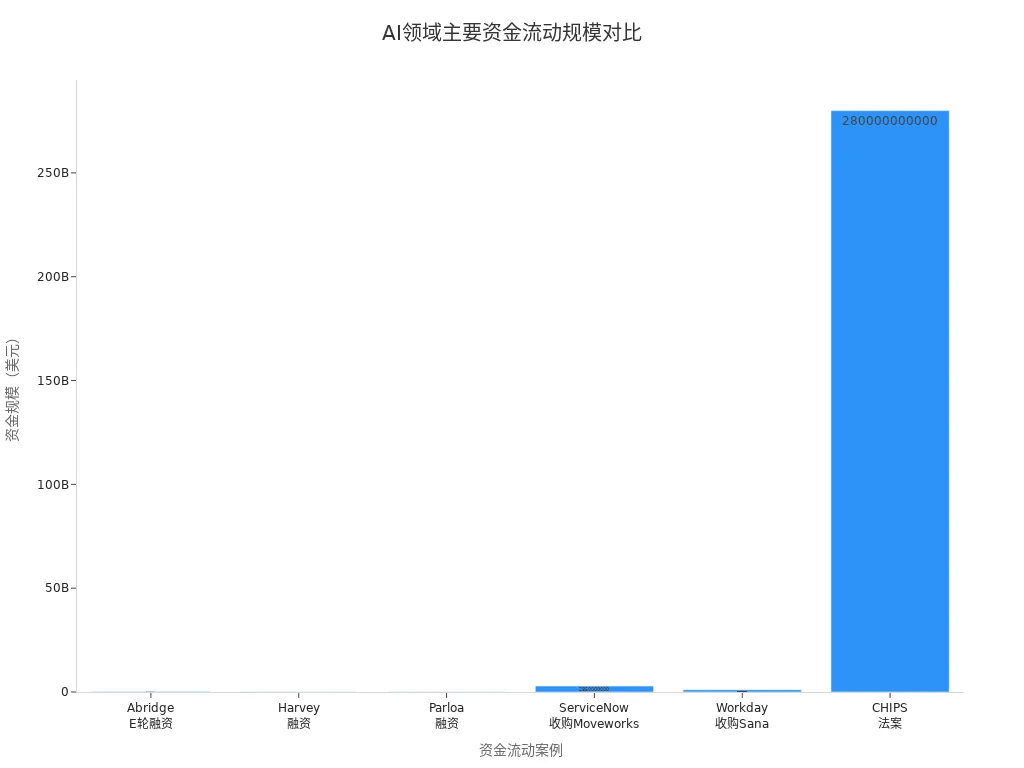
Main force capital is deeply positioned in the AI sector, with frequent corporate innovation budgets and M&A activity, and continued increases in government funding. Investor sentiment has shifted toward AI concept stocks, with capital flowing out of traditional tech stocks and into AI-related assets with growth momentum and valuation advantages. For needs such as global payments and collections, international remittances, and real-time digital currency exchange, BiyaPay provides convenient capital flow solutions for Chinese-speaking users, supporting deposits and withdrawals for U.S. stocks and Hong Kong stocks trading to meet the diverse needs of cross-border investors.
Overall, the capital side of AI concept stocks remains strong, but attention should be paid to the dynamic balance between capital expenditure and debt levels, and vigilance is needed for potential risks from liquidity tightening.
Divergence and Sustainability of AI Concept Stocks

Image Source: pexels
Leaders and Sub-Sectors
In 2026, divergence within the AI concept stock sector has become even more pronounced. Leading companies continue to make breakthroughs in technological innovation and industrial applications, driving the overall industry toward high-quality development.
- In the e-commerce field, AI-driven companies such as Amazon and Alibaba significantly enhance market competitiveness through deep application of AI technology to optimize operations and customer interactions.
- In the financial industry, banks that invested in AI early (such as Hong Kong licensed banks) achieve higher customer retention rates and lower operating costs in fraud detection and intelligent advisory services.
- Industry analysts expect that in the coming years, AI leaders will continue to evolve toward more advanced technologies such as multimodal AI and real-time personalization, further widening the gap with competitors.
- The semiconductor industry stands out particularly, with a growth rate of 22% in 2025 and an expected acceleration to 26% in 2026. High-value AI chips drive about half of total revenue, despite accounting for less than 0.2% of unit sales. Global semiconductor industry annual sales are expected to reach $975 billion, with AI infrastructure and data center demand serving as the main growth drivers.
- The United States, Japan, South Korea, China, Taiwan, and Europe contribute prominently to data center and infrastructure construction, but only a few companies gain significant value and valuation premiums, while most companies see moderate returns on investment without fundamental changes.
| Stock Type | Average Annual Return |
|---|---|
| High-Quality AI Stocks (A-rated) | 32.52% |
| Broader Market (Tech Stocks) | 4%-5% |
High-quality AI stocks significantly outperform the broader market, with expected annual returns of 32.52%, while tech stocks overall are only 4%-5%. This divergence reflects capital’s concentrated allocation to high-quality enterprises, as investors prefer leading companies with performance drivers and industrial implementation capabilities.
Bubbles and Style Rotation
Investor expectations for AGI realization have fueled a speculative environment for AI concept stocks, leading to inflated market valuations.
Technological progress is seen as incremental rather than revolutionary, prompting investors to reassess holdings. Companies face real obstacles in adopting AI, including lower-than-expected returns on investment, cultural resistance, and regulatory delays. Recent model progress represents only modest improvements, failing to meet AGI expectations, and the gap between reality and expectations may trigger price corrections.
In 2025, AI stocks significantly outperformed the S&P index, but most returns were concentrated in a few stocks. International stocks outperformed U.S. stocks for the first time, rising approximately 27% and 16% respectively. Consumer spending remained strong, with hiring and layoffs unusually calm. Market growth may have been pulled forward in 2025, leading to more moderate returns in 2026.
Investors are shifting from AI-dominant tech stocks to traditional industries, signaling a change in investor sentiment and strategy.
The S&P 500 stagnated, while the Dow Jones Industrial Average rose 3%, as investors rotated from tech-heavy indices to sectors with less AI exposure. Software stocks fell out of favor due to concerns over AI disruption, and traditional economic sectors regained attention, especially infrastructure.
Investors exhibit a mix of caution and optimism toward AI concept stocks, with particular attention to bubble risks and market style changes. The top 10 stocks in the S&P 500 account for about 40% of the index, hitting a historic high in market concentration, leaving some investors uneasy. Compared to the internet bubble, current AI giants have lower debt-to-earnings ratios, and companies such as Nvidia and Meta report strong profit growth. Discussions about potential stock bubbles gradually increased in 2025, with investor attention to the AI bubble rising significantly.
Performance Drivers and Industrial Implementation
Performance drivers have become the core logic for the sustained performance of AI concept stocks. Nvidia is expected to report quarterly revenue of $65.55 billion, and Goldman Sachs predicts it will exceed expectations by nearly $2 billion. Nvidia continues to surpass performance expectations amid surging demand, with CFO Colette Kress stating that demand continues to increase and AI product revenue is expected to exceed the early forecast of $500 billion by the end of 2026. Cloud companies providing Nvidia chips also report surging demand, prompting increased infrastructure investment.
The industrial AI community is evolving toward more practical layered understanding, emphasizing assistants that deliver value across multiple manufacturing facilities. Industrial AI focuses not only on analytics and generation capabilities but more on the practical challenges of deployment, management, and scaling. The integration of AI with infrastructure workflows—especially in DataOps, MLOps, and DevOps—has become a key driver for accelerating value realization.
Investment logic is gradually shifting toward precise diversification; traditional 60/40 portfolios are no longer reliable, and investors seek new diversification strategies. Many investors view alternative investments as strategically necessary to enhance portfolio resilience. Global equity returns remain strong with undiminished market vitality, but investors focus more on performance drivers and industrial implementation, making high-quality AI concept stocks the focus of capital pursuit.
For scenarios such as global payments and collections, international remittances, and real-time digital currency exchange, BiyaPay provides convenient capital flow solutions for Chinese-speaking users, supporting deposits and withdrawals for U.S. stocks and Hong Kong stocks trading to meet the diverse needs of cross-border investors. As AI industrial applications land, demand for related fintech services continues to grow, driving improvements in capital flow efficiency.
Investment Strategy Recommendations
Style Rotation and Asset Allocation
In 2026, market style rotation has become a core focus for investors. The bull market has lasted four years, with increased short-term volatility and capital flows dominating sector performance. Investors generally remain optimistic about stocks, with stock overweights reaching 28%, a 15-year high. High stock allocations may bring volatility, and investors need to adjust asset structures based on their own risk preferences.When sector rotation speeds up, outcomes depend not only on market views, but also on whether research, stock tracking, and reallocation can be handled in one workflow. In that context, it helps to start with stock information lookup to follow valuation changes and unusual moves in AI-related names, then use the trading portal only when the position plan is clear.
For cross-market investors, that kind of execution continuity often matters more than simply chasing hot themes. BiyaPay functions as a multi-asset wallet covering cross-border payments, investing, trading, and fund management scenarios, and it holds relevant compliance registrations in jurisdictions including the United States and New Zealand, making it more suitable as a fund-routing and execution-support tool.
- Aggressive investors tend to allocate to multiple AI-related stocks in pursuit of high growth.
- Cautious investors are better suited to select one or two high-quality AI concept stocks with safety margins.
- Long-term portfolios help capture structural technological change dividends; it is recommended to focus on AI-driven productivity improvements and margin enhancements.
- When allocating capital, cross-border investors can use BiyaPay to achieve global payments and collections, international remittances, and real-time digital currency exchange, meeting deposit and withdrawal needs for U.S. stocks and Hong Kong stocks trading and improving capital flow efficiency.
High-Quality Stock Selection Logic
Screening high-quality AI concept stocks requires focusing on companies’ performance in AI infrastructure, revenue visibility, and cash flow.
- Companies such as Nvidia, AMD, and TSMC possess core competitiveness in AI infrastructure construction, driving global IT spending to exceed $6 trillion.
- Micron Technology is expected to see significant revenue growth due to rising AI inference demand.
- Alphabet expands AI applications backed by stable advertising revenue, while Broadcom achieves 65% annual revenue growth in large-scale AI systems.
- Investors should prioritize companies with strong financial strength, trust and distribution advantages, irreplaceable data resources, and buy them at reasonable prices.
- Pay attention to revenue visibility brought by innovative products such as the Blackwell platform and Vera Rubin system; high-quality companies can continue investing and achieve growth.
| Selection Criteria | Representative Companies | Key Metrics |
|---|---|---|
| AI Infrastructure Capability | Nvidia, AMD, TSMC | Technological leadership, market share |
| Revenue Visibility | Nvidia, Alphabet | Future revenue forecasts |
| Stable Cash Flow | Alphabet | Advertising business, expansion capability |
| Data Resource Advantage | Broadcom | Annual revenue growth |
Risk Prevention and Dynamic Adjustment
AI concept stocks face risks such as economic pressure, labor disruptions, and high valuations. Investors need to dynamically adjust strategies and strengthen defensive allocations.
- Long-short stock allocations and hedging strategies can mitigate risks from market volatility.
- Dynamically monitor inflation trends, AI industry correlations, and hedging effectiveness, and adjust portfolios in a timely manner.
- J.P. Morgan predicts a 35% global economic recession risk; institutional investors recommend using buffered ETFs and structured products (such as CPSL) for downside protection while maintaining equity exposure to AI-driven capital expenditures.
- Investors should focus on profitability and investment quality, take profits in small-cap stocks when appropriate, and expand investments in specific industry AI adopters.
- Market sentiment and volatility affect capital flows; it is recommended to continuously monitor industry dynamics and flexibly adjust asset allocation.
In global capital flow and cross-border transaction scenarios, investors can achieve efficient capital management through BiyaPay, supporting U.S. stocks and Hong Kong stocks trading deposits/withdrawals and real-time digital currency exchange to meet diversified asset allocation needs.
Market analysts generally believe that AI concept stocks in the second half of 2026 have strong sustainability, with demand trends remaining robust. AGI expectations, market liquidity, sector divergence, and performance drivers collectively influence sector performance. Companies such as Tesla demonstrate differentiated advantages by focusing on embodied intelligence and physical robotics. Investors need to monitor changes in capital availability, easing of supply constraints, and capacity allocation adjustments, maintain rational investing, dynamically optimize strategies, closely track market changes, and prioritize long-term fundamentals and sustainable paths.
FAQ
What are the main drivers of AI concept stocks in the second half of 2026?
Market liquidity, AGI realization expectations, policy support, earnings growth, and capital differentiation jointly drive AI concept stock performance. Rate cuts in the U.S. market and increased corporate capital expenditure provide strong support for the sector.
With increasing divergence in the AI sector, how should investors select high-quality targets?
Investors should focus on companies’ core competitiveness in AI infrastructure, revenue visibility, cash flow, and data resources. Prioritize leading companies with performance drivers and industrial implementation capabilities.
Do current AI concept stocks carry bubble risks?
Some AI concept stocks have elevated valuations, and market concentration has increased, so bubble risks require vigilance. Investors should focus on earnings realization and industrial application landing, avoiding blindly chasing highs.
What impact do changes in capital flows have on AI concept stocks?
Main force capital continues to flow into AI infrastructure and innovative application areas, driving valuation increases for related companies. Rising corporate debt levels require attention to the dynamic balance between capital expenditure and cash flow.
How to manage risks when investing in AI concept stocks?
Investors can adopt long-short allocations, hedging strategies, and dynamic asset structure adjustments. It is recommended to continuously monitor industry dynamics and market sentiment, prioritizing companies with stable performance and solid fundamentals.
*This article is provided for general information purposes and does not constitute legal, tax or other professional advice from BiyaPay or its subsidiaries and its affiliates, and it is not intended as a substitute for obtaining advice from a financial advisor or any other professional.
We make no representations, warranties or warranties, express or implied, as to the accuracy, completeness or timeliness of the contents of this publication.
Related Blogs of

How Do AI Servers Drive Storage Demand? The Roles of HBM, Server DRAM, Enterprise SSDs, and HDDs


AI Storage Supply Chain Map: Chips, HDDs, SSDs, Packaging Equipment, and Enterprise Storage Systems


Why Is HDD Supply and Demand Tightening? AI Data Centers, Long-Term Agreements, and Western Digital/Seagate Pricing Power


Why Does AI Compute Growth Drive Storage Demand? The Difference Between Training, Inference, and Data Retention

Choose Country or Region to Read Local Blog
 Australia
 Austria
 Belgium
 Canada
 Cyprus
 Czech Republic
 Denmark
 Estonia
 Finland
 France
 Germany
 Greece
 Hong Kong
 India
India Indonesia
 Ireland
 Italy
Italy Japan
Japan Latvia
 Lithuania
 Luxembourg
 Malaysia
 Malta
Malta Morocco
 Nepal
Nepal Netherlands
 New Zealand
 Norway
 Pakistan
 Philippines
 Poland
 Portugal
 Romania
 Singapore
 Slovakia
 Slovenia
 South Africa
 South Korea
 Spain
Spain Sweden
 Thailand
 The United States
 Turkey
 United Arab Emirates
 United Kingdom
 Vietnam
Contact Us




BIYA GLOBAL LLC is registered with the Financial Crimes Enforcement Network (FinCEN), an agency under the U.S. Department of the Treasury, as a Money Services Business (MSB), with registration number 31000218637349, and regulated by the Financial Crimes Enforcement Network (FinCEN).
BIYA GLOBAL LIMITED is a registered Financial Service Provider (FSP) in New Zealand, with registration number FSP1007221, and is also a registered member of the Financial Services Complaints Limited (FSCL), an independent dispute resolution scheme in New Zealand.