AI Applications in Sports Events: Investing in US SaaS Companies Providing Data Analysis for the World Cup





Image Source: unsplash
US SaaS companies are driving the transformation of AI applications in sports events. Companies such as Palantir, Snowflake, Sportradar, and Hudl provide data analysis, video parsing, and referee assistance for top-tier events like the World Cup. The 2026 World Cup will utilize Lenovo servers and edge facilities to support the Hawk-Eye Video Assistant Referee system. The tournament will implement 3D player avatar scanning, AI referee perspectives, and hyper-personalized fan experiences. Investors need to closely monitor the market opportunities brought by these technological innovations.
If you also care about the link between research and execution, it helps to evaluate market information and funding preparation within the same workflow. A service like the BiyaPay website, positioned as a multi-asset wallet covering investing, trading, and fund management, can first be used through its stock information page to review relevant U.S. names, and then through its exchange rate converter to estimate conversion costs across currencies.
Used in this context, the tool works better as a supporting step before investment decisions rather than a substitute for research itself. BiyaPay also operates with relevant compliance registrations in jurisdictions including the United States and New Zealand, making it suitable for cross-border fund planning and multi-currency management when you want to assess sports-AI opportunities with trading access, funding routes, and execution cost in one framework.
Key Points
- US SaaS companies enhance data analysis capabilities in sports events through AI technology, helping teams make decisions quickly.
- AI significantly improves refereeing accuracy and efficiency in referee assistance and event operations, enhancing the spectator experience.
- Investors should focus on the technological innovation capabilities and data security management of US SaaS companies to seize market opportunities.
- AI technology drives personalized experiences in sports events, increasing fan engagement and loyalty.
- AI applications in future sports events will continue to expand; investors need to be cautious of policy changes and market competition risks.
AI Applications of US SaaS Companies in Sports Events

Image Source: pexels
Palantir’s Data Analysis Solutions
Palantir stands out in the field of AI applications for sports events. The company provides real-time data integration and dynamic ontology structures for major international events, enabling teams to make rapid decisions under high-pressure conditions. Taking F1 racing and the World Cup as examples, Palantir can integrate multi-source data in real time, supporting coaches and management in making instant adjustments based on match progress. Its dynamic ontology structure helps organize and streamline complex data, allowing teams to focus on key performance indicators and improve collaboration efficiency. The table below summarizes Palantir’s core technical advantages in sports events:
| Evidence Point | Description |
|---|---|
| Real-Time Data Integration | Provides real-time data consolidation, supports rapid decision-making, suitable for high-time-sensitivity events such as F1 and the World Cup. |
| Dynamic Ontology Structure | Optimizes data organization, highlights key performance factors, and promotes efficient team collaboration. |
| Data Potential Mining | Enables deep data utilization, supporting coaches and management in making more forward-looking tactical and operational decisions. |
Palantir’s business model is primarily B2B, emphasizing the importance of data-driven decision-making. Long-term contracts and high-margin SaaS business models bring stable revenue streams. The implementation of AI applications in sports events has driven the digital transformation of event management and tactical optimization.
Snowflake’s Data Infrastructure
Snowflake provides robust data infrastructure for sports events, supporting real-time analysis and large-scale data processing. Features such as micro-partitioning, Snowpipe real-time data ingestion, and multi-cluster architecture enable efficient, secure data flow and analysis during events. The table below highlights Snowflake’s key technologies in sports event data management:
| Feature | Description |
|---|---|
| Micro-Partitioning | Optimizes data access and compression, improving query efficiency. |
| Snowpipe | Enables near-real-time data ingestion, responding quickly to event dynamics. |
| Multi-Cluster Architecture | Supports elastic scaling of compute resources, meeting high-concurrency event data processing needs. |
| Hybrid Architecture | Compatible with various workloads, improving system elasticity and responsiveness. |
| Data Storage Layer | Provides secure, reliable, and elastic data storage, optimizing data compression and access. |
| Cloud Object Storage | Supports major cloud platforms such as AWS, Google Cloud, and Azure, ensuring global data availability. |
Snowflake has established partnerships with multiple sports organizations. For example, US bobsled athlete Kaysha Love uses Snowflake’s data management capabilities to improve track performance. Snowflake’s SaaS model emphasizes long-term contracts and high margins, supporting the sustainable development of AI applications in sports events.
Sportradar’s Sports Data AI
Sportradar specializes in sports data AI, serving teams, broadcasters, and betting markets. The company uses AI technologies such as real-time player tracking, data processing, and advanced visualization to provide actionable insights for events. Its AI system can track every player’s skeletal points, generating 3D animations and heat maps to help coaches and analysts deeply understand match dynamics. The table below summarizes Sportradar’s AI technology applications:
| AI Technology | Function Description |
|---|---|
| Real-Time Player Tracking | Tracks player skeletal points and analyzes individual performance in real time. |
| Data Processing | Integrates statistical and motion data to generate actionable insights. |
| Advanced Visualization | Provides 3D animations, heat maps, and performance metrics to enhance viewer experience. |
| 4Sight Streaming | Uses AI to generate animated overlays and instant statistics, improving event interpretation efficiency. |
| Live Basketball Action Stats | Monitors match details, captures instant decisions, and supports tactical analysis. |
Sportradar has signed exclusive data distribution agreements with top leagues such as MLB and NBA, driving new betting markets and fan interaction models. AI-driven AI applications in sports events not only improve viewer experience but also bring innovation opportunities for betting and content distribution. Sportradar’s business model focuses on data licensing and value-added services, with strong market barriers.
Hudl and AI Video Analysis
Hudl holds a leading position in AI video analysis. The company provides automated analysis, detailed reports, and comprehensive metrics for coaches and athletes worldwide, helping coaches make data-driven decisions. Hudl’s AI tools can automatically generate match clips, quickly identify key trends, and optimize training plans. The table below shows quantifiable outcomes brought by Hudl’s AI video analysis:
| Outcome Type | Description |
|---|---|
| Time Savings | Coaches significantly reduce time spent reviewing match footage after using the AI system. |
| Automatic Clip Generation | The system automatically classifies match segments, allowing coaches to quickly locate key moments. |
| Data-Driven Decisions | AI-generated heat maps reveal opponent attack zones, helping identify defensive weaknesses. |
| Training Plan Optimization | Quick insights support coaches in adjusting strategies and creating smarter training plans. |
| Athlete Performance Overview | AI performance summaries consolidate match reviews into structured overviews for deeper analysis. |
Hudl’s AI analysis tools enable teams at all levels to access insights previously available only to top clubs. Coaches can batch-upload multiple matches to improve analysis efficiency. AI analysis helps coaches quickly identify key trends and drive athlete skill improvement. Hudl adopts a SaaS subscription model, emphasizing long-term customer relationships and continuous innovation.
In recent years, AI applications in sports events have continued to deepen. US SaaS companies use artificial intelligence, machine learning, computer vision, and natural language processing technologies to drive digital upgrades in event data analysis, tactical optimization, and referee assistance. In the first half of 2025, global sports technology investment reached $51.9 billion, with approximately 30% driven by AI. Market growth is mainly fueled by efficiency improvements, increased M&A activity, and the rising unique value of data. US SaaS companies, with their technological innovation and business model advantages, have become core drivers of AI applications in sports events.
AI Innovative Technologies Empowering the World Cup
Lenovo Football AI Pro and VAR
The 2026 World Cup will become a model of deep AI empowerment. Lenovo provides a comprehensive hardware foundation for the event, including ThinkPad laptops, tablets, Motorola phones, and servers. These devices support key aspects such as event content production, intelligent operations, data collection, and real-time refereeing. Football AI Pro, as a generative AI knowledge assistant, can analyze millions of football data points and provide multilingual match intelligence analysis for coaches and analysts.
FIFA plans to introduce AI-driven 3D player avatars in this World Cup. Every player will undergo digital scanning before the match to generate high-precision 3D models. These models will be directly integrated into the VAR system, improving the accuracy and transparency of offside decisions. The table below summarizes the main technological innovations:
| Technological Innovation | Description |
|---|---|
| Football AI Pro | Generative AI knowledge assistant that analyzes millions of football data points and provides multilingual match intelligence analysis. |
| 3D Player Avatars | Every player will be digitally scanned to generate precise body part dimensions, improving offside decision accuracy. |
| Referee View | Captures real-time video from the referee’s perspective, using AI stabilization software to smooth video clips and enhance viewing experience. |
AI Improving Refereeing and Event Experience
AI technology greatly improves the efficiency and fairness of referee decisions. Taking the VAR system as an example, AI-driven 3D player avatars can precisely track player movements in crowded or high-speed scenarios, improving offside rulings. Referee perspective footage processed by AI stabilization software enhances transparency and audience understanding of decisions.
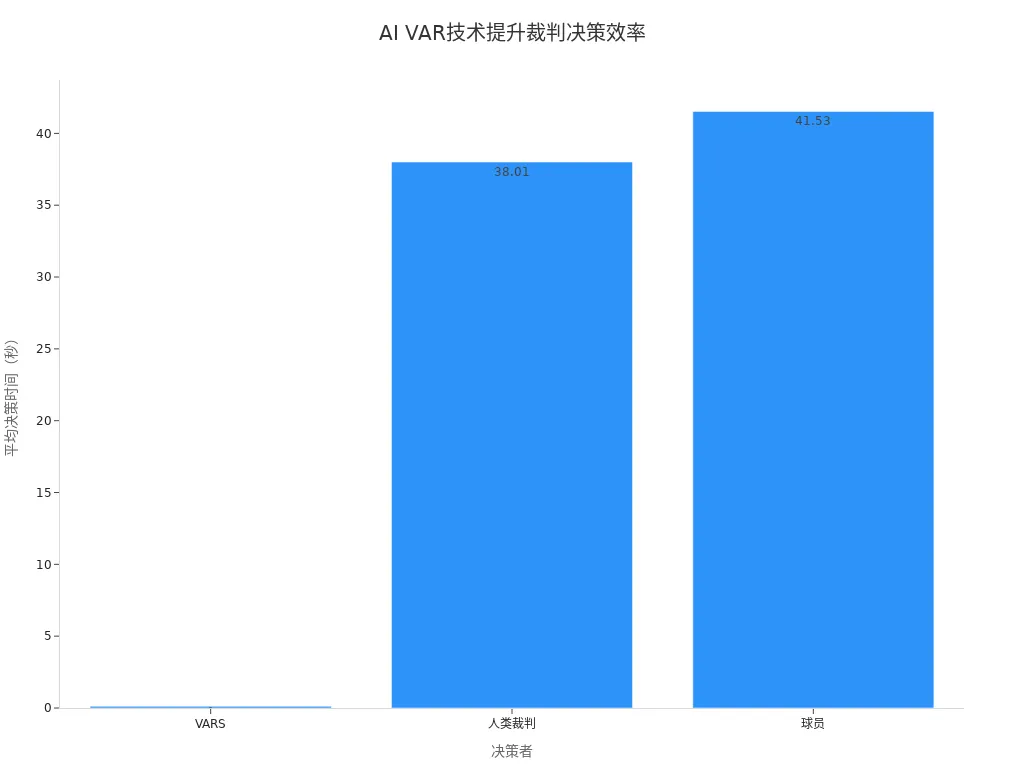
Statistics show that the average VAR decision time is only 120 milliseconds, far faster than the 38.01 seconds for human referees and 41.53 seconds for players. The chart below shows a comparison of average decision times among different decision-makers:
In addition, AI systems such as Hawk-Eye achieve near-100% decision accuracy in sports such as tennis and football. The VAR system provides instant replays and 3D reconstructions for major events like the World Cup, significantly improving event fairness and viewing experience.
Global AI Technology Integration Trends
AI applications in global sports events are showing integration trends. Major leagues and event organizations actively introduce AI technology to drive athlete performance analysis, injury prevention, fan engagement, and operational process optimization. AI also plays an important role in sports broadcasting and media content distribution, changing content delivery and fan interaction methods.
International cooperation has promoted innovation in athlete performance tracking, event broadcasting, cybersecurity, and sustainable development. AI is widely used in sports medicine, including diagnostic tools, behavior monitoring systems, and health metric tracking devices.
Chinese companies such as Lenovo actively participate in World Cup AI technology deployment, driving the upgrade of the “intelligent + sports” paradigm and providing replicable technical solutions for global sports events.
AI Application Scenarios in Sports Events

Image Source: pexels
Tactical Analysis and Team Optimization
AI technology has become an important tool for team tactical analysis and optimization. Coaches and analysts rely on AI systems to track match momentum, formation weaknesses, and player status in real time. AI analysis focuses not only on the home team but also on opponent data, identifying patterns and trends to help formulate more targeted game plans. Lasting Dynamics uses reinforcement learning models to simulate thousands of match scenarios, considering opponent tendencies, player fatigue, weather conditions, audience noise, and other factors. AI automatically processes video footage, extracting key moments, and provides actionable insights for coaches. US SaaS companies such as Hudl and Palantir excel in AI applications for sports events, driving team tactical optimization and customized training plans.
Referee Assistance and Data-Driven Decisions
The accuracy and efficiency of referee decisions have significantly improved. AI systems are trained on large volumes of data samples using deep learning algorithms to identify penalty standards in different situations. Sensor technology collects data on ball speed, angle, athlete position, and movement, combined with images and video to provide referees with comprehensive information. Hawk-Eye Innovations’ motion capture system performs excellently in tennis and football, with accuracy higher than human referees. The MLB Automated Ball-Strike System (ABS) uses AI algorithms to determine whether a pitch is in the strike zone, improving decision accuracy. AI applications in sports events are gradually eliminating linesmen in international competitions, enhancing match fairness.
Fan Experience and Content Personalization
AI technology brings more immersive viewing experiences to fans. Referee perspectives and personalized highlight tools provide unique viewpoints and customized content for fans. Lenovo integrates innovative technologies, such as Football AI Pro, AI-driven 3D player avatars, and next-generation referee perspectives, improving referee accuracy, match analysis, and fan engagement. AI enhances fan interaction through personalized content recommendations, chatbots, and virtual assistants. Companies such as Sportradar and Snowflake use AI to analyze fan preferences, customize content and promotional activities, and increase fan loyalty and engagement.
Event Operations and Commercial Value
AI improves event operational efficiency, helping organizations manage resources and schedule activities. Predictive analytics optimizes event scheduling, resource management, and ticketing to ensure safety and maximize revenue. Technologies such as TRACAB and Hawk-Eye enhance match data analysis capabilities and improve audience interaction. According to Allied Market Research data, the global AI in sports market was valued at $2.2 billion in 2022 and is expected to grow to $29.7 billion by 2032. AI technology in sports events demonstrates enormous commercial value and operational potential. The table below shows the main application scenarios and functions:
| Application Scenario | Specific Function Description |
|---|---|
| Athlete Performance Analysis | Real-time tracking and data analysis, providing personalized training and injury prevention solutions. |
| Personalized Training | AI devices track heart rate, endurance, and stress levels to create customized training plans. |
| Injury Prevention | Biomechanical and movement pattern analysis to identify potential injuries in advance and design rehabilitation plans. |
| Fan Interaction & Experience | Personalized content recommendations, chatbots, and virtual assistants enhance fan engagement and experience. |
| Operational Management | AI improves event scheduling, resource management, and ticketing efficiency, ensuring safety and revenue maximization. |
| Broadcasting & Media | Automated commentary and highlight creation improve event broadcast appeal and information delivery efficiency. |
AI applications in sports events continue to expand, driving comprehensive upgrades in tactical analysis, referee assistance, fan experience, and event operations. US SaaS companies enhance the commercial value and management efficiency of the sports industry through innovative technologies.
Investment Opportunities and Risks
Market Prospects and Growth Potential
US SaaS companies in the sports event AI analysis field demonstrate strong market growth momentum. The sports analytics service platform market is expected to reach $2.11 billion by 2034, with a compound annual growth rate of 6.0%. Demand for AI-driven sports analytics platforms continues to rise in the US market, driving rapid industry expansion. The table below shows the market size and growth rate of AI analytics platforms for sports events in the United States:
| Year | Market Size (USD Billion) | Annual Growth Rate (CAGR) |
|---|---|---|
| 2024 | 4.80 | N/A |
| 2025 | 6.09 | N/A |
| 2033 | 41.00 | 26.92% |
Growth in the sports analytics market is primarily driven by data-driven strategies. These strategies improve athlete performance, optimize fan experience, and increase event engagement. More sports organizations are adopting real-time data analysis and insights, driving integration of advanced technologies such as artificial intelligence and machine learning. The market size is expected to reach $1.38 billion by 2025 and grow to $2.11 billion by 2034. The US market shows high interest in predictive analytics applications in betting and fantasy sports.
The global sports analytics service platform market is expected to reach $2.11 billion by 2034, with a compound annual growth rate of 6.0%.
Technical Barriers and Competitive Landscape
Technical barriers in the sports event AI analysis field mainly lie in data uniqueness, system complexity, and algorithmic innovation. US SaaS companies with unique data resources and complex system architectures possess strong competitive advantages. Within the industry, companies such as Palantir, Snowflake, Sportradar, and Hudl form high barriers through continuous technological innovation and deep data integration. Advances in AI technology may disrupt traditional SaaS models, and some existing software solutions face viability challenges. Companies that can continuously optimize algorithms and improve data processing capabilities will maintain leadership in market competition.
- Advances in AI may disrupt traditional SaaS models, leading to questions about the viability of existing software solutions.
- Companies with unique data and complex systems may still thrive, indicating selective investment opportunities.
- Investors express concerns about the future of “per-seat” pricing models, believing that improved efficiency in an AI-enhanced future may reduce the number of seats.
The US market’s reliance on data-driven strategies continues to increase. Sports event AI analytics platforms drive industry innovation by improving athlete performance and fan engagement. The importance of predictive analytics in betting and fantasy sports is gradually rising, further expanding market space.
- Increasing reliance on data-driven strategies
- Improving athlete performance and fan engagement
- Growing importance of predictive analytics in betting and fantasy sports
Policy and Compliance Risks
US SaaS companies must pay attention to policy and compliance risks in AI applications for sports events. US regulatory authorities impose strict requirements on data security, privacy protection, and algorithm transparency. Companies need to ensure that data collection, storage, and processing comply with relevant regulations to avoid legal risks due to non-compliance. In the context of globalization, cross-border data flows and policy differences across regions also pose challenges. The US market’s compliance requirements for sports betting, data licensing, and content distribution continue to rise; companies must closely monitor policy changes and adjust operational strategies in a timely manner.
Data security has become a key concern for investors. Companies need to establish robust data protection mechanisms to prevent data breaches and misuse. Algorithm transparency and fairness have also become core regulatory focuses; companies need to enhance technological compliance capabilities to ensure the sustainable development of sports event AI analytics platforms.
Investor Focus Areas
When evaluating US SaaS companies’ sports AI analytics businesses, investors should focus on the following factors:
- Vendor track record of success
- Comprehensiveness of the solution
- Ease of use
- Alignment with organizational goals
- Integration capabilities with existing systems
Companies that can provide comprehensive, easy-to-use solutions highly aligned with client goals will gain higher market recognition. System integration capabilities determine whether companies can smoothly integrate into existing sports organization processes and increase customer stickiness. Investors need to focus on companies’ capabilities in data security, algorithmic innovation, and policy compliance to assess their long-term growth potential.
The sports event AI analytics platform market growth is driven by data-driven strategies, technological innovation, and policy compliance. US SaaS companies enhance industry competitiveness through continuous product and service optimization. Investors should focus on market prospects, technical barriers, policy risks, and core enterprise capabilities to seize investment opportunities in AI applications for sports events.
AI technology is driving sports event data analysis toward intelligence. US SaaS companies demonstrate unique value in top-tier events such as the World Cup through technological innovation and global layout. Investors can focus on companies’ data security capabilities, algorithmic innovation, and compliance management. In the future, deep integration of AI and sports will continue to unlock commercial potential, but caution is needed regarding policy changes and market competition risks.
FAQ
What are the main advantages of AI data analysis in sports events?
AI data analysis improves decision-making efficiency in events. Teams can access key data in real time to optimize tactics. Event organizers use AI to enhance operational efficiency and viewer experience. SaaS platforms support multi-party collaboration and drive digital transformation in the sports industry.
What core metrics should investors focus on when investing in US SaaS sports AI companies?
Investors should pay attention to companies’ technological innovation capabilities, uniqueness of data resources, customer stickiness, and compliance management levels. Long-term contracts and high-margin SaaS models support sustained growth. Market share and global layout are also important.
How important are data security and privacy protection in sports AI applications?
Data security directly affects company reputation. Sports AI platforms must strictly comply with data protection regulations to prevent data breaches. The US market has high data compliance requirements; companies need to continuously optimize security mechanisms to protect user and organizational interests.
How does AI technology improve the fan viewing experience?
AI enables personalized content recommendations and real-time data interpretation. Fans obtain richer viewing experiences through multi-perspective videos and customized information. SaaS platforms support interactive features, enhancing fan engagement and loyalty.
What challenges will future AI applications in sports events face?
Rapid technological iteration brings system upgrade pressure. Data compliance and cross-border policy differences increase operational difficulty. Intensified market competition requires companies to continue innovating. Investors need to pay attention to policy changes and technical barriers to assess long-term risks.
*This article is provided for general information purposes and does not constitute legal, tax or other professional advice from BiyaPay or its subsidiaries and its affiliates, and it is not intended as a substitute for obtaining advice from a financial advisor or any other professional.
We make no representations, warranties or warranties, express or implied, as to the accuracy, completeness or timeliness of the contents of this publication.
Related Blogs of

How to Read Pure Storage and NetApp Earnings? ARR, Cloud Revenue, Gross Margin, and Cash Flow Metrics


Why Is Western Digital’s Gross Margin Changing? Nearline HDDs, Long-Term Pricing, and Cloud Customer Demand


How Should You View Seagate’s HAMR Technology? Nearline HDD Capacity Upgrades and the Supply-Demand Cycle

Why Can’t HBM Exist Without Advanced Packaging? The Role of TSV, CoWoS, and Packaging Equipment

Choose Country or Region to Read Local Blog
 Australia
 Austria
 Belgium
 Canada
 Cyprus
 Czech Republic
 Denmark
 Estonia
 Finland
 France
 Germany
 Greece
 Hong Kong
 India
India Indonesia
 Ireland
 Italy
Italy Japan
Japan Latvia
 Lithuania
 Luxembourg
 Malaysia
 Malta
Malta Morocco
 Nepal
Nepal Netherlands
 New Zealand
 Norway
 Pakistan
 Philippines
 Poland
 Portugal
 Romania
 Singapore
 Slovakia
 Slovenia
 South Africa
 South Korea
 Spain
Spain Sweden
 Thailand
 The United States
 Turkey
 United Arab Emirates
 United Kingdom
 Vietnam
Contact Us




BIYA GLOBAL LLC is registered with the Financial Crimes Enforcement Network (FinCEN), an agency under the U.S. Department of the Treasury, as a Money Services Business (MSB), with registration number 31000218637349, and regulated by the Financial Crimes Enforcement Network (FinCEN).
BIYA GLOBAL LIMITED is a registered Financial Service Provider (FSP) in New Zealand, with registration number FSP1007221, and is also a registered member of the Financial Services Complaints Limited (FSCL), an independent dispute resolution scheme in New Zealand.