Positioning in S&P 500 ETFs in 2026: It's Not Too Late to Get Started Now





Image Source: unsplash
Considering positioning in S&P 500 ETFs right now is still a wise choice. Over the past decade, U.S. stocks have achieved an annualized return of 13%, and S&P 500 ETFs continue to attract global capital inflows, demonstrating strong market appeal. The table below shows that in 2022, S&P 500 ETFs attracted inflows of $137 billion, accounting for 27% of global equity ETF inflows.
| Year | Inflows Attracted (in USD billions) | Percentage of Global Equity ETF Inflows (%) |
|---|---|---|
| 2022 | 1370 | 27 |
| 2021 | 1190 | 13 |
| 2020 | 1 | 1 |
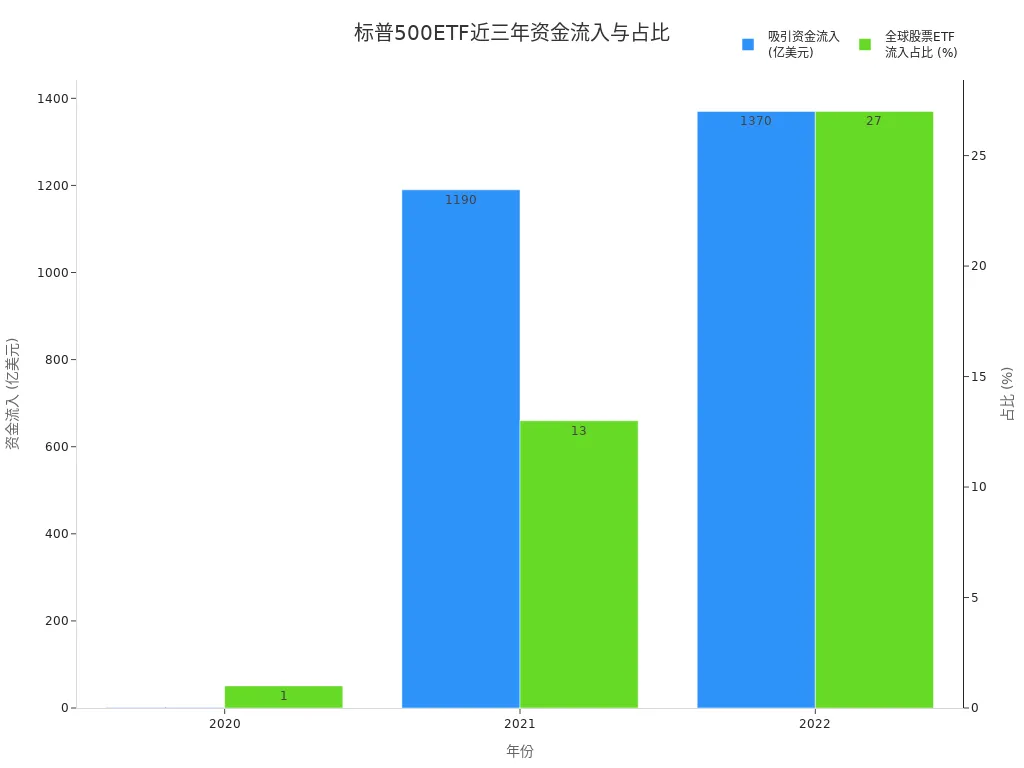
You can capture long-term investment dividends from U.S. stock economic growth and the market position of ETFs. Taking action now will not miss new opportunities in global asset allocation.
Key Takeaways
- Positioning in S&P 500 ETFs is a wise choice for capturing long-term U.S. stock growth; investors should pay attention to market trends and institutional forecasts.
- By investing in S&P 500 ETFs, investors can effectively diversify risk and reduce the overall volatility of their investment portfolio.
- Choosing low-cost ETF products, such as VOO and IVV, can significantly reduce long-term investment costs and enhance returns.
- Adopting dollar-cost averaging and batch position-building strategies can reduce risks from market volatility and ensure investment stability.
- Regularly review your investment portfolio and flexibly adjust allocations to ensure investment decisions always align with personal risk preferences and market changes.
Timing Analysis for Positioning in S&P 500 ETFs Now

Image Source: pexels
Long-Term Investment Window
When considering positioning in S&P 500 ETFs, the first thing to focus on is grasping the long-term investment window. Major investment banks such as Morgan Stanley, Goldman Sachs, Bank of America, and JPMorgan all hold optimistic views on the U.S. stock market over the next two years. The table below shows major institutions’ forecasts for the S&P 500 Index before 2026:
| Institution | Forecast S&P 500 Index Level | Forecast Timeframe |
|---|---|---|
| Morgan Stanley | 7800 points | Within the next 12 months |
| Goldman Sachs | 7600 points | End of 2026 |
| Bank of America | 7100 points | End of 2026 |
| JPMorgan | 7500 points | End of 2026 |
| Motley Fool | Decline of at least 20% | January 1, 2026 |
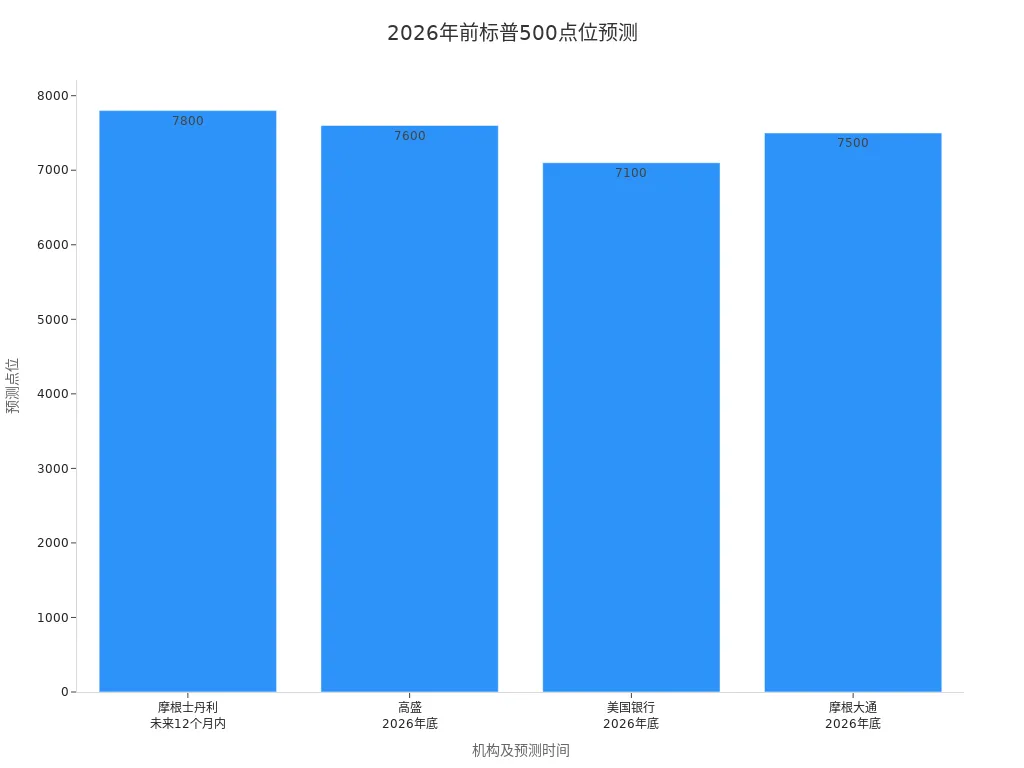
You can see that the vast majority of institutions hold a positive view on the mid- to long-term trend of the S&P 500 Index. Although there are some divergent opinions, the overall market expectation remains bullish. Positioning in S&P 500 ETFs at the current point allows you to capture dividends from global economic recovery and the growth of leading U.S. companies.
U.S. Stock Economic Outlook
You need to pay attention to changes in the fundamentals of the U.S. economy. Forecasts from the Federal Reserve and the International Monetary Fund (IMF) for U.S. GDP growth over the next two years are as follows:
| Year | GDP Growth Forecast |
|---|---|
| 2023 | 2.4% |
| 2024 | 2.0% |
- The Organisation for Economic Co-operation and Development (OECD) has lowered its 2025 U.S. GDP growth forecast from 2.2% to 1.6%.
- The International Monetary Fund (IMF) has lowered its 2025 growth expectation to 1.8%.
Although economic growth has slowed somewhat, the U.S. economy still maintains a leading position globally. When positioning in S&P 500 ETFs, you can leverage the resilience and innovation capabilities of the U.S. economy to diversify risks from a single market. In 2024, the market size growth rate of S&P 500 ETFs reached 82%, with total scale reaching 3.7 trillion yuan, and the number of products exceeding 1,000, demonstrating strong market attractiveness and investor confidence.
| Indicator | 2024 Data |
|---|---|
| Market Size Growth Rate | 82% |
| Total Scale | 3.7 trillion yuan |
| Number of Products | 1037 |
| Net New Products | 139 |
| Equity ETF Number | From 767 to 893 |
| Equity ETF Scale | From 1.50 trillion to 2.99 trillion |
| Institutional Holding Proportion | 58.12% |
| Broad-Based ETF Institutional Holding Proportion | 69.23% |
| Broad Dividend ETF Institutional Proportion | 57.13% |
You can see that the proportion of institutional investors holding S&P 500 ETFs continues to increase, indicating enhanced long-term allocation confidence in the U.S. stock market from professional funds. Globally, there are nearly 300 ETF products tracking the S&P 500 Index, and in China’s Shanghai and Shenzhen markets, there are also 4 ETF products linked to the S&P 500. Positioning in S&P 500 ETFs has become an important choice for global asset allocation.
Market Heat and Premium Phenomena
When investing in S&P 500 ETFs, you also need to pay attention to market heat and premium phenomena. In 2023, S&P 500 ETFs underperformed Nasdaq ETFs slightly, but in 2024, both rose more than 20%, with the gap narrowing significantly. In 2025, U.S. stock volatility increased, but positive returns still existed. In 2024, investor confidence in S&P 500 ETFs continued to rise, with more investors recognizing ETF dollar-cost averaging strategies. Many funds achieved returns exceeding 100%, and some investors obtained annualized returns of 37% to 44% through ETF combinations and grid strategies, far surpassing the 18% of the CSI 300 Index.
You also need to note recent fluctuations in the premium rate of S&P 500 ETFs. Data shows that the highest premium rate reached 26.21%, with the range often exceeding 10%. High premiums reflect market heat but also mean higher short-term buying costs, requiring caution against chasing highs.
| Indicator | Value |
|---|---|
| Highest Premium Rate | 26.21% |
| Premium Rate Range | Exceeding 10% |
Tip: When positioning in S&P 500 ETFs, it is recommended to adopt strategies such as batch position-building and dollar-cost averaging to reduce short-term fluctuation risks from premiums and enhance the certainty of long-term returns.
Through scientific analysis of the investment window, economic fundamentals, and market heat, you can better grasp the optimal timing for positioning in S&P 500 ETFs and achieve steady growth in global asset allocation.
Investment Value of Positioning in S&P 500 ETFs
Diversifying Risk and U.S. Stock Leaders
When allocating global assets, diversifying risk is the primary goal. The correlation coefficient between S&P 500 ETFs and major A-share indices is below 0.5, meaning you can effectively reduce overall portfolio volatility by investing in S&P 500 ETFs. S&P 500 ETFs cover multiple U.S. industries such as information technology, healthcare, and finance, with each industry accounting for more than 10%. You can also directly participate in the world’s largest leading companies, such as Apple, Microsoft, Amazon, etc. The table below shows the main industry distribution:
| Industry | Proportion |
|---|---|
| Information Technology | >10% |
| Healthcare | >10% |
| Finance | >10% |
| Other Industries | <10% |
Low Costs and Steady Growth
Choosing S&P 500 ETFs allows you to enjoy low-cost advantages. ETF management fees are far lower than those of actively managed funds, and long-term holding can significantly reduce investment costs. S&P 500 ETFs have historically exhibited lower volatility and smaller drawdowns than tech stock indices. During market fluctuations, you can still maintain relatively high capital safety. Although risks such as market volatility, concentration of constituent stocks, and high premiums exist, overall, S&P 500 ETFs provide a foundation for steady growth.
Diversified Asset Allocation
In asset allocation, S&P 500 ETFs are the top choice for long-term allocation by billion-level funds. In 2024, the Southern S&P 500 ETF became the product with the most increased holdings by FOF funds. You can combine S&P 500 ETFs with A-shares, Hong Kong stocks, bonds, gold, and other assets to build a diversified investment portfolio. This way, you not only capture growth opportunities in the U.S. stock market but also effectively diversify systemic risks from a single market.
Tip: When positioning in S&P 500 ETFs, it is recommended to scientifically allocate proportions based on your own risk preferences to enhance the overall stability of the investment portfolio.
S&P 500 ETF Selection and Comparison

Image Source: pexels
Mainstream ETF (SPY, VOO, IVV) Comparison
When choosing S&P 500 ETFs, you usually focus on these three mainstream products: SPY, VOO, and IVV. They all track the S&P 500 Index but differ in fees, structure, and dividend handling. The table below helps you quickly understand their main features:
| Feature | VOO (Vanguard) | IVV (iShares) | SPY (State Street) |
|---|---|---|---|
| Expense Ratio | 0.03% | 0.03% | 0.0945% |
| Fund Structure | Open-end fund | Open-end fund | Unit Investment Trust (UIT) |
| Dividend Handling | Automatic reinvestment | Automatic reinvestment | Cash distribution |
| Tax Efficiency | Higher | Higher | Relatively lower |
| Trading Liquidity | Very high | Very high | Extremely high, largest options market |
| Asset Scale | Global first | Huge | Huge |
You can see that SPY has advantages in liquidity and options markets, while VOO and IVV are favored by long-term investors for their extremely low expense ratios and high tax efficiency.
Expense Ratio and Liquidity
When investing in ETFs, the expense ratio directly affects long-term returns. The expense ratios of VOO and IVV are only 0.03%, far lower than SPY’s 0.0945%. If you prioritize trading flexibility, SPY’s average daily trading volume leads globally and is suitable for high-frequency traders. The liquidity of VOO and IVV is also excellent, suitable for most investors’ long-term holding.
Fund Structure and Tax Differences
You need to understand the impact of fund structure on the investment experience. VOO and IVV adopt an open-end structure that supports automatic dividend reinvestment, offering higher compounding efficiency. SPY is a unit investment trust with dividends distributed in cash, which may cause cash drag. In terms of taxation, VOO and IVV have higher tax efficiency and are suitable for investors pursuing long-term compounding.
How to Choose the ETF That Suits You
When positioning in S&P 500 ETFs, you should combine your own needs and investment channels. If you prefer the U.S. stock market, you can directly choose VOO, IVV, or SPY. If investing in China, you can participate in the U.S. stock market through products such as Bosera S&P 500 ETF and its feeder funds, Southern S&P 500 ETF, Huaxia S&P 500 ETF, etc. The on-exchange scale of Bosera S&P 500 ETF exceeds 8.5 billion yuan, with excellent liquidity and no subscription fees for on-exchange trading, making it suitable for investors seeking convenient allocation to U.S. stock assets.
Tip: When selecting ETFs, it is recommended to prioritize expense ratio, liquidity, and tax efficiency, and scientifically allocate assets based on your investment habits and channels.
Strategic and High-Risk ETF Tools
Equal-Weight, Growth, Value ETFs
When allocating S&P 500 ETFs, you can pay attention to strategic products. Equal-weight ETFs assign the same weight to each constituent stock, reducing the impact of a single leader on the index. Growth ETFs focus on high-growth companies and are suitable when you are bullish on sectors like technology and healthcare. Value ETFs emphasize low-valuation, high-dividend companies and are suitable for pursuing steady returns. You can flexibly adjust the allocation proportion of strategic ETFs based on market cycles and personal preferences.
Enhanced Return ETFs
If you want to enhance investment returns, you can consider enhanced return ETFs. These products seek to obtain excess returns in volatile markets through options strategies, dividend reinvestment, and other methods. You need to note that enhanced return ETFs have higher risks and complexity and are suitable for investors with certain investment experience. When choosing, pay attention to product structure, fees, and historical performance to avoid overlooking potential risks in pursuit of high returns.
Pros and Cons of Leveraged ETFs
If pursuing high returns, you can choose leveraged ETFs. Leveraged ETFs amplify index ups and downs through financial derivatives, commonly offering 2x or 3x leverage. In bull markets, they offer opportunities for returns far exceeding ordinary ETFs, but losses are similarly amplified during declines. Data shows that leveraged ETFs can achieve annualized returns above 16%, but with maximum drawdowns up to -49.22%.
| Indicator | Value |
|---|---|
| Annualized Return | Above 16% |
| Maximum Drawdown | -49.22% |
You need to weigh high returns against high risks, reasonably control positions, and avoid one-time heavy positions.
Suitability for Long-Term Holding
When considering long-term holding of high-risk ETFs, exercise extra caution. Strategic ETFs such as equal-weight, growth, and value types are suitable for mid- to long-term allocation. Enhanced return and leveraged ETFs are more suitable for short-term or swing trading. You can adopt batch positioning and dollar-cost averaging strategies to reduce risks from market volatility. Choose ETF tools scientifically based on your risk tolerance to ensure steady asset growth.
Tip: When using high-risk ETFs, it is recommended to build positions in batches and avoid one-time heavy positions to improve the investment safety margin.
2026 Positioning in S&P 500 ETFs Allocation Suggestions
Beginner Allocation Plan
When just starting to invest, it is recommended to adopt a “core-satellite” portfolio strategy. This balances steady appreciation with flexibility in responding to market fluctuations. You can refer to the following asset allocation table:
| Asset Allocation | Investment Tool | Description |
|---|---|---|
| 60% Core Position | S&P 500 ETFs (e.g., VOO, SPY) or Nasdaq 100 ETF (QQQ) | Covers large-cap/tech leaders for long-term appreciation |
| 20% Satellite Position | Dividend ETFs (e.g., SCHD), healthcare/consumer sector ETFs | Capture high dividends and stable cash flows |
| 20% Reserve Cash | USD money market funds or short-term Treasuries | For buying on dips or handling emergencies |
You can dollar-cost average 10%-20% each month, using intelligent dollar-cost averaging tools like Yingmi Fund to reduce timing pressure. You can also allocate 30% of funds to bond funds and 70% to dollar-cost average S&P 500 ETFs to further diversify risk. This positioning in S&P 500 ETFs helps you establish long-term investment habits and steadily improve asset safety margins.
Tip: When investing as a beginner, avoid one-time heavy positions. Persist with dollar-cost averaging and patiently wait for the compounding effect to emerge.
Conservative Allocation Suggestion
When pursuing steady returns, focus on balanced asset allocation. You can choose products such as E Fund S&P 500 ETF (161125) or Huaxia S&P 500 ETF (159655), leveraging their high liquidity and low management fees. You can refer to the table below to understand the historical return performance of S&P 500 ETFs:
| Time Period | S&P 500 ETF Return Rate |
|---|---|
| Last Year | 38.33% |
| Last Three Years | 35.64% |
You can allocate 50%-60% of funds to S&P 500 ETFs, 20%-30% to bond funds, and the remainder to money market funds or gold ETFs. This allows you to enjoy long-term growth dividends from U.S. stocks while effectively hedging against market volatility risks.
Suggestion: Regularly review your investment portfolio and dynamically adjust proportions based on market changes to ensure asset allocation always matches your risk tolerance.
If you plan to use a live account for this type of allocation, it is also worth paying attention to trading access and fund transfer efficiency, not just ETF fees and liquidity. A platform such as the BiyaPay website, positioned as a multi-asset trading wallet, covers cross-border payments, investing, and fund management, making it easier to view U.S. stock allocation within a broader asset framework. You can first use its stock information lookup function to review S&P 500 ETF and related U.S. stock product details, then decide whether to proceed through the trading portal based on your own risk tolerance. For users who also care about compliance and fund security, this kind of licensed platform structure can provide a more reliable operating environment for long-term investing.
Aggressive Allocation Approach
When having a higher risk preference, you can appropriately increase the proportion of equity assets to pursue higher returns. Allocate 70%-80% of funds to S&P 500 ETFs or Nasdaq ETFs, 10%-20% to growth, equal-weight, or enhanced return ETFs, and the remainder as reserve cash or short-term bond funds. You can also pay attention to sector rotation and flexibly adjust satellite positions to capture structural market opportunities.
When choosing Huaxia S&P 500 ETF, you can leverage its flexible holding adjustments to quickly respond to changes in index constituents. You can also pay attention to leveraged ETFs but must strictly control positions to avoid significant drawdowns due to market volatility.
Risk Warning: When pursuing high returns, be sure to set stop-loss lines, reasonably diversify investments, and prevent a single asset from dragging down overall returns.
Dynamic Adjustment and Batch Positioning
In actual operations, attach great importance to batch positioning and dynamic adjustment. The volatility of the U.S. stock market is 16.61%, with an annualized return of about 9.85%. Through batch position-building and regular fixed-amount investments, you can effectively smooth costs and reduce the risk of chasing highs. Flexibly adjust allocation proportions based on market environment and personal goals. For example, during significant market pullbacks, use reserve cash for batch buying on dips to enhance overall return expectations.
Regularly review your investment portfolio, monitor ETF expense ratios, liquidity, and constituent stock changes, and optimize asset allocation in a timely manner. This way, you can achieve steady asset growth in long-term investing.
Conclusion: Adopting batch positioning and dynamic adjustment strategies allows you to better cope with market uncertainty and improve the win rate of long-term investments.
Positioning in S&P 500 ETFs now remains a wise choice. Long-term investing can help you capture growth dividends from U.S. stocks. You should scientifically select ETF products based on your risk preferences and goals. After investing, it is recommended to monitor changes in fund risk levels and flexibly adjust allocations to ensure investment decisions always suit yourself:
- Regularly check the investment portfolio to adapt to market environment changes
- Pay attention to fund risk levels and optimize asset allocation in a timely manner
Invest rationally and continue learning to achieve steady asset growth.
FAQ
Are S&P 500 ETFs suitable for long-term holding?
You can hold S&P 500 ETFs long-term. This product diversifies risk with stable historical returns. Long-term investing helps you enjoy compounding growth and reduces the impact of short-term fluctuations.
What are the main risks to pay attention to when investing in S&P 500 ETFs?
You need to pay attention to exchange rate fluctuations, market drawdowns, and premium risks. During U.S. stock volatility, ETF net values may adjust significantly. Adopt batch position-building to reduce risks from buying at a single point.
How can Chinese investors buy S&P 500 ETFs?
You can purchase on-exchange ETFs through brokerage accounts, such as Bosera, Southern, and Huaxia S&P 500 ETFs. You can also choose feeder funds, which are suitable for dollar-cost averaging and small-amount investments.
What is the difference between S&P 500 ETFs and Nasdaq ETFs?
When investing in S&P 500 ETFs, you get broader industry coverage. Nasdaq ETFs focus mainly on tech stocks with greater volatility. You can flexibly allocate based on risk preferences and market judgments.
*This article is provided for general information purposes and does not constitute legal, tax or other professional advice from BiyaPay or its subsidiaries and its affiliates, and it is not intended as a substitute for obtaining advice from a financial advisor or any other professional.
We make no representations, warranties or warranties, express or implied, as to the accuracy, completeness or timeliness of the contents of this publication.
Related Blogs of

How to Read Pure Storage and NetApp Earnings? ARR, Cloud Revenue, Gross Margin, and Cash Flow Metrics


How to Read NAND Contract Prices and Spot Prices? Why Enterprise SSDs and Consumer SSDs Do Not Move in Sync


How Should You View Seagate’s HAMR Technology? Nearline HDD Capacity Upgrades and the Supply-Demand Cycle

How Is China’s Memory Supply Chain Different from Overseas Memory Leaders? A Comparison with Micron, SanDisk, Western Digital, and Seagate

Choose Country or Region to Read Local Blog
 Australia
 Austria
 Belgium
 Canada
 Cyprus
 Czech Republic
 Denmark
 Estonia
 Finland
 France
 Germany
 Greece
 Hong Kong
 India
India Indonesia
 Ireland
 Italy
Italy Japan
Japan Latvia
 Lithuania
 Luxembourg
 Malaysia
 Malta
Malta Morocco
 Nepal
Nepal Netherlands
 New Zealand
 Norway
 Pakistan
 Philippines
 Poland
 Portugal
 Romania
 Singapore
 Slovakia
 Slovenia
 South Africa
 South Korea
 Spain
Spain Sweden
 Thailand
 The United States
 Turkey
 United Arab Emirates
 United Kingdom
 Vietnam
Contact Us




BIYA GLOBAL LLC is registered with the Financial Crimes Enforcement Network (FinCEN), an agency under the U.S. Department of the Treasury, as a Money Services Business (MSB), with registration number 31000218637349, and regulated by the Financial Crimes Enforcement Network (FinCEN).
BIYA GLOBAL LIMITED is a registered Financial Service Provider (FSP) in New Zealand, with registration number FSP1007221, and is also a registered member of the Financial Services Complaints Limited (FSCL), an independent dispute resolution scheme in New Zealand.