
Using Large Language Models to Auto-Fill Cross-Border Remittance Compliance Declaration Forms: Efficiency Improvement in Practice





Image Source: pexels
In cross-border remittance compliance declaration, you often face complicated information, heavy review pressure, and frequent manual entry errors. Large language model auto-fill technology can significantly improve your efficiency, reduce mistakes caused by manual operations, and achieve systematic and explainable compliance review processes. According to real-world application feedback, after adopting large models, the automatic matching rate can reach above 95%, and financial close time can be shortened by 50% to 60%. In practice, auto-fill is more suitable for the upstream steps of compliance work, such as document structuring, field extraction, and rule validation, while the actual fund movement should still go through a compliant execution channel. A multi-asset wallet such as BiyaPay fits naturally into that later stage because it covers cross-border payments, treasury movement, and multi-currency conversion; before submission, its remittance flow and exchange rate comparison tool can also help teams cross-check declared amounts against the actual FX path and transfer cost.The table below shows some core data on efficiency gains from large model auto-fill:
| Metric | Traditional System Matching Rate | GPT-4 Expected Matching Rate | Note |
|---|---|---|---|
| Automatic Matching Rate | 70% – 90% | 95% and above | May capture edge cases |
| Financial Close Time Reduction | N/A | 50% – 60% | AI detects issues early, shortens close cycle |
Key Takeaways
- Large language model auto-fill technology improves cross-border remittance compliance declaration efficiency, with automatic matching rates reaching 95%.
- Adopting automated processes reduces manual operations, lowers error rates, and ensures accuracy in compliance reviews.
- The system automatically loads the latest compliance policies, ensuring declaration information meets regulatory requirements in various countries and avoiding declaration failures.
- Real-time data validation and multi-layer checks enhance data security and prevent identity theft and data leakage.
- Continuous evaluation and optimization of model performance ensure the system remains efficient, compliant, and secure while adapting to business changes.
Pain Points of Traditional Processes

Image Source: pexels
Complexity of Compliance Declaration
When handling cross-border remittance compliance declarations, you often face multiple layers of regulatory requirements and complex business processes. Different countries and regions impose strict standards, formats, and content requirements for declaration information. You must accurately understand each policy to ensure all data complies with the latest regulations. Industry reports indicate that banks often wait for beneficiaries to report key information, which easily leads to delayed fund arrival. Receiving institutions temporarily hold remittances until foreign exchange control procedures are completed. These process steps increase compliance risk and significantly extend the overall handling cycle.
| Pain Point | Description |
|---|---|
| Regulatory Requirements | Banks wait for beneficiaries to report certain information, causing delayed fund arrival. |
| Remittance Institution Processing Delays | Receiving institutions temporarily hold funds until foreign exchange control is completed. |
| Local Payment Format Requirements | Beneficiaries require different payment message standards or structures, leading to incomplete or missing information. |
Inefficient Information Collection and Entry
In the information collection and entry stage, you often need to manually organize large volumes of materials. Traditional processes rely on manual gathering, verification, and input, making information omission or format mismatches common. Without real-time payment systems, remittances arriving outside business hours are delayed until the next working day. Due to technical limitations, many steps cannot be automated, further impacting overall efficiency. You will find that information flow is slow and data accuracy is difficult to guarantee.
If you adopt large language model auto-fill, you can significantly increase the level of automation in information collection and entry, reduce manual intervention, and improve overall efficiency.
High Error Rate in Manual Operations
During manual operations, errors easily occur due to fatigue, oversight, or inconsistent policy understanding. When processing data manually, full coverage of format, content, and logic validation is difficult to achieve. Industry reports note that technical limitations still force widespread manual handling, directly affecting payment speed and accuracy. Even with new technologies, if beneficiary steps cannot be automated, improvements in payment speed remain limited. You need to spend more time on review and correction, further increasing operational costs and compliance risks.
Large Language Model Auto-Fill Workflow
Data Collection and Preprocessing
In cross-border remittance compliance declaration, you first face the challenge of collecting and preprocessing multi-source heterogeneous data. The large language model auto-fill process automatically pulls raw data from upstream business systems, payment channels, customer databases, and other sources. The system corrects data to ensure completeness and consistency, improving overall compliance. You can also use validation frameworks for preliminary screening of data accuracy, removing invalid or anomalous information. The preprocessing layer cleans input data, removes redundant fields and format errors, directly affecting the accuracy of subsequent screening and reconciliation. High-quality MX data improves sanction matching precision and enhances anti-fraud capabilities. For anti-money laundering (AML) scenarios, the system supplements contextual information to meet regulatory requirements. Refer to the table below for common data types and their roles in the process:
| Data Type | Importance Description |
|---|---|
| Upstream Data Correction | Ensures data completeness and consistency, improves compliance. |
| Validation Framework | Ensures data accuracy and compliance. |
| Preprocessing Layer | Ensures cleanliness of input data, directly affects screening and reconciliation accuracy. |
| High-Quality MX Data | Improves sanction matching precision and enhances anti-fraud scoring. |
| Contextual Information for AML Scenarios | Provides better compliance context and meets regulatory requirements. |
Through automated data collection and preprocessing, you lay a solid foundation for subsequent semantic parsing and rule modeling, significantly reducing manual intervention and initial errors.
Semantic Parsing and Entity Recognition
After data preprocessing, you rely on large models to perform deep semantic parsing and entity recognition on textual information. The large language model auto-fill system automatically identifies key entities such as remitter, beneficiary, address, account information, and transaction amount. You can leverage the powerful natural language processing capabilities of large language models (such as Claude 3, GPT-4) to automatically complete tasks like named entity recognition (NER) and relation extraction (RE). The system combines algorithms such as Conditional Random Fields (CRF) and Bi-directional Long Short-Term Memory networks (BiLSTM-CRF) to improve entity extraction accuracy in legal and financial domains. Pre-trained models (such as BERT, GPT-2) perform excellently in semantic parsing and entity recognition, capable of handling complex unstructured text and multilingual scenarios.
In practical operation, you will find that large models can automatically identify named entities in text fragments and accurately extract their attributes. With the development of deep learning technology, named entity recognition has become a key component in compliance automation workflows. You no longer need manual annotation and extraction — large models automatically complete information extraction, greatly improving efficiency and accuracy.
- Large language models generally achieve F1 scores above 0.85 in multilingual entity recognition, demonstrating strong unified representation capabilities.
- You can rely on large models to process unstructured and semantically implicit information, especially showing clear advantages in identifying new risk patterns.
Compliance Rule Modeling
In compliance declaration, you must strictly follow the rules and standards of regulatory authorities in each country. The large language model auto-fill system automatically loads the latest compliance policies and business rules, building knowledge graphs and rule engines. You can automatically match declaration fields with compliance requirements through the system, ensuring all data items conform to international standards such as ISO and SWIFT. The system automatically adjusts field formats and content according to the regulatory requirements of different countries and regions, avoiding declaration failures due to rule non-compliance.
You no longer need to manually maintain complex rule libraries — the system automatically updates and optimizes compliance rules. Large models can dynamically adjust rule mapping logic based on historical cases and the latest policies, improving coverage of high-risk transactions. Through knowledge modeling and rule inference, you can achieve end-to-end automated compliance review, significantly reducing false positive rates and manual review workload.
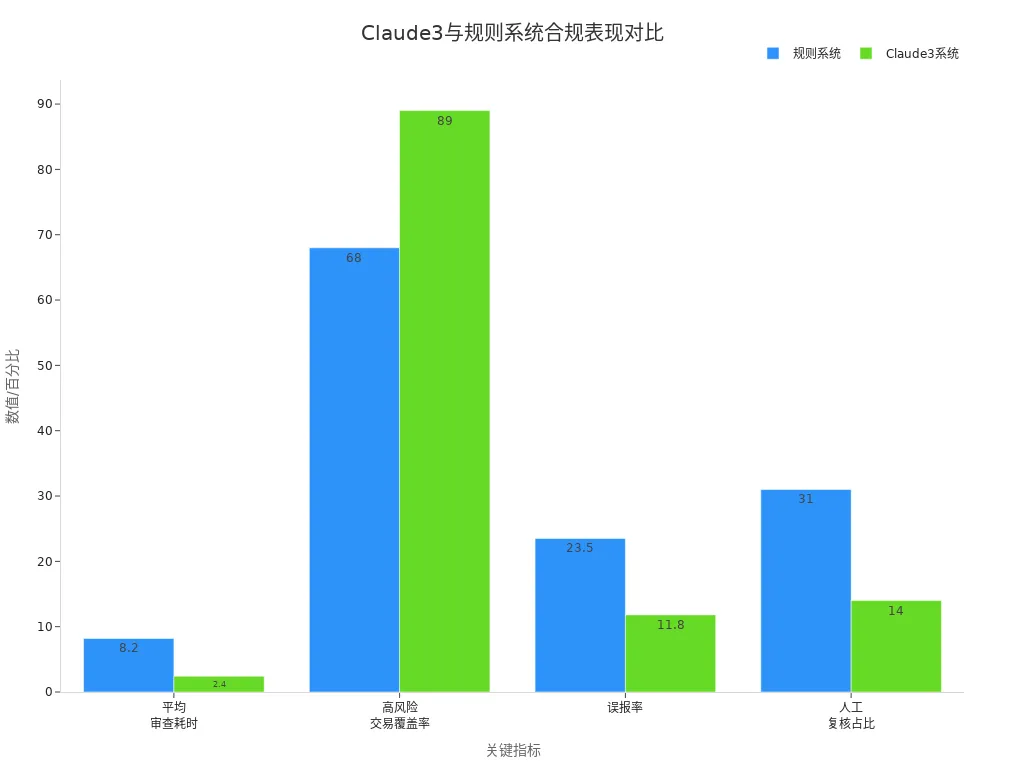
As shown in the chart above, after adopting large language model auto-fill, average review time is reduced to 2.4 seconds, high-risk transaction coverage increases to 89%, false positive rate drops to 11.8%, and manual review ratio falls to 14%. You can clearly see the dual improvement in efficiency and accuracy.
Auto-Fill and Validation
After completing data collection, semantic parsing, and rule modeling, the system automatically populates compliance data into declaration forms. You no longer need to manually enter information — the system automatically generates structured declaration content based on entity recognition results and rule mapping. After filling, the system performs multi-layer validation to ensure all fields comply with regulatory requirements. Refer to the table below for common validation rules:
| Validation Rule | Description |
|---|---|
| Name | Must not be empty and character count ≤ 140 |
| Address | Must be structured (unstructured addresses no longer supported) |
| BIC | Must be a valid SWIFT code |
| LEI Format | Must follow ISO 17442 |
| Country and Currency Codes | Limited to ISO standard codes |
| Illegal Characters | No illegal/unprintable characters allowed |
| Date | Must be logical (YYYY-MM-DD) |
Through auto-fill and validation, you can significantly reduce format errors and compliance risks caused by manual operations. The system automatically flags anomalous fields and supports quick corrections, ensuring declaration materials pass compliance review on the first attempt. Large language model auto-fill not only improves overall efficiency but also delivers higher accuracy and compliance assurance.
Key Technologies and Practical Implementation
Entity Recognition and Semantic Understanding
In cross-border remittance compliance declaration, you first rely on the large language model auto-fill system to perform entity recognition and semantic understanding on multi-source data. The system automatically extracts key information such as remitter, beneficiary, account, address, and amount, accurately distinguishing different entity types. You can leverage pre-trained language models to handle unstructured text and improve named entity recognition accuracy. The system also uses context to understand deeper semantics such as remittance purpose and fund flow direction, automatically completing information extraction and categorization.
In actual operation, you only need to upload raw declaration materials — the system automatically completes entity annotation and semantic parsing, greatly reducing manual intervention.
Rule Mapping and Risk Detection
In compliance declaration, you must ensure all data items meet the latest regulatory requirements. The system automatically maps structured data to compliance rules and dynamically detects potential risks. You can improve risk identification capabilities through the following methods:
- Use an AI-driven data extraction engine to automatically convert remittance advice, payment instructions, SWIFT MT, and ISO 20022 messages into structured data.
- Dynamic risk checks apply intelligent rules in real time based on payment geography, stated purpose, and counterparty risk profile.
- Entity graph linking technology creates connected views of documents and transaction activities, revealing repeated anomalous patterns in geography or participants.
In daily operations, you can detect high-risk transactions in real time — the system automatically flags anomalies and supports quick decision-making and intervention.
Decision Explainability and System Integration
In compliance automation workflows, decision explainability and system integration capabilities are equally important. The system provides detailed explanations for each decision step, allowing you to trace the data and rules behind every compliance judgment. Refer to the table below for accuracy rates of commonly used methods:
| Method | Accuracy | Note |
|---|---|---|
| Rule Explanation | 97% | Classification accuracy |
| Data Extraction Tool Selection | 97% | Correct selection rate |
| Rule Execution | 97.7% | Significantly better than baseline |
You can implement structured strategies to ensure the accuracy and reliability of large model outputs. The system continuously optimizes best practices, transforming large language model auto-fill from an experimental tool into a core asset of compliance automation. When integrating with existing business systems, you can achieve seamless docking to improve overall operational efficiency and compliance level.
Risk Control and Compliance Assurance

Image Source: pexels
Data Security and Privacy
In cross-border remittance compliance declaration automation, you must place high importance on data security and privacy protection. The system performs real-time digital identity verification of enterprises without paper documents, significantly reducing identity theft and forgery risks. Standardized digital identity frameworks simplify and secure cross-border payment processes, preventing data leakage. You can further enhance data security by relying on anti-money laundering and know-your-customer procedures, ensuring sensitive information is encrypted and under strict access control during transmission and storage.
- Real-time digital identity verification of enterprises prevents fraud and forgery
- Standardized frameworks simplify cross-border payments and improve data security
- AML and KYC procedures ensure information compliance
Compliance and Human Intervention
In automated compliance declaration workflows, you still need to balance compliance with human intervention. Agentic AI helps you avoid sanctions, fraud, and regulatory risks across multiple jurisdictions and automatically maintains complete audit trails, recording the data and rules behind every decision. In complex or exceptional cases, human intervention remains essential. Compliance teams can review high-risk transactions to ensure every system output is traceable and explainable.
- Agentic AI automatically mitigates sanctions and regulatory risks
- Audit trails record decision basis, improving transparency
- Human intervention handles exceptions, ensuring compliance
Effectiveness Evaluation and Continuous Optimization
You need to continuously evaluate the performance of the automated system through multi-dimensional metrics and keep optimizing model performance. Common evaluation metrics include accuracy, relevance, consistency, latency and efficiency, and user feedback. You can regularly update datasets to ensure the model keeps pace with business and regulatory changes. Through feedback loops and A/B testing, you can continuously improve model response quality and compliance capability.
| Metric | Description |
|---|---|
| Accuracy | Output compared against authoritative knowledge bases or benchmarks |
| Relevance | Response meets user intent and provides actionable insights |
| Consistency | Tracks variability across repeated queries |
| Latency & Efficiency | Measures response time and ensures it meets business operational needs |
| User Feedback | Collects qualitative input from teams or users to optimize the model |
Through scientific evaluation and continuous optimization, you can ensure the large language model auto-fill system remains efficient, compliant, and secure.
By using large language models for auto-fill, you significantly improve the efficiency of cross-border remittance compliance declaration, reduce operational risk, and strengthen compliance assurance. In the future, you can focus on improving model accuracy and advancing process intelligence. Industry trends indicate that ISO 20022 structured data, end-to-end traceability, and automated processing will drive widespread adoption of compliance automation. When implementing in practice, you can refer to the following recommendations:
- Centralize compliance data and monitoring, implement risk-based tiered management
- Leverage artificial intelligence for customer due diligence and transaction monitoring
- Improve sanctions screening processes and automate report and form generation
FAQ
What are the main advantages of using large language models to auto-fill cross-border remittance compliance declaration forms?
You can significantly improve declaration efficiency, reduce manual error rates, and achieve automated compliance workflows. The system supports multiple languages and currencies, adapts to regulatory requirements in different countries, and enhances overall compliance levels.
How is data security and privacy protected?
You can ensure the security of sensitive information during transmission and storage through end-to-end encryption, access permission controls, and digital identity verification. The system supports compliant data isolation and audit trails to prevent data leakage.
How does the system handle compliance requirements in different countries and regions?
You can rely on large models to automatically load and update the latest compliance policies in each region, automatically adjusting declaration fields and formats. The system supports international standards such as ISO and SWIFT, ensuring declaration materials pass review on the first attempt.
Can it be seamlessly integrated with existing business systems?
You can connect the auto-fill system with existing ERP, payment, risk control, and other platforms through API interfaces or customized integration solutions, achieving end-to-end automated processing and improving overall operational efficiency.
What are the applications of BiyaPay in cross-border payments and compliance automation?
You can use BiyaPay to achieve global payments and remittances, real-time exchange between fiat and cryptocurrency, USDT to USD or HKD conversion, and convenient deposit/withdrawal for US stocks and Hong Kong stocks trading funds, meeting diverse compliance needs.
*This article is provided for general information purposes and does not constitute legal, tax or other professional advice from BiyaPay or its subsidiaries and its affiliates, and it is not intended as a substitute for obtaining advice from a financial advisor or any other professional.
We make no representations, warranties or warranties, express or implied, as to the accuracy, completeness or timeliness of the contents of this publication.
Related Blogs of

Crypto Trading Bots: Types, Costs, and Security Risks


MACD Crypto Trading Strategy: Settings, Signals, and Risk Management




Choose Country or Region to Read Local Blog
 Australia
 Austria
 Belgium
 Canada
 Cyprus
 Czech Republic
 Denmark
 Estonia
 Finland
 France
 Germany
 Greece
 Hong Kong
 India
India Indonesia
 Ireland
 Italy
Italy Japan
Japan Latvia
 Lithuania
 Luxembourg
 Malaysia
 Malta
Malta Morocco
 Nepal
Nepal Netherlands
 New Zealand
 Norway
 Pakistan
 Philippines
 Poland
 Portugal
 Romania
 Singapore
 Slovakia
 Slovenia
 South Africa
 South Korea
 Spain
Spain Sweden
 Thailand
 United States
 Turkey
 United Arab Emirates
 United Kingdom
 Vietnam