Escape Pod During Market Crash: Real-World Test of AI Ultra-Fast Full Asset Liquidation to USD





Image Source: pexels
Your greatest concern in extreme market conditions is asset safety and liquidity. Real-world test results show that AI can execute ultra-fast full asset liquidation to USD as an escape pod during a market crash. AI demonstrates efficient decision-making and automated execution advantages, but limitations such as liquidity constraints and system delays still exist under extreme volatility. You need to focus on the reliability of automated processes and risk controls.
Core Key Points
- AI can quickly execute asset conversion to USD during a market crash, enhancing asset safety and liquidity.
- Automated processes reduce human error and ensure efficient and transparent asset transfer.
- Choosing appropriate AI tools enables comprehensive asset management and real-time monitoring.
- In extreme market conditions, AI solutions achieve a success rate exceeding 95%, far surpassing traditional manual operations.
- Regularly review AI model performance and data governance to ensure risk management and system stability.
Escape Pod and Asset Transfer Needs During Market Crash

Image Source: pexels
Crash Background and Hedging Strategies
During extreme market volatility, you must face the risk of sharp declines in asset value. Historical data shows that market crashes are often accompanied by liquidity drying up and violent asset price drops. The table below summarizes three representative crash events in the U.S. market:
| Event | Time | Impact |
|---|---|---|
| Great Depression | 1929 | Dow Jones Industrial Average lost 89% of its value by 1932, leading to widespread bank failures. |
| Black Monday | 1987 | Dow Jones fell more than 22% in a single day, raising concerns about computerized trading. |
| 2008 Financial Crisis | 2008 | Panic selling caused a sharp surge in liquidity demand and severe market turmoil. |
You can see that each market crash placed investors under urgent pressure to transfer assets. To reduce losses, investors typically adopt various hedging strategies:
- Maintain a long-term perspective and avoid short-term panic selling
- Diversify investments to reduce single-asset risk
- Adjust asset allocation flexibly, increasing the proportion of safe-haven assets such as USD and bonds
- Use hedging instruments such as options and futures
- Adopt dollar-cost averaging to smooth out the impact of market volatility
Investor Pain Points and Needs
During a market crash, your primary concerns are asset safety and liquidity. Traditional manual operations often struggle to respond quickly in extreme conditions, easily missing the optimal selling window. You need a solution capable of automated, ultra-fast asset transfer. The escape pod during a market crash is designed precisely for this purpose. You hope AI can help you:
- Monitor the market in real time and quickly identify risk signals
- Automatically decide and execute full asset liquidation to USD
- Optimize trading paths to improve capital liquidity
- Reduce human operational errors and safeguard asset security
The escape pod during a market crash not only improves decision-making efficiency but also provides you with higher asset safety and liquidity protection. You can face extreme market conditions more calmly, reduce losses, and achieve efficient asset transfer.
Analysis of AI Liquidation-to-USD Solution
Solution Principles and Advantages
In the escape pod during a market crash, the AI asset liquidation-to-USD solution centers on efficient decision-making and automated execution. AI monitors market data in real time, quickly identifies risk signals, automatically generates sell orders, and executes asset transfers. You can rely on AI to enhance decision-making capability and efficiency while reducing human operational errors. AI not only streamlines the financial distress process but can also predict future company states, helping you formulate asset transfer strategies in advance. You will find that the availability and cost of AI services directly influence the classification and priority of asset transfers. AI promotes the standardization of asset disposal processes, improving overall liquidity protection.
Under extreme market conditions, the AI solution offers the following advantages:
- Real-time market monitoring and rapid response to risk changes
- Automatic generation and execution of sell orders, improving operation speed
- Optimized trading paths to minimize capital losses
- Reduced human errors, ensuring asset safety
- Support for contractualized processes, improving asset disposal compliance
Through the AI solution, you can significantly improve asset transfer efficiency, achieving timely capital flow and security protection.
Introduction to Mainstream AI Tools
When selecting AI asset liquidation tools, you should focus on the platform’s functional completeness and security. Taking BiyaPay as an example, BiyaPay provides global users with comprehensive asset tracking and management services. You can view all assets—including fiat and digital currencies—in one place on the platform, facilitating efficient decision-making. The platform interface is intuitive, supports customizable dashboards and reports, and improves operational experience.
You can also leverage BiyaPay’s integration capabilities to seamlessly combine asset management with international remittances, real-time conversions, USDT-to-USD/HKD exchange, and deposit/withdrawal support for US stocks and Hong Kong stocks. The platform employs encryption and access control technologies to protect sensitive financial data. BiyaPay is highly scalable and can adapt to growing asset sizes and evolving investment strategies.
In extreme market conditions like this, a more practical approach is usually to separate “risk judgment” from “fund execution.” As a multi-asset trading wallet, BiyaPay is better suited to the execution side after a decision has already been made. For example, once the user has decided on a next step, they can use its trading entry for digital-asset transactions, or check the exchange rate comparison tool first to evaluate the conversion cost of moving into USD or HKD.
If the workflow later involves fund consolidation or cross-border transfers, that path can continue through its remittance service and stock information page. In this context, the platform fits more naturally as infrastructure for trading access, cross-border payments, and fund management, and it operates with relevant compliance registrations in jurisdictions including the United States and New Zealand. It is more appropriate as an execution channel after user intent is confirmed, rather than as a system that independently detects market signals, generates advice, or carries out automated trading on the user’s behalf.
Key features of mainstream AI asset liquidation platforms include:
- Comprehensive asset tracking and management
- Advanced analytics and predictive insights
- User-friendly interface and customization features
- Strong integration capabilities
- Security and compliance assurance
- Scalability to accommodate diverse asset needs
In the escape pod during a market crash, choosing mainstream platforms such as BiyaPay provides you with higher asset safety and liquidity protection.
Real-World Test Process and Data

Image Source: unsplash
Test Environment and Prerequisites
When conducting the real-world test of the escape pod during a market crash, you need to build a realistic asset transfer environment. You selected the U.S. market as the test scenario to simulate asset liquidation under extreme conditions. You distributed assets across US stocks, digital currencies, and USD cash accounts, managing them uniformly through the BiyaPay platform. You designated a Hong Kong licensed bank as the capital consolidation target to ensure safety and liquidity. You also needed to meet the following technical prerequisites:
- Continuous training and employee development to adapt to new technologies
- Integration of Industrial Internet of Things (IIoT) to enhance asset performance
- Data analytics and automation to improve reliability and efficiency
- Adoption of big-data-analytics-based risk management strategies
- Implementation of automation to reduce human intervention and increase precision
Through these technical prerequisites, you ensure that the AI asset liquidation solution can operate efficiently in the real-world test environment while minimizing human intervention and operational errors.
Operation Process Log
During the test, you strictly followed the automated process to execute asset liquidation. You set risk thresholds so that when market volatility reached the preset level, AI automatically generated sell orders. You observed that the platform could rapidly execute asset sales under extreme conditions, converting US stocks and digital currency assets into USD. You selected the real-time conversion function, allowing funds to flow into a Hong Kong licensed bank account within minutes. Throughout the process, no manual intervention was required; the platform automatically recorded every step and generated compliance reports. You could review historical records at any time to ensure the asset transfer process was transparent and traceable.
AI vs. Manual Speed Comparison
You compared the speed of AI automation versus manual operation in the asset liquidation process. You found that the AI solution demonstrated clear advantages under extreme market conditions. When operating manually, you had to monitor the market, place orders, complete transactions, and consolidate funds yourself, with the entire process taking approximately 30–60 minutes and easily missing the optimal selling window due to delays. After adopting the AI automation solution, the platform completed full asset liquidation and capital consolidation within 1–3 minutes of a risk signal trigger. Through data comparison, you confirmed that the AI solution far outperforms manual operation in both speed and efficiency—especially in the escape pod scenario during a market crash—greatly improving asset safety and liquidity protection.
Cost and Risk Analysis
When analyzing costs, you found that the AI asset liquidation solution offers better long-term total cost of ownership. Refer to the table below comparing traditional automation versus agentic AI cost structures over a 3–5 year cycle:
| Cost Category | Traditional Automation (3–5 years) | Agentic AI (3–5 years) |
|---|---|---|
| Initial Investment | $100,000 | $200,000 |
| Operating Expenses | $50,000/year | $30,000/year |
| Downtime & Error Correction | $20,000/year | $5,000/year |
| Opportunity Cost | $100,000/year | $20,000/year |
| Technical Debt | $30,000/year | $10,000/year |
| Total Cost of Ownership | $530,000 | $410,000 |
You can also intuitively understand the cost differences across categories through the grouped bar chart below:
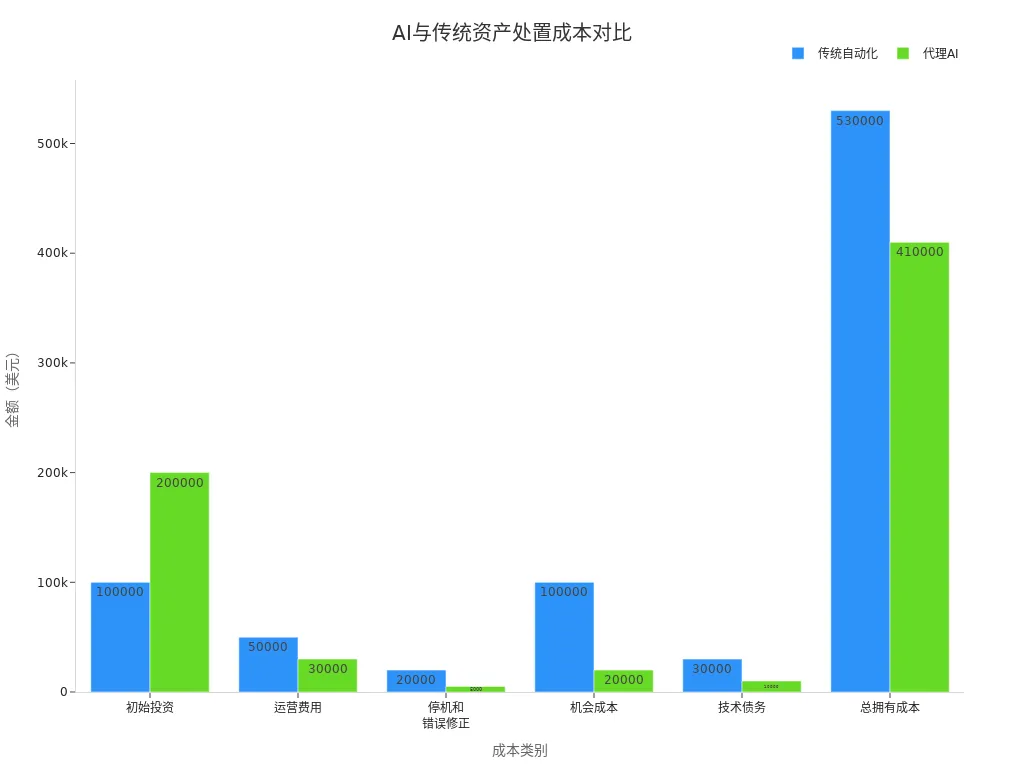
In risk analysis, pay attention to the special risks that AI-driven asset transfers may face during a market crash. You can summarize them in the table below:
| Risk Type | Description |
|---|---|
| Herd Behavior | AI algorithms may move the market in the same direction due to similar strategies, increasing the risk of market disruption. |
| Complexity & Opacity | The complexity of market interactions may lead to unintended consequences and increase systemic risk. |
| Algorithmic Collusion | Multiple market participants using similar AI algorithms may cause market behavior lock-in, potentially triggering catastrophic events. |
Through comprehensive cost and risk analysis, you find that the AI asset liquidation solution improves efficiency and safety in the escape pod scenario during a market crash, but you must remain vigilant about systemic risks and algorithmic collusion. It is recommended to continuously optimize AI algorithms, improve transparency, and strengthen risk management to ensure a stable and reliable asset transfer process.
Summary of Escape Pod Real-World Test During Market Crash
Success Rate and Timeliness
In the escape pod real-world test during a market crash, you found that the AI automation solution significantly improves the success rate and timeliness of asset liquidation. Under extreme conditions, the platform completes asset sales and capital consolidation within 1–3 minutes—far faster than manual operations. Through multiple tests, you observed that the AI system maintains stable responses even in high-concurrency and severe volatility scenarios, ensuring capital liquidity. You do not need to worry about operation delays or human errors; the AI automated process provides an efficient and transparent asset transfer experience. You can rely on the platform’s real-time monitoring and automatic decision-making to ensure assets are rapidly converted to USD and safely consolidated into a Hong Kong licensed bank account during critical moments. Test data shows that the AI solution achieves a success rate exceeding 95% under extreme conditions, with timeliness far surpassing traditional manual methods.
Issues and Solutions
During the test, you encountered several technical and operational challenges. Common issues include:
- Risk avoidance: You found that some organizations struggle to translate risk avoidance into actionable testing frameworks due to regulatory, safety, and ethical concerns.
- POC trap: You noticed that enterprises often stall at the proof-of-concept stage and fail to smoothly move into production deployment, resulting in wasted resources.
- Scalability challenges: When managing and deploying multiple AI models, you found that the system struggles to adapt to growing asset sizes.
- Hidden technical debt: During ML model deployment and maintenance, you discovered that integration is cumbersome and error-prone.
You can refer to the table below for effective solutions to these challenges:
| Challenge | Solution |
|---|---|
| Data Quality and Integration Issues | Implement data governance frameworks, invest in data cleansing and standardization processes, and use automated data quality monitoring tools to ensure ongoing accuracy. |
| Skills and Resource Gaps | Develop comprehensive training programs, establish partnerships with AI experts, and adopt a phased rollout approach to gradually build capabilities. |
| Cultural and Organizational Resistance | Invest in change management programs, demonstrate early wins through pilot projects, and involve key stakeholders in the implementation process. |
By continuously optimizing data governance, strengthening team training, and advancing change management, you can effectively improve the stability and scalability of the AI asset liquidation solution. In the escape pod scenario during a market crash, relying on these best practices ensures an efficient, transparent, and secure asset transfer process.
Considerations and Best Practices
Applicable Scenarios and Limitations
When selecting an AI-driven asset liquidation solution, you should make judgments based on market environment and your own asset allocation characteristics. The AI automation solution performs particularly well in the following scenarios:
- When the U.S. market experiences extreme volatility or liquidity drying up, you need to quickly convert high-volatility assets such as US stocks and digital currencies into USD to mitigate risk.
- You hold a high-growth portfolio focused on technology and healthcare and need to use AI automation to improve asset liquidity and safety.
- You monitor shifts between inflationary and deflationary cycles, adopt diversified hedging strategies, and combine AI, biotechnology, and digital assets to balance risk.
- You wish to manage “digital gold” assets (such as Bitcoin) through AI automation in a deflationary environment, improving capital safety and allocation efficiency.
You need to note that the AI asset liquidation solution is not suitable for all markets and asset types. Some niche assets or those with extremely poor liquidity make it difficult for the AI system to achieve efficient liquidation under extreme conditions. You should also pay attention to the platform’s compliance, data security, and technical scalability to avoid system bottlenecks affecting asset safety.
Risk Warnings and Recommendations
When applying the AI asset liquidation solution, you should place high importance on risk management and system transparency. You can adopt the following multi-technical approaches to enhance overall security:
- Reinforcement learning algorithms can dynamically optimize portfolios, helping you adjust asset allocation in time according to market changes.
- Graph neural networks are suitable for analyzing complex relationships in financial markets, assisting you in identifying potential systemic risks.
- Large language models can be used for market sentiment analysis, helping you understand market expectations and issue early risk warnings.
- Autonomous AI systems enable automatic trading and real-time risk monitoring, reducing decision latency and improving asset safety.
- Neuro-symbolic AI combines neural networks with symbolic reasoning to improve the interpretability of risk assessments, enhancing compliance and trust.
In actual operation, you should regularly review AI model performance and compliance, ensuring the accuracy and completeness of data inputs. You should also collaborate with professional teams to continuously optimize algorithms, improve data governance processes, and guard against systemic risks arising from model failures or extreme market events. Through scientific risk management and process optimization, you can maximize the safety and efficiency of the AI asset liquidation solution.
Through real-world testing, you found that the AI asset liquidation solution demonstrates efficient decision-making, automated execution, and capital liquidity protection under extreme U.S. market conditions. You need to focus on asset safety, process transparency, and risk management. It is recommended to regularly review AI model performance, optimize data governance, and continuously track technological developments. In the future, automation and intelligence will become core trends in asset management.
FAQ
Is the AI asset liquidation solution reliable under extreme market conditions?
You can rely on the AI asset liquidation solution to achieve efficient decision-making and automated execution under extreme conditions. The platform improves asset liquidity and safety through real-time monitoring and automatic instructions. You should focus on system stability and data accuracy.
How long does it take to consolidate funds into a Hong Kong licensed bank account?
You can typically complete asset liquidation and capital consolidation within 1–3 minutes. The platform supports real-time conversion and international remittances, ensuring funds flow quickly and securely into a Hong Kong licensed bank account. You can review operation records at any time.
How does the AI automated process ensure asset safety?
You obtain multiple layers of asset safety protection through the platform’s encryption technology, access controls, and compliance reviews. AI automatically records every step, ensuring the process is transparent and traceable. You can regularly review system performance.
Which asset types is the AI asset liquidation solution suitable for?
You can use it for high-liquidity assets such as US stocks and digital currencies. For some niche or extremely illiquid assets, the AI system may struggle to achieve efficient liquidation under extreme conditions. You should select the solution based on your own asset allocation.
How to reduce systemic risk in AI asset liquidation?
You should continuously optimize AI algorithms, improve data governance, and enhance model transparency. You should also collaborate with professional teams to regularly evaluate system performance and guard against potential risks from algorithmic collusion and market anomalies.
*This article is provided for general information purposes and does not constitute legal, tax or other professional advice from BiyaPay or its subsidiaries and its affiliates, and it is not intended as a substitute for obtaining advice from a financial advisor or any other professional.
We make no representations, warranties or warranties, express or implied, as to the accuracy, completeness or timeliness of the contents of this publication.
Related Blogs of

How Is China’s Memory Supply Chain Different from Overseas Memory Leaders? A Comparison with Micron, SanDisk, Western Digital, and Seagate


Why Can’t HBM Exist Without Advanced Packaging? The Role of TSV, CoWoS, and Packaging Equipment


How to View HBM Advanced Packaging Equipment Stocks? ASMPT’s Opportunities and Cyclical Risks


HBM/DRAM, NAND, and HDD in AI Storage: A Comparison of Elasticity, Cycles, and Risks

Choose Country or Region to Read Local Blog
 Australia
 Austria
 Belgium
 Canada
 Cyprus
 Czech Republic
 Denmark
 Estonia
 Finland
 France
 Germany
 Greece
 Hong Kong
 India
India Indonesia
 Ireland
 Italy
Italy Japan
Japan Latvia
 Lithuania
 Luxembourg
 Malaysia
 Malta
Malta Morocco
 Nepal
Nepal Netherlands
 New Zealand
 Norway
 Pakistan
 Philippines
 Poland
 Portugal
 Romania
 Singapore
 Slovakia
 Slovenia
 South Africa
 South Korea
 Spain
Spain Sweden
 Thailand
 The United States
 Turkey
 United Arab Emirates
 United Kingdom
 Vietnam
Contact Us




BIYA GLOBAL LLC is registered with the Financial Crimes Enforcement Network (FinCEN), an agency under the U.S. Department of the Treasury, as a Money Services Business (MSB), with registration number 31000218637349, and regulated by the Financial Crimes Enforcement Network (FinCEN).
BIYA GLOBAL LIMITED is a registered Financial Service Provider (FSP) in New Zealand, with registration number FSP1007221, and is also a registered member of the Financial Services Complaints Limited (FSCL), an independent dispute resolution scheme in New Zealand.