Agentic AI Industry Chain Panorama: US Stock Investment Guide from Underlying Compute to Application Layer





Image Source: pexels
Investors are highly focused on the structure, core segments, and US stock investment opportunities within the Agentic AI industry chain panorama. The US Agentic AI market is growing rapidly, with the 2024 market size shown in the table below:
| Year | Market Size (USD) | Compound Annual Growth Rate (CAGR) |
|---|---|---|
| 2024 | 1.74 billion | 51.6% |
| 2024 | 1.58 billion | 43.6% |
| 2026 | 2.33 billion | N/A |
Currently, the market presents the following investment opportunities and risks:
- Investment opportunity: The US Agentic AI market is expected to grow from $2.43 billion in 2025 to $65.25 billion by 2034, with an average annual growth rate of 44.10%.
- Investment opportunity: Widespread adoption across finance, healthcare, retail, and telecommunications continues to drive industry development.
- Risk: Potential job displacement and AI ethics issues may impact market confidence.
Before diving deeper into the industry structure, investors often build a basic toolkit for information filtering and target tracking. For instance, you can use BiyaPay’s stock information page to quickly review market performance, fundamentals, and sector movements of AI-related US stocks, helping you understand capital rotation and attention across different layers of the industry chain.
From a product perspective, BiyaPay is better understood as a multi-asset trading wallet covering cross-border fund flows, US and Hong Kong stock trading, and digital asset management, with compliance registrations in jurisdictions such as the United States and New Zealand. In practice, tools like this are more useful as a bridge between research and execution, rather than a standalone data source, helping translate industry analysis into actual investment decisions.
Key Takeaways
- The Agentic AI market is projected to reach $65.25 billion by 2034, with a compound annual growth rate of 44.10%.
- Investors should focus on companies in the underlying compute layer, model & platform layer, and application layer, prioritizing those with technological innovation and industry expertise.
- Cloud computing and edge computing provide flexible resources for Agentic AI, enhancing intelligent decision-making and system reliability.
- Growing enterprise demand for industry-specific solutions is driving optimization of AI platforms in compliance and privacy.
- Investors need to monitor market volatility and technical risks, diversifying investments appropriately to improve portfolio stability.
Agentic AI Industry Chain Panorama and Layering

Image Source: pexels
Definition of Agentic AI
Agentic AI refers to a new generation of artificial intelligence systems capable of autonomous planning, decision-making, and execution. Compared with traditional AI, Agentic AI can independently complete complex tasks without continuous supervision, demonstrating higher autonomy and adaptability. Traditional AI typically relies on detailed instructions, has limited execution scope, and struggles to handle dynamically changing environments. Agentic AI, however, can continuously learn from actual outcomes and experience, possesses foresight, and can anticipate and prevent problems. The table below compares their core characteristics:
| Feature | Traditional AI | Agentic AI |
|---|---|---|
| Autonomy | Requires detailed prompts or instructions | Can execute independently under limited supervision |
| Scalability | Linear scaling with human teams | Can handle complex workflows without proportional human increase |
| Adaptability | Static — no updates after training | Dynamic — learns from outcomes and experience |
| Foresight | Reacts only when problems occur | Can predict and prevent problems |
The emergence of Agentic AI is driving reconstruction of the industry chain panorama, bringing broader application scenarios and investment opportunities.
Three Major Layers of the Industry Chain
The Agentic AI industry chain panorama is mainly divided into three layers: infrastructure layer, agent + model layer, and application layer. Each layer performs critical functions and collectively supports the efficient operation of the Agentic AI ecosystem.
- Infrastructure layer: Provides compute power, storage, and integration capabilities for the entire system, encompassing key technologies such as cloud computing, vector databases, orchestration tools, and APIs.
- Agent + model layer: Serves as the core intelligence layer, combining large language models with agent frameworks to support planning, memory, decision-making, and tool invocation; representative platforms include LangChain and AutoGen.
- Application layer: Directly oriented user and business scenarios, covering innovative applications such as AI copilots, autonomous research bots, and workflow optimizers.
The table below shows the layered structure of the Agentic AI industry chain panorama and typical examples:
| Layer | Description | Examples |
|---|---|---|
| Application Layer | Where agents interact with users and systems | AI copilots, autonomous research bots, workflow optimizers |
| Agent + Model Layer | Combines large language models with agent frameworks to support planning, memory, decision-making, and tool usage | LangChain, AutoGen |
| Infrastructure Layer | Foundation supporting the entire system, ensuring scalability, performance, and integration | Cloud computing, vector databases, orchestration tools, APIs |
The layering logic of the industry chain panorama is clear, enabling investors to identify core companies and potential opportunities at each segment and provide a scientific basis for US stock allocation.
Underlying Compute and Infrastructure

Image Source: unsplash
Chips and Data Centers
Chip technology and data centers form the core foundation of the Agentic AI industry chain panorama. In recent years, the inference-optimized chip market has grown rapidly, with market size expected to exceed $50 billion by 2026. AI chips combining training and inference are poised to dominate the overall $200 billion market. Companies such as NVIDIA and AMD continue to drive chip innovation and improve model inference efficiency. As compute power hubs, data centers already consumed about 4.4% of US electricity in 2023, with power consumption set to rise further in the coming years. AI’s dependence on electricity is driving continuous upgrades to data center infrastructure to ensure efficient operation of Agentic AI systems.
Cloud Computing and Edge Computing
Cloud computing and edge computing provide flexible resource scheduling and localized intelligence for Agentic AI. Mainstream cloud service platforms such as OCI Data Science, OCI Data Integration, OCI Search with OpenSearch, etc. offer end-to-end capabilities including model training, data processing, and serverless computing for data scientists and developers. Edge computing deploys AI agents on local networks to enable real-time interaction with IoT devices and sensors, improving response speed and data privacy protection. The combination of Agentic AI and edge computing significantly optimizes intelligent decision-making and system reliability in distributed environments.
Representative Companies and Market Performance
In the US stock market, Nvidia, Microsoft, Google, and others hold leading positions in the underlying compute field. The table below shows the market share of major companies:
| Company | Market Share |
|---|---|
| Nvidia | 7% – 9% |
| Microsoft | 8% – 10% |
| 6% – 8% |
In addition, AWS, Oracle, IBM, Snowflake, and others perform strongly in cloud computing, data management, and AI infrastructure. Companies such as Aisera, Appian, and ServiceNow focus on intelligent automation and platform services, driving continuous expansion of the Agentic AI industry chain panorama. Rising compute demand is boosting the performance of related companies and providing investors with abundant US stock allocation opportunities.
Middle Layer: Models and Platforms
Large Models and Algorithm Innovation
The middle-layer models of Agentic AI have shown significant innovation vitality in recent years. Mainstream large models now not only possess strong autonomous decision-making capabilities but can also proactively initiate actions, adapt to complex and changing environments, and achieve a certain degree of self-management. The widespread application of reinforcement learning enables AI agents to integrate into data pipelines, automatically monitor system health, and promptly detect and repair potential issues. Cross-industry application scenarios continue to expand, with AI agents already implemented in customer service, healthcare, finance, manufacturing, and other fields, improving service immediacy and humanized response. Market preference for open-source models is growing, especially for small models that gain more attention in specific tasks due to their flexibility and efficiency. These innovations are driving continuous upgrades across the Agentic AI industry chain.
AI Development Platforms
AI development platforms provide a solid foundation for the scalability and implementation of Agentic AI solutions. Building efficient AI agent systems depends not only on selecting appropriate large models but also on assembling complete frameworks, memory management, governance mechanisms, and deployment pipelines. Platform products such as BiyaPay, tailored to the diverse needs of Chinese-speaking users, emphasize security, performance optimization, and modular design, enhancing the reliability and scalability of custom applications while ensuring user experience. Developers can flexibly integrate various AI tools on the platform, quickly respond to business changes, and meet intelligent upgrade needs across different industries. Through continuous iteration of best practices, AI development platforms have become a key enabler for large-scale Agentic AI adoption.
Investment Logic and Company Analysis
When selecting middle-layer companies, investors generally focus on their adaptability to AI technological change. Companies with deep domain expertise that can continuously accumulate and transform industry experience will gain advantages in fierce market competition. Strong customer relationships help maintain stable business growth and enhance client stickiness. Operational discipline and the ability to create measurable value for customers are important criteria for assessing long-term growth potential. B2B SaaS companies that combine efficient knowledge systems with domain expertise can unlock greater value. In the US stock market, middle-layer companies with these characteristics are expected to become core beneficiaries in the Agentic AI industry chain and deserve investors’ focused attention.
Application Layer Investment Map
Typical Application Scenarios
The application layer of Agentic AI in the US market shows diversified development trends. Autonomous process automation, predictive analytics & decision support, intelligent virtual assistants, RPA integration, smart manufacturing & industrial IoT have become key areas of market focus. Autonomous process automation leads with 24% market share, enabling enterprises to reduce operating costs and improve ROI through Agentic AI deployment. Predictive analytics & decision support accounts for 19%, with enterprises using AI for real-time self-learning analysis and proactive decision-making. Intelligent virtual assistants hold 18% share, with capabilities surpassing traditional Q&A to independently execute complex tasks. RPA integration and smart manufacturing account for 15% and 13% respectively, driving automated self-optimization and autonomous monitoring in industrial IoT scenarios.
The table below summarizes the main application scenarios and their market shares:
| Application Scenario | Market Share, 2025 (%) | Key Highlights |
|---|---|---|
| Autonomous Process Automation | 24% | Reduces costs, improves ROI, creates immediate value |
| Predictive Analytics & Decision Support | 19% | Real-time self-learning analysis, enables proactive and data-driven decisions |
| Intelligent Virtual Assistants | 18% | Independently executes tasks and solves problems, beyond simple queries |
| RPA Integration | 15% | Combines traditional RPA with Agentic AI for automated self-optimization |
| Smart Manufacturing & Industrial IoT | 13% | Autonomous monitoring and optimization, drives industrial intelligence |
| Others | 11% | Continued growth in automation of knowledge work and related task functions |
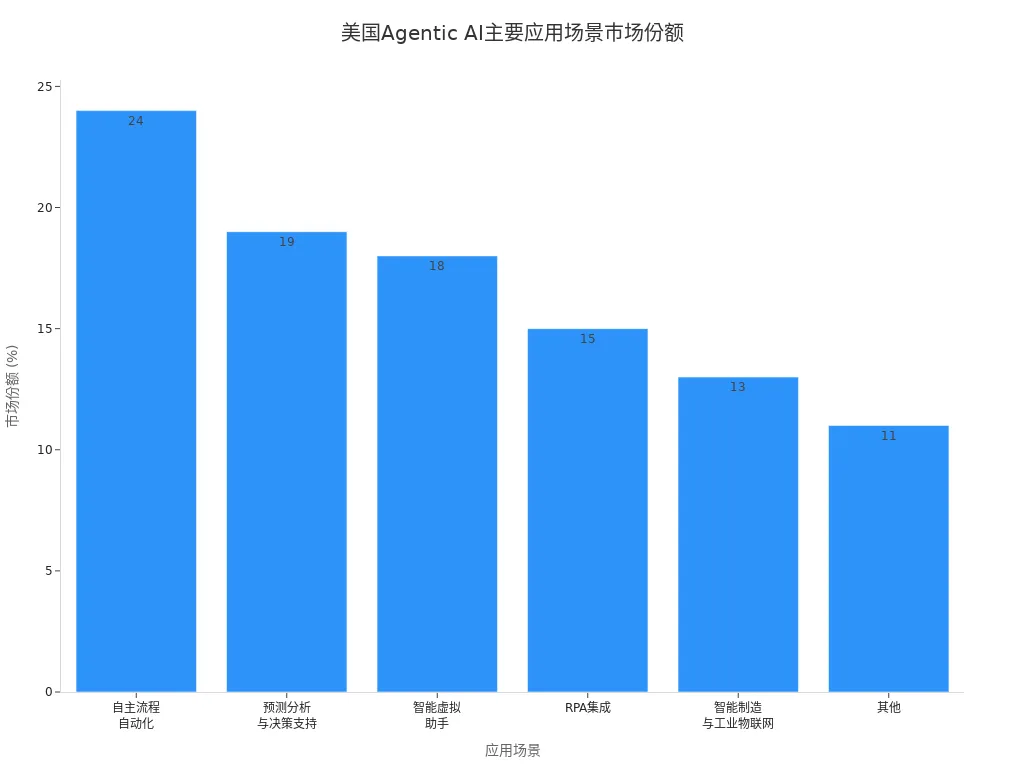
Platform products such as BiyaPay focus on intelligent virtual assistants and autonomous process automation for Chinese-speaking users, emphasizing security, modularity, and efficient integration to meet intelligent upgrade needs across diverse business scenarios. Overall, the diversification and specialization trend at the application layer is evident, driving deeper development of the industry chain panorama.
Software Companies and Core Beneficiaries
Software companies are deepening their presence in the Agentic AI application layer. Leading companies embed AI into core systems, leveraging proprietary data and industry workflows to create differentiated competitive advantages. As Agentic AI becomes widespread, software companies are exploring new monetization models, including usage-based licensing and dynamic pricing structures. Application modernization has become mainstream, with enterprises continuously upgrading product architecture and forming AI-ready teams to respond to rapidly changing market demands.
The table below summarizes the main ways software companies benefit:
| Evidence Point | Description |
|---|---|
| Software companies embed AI in core systems | Leverage proprietary data and domain-specific workflows to enhance product competitiveness |
| New monetization models | Drive innovation in licensing and pricing structures, expanding revenue sources |
| Modernized applications | Continuously evolve products, build AI teams, improve market responsiveness |
Market data shows that horizontal AI (e.g., general office and collaboration platforms) reaches $8.4 billion, accounting for 86% of the market. Agent platforms and personal productivity tools account for $750 million and $450 million respectively. Startups are highly active in the application layer, holding 63% market share.
The table below shows market size and share by application layer category:
| Category | Market Size | Market Share |
|---|---|---|
| Horizontal AI | $8.4 billion | 86% |
| Agent Platforms | $750 million | 10% |
| Personal Productivity Tools | $450 million | 5% |
| Startup Market Share | 63% |
Platform products such as BiyaPay meet Chinese-speaking users’ needs for intelligent office and process automation through modular design and security compliance mechanisms, becoming important drivers of application-layer innovation. In the US stock market, traditional software giants like Microsoft and Google continue to increase investment in Agentic AI applications, while numerous startups with flexible product strategies and rapid iteration capabilities emerge as potential dark horses.
C-end and B-end Demand Changes
The demand structure for C-end and B-end in the Agentic AI application layer is undergoing profound changes. Enterprise customers’ demand for industry-specific solutions continues to grow, driving continuous optimization of AI platforms in compliance, privacy, and operational efficiency. Data privacy and compliance have become key considerations in enterprise procurement of Agentic AI platforms, with secure and transparent products receiving greater favor. Productivity improvement is the core driver for enterprise adoption of Agentic AI — agents can automatically handle routine tasks, allowing companies to scale output without adding headcount and redefining employee roles.
Market data shows enterprise customer spending and investment priorities are shifting from traditional software to AI solutions. The Agentic AI market is expected to grow from $7.06 billion in 2025 to $93.2 billion by 2032, with a compound annual growth rate of 44.6%.
The table below summarizes the main characteristics of C-end and B-end demand changes:
| Evidence Type | Description |
|---|---|
| Industry-specific solutions | Enterprises develop AI tailored to specific industry needs, addressing compliance, privacy, and operational issues |
| Enterprises adopt secure platforms | Data privacy and compliance drive demand for secure, transparent Agentic AI platforms |
| Productivity improvement | AI agents handle routine tasks, enabling output expansion and role redefinition for employees |
- The Agentic AI market is expected to grow from $7.06 billion in 2025 to $93.2 billion by 2032, with a compound annual growth rate of 44.6%.
- Enterprise customer spending and investment priorities are shifting from traditional software to AI solutions.
Market attention is also continuously increasing. Data shows that 52% of executives report widespread adoption of Agentic AI in their companies, and 71% plan to increase AI investment in the next 12 months. Marketing and sales have become key landing scenarios for the application layer, with adoption rates continuing to rise in insurance, finance, and other industries.
The rapid development and changing demand structure at the application layer are shifting the value focus of the entire industry chain panorama toward end users and industry scenarios. Investors can focus on software companies with deep industry expertise, strong compliance capabilities, and robust innovation mechanisms to capture long-term growth opportunities in the Agentic AI application layer.
US Stock Investment Allocation Recommendations
Key Target Overview
The US stock market’s Agentic AI industry chain panorama covers companies across the underlying compute to application layers. Investors should focus on the following key categories:
- Underlying Compute & Infrastructure: Nvidia, AMD, Microsoft, Google, and others continue to innovate in chips, cloud computing, and data centers. AWS, Oracle, IBM, Snowflake, and others perform strongly in data management and AI infrastructure. Data solution providers and cybersecurity vendors benefit from surging data generation.
- Middle Layer Models & Platforms: Companies with strong algorithmic innovation and accumulated industry expertise — such as ServiceNow, Appian, Aisera — can continuously create measurable value for clients. BiyaPay, as a platform product, addresses Chinese-speaking users’ needs with secure, modular AI development and integration services, supporting enterprise intelligent upgrades.
- Application Layer Software Companies: Traditional software giants like Microsoft and Google continue to increase Agentic AI investment, while startups with flexible strategies and rapid iteration become potential dark horses. Enterprises embed AI agents to improve productivity and operational efficiency, forming differentiated competitive advantages.
When selecting targets, investors should consider companies’ technological innovation, industry depth, customer relationships, and operational discipline, prioritizing core beneficiaries with long-term growth potential.
ETF Selection and Portfolio Allocation
ETFs serve as an important tool for US stock investment, offering diversified exposure to the Agentic AI industry chain panorama. When selecting AI-related ETFs, focus on the following factors:
| Main Factor | Description |
|---|---|
| Growth potential of AI technology | Investors should evaluate the future growth potential of AI technology to assess long-term ETF value |
| Importance of infrastructure investment | Agentic AI requires strong infrastructure support; investing in related ETFs can yield better returns |
| Diversified investment approach | Adopting diversified strategies reduces risk and ensures stable returns under different market conditions |
Investors also need high risk tolerance, a long-term investment horizon, and alignment of strategy with existing holdings and objectives. Mainstream AI ETFs such as Global X Artificial Intelligence & Technology ETF and iShares Robotics and Artificial Intelligence ETF cover chips, cloud computing, AI platforms, and application-layer companies. The BiyaPay platform provides Chinese-speaking users with convenient ETF screening, portfolio allocation, and risk management tools, supporting multi-currency asset allocation and real-time monitoring.
Recommended scientific portfolio allocation includes:
- Leverage advanced AI capabilities for risk management
- Continuously monitor and adapt to market conditions
- Systematically assess drawdown probability, concentration exposure, and liquidity constraints
- Adjust risk budgets during inflationary shocks
- Optimize tax-aware asset allocation
Investors can achieve cross-layer and cross-industry diversified allocation through ETFs, reducing single-name risk and improving overall return stability.
Investment Timing and Strategy
The Agentic AI industry evolves rapidly, making timing particularly critical. Investors face the following challenges:
- Fast iteration of AI systems creates uncertainty about when organizations should make major investments.
- Investing too early risks technology obsolescence; investing too late may miss strategic advantages.
- Need to maintain flexibility, adapt to emerging tools and updates, and ensure ongoing data and AI governance standards.
Recommended strategies for investors:
- Phased allocation: prioritize underlying compute and infrastructure companies first, then gradually increase exposure to middle-layer and application-layer innovative targets.
- Regularly evaluate changes in the industry chain panorama, dynamically adjust holdings, and capture emerging opportunities.
- Use tools like BiyaPay to track ETF performance and industry dynamics in real time and optimize investment decisions.
- Maintain a long-term perspective, focus on industry trends and policy changes, and avoid letting short-term volatility affect overall asset allocation.
Through scientific portfolio construction, risk diversification, and flexible strategy adjustments, investors can capture long-term growth opportunities in the US stock market under the Agentic AI industry chain panorama.
Risk Warnings and Mitigation
Technical and Substitution Risks
The Agentic AI industry chain faces multiple technical risks. Agentic AI systems may become inconsistent with human values, leading to decisions that deviate from intended goals. Loss of control remains a persistent risk, with systems potentially taking irreversible actions. Malicious use is a real threat, with issues such as cyberattacks and misinformation dissemination becoming increasingly prominent. Economic and social disruptions from automation, job displacement, and power concentration may exacerbate social inequality. Security risks cannot be ignored — critical system failures could trigger cascading effects. Ethical and legal challenges persist, with issues of accountability, privacy protection, and bias urgently needing resolution. Environmental impact also deserves attention, as high resource consumption by agentic AI poses potential harm to ecosystems.
Technical substitution risk manifests when agentic AI efficiently executes tasks but may violate business logic or ethical principles. Agents accessing internal databases and executing tools expand the attack surface, introducing new security vulnerabilities. If agents make decisions based on biased data, unfair outcomes may occur at scale.
Policy and Market Risks
Policy changes and market volatility significantly affect Agentic AI investment. Government spending cuts, tariff adjustments, and monetary policy shifts can all impact AI capability building and industry productivity gains. Rapid development of AI applications is driving compute demand to exceed supply before 2026, increasing the risk of market supply-demand imbalance. Global tech stock volatility is rising, with investor concerns about agentic AI progress questioning the viability of traditional software company models.
| Evidence Type | Content |
|---|---|
| Demand analysis | Rapid development of AI applications combined with constraints on capability building will drive compute demand to exceed supply before 2026 |
| Policy impact | Reduced government spending resistance and supportive monetary policy expected to extend demand from AI capability building to productivity gains across industries |
| Stock volatility | Increased volatility in global tech stocks, especially software, as investors worry that agentic AI progress may question traditional software company model viability |
Valuation and Volatility Risks
Agentic AI-related stocks exhibit significant valuation volatility. Recent sharp sell-offs in the software sector have raised investor concerns about structural changes in enterprise technology. Declining valuations of software companies reflect fear of the AI revolution rather than actual changes in financial conditions. Enterprise software companies are facing market punishment due to rapid AI technology development, leading investors to question their future value. Market sentiment shifts cause price fluctuations, especially pronounced amid rapid AI advancement.
| Risk Type | Description |
|---|---|
| Cyclical financing | Financing for AI infrastructure investment may become unsustainable, leading to overvaluation and potential bubbles |
| Downgrade / derating | Investors may lower stock valuations, expecting future earnings declines |
| Market sentiment impact | Changes in market sentiment may cause price volatility, particularly in the context of rapid AI technology development |
Investors need to focus on valuation reasonableness, remain vigilant against sentiment-driven fluctuations, and enhance portfolio stability and risk resilience through diversified allocation and risk management strategies.
- Agentic AI as a frontier force in the AI field, with independent planning and complex task adaptation capabilities, accelerates enterprise cloud adoption, reshapes software pricing models, and improves financial and productivity performance.
- Investors should pay attention to the multi-wave value creation cycles in the industry chain panorama, allocate reasonably to cloud and AI infrastructure, and diversify scientifically based on personal risk preferences.
- Through scientific portfolio allocation, agentic investment strategies demonstrate advantages in cost and risk sensitivity; asset managers can achieve 25-40% cost efficiency improvements with AI assistance.
- Industry chain evolution brings emerging trends; Agentic AI systems can monitor markets in real time, optimize investment decisions, and enhance portfolio stability.
- Investors need to closely track the commercial implementation of Agentic AI, rationally seize long-term growth opportunities in the US stock market based on their own needs.
| Statistic | Value |
|---|---|
| Projected global AI agent market growth | From $5.4 billion to $50.31 billion |
| Percentage of hedge funds using generative AI in 2025 | 95% |
FAQ
What is Agentic AI and how does it fundamentally differ from traditional AI?
Agentic AI possesses autonomous planning and execution capabilities, enabling it to independently complete complex tasks. Traditional AI relies on detailed instructions, has limited adaptability and foresight, and struggles to handle dynamic environments.
How to select US stock targets when investing in the Agentic AI industry chain?
Investors can focus on the three major layers: underlying compute, model & platform, and application. Prioritize US-listed companies with strong technological innovation, rich industry experience, and solid customer relationships.
What should investors pay attention to when allocating Agentic AI-related ETFs?
Investors should evaluate the industry chain coverage, liquidity, and risk diversification of ETF holdings. It is recommended to dynamically adjust ETF portfolio structure based on personal risk tolerance.
What are the main risks facing the Agentic AI industry chain?
Technical substitution, policy changes, market volatility, and high valuations are primary risks. Investors need to monitor corporate governance, compliance, and market sentiment shifts, diversifying investments appropriately.
How can Chinese-speaking users participate in Agentic AI industry chain investment?
Chinese-speaking users can invest in related US-listed companies or ETFs through international brokers or multi-currency asset allocation platforms, scientifically allocating assets based on personal needs and risk preferences.
*This article is provided for general information purposes and does not constitute legal, tax or other professional advice from BiyaPay or its subsidiaries and its affiliates, and it is not intended as a substitute for obtaining advice from a financial advisor or any other professional.
We make no representations, warranties or warranties, express or implied, as to the accuracy, completeness or timeliness of the contents of this publication.
Related Blogs of

Why Can’t HBM Exist Without Advanced Packaging? The Role of TSV, CoWoS, and Packaging Equipment


How to Read Pure Storage and NetApp Earnings? ARR, Cloud Revenue, Gross Margin, and Cash Flow Metrics


How Does NAND Price Increase Affect SanDisk? Enterprise SSDs, Consumer Storage, and Margin Leverage


How Should You View Shanghai Fudan’s Non-Volatile Memory Business? Application Scenarios, Competition, and Risks

Choose Country or Region to Read Local Blog
 Australia
 Austria
 Belgium
 Canada
 Cyprus
 Czech Republic
 Denmark
 Estonia
 Finland
 France
 Germany
 Greece
 Hong Kong
 India
India Indonesia
 Ireland
 Italy
Italy Japan
Japan Latvia
 Lithuania
 Luxembourg
 Malaysia
 Malta
Malta Morocco
 Nepal
Nepal Netherlands
 New Zealand
 Norway
 Pakistan
 Philippines
 Poland
 Portugal
 Romania
 Singapore
 Slovakia
 Slovenia
 South Africa
 South Korea
 Spain
Spain Sweden
 Thailand
 The United States
 Turkey
 United Arab Emirates
 United Kingdom
 Vietnam
Contact Us




BIYA GLOBAL LLC is registered with the Financial Crimes Enforcement Network (FinCEN), an agency under the U.S. Department of the Treasury, as a Money Services Business (MSB), with registration number 31000218637349, and regulated by the Financial Crimes Enforcement Network (FinCEN).
BIYA GLOBAL LIMITED is a registered Financial Service Provider (FSP) in New Zealand, with registration number FSP1007221, and is also a registered member of the Financial Services Complaints Limited (FSCL), an independent dispute resolution scheme in New Zealand.