World Cup Period Surge in Flights to the US: Can Delta Air Lines (DAL) and United Airlines (UAL) Stocks Be Chased Now?




Image Source: unsplash
Investors facing the phenomenon of surging airfares to the US during the World Cup period need to remain cautious. Data shows that airfares to the US in December 2025 rose 19.89% compared to the previous month, while December 2024 saw a year-over-year increase of 26.27%.
| Time | Fare Change (%) |
|---|---|
| November 2025 | - |
| December 2025 | 19.89% |
| December 2024 | 26.27% |
Delta Air Lines (DAL) and United Airlines (UAL) benefit significantly in the short term, but investors should combine fundamentals with market volatility to rationally judge subsequent actions.
Key Takeaways
- During the World Cup period, airfares to the US rise sharply, and investors need to cautiously evaluate market dynamics.
- Airlines such as Delta Air Lines and United Airlines achieve significant profit growth under high demand, with short-term stock performance outperforming peers.
- Pay attention to the impact of oil price fluctuations on airline profitability; rising oil prices may compress profit margins.
- Investors should formulate reasonable investment strategies based on their own risk tolerance and avoid blindly chasing highs.
- Continuously monitor macroeconomic conditions and industry competition to assess the sustainability of airlines’ long-term performance.
Analysis of the Impact of Surging Airfares to the US During the World Cup
Image Source: unsplash
Surge in Demand and Insufficient Supply
The surge in airfares to the US during the World Cup period is primarily driven by a sharp increase in demand. It is expected that the World Cup will bring significant passenger traffic to airlines. Fans, media, and related staff are booking flights in large numbers, rapidly pushing up overall demand. Airlines are making strategic adjustments to cope with the anticipated influx of fans. The U.S. Department of Transportation predicts that domestic travel during the World Cup will be above average levels, with significant increases in demand for short- and medium-haul flights, especially during group stage and knockout matches. The 2026 World Cup will feature 48 teams and 104 matches for the first time, attracting more fans and media participation.
| Source of Evidence | Main Content |
|---|---|
| Amadeus Travel Intelligence | During the 2026 World Cup, flight bookings to North America increased 15% year-over-year. After the match schedule was released, 37% of bookings were completed within one month. UK tourists accounted for 18% of international bookings. |
On the supply side, although airlines are actively adding flights to meet demand, structural shortages still exist. Major U.S. airlines such as American Airlines added 27,000 flights during the World Cup, covering popular routes such as Los Angeles–Seattle, Boston–Dallas–Fort Worth, and Atlanta–Miami. Fans show particularly strong demand for short- and medium-haul flights during the group stage and knockout rounds. Despite the increase in flight numbers, it remains difficult to fully meet the surging demand, resulting in sustained fare increases.
Impact on Airline Performance
The surge in airfares to the US during the World Cup directly drives improved airline performance. As major participants in the U.S. market, Delta Air Lines and United Airlines benefit significantly. High fares drive revenue and profit growth, and airlines optimize flight schedules and improve load factors through strategic adjustments. Data shows that Delta Air Lines achieved $5B in profit, with record revenue and a target of approximately 20% earnings growth. United Airlines expects record profits in 2026, with profits reaching $1.04B driven by high fares.
| Airline | Profit | Revenue Growth Situation |
|---|---|---|
| Delta Air Lines | $5B | Record revenue, targeting approximately 20% earnings growth |
| United Airlines | $1.04B | Expected record profits in 2026, driven by high fares |
Although some flights were temporarily adjusted or canceled, overall booking conditions remain strong, demonstrating high demand for air travel to the US during the World Cup. Since the event is held across the United States, Canada, and Mexico, many fans flexibly arrange match itineraries, reducing the overall risk of travel cancellations. Airlines maximize revenue through flexible scheduling and optimized route layouts.
Short-Term Stock Performance
The surge in airfares to the US during the World Cup drives outstanding short-term stock performance for airlines. Investors focus on the positive impact of high fares and passenger traffic growth on performance, pushing up Delta Air Lines and United Airlines stock prices. Market data shows significant increases in flight bookings and substantial fare rises, with investors expecting airlines to achieve higher profits. In the short term, stock prices benefit from performance improvements and market sentiment, outperforming the industry average.
Airlines enhance profitability through strategic adjustments and flexible responses. Investors need to pay attention to the sustainability of the airfare surge to the US during the World Cup, as well as the airlines’ measures in supply and operations. Short-term positives drive stock price increases, but long-term performance still requires comprehensive judgment based on macroeconomic conditions, industry competition, and other factors.
Investment Opportunities and Earnings Performance

Image Source: pexels
Market Data and Earnings Highlights
Recent earnings reports from Delta Air Lines and United Airlines show strong performance, demonstrating solid profitability for both companies amid the surge in airfares to the US during the World Cup. Delta Air Lines achieved a historic $5 billion profit in 2025, with annual revenue growth of 2%-4% and earnings per share guidance of approximately $6. United Airlines reported $4.3 billion in annual profit in 2025, with fourth-quarter profit of $1.325 billion, earnings per share of $10.20 (up 8% year-over-year), fourth-quarter revenue of $15.4 billion (a record high).
The table below summarizes the key financial indicators of the two companies:
| Airline | Key Financial Indicators |
|---|---|
| Delta Air Lines | Record profit $5 billion, annual revenue growth 2%-4% |
| Earnings per share guidance approximately $6 | |
| United Airlines | Annual profit $4.3 billion, Q4 profit $1.325 billion |
| Earnings per share $10.20, up 8% year-over-year | |
| Q4 revenue $15.4 billion, record high |
United Airlines’ actual earnings per share range was $3–3.5, exceeding analysts’ expectation of $2.86, demonstrating the company’s earnings resilience amid rising fares and surging demand. Delta Air Lines also benefits from high fares and passenger traffic growth, with earnings data directly reflecting the positive pull from surging airfares to the US during the World Cup.
Fuel costs and hedging strategies are also important factors affecting airline performance. Delta Air Lines effectively controls cost volatility through flexible fuel hedging strategies. United Airlines relies on scale advantages and route network optimization to improve operational efficiency. Both companies emphasize in their earnings reports that they will continue to optimize cost structures in the future to address oil price fluctuations and market uncertainty.
Valuation and Gain Comparison
While focusing on performance, investors also need to evaluate the valuation levels and market performance of airline stocks. Delta Air Lines currently has a P/E ratio of 7.70, which is at a relatively low level in the industry, indicating certain valuation advantages. Although United Airlines has not disclosed the latest P/E ratio, its total revenue in 2025 reached $59.1 billion (up 3.5% year-over-year), adjusted earnings per share of $10.20 (up 8% year-over-year), and record full-year passenger volume, showing strong fundamental support.
Recently, Delta Air Lines saw pre-market gains of 8%, with early session gains of 6.4%, while United Airlines rose 4%, both outperforming American Airlines and Southwest Airlines. The table below compares the recent stock gains of major airlines:
| Airline | Stock Gain |
|---|---|
| Delta Air Lines | 8% (pre-market) |
| Delta Air Lines | 6.4% (early session) |
| United Airlines | 4% |
| American Airlines | 4% |
| Southwest Airlines | 2% |
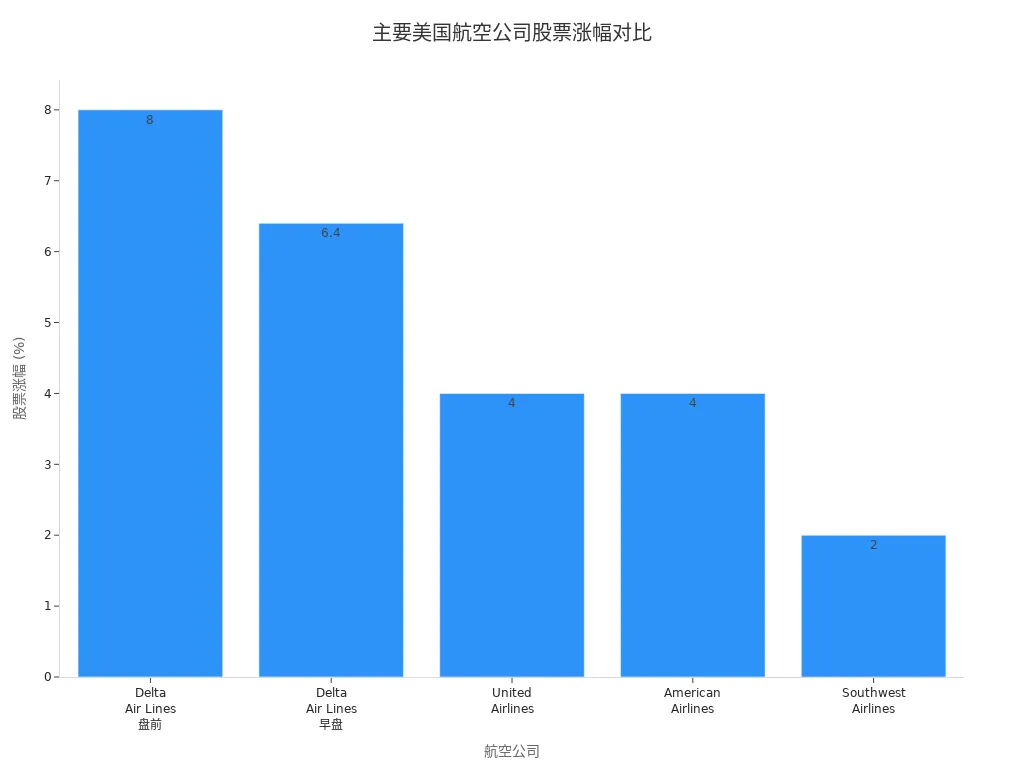
Delta Air Lines and United Airlines outperform their peers in stock performance, reflecting high market expectations for performance improvements driven by surging airfares to the US during the World Cup. Investors need to pay attention to the match between valuation and performance to avoid valuation bubbles caused by short-term positives.
If you plan to keep tracking event-driven names such as DAL and UAL, it is often more useful to verify the data in more detail rather than focus only on short-term price moves. For example, you can use BiyaPay’s stock information lookup to review share price, basic company data, and market performance, then compare that with the airfare trend, oil-price pressure, and earnings cycle discussed in the article to judge whether the trading thesis is still intact. If multi-currency fund planning is also part of your process, you can check the official website for its cross-border payment and fund-management scenarios. As a multi-asset trading wallet, BiyaPay covers cross-border payments, trading, and asset management use cases, and has relevant registrations and licensing disclosures in jurisdictions including the United States and New Zealand, making it a practical support tool for cross-border investing.
Industry Prosperity and Growth Expectations
The overall prosperity of the U.S. aviation industry continues to improve, with optimistic growth expectations. Global business travel spending is expected to reach $1.62 trillion in 2026, with an annual growth rate of 8.1%. U.S. company budgets are expected to grow 4.9%, while European company budgets grow 5.8%. Total U.S. travel spending is forecast to reach $1.2 trillion in 2026.
The table below shows the main growth indicators of the industry:
| Indicator | 2025 Forecast | 2026 Forecast | Annual Growth Rate |
|---|---|---|---|
| Global Business Travel Spending | $1.57 trillion | $1.62 trillion | 8.1% |
| U.S. Company Budget Growth | N/A | 4.9% | N/A |
| European Company Budget Growth | N/A | 5.8% | N/A |
| U.S. Total Travel Spending Forecast | N/A | $1.2 trillion | N/A |
The surge in airfares to the US during the World Cup not only drives airline performance but also enhances overall industry prosperity. With the continued recovery of global business and leisure travel demand, the aviation industry is expected to maintain medium-to-high growth. For Chinese-speaking users, choosing cross-border payment tools such as Biyapay that support multi-currency settlement and convenient payments helps improve the ticketing and travel experience and meet diverse fund management needs. U.S. stock investors can comprehensively judge investment opportunities in Delta Air Lines and United Airlines by combining industry prosperity, company earnings performance, and valuation levels.
Risk Factor Analysis
Oil Price Fluctuations and Profit Risks
Airline profitability is highly dependent on fuel costs. Recently, global oil prices have risen significantly, with Brent crude approaching USD 90 per barrel, mainly due to geopolitical tensions, particularly the conflict between the United States and Iran. Fuel costs account for 25.7% of airline operating expenses, becoming a key factor affecting profits. Jet fuel costs are rising even faster than crude oil itself, and the widening ‘crack spread’ further compresses airline profit margins. If oil prices remain high, the profitability of Delta Air Lines and United Airlines will face direct threats.
Investors need to closely monitor international oil price trends and airline fuel hedging strategies to timely assess profit risks.
Sustainability of Short-Term Positives
International events such as the World Cup bring short-term demand peaks, and airlines actively respond by adding flights and deploying larger aircraft. For example, American Airlines added 27,000 extra seats during the event, covering 12 routes, including temporary direct flights and larger aircraft deployment. The table below shows relevant data:
| Airline | Extra Seats | Number of Routes | Remarks |
|---|---|---|---|
| American Airlines | 27,000 | 12 | Temporary direct flights and larger aircraft deployment, short-term demand peak |
Nevertheless, questions remain about whether short-term positives can be sustained. Safety issues, market volatility, and demand回落 after the event may all affect subsequent airline revenue. Investors should be wary of performance fluctuations driven by short-term events and avoid blindly chasing highs.
Macroeconomic and Industry Competition
The U.S. aviation industry is influenced by multiple macroeconomic factors. Premium travel demand remains strong, but changes in consumer confidence and spending habits may affect overall revenue. Fuel price fluctuations directly impact operating costs, while capacity management capabilities determine pricing power and load factors. Geopolitical events continue to affect international travel, and labor costs and staffing also become important variables for profit margins. Industry consolidation trends are evident, with some companies optimizing market structure through bankruptcy reorganization, and large airlines such as Delta and United benefiting from increased market share.
| Competitive Factor | Impact |
|---|---|
| Premium Services | Delta and United enhance market share through premium seating and loyalty programs |
| Airport Hub Advantages | Major city hub status helps manage capacity and pricing |
| Profitability | Delta and United outperform American Airlines in profitability |
Delta and United maintain leadership through premium services and hub advantages, but the competitive landscape continues to evolve, and investors need to monitor dynamic changes in market share and profitability.
Policy and External Uncertainty
The U.S. aviation industry faces multiple policy and external uncertainties. Tariff policies directly affect new aircraft delivery schedules, and Delta Air Lines has delayed fleet expansion plans due to tariffs. Changes in consumer demand and economic uncertainty make airlines conservative in expansion and fleet planning. Government policy adjustments, potential government shutdowns, or changes in travel policies may all bring operational risks. Investors should pay attention to policy dynamics and changes in the external environment and adjust investment strategies in a timely manner.
In summary, oil prices, short-term demand, macroeconomic conditions, industry competition, and policy risks collectively affect the long-term performance of airlines, and investors need to comprehensively assess multiple risk factors.
Investment Recommendations
Buy, Wait and See, or Build Positions in Batches
In the current market environment, investors need to combine airline fundamentals and market performance to formulate scientific investment strategies. Data shows that Delta Air Lines and United Airlines stocks have recently risen 88.1% and 150% respectively, with excellent performance. Among analysts’ ratings for the two companies’ stocks, 89% recommend buying, with only 7.1% recommending hold and 3.6% recommending sell. Most institutions are optimistic about their medium- to long-term growth potential.
| Airline | Stock Performance | Investment Strategy | Price Target |
|---|---|---|---|
| Delta Air Lines | Up 88.1% | Focus on premium travel and capacity management | $100 |
| United Airlines | Up 150% | Premiumization and strategic route expansion | $130 |
Delta Air Lines is implementing a diversification strategy to improve operational efficiency and reduce debt, targeting $10 billion in free cash flow between 2023 and 2025. United Airlines focuses on premium products and route network optimization to attract high-value customers. Considering the cyclical nature of the aviation industry and short-term positive factors, investors can adopt a batch position-building strategy to gradually increase holdings and reduce the risk of buying at a single point. For investors with lower risk tolerance, it is recommended to wait and see, waiting for market pullbacks or further performance confirmation before making decisions.
Risk Control and Key Focus Areas
The aviation industry is highly volatile, and investors need to focus on the following risk factors:
- Oil price fluctuations directly affect airline profitability. Investors should closely track international oil price trends and company fuel hedging strategies.
- Changes in market supply and demand relationships may lead to fare adjustments, affecting revenue and profit performance.
- Airline financial conditions and debt levels need continuous monitoring, especially during fluctuations in industry prosperity.
- Industry trends and policy changes may bring uncertainty, including new technology applications, environmental policies, international travel restrictions, etc.
- Major accidents or negative public opinion can affect customer trust and future bookings, requiring attention to company response measures and brand management.
Investors should rationally assess their own risk tolerance and flexibly adjust positions based on market dynamics. It is recommended to regularly review investment logic, pay attention to company earnings reports, industry data, and macroeconomic changes, and avoid blindly chasing highs due to short-term positives. For Chinese-speaking users, cross-border investment needs to consider exchange rate fluctuations and compliance of fund flows; choosing compliant U.S. stock brokers and multi-currency settlement tools helps improve fund management efficiency.
Delta Air Lines and United Airlines benefit significantly during the World Cup period, but investors need to rationally judge whether to chase at high levels.
- Risk tolerance determines investment strategy; individuals should adjust positions according to their own preferences to cope with market volatility.
- Airlines are highly sensitive to fuel costs and geopolitics; after sharp price increases, the market may see corrections.
Investors should continue to monitor market dynamics, combine with their actual situation, and avoid blindly chasing highs.
FAQ
Why do airfares to the US surge significantly during the World Cup period?
Surging demand drives fare increases. Fans, media, and business travelers concentrate bookings, while airline capacity is limited, leading to supply-demand imbalance and direct price rises.
Can the earnings growth of Delta Air Lines and United Airlines be sustained?
Earnings growth is highly dependent on short-term demand brought by the event. After the event ends, performance will depend on multiple factors including macroeconomic conditions, oil prices, and industry competition.
How much impact do oil price fluctuations have on airlines?
Fuel costs account for a high proportion of operating expenses. Rising oil prices compress profit margins. Airlines usually adopt hedging strategies but cannot completely avoid risks.
What are the main risks to consider when investing in airline stocks?
Investors need to pay attention to oil prices, market demand, policy changes, and industry competition. After short-term positives end, stock prices may pull back. Rationally assessing risk tolerance is very important.
*This article is provided for general information purposes and does not constitute legal, tax or other professional advice from BiyaPay or its subsidiaries and its affiliates, and it is not intended as a substitute for obtaining advice from a financial advisor or any other professional.
We make no representations, warranties or warranties, express or implied, as to the accuracy, completeness or timeliness of the contents of this publication.
Related Blogs of

How Is China’s Memory Supply Chain Different from Overseas Memory Leaders? A Comparison with Micron, SanDisk, Western Digital, and Seagate


How to Read NAND Contract Prices and Spot Prices? Why Enterprise SSDs and Consumer SSDs Do Not Move in Sync


How Does NAND Price Increase Affect SanDisk? Enterprise SSDs, Consumer Storage, and Margin Leverage


How to Read Pure Storage and NetApp Earnings? ARR, Cloud Revenue, Gross Margin, and Cash Flow Metrics

Choose Country or Region to Read Local Blog
 Australia
 Austria
 Belgium
 Canada
 Cyprus
 Czech Republic
 Denmark
 Estonia
 Finland
 France
 Germany
 Greece
 Hong Kong
 India
India Indonesia
 Ireland
 Italy
Italy Japan
Japan Latvia
 Lithuania
 Luxembourg
 Malaysia
 Malta
Malta Morocco
 Nepal
Nepal Netherlands
 New Zealand
 Norway
 Pakistan
 Philippines
 Poland
 Portugal
 Romania
 Singapore
 Slovakia
 Slovenia
 South Africa
 South Korea
 Spain
Spain Sweden
 Thailand
 The United States
 Turkey
 United Arab Emirates
 United Kingdom
 Vietnam
Contact Us




BIYA GLOBAL LLC is registered with the Financial Crimes Enforcement Network (FinCEN), an agency under the U.S. Department of the Treasury, as a Money Services Business (MSB), with registration number 31000218637349, and regulated by the Financial Crimes Enforcement Network (FinCEN).
BIYA GLOBAL LIMITED is a registered Financial Service Provider (FSP) in New Zealand, with registration number FSP1007221, and is also a registered member of the Financial Services Complaints Limited (FSCL), an independent dispute resolution scheme in New Zealand.