China Merchants Bank / China Construction Bank Outflow Flagged as Non-Counter? Revealing Bank Risk Control Rules for Crypto Asset to Fiat Conversion





Image Source: pexels
When withdrawing funds from China Merchants Bank, users often worry whether non-counter operations will trigger bank risk control. The bank uses systems to automatically identify large-amount or frequent fiat exchange transactions related to crypto assets, with a focus on reviewing the source and destination of funds. Some users, due to a lack of compliant supporting documents, are prone to having their accounts frozen or investigated. Users need to understand the bank’s monitoring mechanisms in advance and standardize operating procedures to effectively reduce risks.
Key Takeaways
- Understanding the bank’s risk control mechanisms and preparing compliant supporting documents in advance can effectively reduce the risk of account freezing.
- When using non-counter withdrawal channels, pay attention to transaction amounts and frequency to avoid triggering the bank’s risk control review.
- Providing detailed proof of fund sources and transaction records can accelerate the bank’s compliance review process and ensure smooth withdrawals.
- Briefly explain the purpose of funds in the remarks, avoiding sensitive words, which helps the bank understand the transaction background and reduce review delays.
- Choose compliant withdrawal channels and partners to ensure fund security and reduce transaction risks.
Key Points on China Merchants Bank Non-Counter Outflow Risk Control
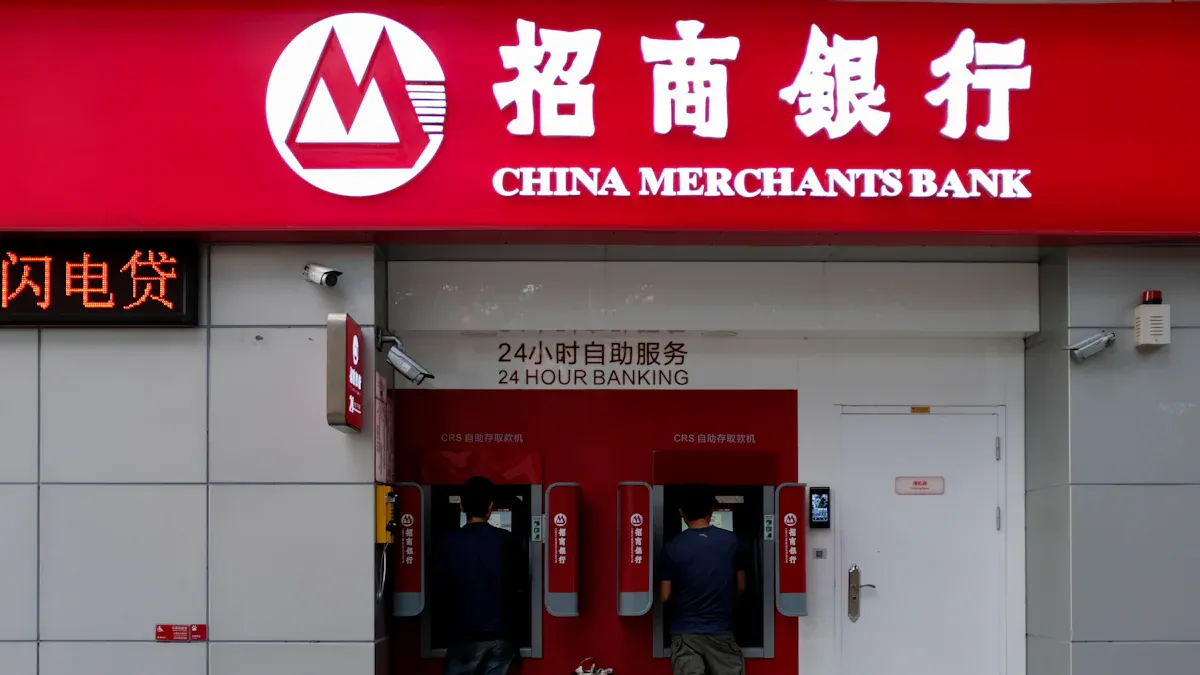
Image Source: unsplash
Non-Counter Withdrawal Channels and Definitions
The non-counter channels for China Merchants Bank outflows mainly include online banking, mobile banking, ATM self-service devices, and third-party payment platforms. These channels allow users to complete fund transfers without personally visiting a bank counter. When users use these methods, the system automatically records transaction time, amount, recipient account, and other information. The bank sets different monitoring and review standards based on the risk level of each channel. For example, single transfer limits for mobile banking and online banking are usually lower than counter operations, and ATM withdrawals also have daily caps.
In the scenario of crypto asset to fiat conversion, users often choose non-counter methods for China Merchants Bank outflows to improve efficiency and convenience. However, the bank’s risk control measures for these channels are relatively strict, particularly focusing on whether the fund flow involves high-risk areas such as crypto asset trading platforms or overseas accounts. The bank uses big data analysis to identify abnormal transaction behavior and conducts focused monitoring on suspicious fund flows.
Common Risks Triggering Risk Control
During China Merchants Bank outflows, non-counter operations are more likely to trigger risk control. The bank mainly focuses on the following types of risks:
- Unclear source of funds: If the user cannot provide legal and compliant proof of fund sources, the bank will classify the transaction as high-risk.
- Abnormal transaction frequency: Multiple large-amount China Merchants Bank outflows in a short period will trigger automatic system alerts.
- Mismatch between account and recipient information: If the recipient account does not match the user’s identity information, the bank will conduct further verification.
- Involvement with crypto asset-related platforms: The bank focuses on monitoring fund flows related to crypto asset exchanges, especially transactions with overseas platforms.
- Fund flows to sensitive regions: If funds frequently flow to high-risk countries or regions such as the United States, the bank will intensify review efforts.
Tip: Once the bank system determines that a transaction poses a risk, it may temporarily freeze the account, require the user to provide additional transaction proof materials, or even initiate a compliance investigation process.
Bank Monitoring of Large and Frequent Transactions
The bank has a comprehensive monitoring mechanism for large and frequent China Merchants Bank outflow transactions. The system sets risk control thresholds based on multiple dimensions such as transaction amount, frequency, and recipient account type. For example, non-counter outflows exceeding 10,000 USD per transaction or cumulatively over 30,000 USD per day will automatically trigger risk control review.
The bank also combines the user’s historical transaction behavior to analyze whether there are abnormal patterns. If a user rarely conducts large-amount China Merchants Bank outflows in normal times but suddenly has large or high-frequency operations, the system will list the account as a key monitoring target.
The table below shows common bank risk control monitoring dimensions:
| Monitoring Dimension | Trigger Condition Example | Possible Consequences |
|---|---|---|
| Single Transaction Amount | >10,000 USD | Review / Freeze |
| Daily Cumulative Amount | >30,000 USD | Review / Freeze |
| Transaction Frequency | >5 large outflows in 1 day | Review / Investigation |
| Fund Flow Direction | Overseas / Crypto asset platforms | Review / Investigation |
Once a bank card is subject to risk control, users will be unable to continue China Merchants Bank outflows through non-counter channels, and in some cases, may even be unable to use funds in the account normally. The bank will require the user to provide detailed transaction explanations, proof of fund sources, and other materials until the risk investigation is completed.
In actual operations, users should understand the bank’s risk control rules in advance, reasonably plan China Merchants Bank outflow schedules, and avoid account restrictions due to improper operations.
Bank Monitoring of Crypto Asset to Fiat Conversion

Image Source: pexels
Transaction Monitoring and Identity Verification Requirements
When handling transactions involving crypto asset to fiat conversion, banks always prioritize anti-money laundering and prevention of financial crimes. Compliance officers continuously monitor all fund flows involving crypto assets. Banks require customers to complete strict identity verification (KYC), including verification of ID documents, facial recognition, proof of address, and other steps.
In actual operations, banks and cryptocurrency exchanges take the following measures:
- Employ anti-money laundering compliance officers, specifically responsible for monitoring crypto asset-related transactions.
- Require customers to submit detailed identity information to ensure the account holder is real and legitimate.
- Continuously track transaction records and issue timely alerts when abnormal fund flows are detected.
- Report suspicious activities to regulatory authorities (such as the U.S. Financial Crimes Enforcement Network FinCEN, Financial Action Task Force FATF).
Taking Biyapay as an example, Chinese-speaking users must upload passports, proof of address, and other documents when conducting crypto asset to fiat conversion, and undergo multiple identity verifications to ensure every fund flow is traceable. The bank system automatically compares customer profiles with transaction behavior; if identity information does not match the fund flow, the system immediately triggers risk control review.
Through KYC and continuous monitoring, banks effectively prevent risks of money laundering, terrorist financing, and other financial crimes, safeguarding the security of the financial system.
Transaction Proof and Fund Source Review
When reviewing crypto asset to fiat conversion transactions, banks typically require customers to provide detailed transaction proof and fund source materials. Common supporting documents include:
- Fund source documents, such as pay stubs, investment income proofs, etc.
- Relevant contracts or agreements
- Invoices
- Tax declaration forms
- Official translations
- Notarized or certified documents
- Explanation materials in the bank’s specified format
In scenarios such as China Merchants Bank outflows, if customers cannot provide the above materials, the bank has the right to reject the transaction or freeze the account. Some Hong Kong licensed banks require customers to supplement detailed transaction ledgers for crypto asset transactions, and may even need contracts or communication records with transaction counterparties. Platforms like Biyapay recommend that Chinese-speaking users prepare all relevant proofs in advance to ensure every link in the fund flow is supported by legal and compliant documents.
Sufficient transaction proof and fund source explanations help banks quickly complete compliance reviews and reduce the risk of account freezing.
Typical Risk Control Scenario Analysis
When monitoring crypto asset-related transactions, banks combine multi-dimensional data analysis to identify suspicious behavior. The following are common risk control scenarios:
| Risk Control Scenario Description | Bank Monitoring Focus | Possible Consequences |
|---|---|---|
| Large deposit into new account followed by full transfer out in short term | Account fund flow does not match customer profile | Trigger risk control investigation, account freeze |
| Frequent large transfers between multiple accounts | Unclear source and destination of funds | Require supplementary transaction proof |
| Frequent conversion of various cryptocurrencies to fiat | Lack of reasonable commercial explanation | Account restrictions, require compliance explanation |
| Small amounts from multiple wallets, then centralized outflow | Dispersed fund inflows, suspected money laundering | Bank reports to regulatory authorities |
| Frequent large USD conversions to cryptocurrencies | Unclear transaction purpose | Key monitoring, restrict certain functions |
Platforms like Biyapay use risk control systems to automatically identify the above abnormal behaviors and promptly remind Chinese-speaking users to supplement materials or adjust transaction methods. After detecting suspicious transactions, banks usually require customers to provide detailed transaction explanations and proof of fund sources, and may suspend related operations such as China Merchants Bank outflows until the risk investigation is completed.
Through multi-dimensional risk control models, banks can effectively identify and intercept high-risk crypto asset transactions, protecting the security of customers and the financial system.
Risk Control Trigger Mechanisms and Responses
Fund Anomalies and Account Freezing
When handling China Merchants Bank outflows and crypto asset to fiat conversions, banks always pay attention to abnormal fund flow situations. The system automatically tracks fund sources and destinations, identifying large, frequent, or pattern-abnormal transactions. Fund anomalies manifest as large USD inflows or outflows in short periods, dispersed funds then centralized outflows, and aggregations related to crypto asset platforms. Banks use AI to analyze transaction patterns and wallet connections, identifying money laundering techniques such as mixers, cross-chain transfers, and rapid fund movements. The table below shows common detection methods used by banks:
| Detection Method | Description |
|---|---|
| Transaction Tracing | Start from known suspicious addresses, track fund flows, and build transaction graphs |
| Pattern Recognition | Identify patterns such as fund aggregation, layering, and rapid splitting, indicating intentional concealment |
| Exit Point Identification | Identify points where funds leave the blockchain, such as centralized exchanges, for identity verification |
Once the system detects fund anomalies, the bank will immediately freeze the account and suspend China Merchants Bank outflow operations. Customers must provide detailed fund sources and transaction proof to cooperate with the compliance investigation. During the freeze period, account funds cannot be transferred out, and some functions are restricted.
Risks of Off-Site and High-Frequency Operations
Banks maintain high vigilance toward off-site operations and high-frequency transactions. If customers conduct multiple large USD transfers via devices in different regions within a short time, the system will automatically flag them as high-risk behavior. High-frequency operations include multiple large outflows in one day, frequent changes of recipient accounts, and fund flows to sensitive regions. AI-driven solutions help institutions detect hidden risks and monitor complex financial behaviors. Banks combine customer historical transaction behavior to analyze whether there are abnormal patterns. If off-site operations do not match customer identity or high-frequency transactions lack reasonable explanations, the bank will intensify review efforts or even suspend certain account functions.
Through continuous monitoring and intelligent analysis, banks effectively prevent risks of money laundering, terrorist financing, and other financial crimes, safeguarding the security of the financial system.
Suggestions for Responding to Risk Control Investigations
When encountering risk control investigations, customers should adopt scientific response measures. Recommendations include:
- Freeze activity. Do not further move funds, consolidate funds, exchange, or withdraw.
- Use alternative KYT services to confirm the legitimacy of fund sources and save relevant screenshots.
- Do not wait for the account to be locked. Immediately contact the custodian holding the wallet keys, such as exchange or new bank support services, describe the situation in detail, and send proof materials.
- If large amounts are involved, consult lawyers specializing in cryptocurrency and anti-money laundering law.
- Record all operations with custodians, including screenshots, communications, and tracing. These materials may become key evidence when communicating with banks, regulators, or law enforcement.
By standardizing operations, timely communication, and fully preparing materials, customers can help quickly lift risk control and restore normal functions for China Merchants Bank outflows and accounts. Banks encourage customers to proactively cooperate with investigations to ensure legal and compliant fund flows.
Compliant and Secure Withdrawal Recommendations
Document Preparation and Transaction Standardization
Compliant withdrawal operations require users to prepare complete documents in advance and strictly comply with bank and regulatory norms. When Chinese-speaking users conduct crypto asset to fiat conversion, it is recommended to follow these steps:
- Customer due diligence: Collect counterparty company information, beneficiaries, websites, domains, legal addresses, contracts or job descriptions, LinkedIn profile links, and prepare invoices.
- KYT and address screening: Use more than two independent service providers to screen counterparty addresses and receiving addresses, saving all original screenshots, PDF reports, and their hash values.
- Jurisdiction and sanctions risk: Ensure counterparties and supply chains are not on sanctions lists.
- Wallet management: Recommend using new non-custodial addresses with no historical inputs to reduce risk.
- Network and asset confirmation: Verify asset codes, networks, chain IDs, address formats, etc., to avoid audit failures due to technical details.
- Test transaction: Conduct small-amount test transfers with counterparties first to ensure smooth process.
- Settlement rules: Clearly define fee-bearing parties and payment confirmation methods.
- Fund source proof: Require counterparties to provide non-privacy-revealing historical records.
- Bank communication: Confirm required documents and limits with the bank in advance to avoid delays due to incomplete materials.
- Evidence management: Create a dedicated folder to record every step of operations.
- Risk control response: Predefine handling processes for red flags.
- Tax and accounting: Prepare all data required by the accounting department.
Sufficient document preparation and standardized operations help banks quickly complete compliance reviews and reduce the risk of account freezing.
Batch Withdrawals and Remark Techniques
Banks strictly monitor large and high-frequency outflows. Users can adopt batch withdrawal methods to reduce single transaction amounts and lower the probability of triggering risk control. For example, split the total amount into multiple transactions, each not exceeding the bank’s risk control threshold (e.g., 10,000 USD), and reasonably schedule withdrawal times to avoid concentrated operations in short periods.
Remarks are equally critical. It is recommended to briefly explain the purpose of funds in each transfer remark, such as “service fee settlement” or “project cooperation payment,” avoiding sensitive words like “cryptocurrency” or “virtual assets.” Standardized remarks help banks understand fund flows and reduce unnecessary reviews.
In actual operations, Chinese-speaking users can refer to the withdrawal processes of platforms like Biyapay, combined with compliance suggestions provided by the platform, to further enhance withdrawal security.
Choosing Compliant Channels and Partners
Choosing compliant withdrawal channels and partners is key to ensuring fund security. Users should prioritize service providers with regulatory qualifications, transparent operating processes, and large historical transaction volumes. The table below compares the features of mainstream compliant channels:
| Selection Criteria | Biyapay (Example) | CoinsPaid | NOWPayments |
|---|---|---|---|
| Regulatory Compliance | Cooperation with Hong Kong licensed banks, strict compliance review | EU licensed, suitable for regulated markets | Registered in St. Vincent and the Grenadines |
| Operation Support | Provides end-to-end crypto asset to fiat conversion services | Supports full crypto payment process | Provides crypto-to-crypto payment infrastructure |
| Historical Processing Volume | Cumulative processing volume over $1 billion since 2019 | Cumulative processing volume over $2.8 billion since 2019 | Cumulative processing volume over $1 billion since 2019 |
Platforms like Biyapay provide compliant withdrawal solutions for Chinese-speaking users, supporting multiple currencies and networks, and cooperating with Hong Kong licensed banks to meet the compliance needs of different users. When selecting partners, users should focus on their compliance qualifications, service capabilities, and historical performance to ensure funds arrive safely and smoothly.
China Merchants Bank and China Construction Bank implement multi-dimensional risk control on non-counter outflows and crypto asset to fiat conversions, with key focus on fund sources, transaction frequency, and flow directions. Compliant operations and sufficient document preparation help reduce account freezing risks. Users should closely monitor changes in bank policies, flexibly adjust withdrawal strategies based on their transaction characteristics. Compliance and security are always prerequisites for successful fund arrival.
FAQ
Why are China Merchants Bank / China Construction Bank non-counter outflows prone to triggering risk control?
Banks focus on monitoring large, frequent, or crypto-related non-counter outflows. The system automatically identifies abnormal transactions to ensure fund security and prevent money laundering risks.
How should users prepare compliant documents to successfully complete crypto asset to fiat conversion?
Users need to prepare proof of fund sources, contracts, invoices, tax declaration forms, and other materials in advance. After the bank reviews complete documents, the withdrawal process will be smoother.
What impact do remarks have on withdrawal reviews?
Remark content should be concise and standardized, explaining the purpose of funds. Avoid using sensitive words like “cryptocurrency” or “virtual assets” to help banks quickly understand the transaction background.
How should users respond after an account is frozen?
Users should immediately contact the bank and proactively provide transaction proof and fund source explanations. Cooperating with compliance investigations helps restore normal account functions as soon as possible.
*This article is provided for general information purposes and does not constitute legal, tax or other professional advice from BiyaPay or its subsidiaries and its affiliates, and it is not intended as a substitute for obtaining advice from a financial advisor or any other professional.
We make no representations, warranties or warranties, express or implied, as to the accuracy, completeness or timeliness of the contents of this publication.
Related Blogs of

Why Is HDD Supply and Demand Tightening? AI Data Centers, Long-Term Agreements, and Western Digital/Seagate Pricing Power


What Is the Difference Between DRAM Contract Price and Spot Price? Which Indicator Should Investors Watch?


AI Storage Supply Chain Map: Chips, HDDs, SSDs, Packaging Equipment, and Enterprise Storage Systems


How Do AI Servers Drive Storage Demand? The Roles of HBM, Server DRAM, Enterprise SSDs, and HDDs

Choose Country or Region to Read Local Blog
 Australia
 Austria
 Belgium
 Canada
 Cyprus
 Czech Republic
 Denmark
 Estonia
 Finland
 France
 Germany
 Greece
 Hong Kong
 India
India Indonesia
 Ireland
 Italy
Italy Japan
Japan Latvia
 Lithuania
 Luxembourg
 Malaysia
 Malta
Malta Morocco
 Nepal
Nepal Netherlands
 New Zealand
 Norway
 Pakistan
 Philippines
 Poland
 Portugal
 Romania
 Singapore
 Slovakia
 Slovenia
 South Africa
 South Korea
 Spain
Spain Sweden
 Thailand
 The United States
 Turkey
 United Arab Emirates
 United Kingdom
 Vietnam
Contact Us




BIYA GLOBAL LLC is registered with the Financial Crimes Enforcement Network (FinCEN), an agency under the U.S. Department of the Treasury, as a Money Services Business (MSB), with registration number 31000218637349, and regulated by the Financial Crimes Enforcement Network (FinCEN).
BIYA GLOBAL LIMITED is a registered Financial Service Provider (FSP) in New Zealand, with registration number FSP1007221, and is also a registered member of the Financial Services Complaints Limited (FSCL), an independent dispute resolution scheme in New Zealand.