Early Positioning for 2026: Which U.S. Stocks Dominate Security and Infrastructure at U.S., Canada, and Mexico Stadiums?





Image Source: pexels
The 2026 FIFA World Cup will be hosted across multiple locations in the United States, Canada, and Mexico, bringing enormous opportunities to the stadium security and infrastructure market. U.S. stock companies dominate this field, holding leading positions through technological advantages and extensive project experience. The table below lists the current major U.S. stock companies participating in stadium security and infrastructure:
| Company Name |
|---|
| Cisco Systems, Inc. |
| Johnson Controls |
| Honeywell |
| Allegion |
| AECOM |
| Jacobs |
| Caterpillar |
| Intel Corporation |
| IBM Corporation |
| Hewlett Packard Enterprise Company |
Investors are focusing on these companies’ deployments in intelligent security, engineering construction, and data processing. Technical barriers, market share, and project delivery capabilities have become core competitive strengths. The monopoly pattern among U.S. stock companies provides forward-looking investment opportunities.
Key Highlights
- The 2026 FIFA World Cup will drive rapid development in the stadium security and infrastructure market across the U.S., Canada, and Mexico—investors should pay attention to the performance of related U.S. stock companies.
- Johnson Controls, Honeywell, and Allegion dominate the stadium security sector, offering intelligent surveillance and access control management solutions.
- AECOM, Jacobs, and Caterpillar demonstrate strong capabilities in the infrastructure field, handling stadium design, construction, and maintenance.
- Tech companies such as NVIDIA and IBM are promoting the intelligentization of stadium security systems, leveraging AI and big data to improve security management efficiency.
- Investors should focus on the application prospects of IoT and 5G technologies in stadiums and select leading companies with technical barriers for investment.
U.S. Stock Companies’ Monopoly Pattern and Leading List
Leading Companies in the Security Sector
Stadium security systems in the U.S., Canada, and Mexico heavily rely on the monopoly pattern of U.S. stock companies. Johnson Controls, Honeywell, and Allegion possess leading technologies in intelligent surveillance, access control management, and emergency response. Stadium operators invest heavily in solutions from these companies to ensure the safety of spectators and athletes. Major stadiums commonly adopt advanced surveillance systems and biometric access controls, improving overall security levels. The table below shows the core metrics of market leaders:
| Evidence Type | Details |
|---|---|
| Market Share | North America held approximately 39% of the market share in 2025, mainly due to existing sports infrastructure and strict safety regulations |
| Technology Adoption | High adoption of AI surveillance and biometric access control |
| Partnerships | Stadium operators collaborate with public-private partnerships to drive security system upgrades |
Leading Companies in the Infrastructure Sector
The infrastructure sector is likewise dominated by U.S. stock companies. AECOM, Jacobs, and Caterpillar possess extensive experience in stadium design, construction, and maintenance. Stadium projects are typically led by these companies, ensuring engineering quality and progress. Stadium management organizations select enterprises with technical barriers and project delivery capabilities through bidding, promoting intelligent upgrades to infrastructure. Engineering equipment and intelligent building solutions have become key to improving stadium operational efficiency.
The Rise of Tech and AI Companies in Stadium Security
Tech and AI companies are driving the intelligentization of stadium security systems. Companies such as NVIDIA, IBM, and Intel provide AI chips and data processing capabilities for security systems. Smart stadiums widely apply AI surveillance, biometrics, and big data analytics to enhance security response speed. Stadium operators collaborate with tech companies to build efficient and intelligent security frameworks. The monopoly pattern among U.S. stock companies continues to strengthen technical barriers, promoting ongoing industry innovation.
U.S. Stock Companies’ Monopoly in the Security Sector

Image Source: pexels
Core Advantages of Johnson Controls
Johnson Controls demonstrates strong technical barriers and market dominance in the stadium security system field. They provide integrated security solutions to multiple large stadiums in North America, covering building automation, security management, access control, and fire protection systems. Allegiant Stadium in Nevada adopts Johnson Controls’ integrated solutions, improving overall venue safety and operational efficiency. The company continuously innovates to meet stadium operators’ demands for efficient security management.
| Project Name | Location | Solution Description |
|---|---|---|
| Allegiant Stadium | Nevada | Provides integrated solutions, including building automation systems, security management, access control, and fire protection systems. |
Johnson Controls, with its rich project experience and technological accumulation, has become a core force in the monopoly pattern of U.S. stock companies. They continuously optimize system integration capabilities, promoting intelligent upgrades to stadium security.
Honeywell’s Intelligent Security Solutions
Honeywell continues to introduce innovative technologies in the stadium security field, elevating security management standards. The company has partnered with Charlotte Hornets to deploy AI-driven automation and security enhancement solutions. State Farm Arena has also adopted Honeywell’s innovative security concepts, driving upgrades to venue security systems. Honeywell helps stadiums achieve efficient and secure operations through intelligent surveillance, automation management, and data analytics.
| Year | Partner/Project | Technology/Innovation |
|---|---|---|
| 2025 | Charlotte Hornets | AI-driven automation and security enhancement |
| 2024 | State Farm Arena | Security and safety concept innovation challenge |
Honeywell’s technological innovation capabilities and project delivery experience position it prominently within the monopoly pattern of U.S. stock companies. Stadium operators highly recognize its intelligent security solutions, driving continuous industry development.
Allegion’s Access Control System Deployment
Allegion focuses on access control systems and biometric technologies, providing high-security-level access control solutions for stadiums. The company ensures the safety of spectators and athletes through smart locks, biometric identity verification, and integrated management platforms. Stadium operators adopt Allegion’s access control systems to enhance venue security protection capabilities. The company continuously optimizes its product line to adapt to diverse stadium needs, consolidating the monopoly position of U.S. stock companies.
Applications of NVIDIA and AI Companies in Security Systems
NVIDIA and other AI companies are driving intelligent upgrades to stadium security systems. AI chips and data processing capabilities have become core technologies in security systems. In 2024, the security and surveillance sector was valued at $420 million, projected to grow to $1,300 million by 2035. The application of AI technology in stadium security brings significant benefits, including a 30% reduction in security incidents and a 40% improvement in emergency response time. Stadium operators collaborate with tech companies to build efficient intelligent security frameworks.
| Application Area | 2024 Valuation (million USD) | Projected Growth by 2035 (million USD) |
|---|---|---|
| Security and Surveillance | 420 | 1300 |
| Measurable Benefits | Specific Data |
|---|---|
| Reduction in Security Incidents | 30% |
| Improvement in Emergency Response Time | 40% |
AI companies continue to enhance data processing and intelligent analysis capabilities, driving stadium security systems toward automation and intelligence. Under the monopoly pattern of U.S. stock companies, tech enterprises have become the driving force for industry innovation.
Future Trends in the Security Sector
Stadium security technology is developing toward intelligence and integration. Advanced AI systems and biometric technologies will enhance security capabilities. Comprehensive surveillance networks and real-time analysis platforms are becoming key. International cooperation and coordination among countries provide assurance for the successful hosting of major events.
- U.S. privacy laws and state-level biometric information protection laws promote compliant technology development.
- Canada’s Personal Information Protection and Electronic Documents Act safeguards data security.
- Mexico’s data protection framework strengthens venue operator responsibilities.
- Advanced surveillance networks integrate thermal imaging and behavioral analysis technologies.
- Data fusion capabilities enable real-time processing of large volumes of information.
- Cross-border surveillance coordination faces challenges from differences in technical platforms.
Regulatory changes are driving stadiums to adopt advanced security systems. Funding is allocated for integrated security systems, including biometric access, CCTV networks, and emergency communication channels. Operators must consider safety standards, accessibility, and environmental regulations to improve compliance, accountability, and public trust. Under the monopoly pattern of U.S. stock companies, the security sector will continue to innovate, meeting the high-standard demands of major events and venue operations.
U.S. Stock Companies’ Monopoly in the Infrastructure Sector
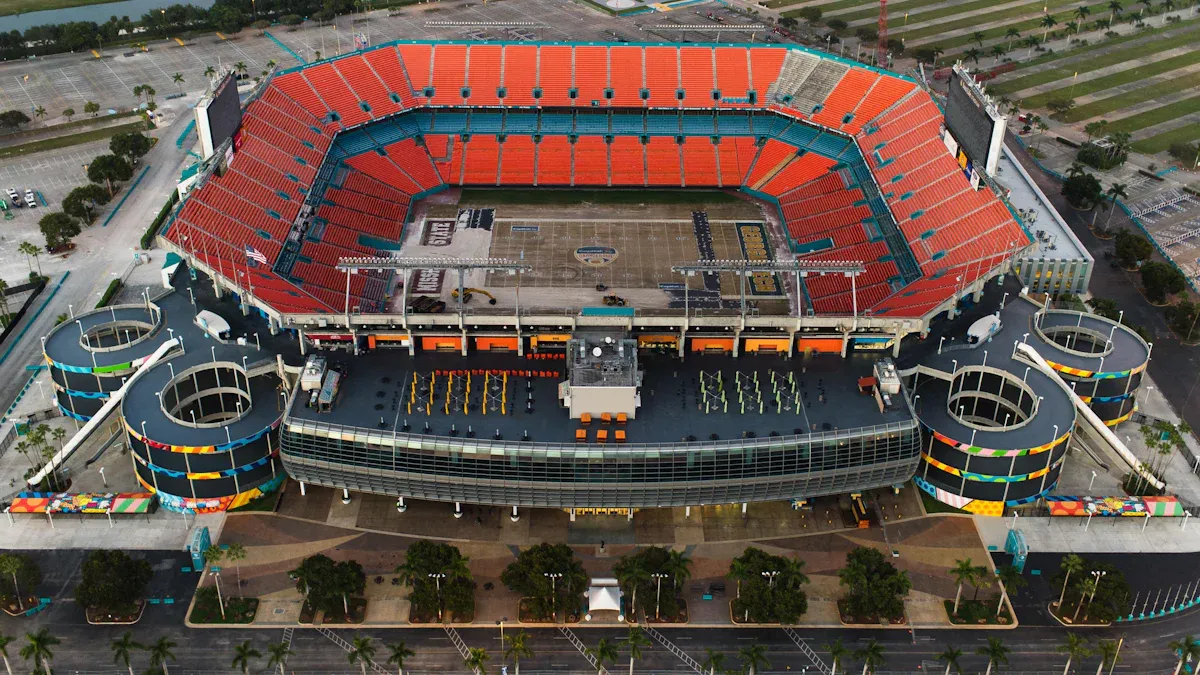
Image Source: pexels
AECOM’s Design and Construction Advantages
AECOM holds a prominent industry position in the stadium infrastructure field across the U.S., Canada, and Mexico. Since 1980, AECOM has built over 90 stadiums and arenas, covering 16 NFL and 18 MLB stadium projects. The company has accumulated extensive experience in design and construction, capable of meeting the high standards for venue functionality and safety required by major events. For example, Caesars Superdome is the world’s largest domed stadium, showcasing AECOM’s capabilities in structural innovation. Mercedes-Benz Stadium features the world’s only oculus-shaped retractable roof, reflecting the company’s technical breakthroughs in complex engineering. SoFi Stadium, with its 3.1 million square feet scale, serves as an exemplar of multi-functional stadiums.
- Representative AECOM projects:
- Caesars Superdome
- Mercedes-Benz Stadium
- SoFi Stadium
AECOM also demonstrates competitive advantages in international event projects. The Brisbane 2032 Olympic Infrastructure Program emphasizes sustainability and long-term community benefits, utilizing AI tools to reduce costs. The King Fahd Stadium Transformation project combines international event experience to manage the construction of multiple sports facilities. The company manages over 140 stadium projects globally, possessing rich experience in international event construction.
| Project Name | Competitive Advantages |
|---|---|
| Brisbane 2032 Olympic Infrastructure Program | Emphasizes sustainability and long-term community benefits, utilizing AI tools to reduce costs |
| King Fahd Stadium Transformation | Combines international event experience to manage the construction of multiple sports facilities |
Jacobs’ Intelligent Upgrade Solutions
Jacobs possesses system integration capabilities in stadium intelligent upgrades. The company provides stadiums with comprehensive services including structural engineering, civil engineering, mechanical and electrical engineering, public health, elevators and escalators, fire protection, and acoustic consulting. For example, Jacobs designed a 140-meter roof truss for Liverpool Football Club, connecting new and old structures to improve venue space utilization. The company also provides civil engineering services for venue expansions, designing and implementing electrical and mechanical systems to ensure efficient and safe venue operations. Jacobs emphasizes sustainable design to help stadiums achieve green and environmentally friendly goals.
| Service Type | Specific Content |
|---|---|
| Structural Engineering | Designed a 140-meter roof truss connecting new and old structures |
| Civil Engineering | Provided services required for venue expansion |
| Mechanical and Electrical Engineering | Designed and implemented electrical and mechanical systems |
| Public Health | Provided related consulting services |
| Elevators and Escalators | Designed and installed to improve accessibility |
| Fire Protection and Acoustic Consulting | Provided fire safety and acoustic design consulting |
| Sustainable Design | Demonstrates commitment to sustainable sports environments |
Jacobs promotes the development of stadium infrastructure toward intelligence and greenification through multi-disciplinary collaboration.
Caterpillar’s Engineering Equipment Assurance
Caterpillar provides advanced engineering equipment for stadium construction and maintenance. The company showcases multiple technological and service solutions to improve construction productivity and safety. Caterpillar participates in industry events such as CONEXPO-CON/AGG, continuously driving innovation in construction equipment. The company offers high-horsepower engines and condition monitoring post-market products to help clients increase equipment uptime. Caterpillar equipment is equipped with collision mitigation systems, effectively improving safety on actual job sites. The Cat Detect series safety technology uses sensor fusion and onboard processing to identify hazards and reduce accident risks. These innovative technologies help elevate productivity and safety standards on complex sites.
- Caterpillar equipment advantages:
- Adopts AI and autonomous technologies to improve construction efficiency
- Equipped with collision mitigation systems to reduce risks
- Reduces accidents through sensors and onboard processing
Caterpillar provides solid assurance for the smooth advancement of projects in the stadium construction field across the U.S., Canada, and Mexico.
Tech Companies Driving Infrastructure Intelligentization
Tech companies play a key role in stadium infrastructure intelligentization. The demand for technological modernization in the 2026 FIFA World Cup mainly stems from FIFA requirements. The scale and complexity of the event have reached historic highs, significantly increasing the demand for technical resources. Previous events such as the 2018 Russia World Cup and 2022 Qatar World Cup set technical standards, emphasizing the importance of 4G/LTE and 5G networks. The United States and Canada hold advantages in telecommunications infrastructure, while Mexico faces certain gaps.
The digital stadium market is expected to achieve an annual growth rate of 20.6% from 2025 to 2037, with total scale potentially reaching $191.7 billion. AI and IoT solutions improve stadium operational efficiency and reduce costs. Digital stadiums create new revenue streams through personalized advertising and data-driven fan insights, enhancing sponsor returns. Mexico has developed the bilingual tourism app “Conoce México” to enhance tourist experiences and promote the modernization of digital tourism infrastructure.
- Manifestations of tech companies driving infrastructure intelligentization:
- Deploying AI and IoT to improve operational efficiency
- Promoting 4G/5G network coverage to meet event demands
- Utilizing digital platforms to enhance tourist experiences and venue management
Tech companies collaborate with infrastructure enterprises in the U.S. stock monopoly pattern, driving stadium infrastructure toward intelligent and digital transformation.
Infrastructure Sector Development Trends
Stadium infrastructure is undergoing technological transformation, creating new revenue opportunities. Large-scale visual environments and real-time rendering technologies enhance audience immersion experiences. Interactive content, gamification, and augmented reality have become strategic tools to boost audience engagement and revenue. Infrastructure reliability has become a core requirement to meet on-site entertainment and real-time data needs. Personalized experiences improve audience loyalty and repeat rates.
Sustainability has become an important direction for 2026 World Cup infrastructure development. Upgrading existing venues to meet higher sustainability standards has become the focus of venue construction in various countries. Mexico leads in LEED certification, serving as a sustainability benchmark. Active user participation in infrastructure construction can maximize its social and economic impact.
Under the monopoly pattern of U.S. stock companies, infrastructure enterprises collaborate with tech companies to innovate, driving stadium infrastructure toward intelligence, greenification, and personalization, providing solid support for the 2026 FIFA World Cup and future major events.
Investment Opportunities and Expansion Plans
Expansion Strategies of Monopoly Companies
Under the monopoly pattern of U.S. stock companies, leading enterprises are accelerating expansion strategies. Companies such as Johnson Controls, Honeywell, and AECOM are actively participating in projects related to the 2026 FIFA World Cup. They enhance stadium security and infrastructure levels through technological upgrades and cross-border cooperation. Many enterprises are increasing investments in IoT, data analytics, and 5G connectivity to promote smart stadium construction. Jacobs and Caterpillar are expanding North American market share through mergers, acquisitions, and strategic alliances. Tech companies collaborate with traditional infrastructure enterprises to form diversified competitive advantages.
Investment Allocation Suggestions
Investors can focus on new opportunities brought by intelligent upgrades to North American stadiums. Market growth drivers mainly come from technological innovation and enhanced audience experiences. The following are investment allocation suggestions:
If you want to turn this theme into actual stock research, it is often more practical to separate sector judgment from company tracking. For names such as Johnson Controls, Honeywell, AECOM, and Jacobs, you can first use BiyaPay’s stock information lookup to review basic profiles, tickers, and market data, then cross-check them against contract wins, capex trends, and technology spending. If you later need to continue from research into execution, the same workflow can extend through the trading portal. BiyaPay is positioned as a multi-asset trading wallet, and its service details and compliance disclosures can be reviewed on the official website.
- Pay attention to the application prospects of emerging technologies such as IoT, data analytics, and 5G in stadiums.
- Select leading companies with project delivery capabilities and technical barriers.
- Evaluate companies’ historical performance and expansion plans in major event projects.
- Combine trends in private equity investment in the sports industry and consider diversified asset allocation.
The North American stadium market is growing rapidly, with continuous increases in sports infrastructure investment. Sports franchises demonstrate resilience during economic fluctuations, helping to diversify portfolio risks.
Risk and Return Analysis
Investing in the stadium security and infrastructure field requires attention to multiple risks. Municipal bonds carry interest rate, credit, and market risks. Some stadium bonds depend on economic and tourism growth, with uncertain returns. If new projects fail to achieve expected economic benefits, investment returns may fall below expectations. Historical data shows low correlation in the sports industry, providing hedging for investment portfolios. Investors should scientifically assess risks and returns by combining corporate expansion strategies and market environments.
U.S. stock companies demonstrate strong technical barriers in the stadium security and infrastructure field. Enterprises such as Johnson Controls, Honeywell, and AECOM dominate the market with rich project experience. Investors can focus on these companies’ deployments in intelligent upgrades and international event projects. Future stadiums will continue developing toward intelligence and greenification. Market risks include technological iteration and policy changes. Early positioning is expected to capture investment opportunities brought by the 2026 FIFA World Cup.
FAQ
How do U.S. stock companies achieve monopoly in the stadium security and infrastructure field?
U.S. stock companies rely on technological innovation, project experience, and capital advantages to dominate the stadium security and infrastructure market. They establish high barriers through continuous R&D and global project delivery, consolidating market share.
What investment opportunities will the 2026 FIFA World Cup bring?
The 2026 FIFA World Cup will drive intelligent upgrades to stadiums. U.S. stock companies hold leading advantages in security, infrastructure, and AI fields. Investors can focus on related companies’ expansion plans and technological innovations to capture market growth dividends.
What technologies does stadium intelligent upgrade mainly rely on?
Stadium intelligent upgrade relies on artificial intelligence, IoT, 5G communications, and big data analytics. These technologies improve operational efficiency, optimize audience experiences, and enhance security management capabilities.
How does Biyapay meet the payment needs of Chinese-speaking users at U.S., Canada, and Mexico stadiums?
Biyapay provides multi-currency settlement and convenient payment services for Chinese-speaking users. Users can make USD payments through Biyapay to meet cross-border consumption and ticketing purchase needs, enhancing the payment experience.
What are the main risks in investing in the stadium security and infrastructure field?
Investors need to pay attention to technological iteration, policy changes, and project return uncertainty. Some projects are heavily influenced by economic fluctuations and require scientific evaluation of companies’ expansion capabilities and market environments.
*This article is provided for general information purposes and does not constitute legal, tax or other professional advice from BiyaPay or its subsidiaries and its affiliates, and it is not intended as a substitute for obtaining advice from a financial advisor or any other professional.
We make no representations, warranties or warranties, express or implied, as to the accuracy, completeness or timeliness of the contents of this publication.
Related Blogs of

How Should You View Seagate’s HAMR Technology? Nearline HDD Capacity Upgrades and the Supply-Demand Cycle


Why Is Western Digital’s Gross Margin Changing? Nearline HDDs, Long-Term Pricing, and Cloud Customer Demand


How to Read NAND Contract Prices and Spot Prices? Why Enterprise SSDs and Consumer SSDs Do Not Move in Sync


HBM/DRAM, NAND, and HDD in AI Storage: A Comparison of Elasticity, Cycles, and Risks

Choose Country or Region to Read Local Blog
 Australia
 Austria
 Belgium
 Canada
 Cyprus
 Czech Republic
 Denmark
 Estonia
 Finland
 France
 Germany
 Greece
 Hong Kong
 India
India Indonesia
 Ireland
 Italy
Italy Japan
Japan Latvia
 Lithuania
 Luxembourg
 Malaysia
 Malta
Malta Morocco
 Nepal
Nepal Netherlands
 New Zealand
 Norway
 Pakistan
 Philippines
 Poland
 Portugal
 Romania
 Singapore
 Slovakia
 Slovenia
 South Africa
 South Korea
 Spain
Spain Sweden
 Thailand
 The United States
 Turkey
 United Arab Emirates
 United Kingdom
 Vietnam
Contact Us




BIYA GLOBAL LLC is registered with the Financial Crimes Enforcement Network (FinCEN), an agency under the U.S. Department of the Treasury, as a Money Services Business (MSB), with registration number 31000218637349, and regulated by the Financial Crimes Enforcement Network (FinCEN).
BIYA GLOBAL LIMITED is a registered Financial Service Provider (FSP) in New Zealand, with registration number FSP1007221, and is also a registered member of the Financial Services Complaints Limited (FSCL), an independent dispute resolution scheme in New Zealand.