How Does Wall Street Use the World Cup Cycle to Exploit Retail Investors? How Retail Investors Can Use Multi-Asset Wallets to Flexibly Exit




Image Source: unsplash
You will notice that every time the World Cup comes around, market volatility rises significantly. Wall Street exploits the World Cup to create emotional fluctuations, with trading volume increasing before matches and then dropping rapidly during matches. You can observe the following abnormal market phenomena:
- Before matches begin, market volatility increases, while volatility decreases during matches.
- Gambling-related stocks outperform other stocks, and small-cap stocks are more heavily influenced by emotions.
- On match days, actual spreads widen, liquidity declines, and noise trading decreases.
If you use a multi-asset wallet, you can flexibly diversify assets, respond promptly to sudden risks, and protect the safety of your funds.
Core Key Points
- During the World Cup, market volatility increases, and retail investors need to be wary of emotion-driven investment behavior and avoid blindly following trends.
- Using a multi-asset wallet allows flexible asset diversification, reduces single-market risk, and improves capital liquidity.
- Pay attention to changes in capital flows, identify Wall Street’s manipulative tactics using the World Cup cycle, and avoid becoming the target of harvesting.
- When selecting a secure wallet, prioritize multi-signature and compliance features to ensure asset safety.
- Regularly evaluate asset allocation, maintain patience, and take profits in a timely manner to avoid impulsive decisions due to short-term fluctuations.
How Wall Street Manipulates the Market Using the World Cup
Image Source: unsplash
Market Sentiment and Capital Flows
During the World Cup, you will find that market sentiment becomes extremely sensitive. Wall Street exploits the World Cup to create hotspots and drive capital flows. Institutional investors usually remain calm and choose stable investment targets. Retail investors, however, are easily influenced by the tournament atmosphere and chase short-term hot stocks.
- Gambling-related stocks significantly outperform other stocks. You may see retail investors increase investments in these stocks and reduce holdings in non-gambling stocks.
- Institutional investors’ trading patterns are more stable and not easily driven by emotions.
If you pay attention to changes in capital flows, you can discover that Wall Street uses the World Cup cycle to position early, attract retail followers, and ultimately achieve harvesting.
Manufacturing Positive and Negative News
Media frequently release positive or negative news during the World Cup, directly influencing your investment decisions. Wall Street exploits the World Cup and uses media to create emotional fluctuations, amplifying market reactions. You can refer to the table below to understand the impact of news on prices in different scenarios:
| Scenario | Price Range | Assumption | Probability |
|---|---|---|---|
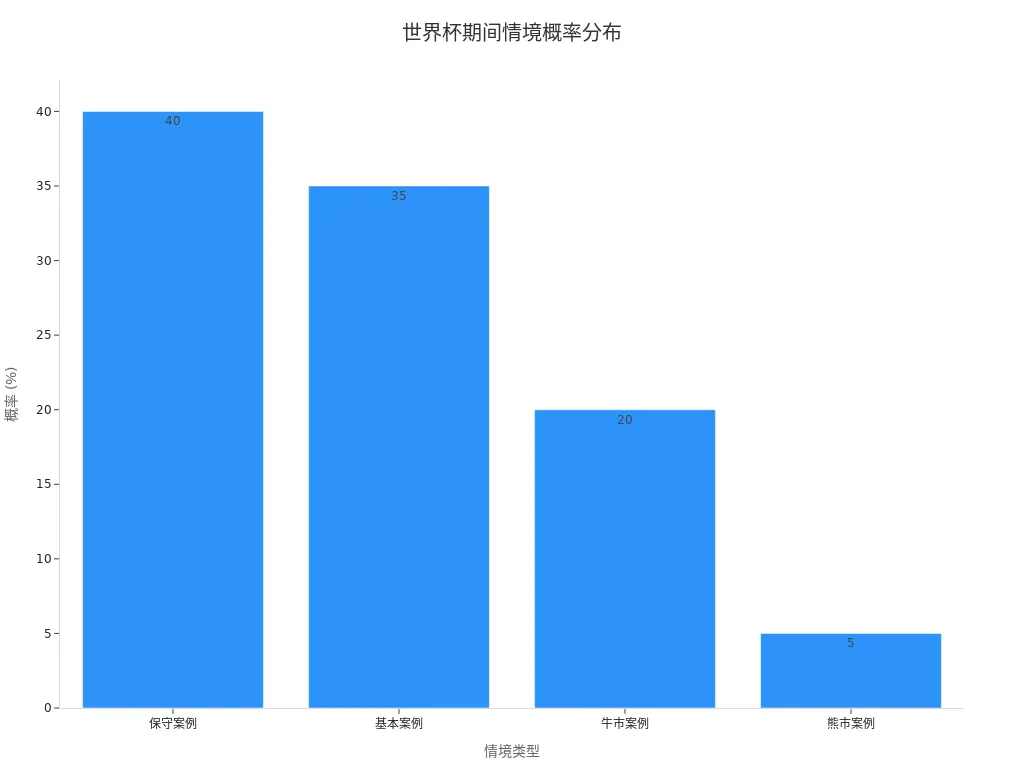
| Conservative Case | $0.06 to $0.08 | World Cup drives moderate participation; U.S. regulatory approval delayed; post-event correction similar to 2022 (60% to 70% drop from peak) | 40% |
| Base Case | $0.10 to $0.12 | World Cup brings 100% to 150% gains; U.S. market re-enters in Q2 2026; MiCA approval drives EU fan token launches | 35% |
| Bull Case | $0.12 to $0.15 | World Cup drives growth exceeding 2022’s 380%; successful U.S. expansion; DeFi integration launches and gains traction | 20% |
| Bear Case | $0.03 to $0.05 | World Cup momentum fails; U.S. expansion blocked or indefinitely delayed by regulators; post-event crash repeats 2022 pattern | 5% |
You can visually understand the probability distribution of different scenarios through the chart below:
Early Exit and Retail Following
Wall Street often exits early using the World Cup cycle to avoid risks at emotional peaks. If you blindly follow, you are likely to buy at highs. Institutional investors gradually reduce positions when market sentiment is high, while retail investors frequently buy hot assets due to media hype and news stimulation. You need to be vigilant about this emotion-driven investment behavior and learn to identify market traps.
If you can observe the pace of institutional operations and combine it with a multi-asset wallet to flexibly transfer funds, you can effectively avoid Wall Street’s harvesting traps using the World Cup.
If you have realized that the real issue is not just whether to chase a theme, but how capital can move across assets more steadily, a practical step is to use Stock Information to review the related sectors and names first, then use the Currency Converter to estimate conversion costs under different capital paths. That makes it easier to judge market conditions, asset positioning, and timing before changing exposure.
In that workflow, BiyaPay is better understood as a supporting layer linking capital conversion, market viewing, and later investment actions. As a multi-asset trading wallet covering cross-border payments, investing, trading, and fund management, it can also connect to a follow-up path through the same ecosystem’s trading entry, while business scope and compliance details are best checked on the official site.
Wall Street’s Tactics for Exploiting Retail Investors Using the World Cup
Hotspot Rotation and Theme Hype
During the World Cup, you will notice that market hotspot rotation accelerates significantly. Wall Street exploits the World Cup to create short-term themes and attract capital inflows into specific sectors. For example, sports betting, entertainment, and advertising-related stocks frequently become market focal points during the event. Institutional investors usually position early in these sectors, using news and emotional hype to drive price increases. If you blindly follow, you are likely to buy at highs and become the harvested party.
You need to be wary of short-term theme hype. Institutions amplify hotspots through media and social platforms, creating an atmosphere of “miss it and lose out.” If you do not deeply analyze fundamentals, you are easily driven by emotions and overlook risks. Wall Street uses the World Cup cycle to rotate hype across different sectors, ultimately achieving capital transfer and profit harvesting.
You can refer to the table below to understand the rotation characteristics of hot sectors during the World Cup:
| Sector | Rotation Frequency | Peak Capital Inflow | Typical Operation Method |
|---|---|---|---|
| Sports Betting | High | $500 million | Early positioning, news hype |
| Entertainment & Media | Medium | $300 million | Positive news driving |
| Advertising & Marketing | Medium | $200 million | Event-related partnership hype |
| Derivatives Market | High | $600 million | Using options, ETFs for rotation |
Short Selling and Smashing Operations
You often see institutions suddenly short sell on a large scale at market highs, causing prices to drop rapidly. Wall Street exploits the high volatility during the World Cup to smash prices when sentiment peaks. Institutional investors use derivatives tools such as options, ETFs, and leveraged products to position short strategies in advance. If you do not take profits in time, you are likely to be passively trapped during price declines.
- Short-selling operations are usually accompanied by the release of negative news, with institutions using media to release negative information and create panic sentiment.
- Smashing behavior triggers chain reactions, causing retail investors to panic sell and prices to fall further.
- If you only focus on short-term gains and ignore risk hedging, you are likely to lose assets during sharp market fluctuations.
You can judge whether institutions are positioning shorts by observing changes in derivatives market trading volume. For example, options trading volume increases significantly during the World Cup, indicating that institutions are using high volatility for arbitrage.
Information Asymmetry and Psychological Games
During the World Cup, you face severe information asymmetry. Wall Street creates complex news environments using the World Cup, with institutions holding first-hand data and analysis tools, while retail investors can only rely on public information. If you lack professional judgment, you are easily misled and make wrong decisions.
You need to improve your information filtering ability. Institutions use psychological games, repeatedly creating positive and negative news to induce frequent retail trading. If you cannot calmly analyze market dynamics, you easily fall into the “chase high, kill low” cycle. Wall Street strengthens information asymmetry using the World Cup cycle, accelerating harvesting through high-frequency trading and algorithmic strategies.
You can use multi-asset wallets and intelligent analysis tools to improve asset liquidity and risk identification capabilities. For Chinese-speaking users, adopting multi-asset wallets such as Biyapay allows flexible fund transfers and avoids risks from information asymmetry. You need to focus on real market data and avoid letting emotions and news drive investment decisions.
Flexible Response Strategies with Multi-Asset Wallets
Image Source: pexels
Wallet Selection and Security Key Points
When choosing a multi-asset wallet, security should always be the top priority. During periods of intense market volatility, only wallets with institutional-grade security architecture can effectively prevent hacker attacks and internal management errors. You should prioritize the following aspects:
- Institutional-grade security: Choose wallets with multi-signature, distributed control, and other security mechanisms to reduce single-point-of-failure risks.
- Compliance: The wallet should provide compliance tools to help you cope with constantly changing regulatory environments, especially in major markets like the United States.
- Multi-asset support and scalability: The wallet must support multiple mainstream digital assets and innovative asset types to meet your asset allocation needs in different market cycles.
- Governance and risk control: Strict governance mechanisms help prevent internal asset misuse and enhance overall security.
- Cost efficiency: While ensuring security, the wallet should offer transparent pricing structures to help you reasonably control management costs.
You can refer to the table below to understand the differences between multi-asset wallets and traditional wallets in terms of security and flexibility:
| Feature | Multi-Asset Wallet (MPC/Multisig) | Traditional Wallet |
|---|---|---|
| Security | Provides multi-signature and distributed control | Single key, single point of failure exists |
| Flexibility | Authorization thresholds can be adjusted as needed | Fixed key management method |
| Control | User has full control over assets | Relies on financial institutions |
| Ability to Handle Market Crises | Maintains asset availability during financial crises | May face access restrictions |
In times of economic uncertainty, adopting non-custodial multi-asset wallets allows you to maintain full control over assets and avoid asset freezes or access restrictions due to institutional instability. For example, during the 2013 Cyprus banking crisis and the 2023 Silicon Valley Bank event, users holding crypto assets were able to effectively protect their wealth and avoid systemic banking risks.
Asset Diversification Strategy
During high-volatility periods like the World Cup, using a multi-asset wallet enables flexible asset diversification and reduces risks from a single market or single asset. You can allocate funds to different types of assets, such as mainstream cryptocurrencies, stablecoins, U.S. market ETFs, and even some compliant digital derivatives. This way, even if one asset class experiences sharp fluctuations, your overall portfolio still has strong risk resistance.
- You can use multi-asset wallets like Biyapay to store assets across different chains, improving asset liquidity.
- You can dynamically adjust the proportions of various assets based on market hotspots and your own risk preferences, avoiding “all-in” on a single track.
- You can use the wallet’s multi-asset management features to monitor asset distribution and performance in real time and promptly identify potential risks.
Asset diversification is not just about simply holding multiple assets; more importantly, it involves flexibly adjusting allocation ratios based on market conditions and personal needs. You should regularly review your asset structure, combine market trends and personal goals, and optimize diversification strategies.
Risk Hedging and Dynamic Adjustment
When market volatility intensifies, risk hedging and dynamic adjustment strategies become especially important. Multi-asset wallets provide you with flexible tools to achieve asset preservation and appreciation across different market cycles.
- You can draw from the practices of multi-strategy hedge funds and combine multiple investment strategies to maximize risk-adjusted returns.
- You can use the wallet’s flexibility to allocate part of your assets to low-volatility products, such as stablecoins or U.S. market ETFs, to reduce overall portfolio volatility.
- You can dynamically allocate funds to the best-performing asset classes based on market changes to improve overall returns.
- You can use the wallet’s built-in risk management tools to set stop-loss, take-profit, and automatic rebalancing rules to respond promptly to sudden market events.
In actual operations, you should pay attention to the following points:
- Regularly assess the market environment and adjust asset allocation based on your own risk tolerance.
- Use the wallet’s multi-asset support and automation features to improve operational efficiency and reduce human errors.
- Pay attention to compliance and policy changes to ensure all asset allocations and transfers comply with local laws and regulations.
Multi-asset wallets not only improve your asset liquidity and security but also provide you with the ability to flexibly respond to market changes. Only by continuously learning and practicing can you truly achieve steady asset growth and risk prevention during high-volatility periods like the World Cup.
Practical Advice and Risk Prevention for Retail Investors
Identifying Market Traps
During the World Cup, you are prone to encountering various investment traps. Identifying these traps is crucial to protecting asset safety. You can take the following measures:
- Only purchase tickets from official channels. FIFA will announce authorized sales channels; always verify information on the official website.
- Be cautious with links. Fake “fan ID” emails or “schedule updates” are common in phishing; avoid clicking suspicious attachments.
- Carefully check domains. Fraudulent websites often use misspellings; always review the URL.
- Avoid deals that seem too good to be true. Promises of guaranteed tickets, early access, or large discounts are often red flags.
- Use security tools. Keep browsers, antivirus software, and security programs updated to prevent malicious domains and phishing ads.
You also need to be wary of investment trends on social media. Fake streaming sites, ticketing websites, and merchandise platforms often use free live streams, low-price tickets, or limited-edition goods as bait, ultimately leading to asset losses or personal information leaks.
Avoiding Blindly Following Trends
During periods of high market volatility, you are easily influenced by social media and hot news. Blindly following trends often leads to buying at highs and asset losses. You should stay calm and independently analyze market dynamics. During major events in the U.S. market, trading volume surges, and banks and merchants need to strengthen fraud protection. As an investor, you should pay attention to international payment risks and cybercrime activities and avoid making impulsive decisions due to short-term emotional fluctuations.
You can refer to regulatory initiatives such as the Global Integrity Program. The program helps member associations combat match-fixing through training and tools, with participation from the United Nations Office on Drugs and Crime and other institutions. Paying attention to these policy changes helps you avoid compliance risks.
| Program Name | Objective | Partners |
|---|---|---|
| Global Integrity Program | Help member associations combat match-fixing | United Nations Office on Drugs and Crime, etc. |
Timely Profit-Taking and Secure Asset Transfer
During high-volatility periods, you need to master techniques for timely profit-taking and secure asset transfer. You can:
- Maintain a long-term perspective, understanding that headlines do not necessarily impact diversified portfolios.
- Reassess asset allocation to reduce investment risk. You cannot control the market, but you can optimize your asset structure.
- Consider a cash emergency fund; it is recommended to prepare three to six months of living expenses.
- Stay patient and avoid impulsive decisions. Advance planning and gradual adjustments help achieve financial goals.
- Seek professional advice and consult a financial advisor when necessary.
By adopting multi-asset wallets like Biyapay, you can flexibly transfer assets and diversify risks. Pay attention to policy changes and compliance requirements to ensure safe and reliable asset allocation. During the World Cup, malicious emails and fraudulent activities are frequent, making secure asset transfer a key step in risk prevention.
During the World Cup cycle, you will find that Wall Street accelerates harvesting retail investors through emotional manipulation, hotspot hype, and information asymmetry. If you adopt multi-asset wallets, you can effectively diversify risks and improve asset liquidity.
- Zero-commission trading and mobile-first platforms allow you to quickly adapt to new investment options, expand asset types, and increase participation.
- During major events, emotional fluctuations easily lead to irrational decisions. By sticking to value investing strategies, you can reduce losses.
You should proactively enhance risk awareness, combine practical operation suggestions, flexibly transfer assets, and protect your personal wealth safety.
FAQ
How do multi-asset wallets help you cope with market volatility during the World Cup?
You can flexibly diversify assets and quickly transfer funds through multi-asset wallets, reducing single-market risk. Biyapay supports multiple asset types, helping you maintain asset liquidity and security during high-volatility periods.
How do you choose a safe and reliable wallet product?
You should prioritize wallets with multi-signature, distributed control, and compliance tools. Biyapay adopts institutional-grade security architecture and supports risk management features to safeguard your assets.
What are the common investment traps during the World Cup?
You are prone to fake news hype, hotspot sector rotation, and high-position buying risks. You need to be wary of social media inducements, avoid blindly following trends, and maintain independent judgment.
How to achieve asset diversification and risk hedging?
You can allocate funds to mainstream cryptocurrencies, stablecoins, and U.S. market ETFs. Biyapay supports multi-chain asset management, helping you dynamically adjust allocations and achieve risk hedging.
What security details should you pay attention to during asset transfers?
You should verify receiving addresses, enable multi-factor authentication, and regularly check wallet security settings. Biyapay provides real-time monitoring and automated management tools to enhance asset transfer security.
*This article is provided for general information purposes and does not constitute legal, tax or other professional advice from BiyaPay or its subsidiaries and its affiliates, and it is not intended as a substitute for obtaining advice from a financial advisor or any other professional.
We make no representations, warranties or warranties, express or implied, as to the accuracy, completeness or timeliness of the contents of this publication.
Related Blogs of

How Should You View Shanghai Fudan’s Non-Volatile Memory Business? Application Scenarios, Competition, and Risks


Why Is Western Digital’s Gross Margin Changing? Nearline HDDs, Long-Term Pricing, and Cloud Customer Demand


How Should You View Seagate’s HAMR Technology? Nearline HDD Capacity Upgrades and the Supply-Demand Cycle


How Is China’s Memory Supply Chain Different from Overseas Memory Leaders? A Comparison with Micron, SanDisk, Western Digital, and Seagate

Choose Country or Region to Read Local Blog
 Australia
 Austria
 Belgium
 Canada
 Cyprus
 Czech Republic
 Denmark
 Estonia
 Finland
 France
 Germany
 Greece
 Hong Kong
 India
India Indonesia
 Ireland
 Italy
Italy Japan
Japan Latvia
 Lithuania
 Luxembourg
 Malaysia
 Malta
Malta Morocco
 Nepal
Nepal Netherlands
 New Zealand
 Norway
 Pakistan
 Philippines
 Poland
 Portugal
 Romania
 Singapore
 Slovakia
 Slovenia
 South Africa
 South Korea
 Spain
Spain Sweden
 Thailand
 The United States
 Turkey
 United Arab Emirates
 United Kingdom
 Vietnam
Contact Us




BIYA GLOBAL LLC is registered with the Financial Crimes Enforcement Network (FinCEN), an agency under the U.S. Department of the Treasury, as a Money Services Business (MSB), with registration number 31000218637349, and regulated by the Financial Crimes Enforcement Network (FinCEN).
BIYA GLOBAL LIMITED is a registered Financial Service Provider (FSP) in New Zealand, with registration number FSP1007221, and is also a registered member of the Financial Services Complaints Limited (FSCL), an independent dispute resolution scheme in New Zealand.