Cross-Border Payroll & Receiving: How Remote Workers Can Receive Salary in USDT and Convert to Fiat?




Image Source: unsplash
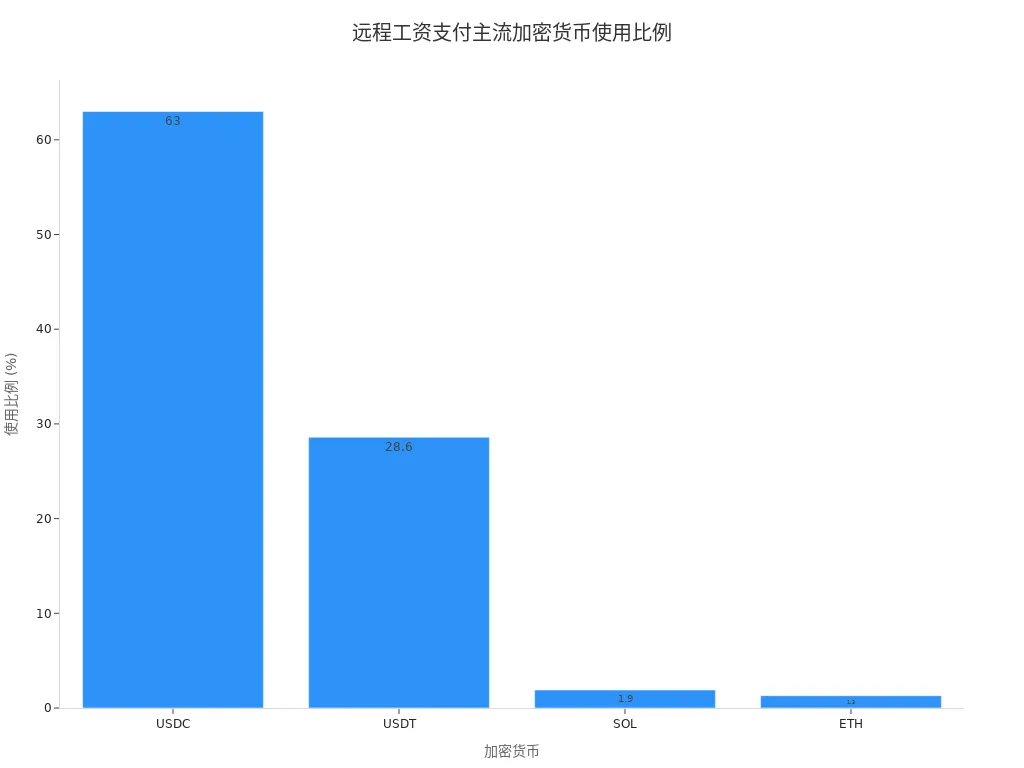
You can use USDT to achieve cross-border payroll, receiving remote salary and converting it into fiat currency. Data shows that currently about 28.6% of remote workers choose USDT as their salary payment tool.
| Cryptocurrency | Usage Percentage |
|---|---|
| USDC | 63% |
| USDT | 28.6% |
| SOL | 1.9% |
| ETH | 1.3% |
You need to complete steps such as wallet setup, receiving payments, conversion, and withdrawal. Throughout the process, security, compliance, and efficiency are the core principles.
You should pay attention to the following legal and compliance risks:
- Regulatory uncertainty: Regulations on cryptocurrency salaries vary across countries.
- Tax implications: Cryptocurrency salary transactions trigger taxable events.
- Labor law compliance: Employers must comply with wage-related laws.
The following sections detail practical methods and risk prevention recommendations for each step.
Key Points
- Use USDT to receive cross-border salary, ensuring stable pay and suitability for global remote payments.
- Choose compliant platforms such as Biyapay to reduce transaction costs and processing time while safeguarding fund security.
- Follow tax compliance requirements, retain transaction records, ensure legality, and avoid legal risks.
- Understand legal regulations on cryptocurrency in different countries to prevent salary payment failures due to compliance issues.
- Regularly audit account security, enable multi-factor authentication, and protect assets from theft and fraud.
Cross-Border Payroll & USDT Receiving Process

Image Source: pexels
Digital Wallet Setup and Management
In cross-border payroll scenarios, you first need a secure and reliable digital wallet to receive USDT. When selecting a wallet, prioritize platforms with good reputation and compliant qualifications, such as Biyapay, swissmoney, etc. The basic process for setting up a wallet is as follows:
- Choose a wallet platform that supports USDT, register, and complete identity verification.
- Create a USDT wallet and securely store the private key and mnemonic phrase to avoid leakage.
- Copy your USDT wallet address and verify the network type (e.g., ERC20, TRC20) to ensure it matches the employer’s payment network.
- Send the wallet address to the employer and wait for them to disburse the USDT salary.
- After receiving USDT, you can choose to hold it, convert it to fiat, or spend it directly.
Taking swissmoney as an example, you need to register an account in the app, add a USDT wallet, and copy the wallet address from the digital assets interface. The entire process is simple, but you must ensure wallet security to avoid asset loss due to private key leakage.
Tip: Be sure to enable multi-factor authentication for the wallet, regularly back up the mnemonic phrase, and prevent asset recovery failure due to device loss or theft.
Employer USDT Salary Disbursement Process
In cross-border payroll, employers must comply with legal regulations in different jurisdictions. Some EU member states allow cryptocurrency salary payments with mutual consent, but China explicitly prohibits salary payments in cryptocurrency. You should understand the policies of the employer’s location to avoid payment failures due to compliance issues.
| Country/Region | Status | Explanation |
|---|---|---|
| European Union | Varies | Certain member states allow crypto salary payments with mutual consent; others require fiat payments. |
| China | Explicitly prohibited | Crypto trading is illegal; salary payments in cryptocurrency are prohibited. |
When disbursing USDT salary, employers must follow these compliance procedures:
- Register and obtain CASP (Crypto-Asset Service Provider) license under supervision.
- Appoint an AML reporting officer, establish AML policies, and implement internal controls.
- Conduct KYC (Know Your Customer) identity verification on employees.
- Continuously monitor transactions, identify suspicious activity, and report to regulators.
- Undergo regular audits to ensure compliance.
When communicating with your employer, proactively inquire about their qualifications to ensure the cross-border payroll process is legal and compliant, reducing the risk of funds being frozen by regulators.
Receiving Payment Precautions and Common Pitfalls
When actually receiving USDT salary, focus on the following risks and pitfalls:
- Legal risk: Mainland China prohibits cryptocurrency trading and salary payments in crypto; related contracts are generally deemed invalid in judicial practice. Some EU countries have lenient policies but still require explicit agreement.
- Compliance risk: If the employer fails to fulfill AML, KYC, and other compliance procedures, funds may be frozen or investigated.
- Technical risk: Incorrect wallet address or mismatched network type may cause permanent asset loss.
- Pitfall warning: Some users mistakenly believe all countries allow cryptocurrency salary payments, but policies vary greatly. Verify policies in advance to avoid losses due to information asymmetry.
| Risk Type | Description |
|---|---|
| ICO Prohibition | The Chinese government bans all forms of initial coin offerings (ICOs), considering them illegal fundraising activities. |
| Legal Invalidity | Chinese courts typically view crypto assets as illegal financial activities, rendering related contracts invalid. |
| Judicial Enforcement Difficulty | Courts face difficulties handling crypto assets, and related creditor claims may be unenforceable. |
Recommendation: In cross-border payroll scenarios, be sure to retain all transaction records and communication evidence for subsequent compliance reporting and source-of-funds proof.
Through the above process, you can efficiently and securely complete USDT receipt, but compliance and risk prevention must be prioritized. Cross-border payroll involves multiple jurisdictions’ laws; it is recommended to continuously monitor policy changes and choose compliant platforms like Biyapay to safeguard fund security.
USDT Management Platforms and Security Precautions
Popular Wallets and Exchange Selection
When selecting a USDT management platform, prioritize platforms with wide global coverage, strong compliance, and rich features. For cross-border payroll, Rise, Bitwage, Deel, Remote, etc., are popular among remote workers. Biyapay is also favored by Chinese-speaking users due to its convenient operation and multi-currency support. The table below compares the coverage and core features of several major platforms:
| Platform | Countries Covered | Main Features |
|---|---|---|
| Rise | 190+ | Supports 100+ cryptocurrencies and 90+ fiat currencies, automated compliance and tax reporting, flexible payment options. |
| Bitwage | 150+ | Non-custodial mode, supports Bitcoin, Ethereum, and stablecoins, flexible payment schedules. |
| Deel | N/A | Contractor withdrawals in stablecoins, suitable for teams already using Deel. |
| Remote | N/A | Began offering contractor stablecoin payments in USDC, suitable for organizations using Remote. |
You can choose based on your needs, considering compliance, currency support, withdrawal convenience, and other factors.
Platform Security and Compliance
When managing USDT assets, platform security and compliance are critical. Mainstream platforms typically offer self-custodial wallets and exchange wallets. Self-custodial wallets give you full control over private keys and support multi-signature and two-factor authentication. Exchange wallets are managed by the platform using encryption, access controls, hardware security modules, and other multi-layer protections. The table below briefly compares the security features of the two wallet types:
| Wallet Type | Security Features |
|---|---|
| Self-Custodial Wallet | User has full control of private keys, supports multi-signature, two-factor authentication, etc. |
| Exchange Wallet | Exchange manages private keys, uses encryption, access controls, hardware security modules, provides multi-signature and two-factor authentication. |
In terms of compliance, global mainstream platforms actively respond to regulations such as the EU’s MiCA. For example, the EU market has imposed strict restrictions on USDT trading, and some exchanges have suspended USDT services for EU residents. In cross-border payroll scenarios, pay attention to whether the platform has AML (Anti-Money Laundering), KYC (Know Your Customer), and other compliance measures. Compliant platforms continuously monitor unusual transactions, prevent financial crimes, and protect fund security.
Account Security Settings and Anti-Fraud Advice
When managing USDT accounts daily, adopt multiple security measures to prevent theft or scams. Recommendations include:
- Enable anti-phishing two-factor authentication (2FA), preferably using hardware security keys or authenticator apps.
- Set complex and unique passphrase combinations including letters, numbers, and symbols.
- Store all recovery codes offline in a secure location, avoiding cloud or email storage.
- Enable withdrawal whitelists, allowing transfers only to wallet addresses under your control.
- Regularly check account login history and watch for abnormal access.
- Protect the wallet from password spraying and credential stuffing attacks.
Tip: When receiving suspicious messages or transfer requests from strangers, stay vigilant and never disclose private keys or mnemonic phrases. Choosing compliant platforms like Biyapay can further reduce the risk of fraud and fund freezing.
USDT to Fiat Conversion Methods
Image Source: pexels
Compliant Exchange Withdrawal Process
When converting USDT to fiat, choosing a compliant exchange is the safest and most regulated method. Compliant platforms such as swissmoney, Coinbase, Biyapay, etc., have strict KYC (Know Your Customer) and AML (Anti-Money Laundering) measures to effectively safeguard fund security. You can follow this process:
- Transfer USDT from your personal wallet to the compliant exchange account.
- On the platform, select to sell USDT and convert it to your desired fiat currency (e.g., USD, EUR, etc.).
- Withdraw the fiat to your bank account via the platform’s supported withdrawal methods. For Chinese-speaking users, some platforms support withdrawals to Hong Kong licensed bank accounts for more convenient fund flows.
During operation, note the strict restrictions on cryptocurrency trading and fiat conversion in mainland China. Directly converting USDT to RMB and withdrawing to a mainland China bank card carries high legal risk. Regulators may freeze related accounts or even pursue legal liability. Therefore, prioritize compliant platforms and withdraw funds to overseas compliant bank accounts to avoid unnecessary risks.
Tip: Compliant exchanges usually conduct additional reviews for large withdrawals. Prepare proof of source of funds and relevant transaction records in advance to pass compliance checks smoothly.
P2P and OTC Off-Exchange Trading
In some countries or regions, you may consider P2P (peer-to-peer) or OTC (over-the-counter) trading to convert USDT to fiat. These methods offer flexible operations and fast fund arrival, but legal and compliance risks are significantly higher. Be aware of the following risks:
- Regulatory oversight of cryptocurrency governance continues to strengthen, with legal risks steadily rising.
- Traditional banks are cautious about cryptocurrency-related transactions and may restrict or freeze related accounts.
- Compliance requirements change frequently, and users may face fines or sanctions during fiat conversion.
In mainland China, fiat withdrawals via P2P and OTC platforms are strictly regulated. Converting USDT to RMB through such methods and withdrawing to a mainland China bank card can easily trigger bank risk controls, leading to account freezes. Even in some EU countries, compliance requirements are escalating, and some banks restrict cryptocurrency-related fund inflows.
If you must use P2P or OTC methods, choose reputable, highly compliant platforms and prioritize withdrawing funds to Hong Kong licensed bank accounts or other overseas compliant channels. Retain all transaction receipts for subsequent compliance reporting and source-of-funds proof.
Note: P2P and OTC trading carry high fraud risks. Verify the counterparty’s identity to avoid asset loss due to information asymmetry.
Conversion Fees and Exchange Rates
During USDT-to-fiat conversion, pay attention to the fees charged by the platform and the actual exchange rate. Fee structures and rate fluctuations vary across platforms, directly affecting your final received amount. Mainstream platform fees and speeds are typically as follows:
- USDT transaction gas fees are generally between 7–10 USD, depending on the selected network (e.g., Ethereum or Tron).
- USDT withdrawal fees are usually lower than Bitcoin due to lower transaction costs on Ethereum and Tron networks.
- USDT transactions are relatively fast, usually completing conversion and arrival within minutes.
When selecting a platform, comprehensively consider fees, exchange rates, arrival speed, and compliance. Some platforms like Biyapay offer multi-currency support and flexible withdrawal options for Chinese-speaking users, effectively reducing conversion costs. Also monitor platform announcements for timely updates on fee and rate adjustments to avoid unnecessary losses due to market fluctuations.
If you care more about whether the full path of receiving salary, converting funds, and withdrawing money feels smooth in practice, it makes sense to first use BiyaPay’s currency converter to estimate how much USDT may become after conversion into different fiat currencies, then decide whether to hold it briefly or exchange it soon after receipt. That makes the transition here feel more natural and closer to how remote workers actually manage payroll.
For many cross-border earners, the real difficulty is not simply receiving USDT, but what comes next: converting it, withdrawing it, and fitting it into everyday spending or broader cash management. Platforms like BiyaPay are easier to understand as a bridge between digital-asset payroll and fiat usage, which is why they fit naturally in this part of the article.
Recommendation: Before large conversions, first test the platform’s withdrawal process and arrival speed with a small amount to ensure fund security.
Platform Case Study: Bitwage Compliant Conversion Practice
Bitwage, an internationally renowned cross-border payroll platform, provides compliant USDT salary conversion services for employers and remote workers. You can achieve compliant conversion through the following methods:
- Employers top up payroll accounts via traditional bank transfers; the platform converts USD to USDT and disburses it to employees.
- Bitwage ensures full-process compliance, meeting U.S. FLSA and other relevant regulations.
- Employees can choose to convert USDT to various fiat currencies and flexibly withdraw to overseas compliant bank accounts.
This model effectively avoids legal risks in mainland China and provides a safe, compliant, and efficient solution for cross-border payroll.
Compliance and Legal Risk Mitigation
Tax Reporting and Source-of-Funds Proof
In cross-border payroll scenarios, you must prioritize tax reporting and source-of-funds proof. Mainland China law explicitly requires wages to be paid in fiat; virtual currency wages are not recognized. If you receive salary in USDT, retain complete documentation of fund sources, transaction records, employment contracts, etc. Some EU countries allow cryptocurrency wages but still require personal income tax reporting. Proactively communicate with your employer to ensure the payroll process is compliant, and promptly report taxes after converting to fiat. Non-compliance or unclear fund sources may lead to banks and regulators refusing deposits or even triggering investigations.
Professional advice: Regularly organize transaction records, contracts, employer qualification proof, and other documents to facilitate tax reporting and source-of-funds verification. Choosing compliant platforms like Biyapay helps improve fund transparency and reporting convenience.
Preventing Account Freezes and Risk Controls
When receiving USDT salary, be vigilant about account freeze risks. Common causes include suspected illegal activity, compliance issues, legal investigations, security precautions, technical errors, and stable asset value fluctuations. Regulators freeze accounts for fraud, money laundering, terrorist financing, etc. You can reduce risks through the following risk control measures:
- Implement KYC and KYB processes to ensure identity and business compliance.
- Define clear transaction policy boundaries and avoid high-risk operations.
- Complete documentation and verification for payees and wallets.
- Record fund sources and link wallets to personal information.
- Retain all transaction receipts for subsequent reporting and investigations.
If you involve withdrawals to mainland China bank cards or forex trading, exercise extreme caution. Mainland China imposes strict criminal penalties for illegal forex trading, and serious cases may constitute crimes. Prioritize Hong Kong licensed bank accounts or overseas compliant channels to mitigate legal risks.
Personal Information Protection
When using USDT wallets and exchanges, strengthen personal information protection. Recommended measures include:
- Enable two-factor authentication (2FA), preferably using Google Authenticator or Authy apps.
- Store seed phrases and private keys offline in secure locations, such as safes or metal cards.
- Use VPN to encrypt internet traffic and avoid operating wallets on public Wi-Fi.
- Store long-term holdings in cold wallets and trading funds in hot wallets.
- Choose trading platforms with strong security, high compliance, and insurance coverage.
- Regularly update wallets, operating systems, and antivirus software to patch security vulnerabilities.
- Set account alerts to monitor abnormal activity and prevent phishing and scams.
Strictly implementing the above measures will effectively reduce risks of asset theft, information leakage, and account freezes. Professional platforms like Biyapay provide multiple security safeguards for Chinese-speaking users, supporting safe and compliant fund operations.
Practical Challenges and Solutions
Handling Account Freezes
During USDT salary receipt and payment, account freezes are a high-frequency risk. Banks and exchanges typically freeze accounts due to compliance reviews, unusual transactions, or policy changes. If you encounter such issues, consider using decentralized exchanges (DEX) for asset management and transfers. DEX allows direct payments in USDT or ETH with full user control over funds, transparent and traceable transaction records, greatly reducing freeze risks caused by third-party intervention. Additionally, DEX operates 24/7, avoiding delays due to bank holidays or weekends. Regularly back up wallet information, retain all on-chain transaction receipts, and promptly communicate with the platform’s compliance department when frozen, submitting source-of-funds and transaction records to expedite unfreezing.
Compliance Reporting and Taxation
After receiving USDT salary, you must strictly fulfill tax reporting obligations. Tax treatment of cryptocurrency wages varies significantly across countries, with extremely strict compliance requirements. Retain detailed salary payment records, including amounts, dates, exchange rates, etc. The table below summarizes key compliance requirements:
| Legal Requirement | Explanation |
|---|---|
| Payment Reporting | Employers must report USDT payments at fair market value to meet tax withholding requirements. |
| Record Keeping | Maintain detailed records of payment amounts, dates, and rates for compliance. |
| Payroll Tax Treatment | Must handle payroll taxes and reporting requirements same as fiat payments. |
| Employee Classification | Correctly distinguish contractors from employees to meet legal requirements. |
| Tax Obligations | USDT received as compensation is taxed at fair market value; subsequent appreciation or depreciation involves capital gains or losses. |
Proactively communicate with your employer to ensure the payroll process is compliant, and promptly report personal income tax after converting to fiat. Errors may lead to substantial fines or account investigations.
Post-Conversion Spending Scenarios
After converting USDT to fiat, you have diverse spending options. Holding USD stablecoins helps you avoid fees from multiple currency conversions. You can choose to convert only when spending is needed to capture better rates. Some tools like Aire support invoicing, receiving payments, holding USD stablecoins, and local spending, greatly improving fund circulation efficiency. You can also use platforms like Biyapay to flexibly manage multi-currency assets for convenient global spending and payments.
Cross-Border Fund Flow Policy Risks
When receiving and paying USDT salary cross-border, highly monitor policy risks. Main challenges include:
- Regulatory compliance: You must comply with laws and regulations in each country to ensure every transaction is legal.
- Tax impact: Cryptocurrency is treated as property, requiring tax reporting and withholding obligations.
- Irreversible transactions: Once USDT is sent to an incorrect address, funds cannot be recovered; perform multiple verifications before operations.
- Legal status differences: Countries have varying legal positions on crypto payments, which may affect salary processing and fund flows.
- Labor law requirements: Ensure wage payments comply with federal and state labor laws, such as minimum wage standards.
Establish robust verification processes, retain all transaction receipts, regularly monitor policy changes, and choose compliant platforms like Biyapay to minimize cross-border fund flow risks.
When receiving and converting cross-border salary in USDT, pay attention to the following key points:
- USDT is pegged 1:1 to the US dollar, ensuring stable salary and suitability for global remote payments.
- Choosing compliant platforms like Biyapay effectively reduces transaction costs and processing time.
- Follow tax compliance, employee consent, and other legal requirements; conduct regular security audits and adopt multi-signature and cold storage to enhance security.
- Flexibly select solutions based on your needs, continuously monitor policy changes, and proactively learn new risk prevention measures.
FAQ
How to choose a USDT wallet and management platform that suits you?
You should prioritize platforms with compliant qualifications, strong security, and good user reputation. Biyapay provides multi-currency management and convenient operations for Chinese-speaking users. Choose self-custodial or exchange wallets based on asset size and usage scenarios.
What are the fees and exchange rate risks when converting USDT to fiat?
During conversion, pay attention to platform fees, typically between 7–10 USD. Exchange rate fluctuations affect the final received amount. Test small transactions in advance to ensure fund security.
How can mainland China users avoid account freeze risks?
Avoid directly converting USDT to RMB and withdrawing to mainland China bank cards. It is recommended to choose Hong Kong licensed bank accounts or overseas compliant channels and retain all transaction receipts for compliance reporting.
How to handle tax reporting after receiving USDT salary?
Retain complete salary payment records and source-of-funds proof. Promptly report personal income tax after converting to fiat. Some EU countries allow cryptocurrency wages but still require lawful taxation.
What to do if funds are frozen during USDT salary receipt and payment?
You can prioritize using decentralized exchanges (DEX) to manage assets. Promptly communicate with the platform’s compliance department, submit source-of-funds and transaction records, and strive to unfreeze funds as soon as possible.
*This article is provided for general information purposes and does not constitute legal, tax or other professional advice from BiyaPay or its subsidiaries and its affiliates, and it is not intended as a substitute for obtaining advice from a financial advisor or any other professional.
We make no representations, warranties or warranties, express or implied, as to the accuracy, completeness or timeliness of the contents of this publication.
Related Blogs of

How Do Foundries Participate in the AI Storage Chain? Mature Nodes, Embedded Memory, and Industry Division of Labor


SanDisk SNDK vs Seagate STX: Who Benefits More from AI Data Growth, NAND Flash or HDD?


Micron MU vs Western Digital WDC: Which Logic Is Stronger, AI Memory or Data Center Hard Drives?


What Is the Difference Between Memory Chip Stocks and Enterprise Storage System Stocks? A Comparison of Business Models, Profit Sources, and Cyclical Characteristics

Choose Country or Region to Read Local Blog
 Australia
 Austria
 Belgium
 Canada
 Cyprus
 Czech Republic
 Denmark
 Estonia
 Finland
 France
 Germany
 Greece
 Hong Kong
 India
India Indonesia
 Ireland
 Italy
Italy Japan
Japan Latvia
 Lithuania
 Luxembourg
 Malaysia
 Malta
Malta Morocco
 Nepal
Nepal Netherlands
 New Zealand
 Norway
 Pakistan
 Philippines
 Poland
 Portugal
 Romania
 Singapore
 Slovakia
 Slovenia
 South Africa
 South Korea
 Spain
Spain Sweden
 Thailand
 The United States
 Turkey
 United Arab Emirates
 United Kingdom
 Vietnam
Contact Us




BIYA GLOBAL LLC is registered with the Financial Crimes Enforcement Network (FinCEN), an agency under the U.S. Department of the Treasury, as a Money Services Business (MSB), with registration number 31000218637349, and regulated by the Financial Crimes Enforcement Network (FinCEN).
BIYA GLOBAL LIMITED is a registered Financial Service Provider (FSP) in New Zealand, with registration number FSP1007221, and is also a registered member of the Financial Services Complaints Limited (FSCL), an independent dispute resolution scheme in New Zealand.