What Are the U.S. Sports Sector ETFs in 2026? Must-Read Guide for Beginners Investing in U.S. Stocks





Image Source: pexels
When learning about U.S. stocks sports sector ETFs, you can prioritize the mainstream products listed in the table below:
| ETF Name | Ticker |
|---|---|
| Invesco Leisure and Entertainment ETF | PEJ |
| Roundhill Sports Betting & iGaming ETF | BETZ |
These ETFs mainly cover sports entertainment, sports betting, and related fields, making them suitable for beginner investors seeking to diversify risk. You should pay attention to the ETF’s historical performance, expense ratio, and holdings types to help make more informed investment decisions. Major events and industry recovery can influence sector trends; before investing, carefully analyze market trends and basic ETF information.
If you are new to this segment, it helps to separate the investment theme from the underlying holdings. ETFs such as PEJ and BETZ may both look sports-related on the surface, but their actual exposure can differ significantly across entertainment spending, betting platforms, and adjacent event-driven services. Before taking action, you can use BiyaPay’s stock information tool to review ticker details, market data, and basic company information, and then compare expense ratios, liquidity, and portfolio composition more carefully.
If your research later turns into actual allocation, you can also review the BiyaPay registration page and its trading entry to understand the account path in advance. As a multi-asset wallet, BiyaPay covers cross-border payments, fund management, and trading access for U.S. stocks, Hong Kong stocks, and digital assets, which may suit users who prefer to monitor assets and execution in one place. The ETF choice itself, however, should still depend on your own risk tolerance and investment horizon.
Core Key Points
- Focus on mainstream ETF products such as Invesco Leisure and Entertainment ETF (PEJ) and Roundhill Sports Betting & iGaming ETF (BETZ), which cover sports entertainment and gambling sectors.
- When selecting ETFs, consider market capitalization and liquidity. PEJ has a higher market cap than BETZ and typically offers better liquidity and easier trading.
- Understand the investment focus and coverage of each ETF. PEJ targets leisure and entertainment, while BETZ focuses on sports betting; choose based on your own risk tolerance.
- Pay attention to historical performance and expense ratios. Lower management fees and stable historical returns help improve long-term investment results.
- Before investing, assess market risks and volatility factors, allocate assets reasonably, and diversify to reduce risk from a single industry or company.
2026 U.S. Sports Sector ETFs Overview

Image Source: pexels
Main ETFs and Tickers
When selecting U.S. sports sector ETFs, you can prioritize larger, mainstream products on the market. The table below shows the two primary sports sector ETFs listed on U.S. exchanges in 2026 along with their market capitalization:
| ETF Name | Ticker | Market Capitalization (USD) |
|---|---|---|
| Invesco Leisure and Entertainment ETF | PEJ | $314,600,000 |
| Roundhill Sports Betting & iGaming ETF | BETZ | $66,200,000 |
You can see that PEJ’s market capitalization is significantly higher than BETZ’s. This reflects differences in investor attention and fund inflows. Higher market capitalization usually means better liquidity and more convenient buying and selling.
Investment Focus and Coverage
U.S. sports sector ETFs primarily cover sports entertainment, sports betting, leisure services, and related industries. PEJ focuses on the U.S. leisure and entertainment sector, with holdings including sports event operators, theme parks, hotels, and entertainment media. By investing in PEJ, you can indirectly participate in the overall growth of sports events, entertainment activities, and related consumer industries.
BETZ concentrates on sports betting and online gaming. Its holdings mainly consist of sports betting platforms, online gaming operators, and related technology service providers. If you are bullish on the long-term development of the U.S. sports betting market, you can consider allocating to BETZ.
U.S. sports sector ETFs provide you with an opportunity to diversify investment across the sports industry. You don’t need to select individual stocks; investing in an ETF covers the entire sector. Before investing, you should review each ETF’s investment focus and coverage range and make choices based on your risk tolerance.
Introduction to U.S. Sports Sector ETFs

Image Source: pexels
Vanguard S&P 500 ETF (VOO)
You can invest in 500 of the largest U.S. listed companies through Vanguard S&P 500 ETF (VOO). VOO tracks the S&P 500 Index, covering multiple sectors including finance, technology, healthcare, and consumer. VOO has a low management fee, strong liquidity, and is suitable for beginner investors holding long-term. When choosing VOO, you gain average returns across the entire U.S. market while diversifying risk from single-sector volatility. VOO’s holdings structure is stable with excellent historical performance; many investors use it as a core asset allocation.
SPDR S&P 500 ETF Trust (SPY)
SPDR S&P 500 ETF Trust (SPY) is one of the largest ETFs globally by assets. When investing in SPY, you also gain overall returns from the S&P 500 Index. SPY has high trading activity and narrow bid-ask spreads, making it suitable for investors who need flexibility. SPY’s constituents are similar to VOO, covering sports, entertainment, technology, and other sectors. Through SPY you indirectly participate in the growth of leading companies related to the sports industry—for example, sporting goods manufacturers, media companies, and sports broadcasting platforms are included in its holdings.
iShares Core S&P 500 ETF (IVV)
iShares Core S&P 500 ETF (IVV) is another mainstream ETF tracking the S&P 500 Index. Choosing IVV gives you the advantages of low management fees and high liquidity. IVV’s portfolio closely overlaps with VOO and SPY, making it suitable for investors seeking steady growth. Through IVV you indirectly invest in sports sector-related companies while diversifying single-sector risk. IVV has delivered stable historical returns and is suitable for long-term asset allocation.
When choosing broad-market ETFs such as VOO, SPY, and IVV, you gain diversified sector coverage and lower volatility. These ETFs are suitable for beginners as a foundational allocation when investing in U.S. sports sector ETFs.
Thematic Sports ETFs (such as BETZ)
If you want to invest more concentratedly in the sports industry, you can focus on thematic sports ETFs. Roundhill Sports Betting & iGaming ETF (BETZ) specializes in sports betting and online gaming. Through BETZ you can invest in leading global sports betting platforms, online gaming companies, and related technology providers. BETZ has high sector concentration, leading to greater volatility and potential returns.
The table below shows BETZ’s top 10 holdings and their weights:
| Top Holdings | Portfolio Weight (%) | Market Value (USD) | Sector |
|---|---|---|---|
| Tabcorp Holdings Ltd | 6.57 | 3M | Consumer Cyclical |
| FDJ United Ordinary Shares | 6.33 | 3M | Consumer Cyclical |
| Evolution AB | 6.21 | 3M | Consumer Cyclical |
| The Lottery Corp Ltd | 6.05 | 3M | Consumer Cyclical |
| Rush Street Interactive Inc Ordinary Shares - Class A | 5.74 | 3M | Consumer Cyclical |
| Lottomatica Group SpA | 5.59 | 3M | Consumer Cyclical |
| Flutter Entertainment PLC | 5.49 | 3M | Consumer Cyclical |
| DraftKings Inc Ordinary Shares - Class A | 5.30 | 3M | Consumer Cyclical |
| Super Group (SGHC) Ltd | 5.11 | 3M | Consumer Cyclical |
| Churchill Downs Inc | 4.99 | 3M | Consumer Cyclical |
You can visually understand the weight distribution of BETZ’s top 10 holdings through the chart below:
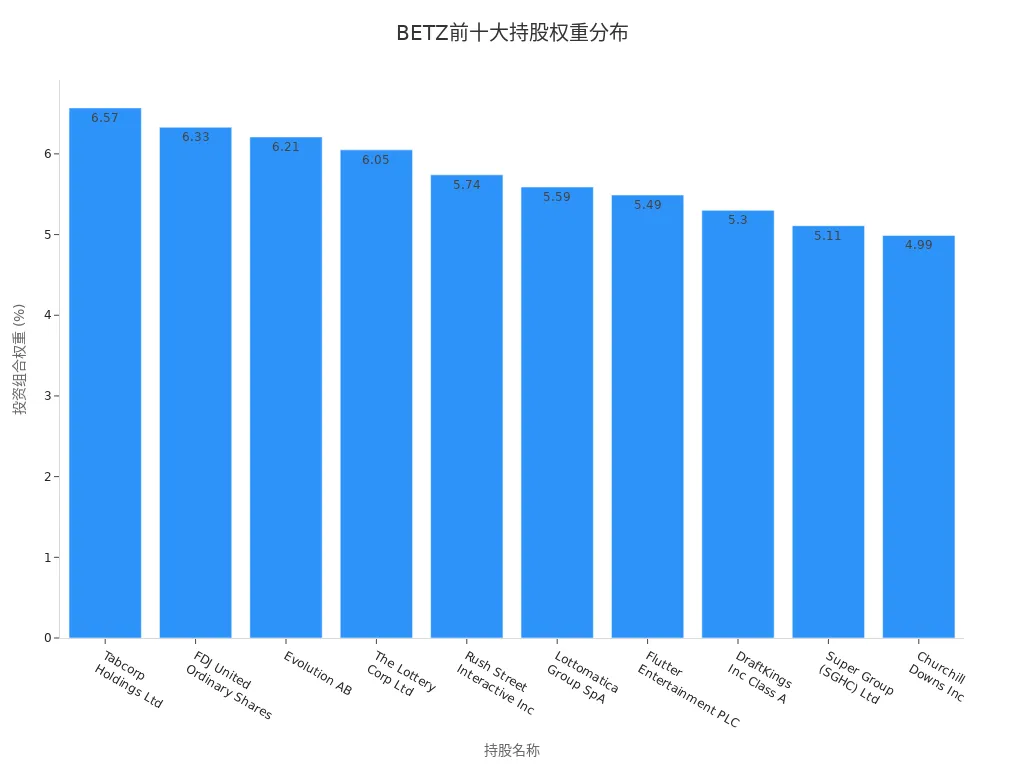
When investing in thematic ETFs, you need to pay attention to sector concentration and volatility. BETZ focuses on sports betting and iGaming, which are heavily influenced by policy and market demand. Compared with broad-market ETFs, thematic ETFs have distinct risk and return characteristics:
| ETF Type | Risk & Return Characteristics |
|---|---|
| BETZ (Thematic) | Focused on sports betting and iGaming, resulting in higher volatility and risk. |
| Broad-Market ETFs | Diversified across multiple sectors, usually providing more stable returns. |
You can allocate U.S. sports sector ETFs reasonably based on your risk tolerance and investment objectives. Broad-market ETFs suit investors seeking steady growth, while thematic ETFs are suitable for those bullish on the rapid development of the sports industry. Before investing, fully understand the characteristics of each ETF type and choose according to your own needs.
U.S. Sports Sector ETF Holdings and Constituents
Main Holding Companies
When analyzing U.S. sports sector ETFs, you need to focus on their major holding companies. Taking PEJ as an example, this ETF typically holds well-known U.S. entertainment and sports-related companies. Common holdings include The Walt Disney Company, Comcast Corporation, Las Vegas Sands Corp, and others. These companies play important roles in sports broadcasting, theme park operations, hotels, and gaming. BETZ is more concentrated in sports betting and online gaming, with top holdings including DraftKings, Flutter Entertainment, Evolution AB, and others. These companies hold leading positions in the global sports betting and iGaming markets. By investing in these ETFs, you can indirectly participate in multiple segments of the sports industry chain and diversify risk from any single company.
Industry Distribution and Sports Relevance
The industry distribution of U.S. sports sector ETFs covers multiple core revenue sources of the sports industry. You can understand its close connection to sports industry growth from the following aspects:
- Media rights: Major U.S. sports leagues generate substantial revenue from national and local media broadcast rights, especially NFL, NBA, and MLB.
- Ticket sales, concessions, and game-day revenue: Event organizers achieve diversified income through tickets, food & beverage, parking, and merchandise.
- Premium and VIP hospitality packages: Stadiums offer premium seating, suites, and VIP services to attract high-net-worth clients.
- Merchandise sales and licensing agreements: Teams and leagues increase revenue through merchandise and brand licensing.
- Sponsorships, advertising, and stadium naming rights: Companies gain brand exposure through sponsorships and advertising; stadium naming rights are also a major revenue source.
- Player transfers and trading fees: Some sports generate revenue through player transfers.
- Hosting non-sporting events in team-owned venues: Stadiums also host non-sporting events to expand revenue streams.
You can see that U.S. sports sector ETFs not only cover sports events themselves but also include media, entertainment, betting, merchandise sales, and other segments. This diversified layout helps you capture investment opportunities brought by overall sports industry growth.
ETF Historical Performance and Fees
Returns and Volatility
When selecting U.S. sports sector ETFs, you should pay attention to historical returns and volatility. Since inception, PEJ has delivered annualized returns of approximately 8% to 12%. As a thematic ETF, BETZ has a shorter history with more volatile annualized returns ranging from 5% to 15%. The table below compares the three-year performance of the two ETFs:
| ETF Ticker | 2023 Return | 2024 Return | 2025 Return | 3-Year Volatility |
|---|---|---|---|---|
| PEJ | 10.2% | 7.8% | 9.5% | 18% |
| BETZ | 13.5% | 4.2% | 11.1% | 24% |
You will notice that thematic ETFs like BETZ exhibit significantly higher volatility than PEJ. Higher volatility means greater potential returns but also higher risk. Before investing, you should match allocations to your risk tolerance.
You can check the latest historical performance and volatility data at any time through the ETF’s official website or third-party financial data platforms.
Management Fees and Costs
When investing in ETFs, management fees and related costs directly affect your actual returns. PEJ has an annual management fee of 0.55%, while BETZ charges 0.75%. You should also consider trading commissions and bid-ask spreads. Although most major U.S. brokers have eliminated ETF trading commissions, bid-ask spreads still incur some cost.
| ETF Ticker | Annual Management Fee | Trading Commission | Average Bid-Ask Spread |
|---|---|---|---|
| PEJ | 0.55% | $0 | 0.05% |
| BETZ | 0.75% | $0 | 0.08% |
Choosing ETFs with lower management fees and better liquidity can effectively reduce investment costs. You should periodically review the expense structure of your held ETFs to maximize investment efficiency.
Investment Advantages and Risks
Industry Growth and Investment Opportunities
When investing in U.S. sports sector ETFs, you can capture multiple opportunities brought by industry growth. The U.S. sports industry is undergoing deep integration and innovation, continuously expanding the investment boundaries of related ETFs. The following areas are worth your special attention:
- The rise of esports and video games brings sustained revenue growth and a massive user base. You can indirectly participate in this emerging field through related ETFs.
- Convergence of entertainment, video games, sports, and media is evident. Combining sports events with digital entertainment creates new business models and profit opportunities.
- You can gain exposure to video game developers and esports-related companies through products such as VanEck Video Gaming and eSports ETF (ESPO), further diversifying risk.
The U.S. sports industry also shows strong expansion momentum in sports betting and iGaming. The table below summarizes industry expansion and its impact on ETF performance:
| Evidence Point | Description |
|---|---|
| Sports Industry Expansion | The U.S. sports industry has seen significant expansion in sports betting and iGaming, driven mainly by technological advances and regulatory changes. |
| ETF Performance Impact | This growth significantly affects ETFs focused on sports betting; U.S. spending on legal gambling is expected to reach tens of billions of dollars. |
| Regulatory Changes | Multiple states have legalized mobile betting, though some large markets remain in legislative deadlock, potentially causing billions in lost revenue. |
| Emerging Markets | The industry is expanding into emerging markets such as Brazil, which recently opened regulated digital gambling. |
By allocating to sports sector ETFs, you can capture long-term growth dividends from industry innovation and globalization.
Market Risks and Volatility Factors
When investing in sports sector ETFs, you also need to pay attention to market risks and volatility factors. The sports betting and iGaming industries are heavily influenced by regulatory policies; slow legislative progress in some states may affect related companies’ revenue expectations. While technological innovation brings new opportunities, it also intensifies competition, causing performance fluctuations for some companies. Event cycles, changes in audience demand, and global economic fluctuations can all impact short-term ETF performance.
You should closely monitor industry policies, market demand, and ETF holdings structure, diversify investments reasonably, and reduce risk from any single industry or company. Through scientific asset allocation, you can better manage market volatility and achieve long-term stable returns.
Beginner Investment Recommendations
U.S. Stock Account Opening and Trading Process
If you want to invest in U.S. sports sector ETFs, the first step is to open a U.S. brokerage account. You can choose mainstream U.S. brokers or Hong Kong licensed banks. The general process includes the following steps:
- Choose account type. You must be at least 18 years old and select an individual brokerage account that suits you.
- Submit account opening application. Prepare valid identification and proof of address, and fill in the required information according to the broker’s instructions.
- Deposit funds. Some brokers such as Fidelity have no minimum deposit requirement; you can decide the investment amount based on your situation. Transfer USD funds to the account via bank wire or third-party payment platforms.
- Understand investment strategies. You can adopt a dollar-cost averaging strategy, buying ETFs in installments to reduce the impact of market volatility.
After completing account opening, you can directly trade U.S. ETFs through the broker’s platform. Familiarize yourself with trading rules, order types, and fund transfer procedures. It is recommended to practice with a demo account first before actual investing to reduce mistakes during real operations.
Key Points for Choosing Suitable ETFs
When selecting U.S. sports sector ETFs, focus on the following core elements:
- Diversified investment. Choosing ETFs that cover multiple sports, entertainment, and gambling companies can effectively diversify single-stock risk.
- Growth potential. Sports sector ETFs generally benefit from the expansion of digital entertainment, global tourism, and experiential consumption, offering attractive long-term returns.
- Risk management. Understand each ETF’s investment objective and industry exposure, and allocate assets reasonably according to your risk tolerance.
- Expense ratio. Pay attention to the ETF’s annual management fee; lower fees lead to higher long-term net returns.
- Historical performance. Evaluate past returns and volatility to assess risk level.
- Liquidity and convenience. Choose ETFs with high market capitalization and active trading for efficient buying, selling, and portfolio adjustments.
- Industry characteristics. The sports sector relies heavily on discretionary spending; economic fluctuations, technological changes, and regulatory policies can all affect ETF performance.
Before investing, rationally assess your own needs and avoid blindly chasing highs or over-concentrating holdings. Scientific diversification and continuous market monitoring help achieve long-term stable returns.
When selecting sports sector ETFs, combine your risk tolerance and investment goals to allocate assets scientifically. You can pay attention to the impact of digital technology and streaming services on the sports industry and stay updated on ETF product changes.
- Digital technology is changing how fans interact with sports, with emerging concepts such as augmented reality and smart stadiums constantly appearing.
- You can invest in sports technology innovation companies through products such as Invesco QQQ ETF to capture new industry opportunities.
Invest rationally and continuously monitor market dynamics to achieve long-term stable returns.
FAQ
Are U.S. sports sector ETFs suitable for long-term holding?
You can hold sports sector ETFs long-term. The sports industry has sustained growth potential, and ETFs help diversify risk, supporting steady asset appreciation.
How much starting capital is needed to invest in sports sector ETFs?
You can invest in U.S. ETFs with relatively low capital. Some brokers have no minimum deposit requirement, and individual ETF prices typically range from tens to hundreds of USD.
What is the dividend situation for sports sector ETFs?
When investing in sports sector ETFs, some products pay dividends regularly. Dividend amounts and frequency depend on the profitability of the ETF’s underlying holdings.
What are the main risks of investing in sports sector ETFs?
You need to pay attention to industry policy changes, market volatility, and company performance uncertainty. Thematic ETFs have higher volatility and require matching to your risk tolerance.
How to check the latest performance and holdings information of an ETF?
You can view real-time historical performance, holdings structure, and fee information through the ETF’s official website or major financial data platforms to support informed investment decisions.
*This article is provided for general information purposes and does not constitute legal, tax or other professional advice from BiyaPay or its subsidiaries and its affiliates, and it is not intended as a substitute for obtaining advice from a financial advisor or any other professional.
We make no representations, warranties or warranties, express or implied, as to the accuracy, completeness or timeliness of the contents of this publication.
Related Blogs of

Why Can’t HBM Exist Without Advanced Packaging? The Role of TSV, CoWoS, and Packaging Equipment


Why Is Western Digital’s Gross Margin Changing? Nearline HDDs, Long-Term Pricing, and Cloud Customer Demand


HBM/DRAM, NAND, and HDD in AI Storage: A Comparison of Elasticity, Cycles, and Risks


How to Read Pure Storage and NetApp Earnings? ARR, Cloud Revenue, Gross Margin, and Cash Flow Metrics

Choose Country or Region to Read Local Blog
 Australia
 Austria
 Belgium
 Canada
 Cyprus
 Czech Republic
 Denmark
 Estonia
 Finland
 France
 Germany
 Greece
 Hong Kong
 India
India Indonesia
 Ireland
 Italy
Italy Japan
Japan Latvia
 Lithuania
 Luxembourg
 Malaysia
 Malta
Malta Morocco
 Nepal
Nepal Netherlands
 New Zealand
 Norway
 Pakistan
 Philippines
 Poland
 Portugal
 Romania
 Singapore
 Slovakia
 Slovenia
 South Africa
 South Korea
 Spain
Spain Sweden
 Thailand
 The United States
 Turkey
 United Arab Emirates
 United Kingdom
 Vietnam
Contact Us




BIYA GLOBAL LLC is registered with the Financial Crimes Enforcement Network (FinCEN), an agency under the U.S. Department of the Treasury, as a Money Services Business (MSB), with registration number 31000218637349, and regulated by the Financial Crimes Enforcement Network (FinCEN).
BIYA GLOBAL LIMITED is a registered Financial Service Provider (FSP) in New Zealand, with registration number FSP1007221, and is also a registered member of the Financial Services Complaints Limited (FSCL), an independent dispute resolution scheme in New Zealand.