Traditional Broker Wire Deposits Too Slow? How to Use Cryptocurrency for Real-Time Deposits into US Stocks




Image Source: pexels
When you use traditional broker wire transfers to deposit funds into a US stock account, you often encounter issues of slow speed and high fees. Processing times vary significantly across different brokers and payment channels:
| Source | Processing Time |
|---|---|
| Fidelity | Bank wire transfers are nearly instant, usually processed within 1-2 days |
| Schwab | Electronic deposits and wire transfers are generally available for same-day trading, but may have a hold period of up to five business days |
| Stripe | Domestic wire transfers are usually completed within one business day; international wire transfers may take 1-5 business days or longer |
Cryptocurrency channels offer you higher flexibility and real-time arrival experience. Transaction fees for single transfers of mainstream blockchains such as Bitcoin and Ethereum are typically between $0.50-$5, while some emerging public chains like Solana and XRP have fees even lower than $0.01. You need to focus on fund sources, compliance requirements, and coin selection, weighing the optimal deposit method based on your own needs.
Key Points
- Cryptocurrency deposits are fast, usually arriving within minutes, far surpassing the 1-5 business days of traditional wire transfers.
- Using stablecoins such as USDT or USDC can reduce handling fees, with overall costs typically below $1.
- Choosing compliant brokers is crucial to ensure legitimate fund sources and avoid the risk of fund freezing.
- Cryptocurrency transfers support 24/7 operations, independent of bank business hours, improving fund liquidity.
- Understand each broker’s fee structure and regulatory policies, and select transparent and secure platforms for deposits.
Comparison Between Traditional Broker Wire Deposits and Cryptocurrency Deposits
Image Source: pexels
Wire Deposit Process and Time
When you use traditional broker wire transfers to deposit funds into a US stock account, you usually need to go through a series of standardized procedures. Taking a Hong Kong licensed bank as an example, the main steps are as follows:
- Log in to the broker or bank’s portal website.
- Select “Transfers & Payments” and enter the “Transfer Funds” menu.
- Choose “Deposit Funds” and specify the “Deposit Method.”
- Obtain detailed operation instructions and complete the transfer according to the guidelines.
The entire process may seem simple, but the actual arrival time is affected by multiple factors. You need to consider the transfer initiation time, bank review, cross-border verification, and other aspects. Generally, wire transfers from Canada or Hong Kong to a US brokerage account take 1 to 5 business days to arrive. Some brokers may experience delays due to compliance reviews, and in extreme cases, it can even exceed one week.
In contrast, cryptocurrency deposit channels such as Biyapay greatly simplify the operation process. You only need to register an account on the Biyapay platform, bind your crypto wallet, select stablecoins such as USDT, enter the broker’s receiving address, and initiate the transfer. The entire process is usually completed within a few minutes, significantly improving fund turnover efficiency.
You can clearly see that traditional broker wire transfers have inherent disadvantages in process and time, especially in cross-border scenarios where efficiency issues are particularly prominent.
Wire Transfer Fees and Costs
When choosing traditional broker wire transfers, you must pay attention to the handling fees at each stage. The following is a comparison of wire transfer fees from major banks:
| Bank | Domestic Incoming | Domestic Outgoing | International Incoming | International Outgoing |
|---|---|---|---|---|
| Bank of America | $15 | $30 | $16 | $45 |
| Capital One | $15 | $30 | $15 | $40-$50 |
| Chase | $0-$15 | $25-$35 | $0-$15 | $0-$50 |
| Citi | $15 | $25 | $15 | $35 |
| Fidelity | $0 | $0 | $0 | $0 |
| PNC | $15 | $25-$30 | $15 | $40-$45 |
| TD Bank | $15 | $30 | $15 | $50 |
| USAA | $0 | $20 | $0 | $45 |
| U.S. Bank | $20 | $30 | $25 | $50 |
| Wells Fargo | $15 | $30 | $16 | $45 |
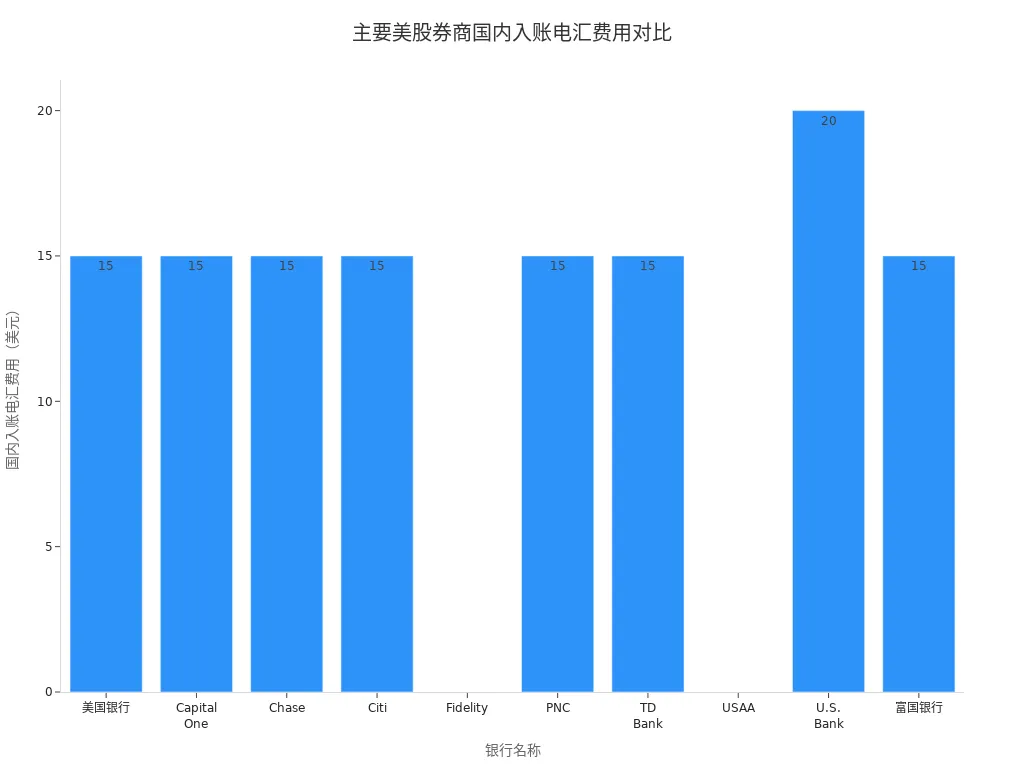
You also need to note that, in addition to the above explicit fees, some banks charge hidden costs. For example, domestic wire transfer outgoing fees are usually between $0 and $35, receiving fees $0 to $15; international wire transfer outgoing fees $35 to $50, receiving fees $0 to $16. The overall cost of international wire transfers is much higher than domestic ones, and while some institutions may waive certain fees, cross-border fund transfers are generally not negligible in cost.
Cryptocurrency Deposit Speed and Convenience
If you choose cryptocurrency channels such as Biyapay to deposit into a US stock account, you will gain significant advantages in speed and convenience. Cryptocurrency transfers are not restricted by bank business hours and support real-time 24/7 arrival. You only need an internet connection and a crypto wallet, without relying on the traditional banking system.
The table below summarizes the main advantages of cryptocurrency deposits:
| Advantage | Description |
|---|---|
| Accessibility | You can easily access cryptocurrency services anytime and anywhere without needing a traditional bank account. |
| Lower Fees and Faster Time | Cryptocurrency transfer fees are far lower than traditional banks, with funds arriving in minutes. |
| Transparency | All transfer records are publicly transparent on the blockchain, making tracking and verification easy. |
In actual operations, you will find that transfer fees on platforms such as Biyapay are usually below $1, and fees on some emerging public chains like Solana and XRP are even lower than $0.01. The efficiency and cost advantages of fund turnover are extremely prominent, especially suitable for investors who have high requirements for fund timeliness.
USD Stablecoins Save Costs
If you choose USD stablecoins such as USDT as the deposit medium, you can further reduce fund turnover costs. Stablecoin transfers settle almost immediately after initiation, greatly shortening the time funds are in transit. You do not need to bear the high fees of traditional banking systems such as SWIFT.
By using stablecoins, you can effectively avoid the high costs of traditional transfers. The following are fees related to USD stablecoins:
| Fee Type | Fee Amount |
|---|---|
| Transaction Fee | 0.1% (e.g., about $10 for $10,000) |
| Withdrawal Fee | $0.10 (regardless of amount) |
| Cross-Chain Swap Fee | $0.20 (regardless of amount) |
| Stablecoin Deposit Fee | 0.3% (minimum $1) |
When operating on platforms such as Biyapay, the overall cost is far lower than traditional broker wire transfers. Stablecoins not only improve fund turnover efficiency but also save you a significant amount in handling fees, especially in large cross-border fund transfer scenarios.
If you are pursuing efficient and low-cost methods for US stock deposits, USD stablecoins and cryptocurrency channels are undoubtedly a better choice.
Cryptocurrency Deposit Process into US Stocks
Image Source: unsplash
Choosing Brokers That Support Cryptocurrency
When selecting a US stock broker that supports cryptocurrency deposits, you need to focus on several core criteria. Security is always the top consideration, ensuring the broker has robust fund supervision and crypto asset protection mechanisms. Transparent and reasonable fees help reduce overall deposit costs. The wider the variety of available cryptocurrencies, the greater the operational flexibility. User reviews reflect the broker’s service quality and real-world experience; it is recommended to refer to industry reputation.
Currently, some international mainstream brokers have opened cryptocurrency deposit channels. For example:
- Interactive Brokers allows clients to use stablecoins for account funding deposits. You can transfer USDC from a crypto wallet to the secure wallet provided by the broker.
- Interactive Brokers plans to support Ripple Coin (RLUSD) and PayPal Coin (PYUSD).
- Deposits incur no handling fees, but you are responsible for blockchain network-related fees.
In actual operations, it is recommended to prioritize brokers that support stablecoin deposits, have low fees, and good user reviews. Third-party platforms such as Biyapay also provide convenient cryptocurrency deposit services for Chinese-speaking users, supporting multiple mainstream stablecoins and public chains to improve fund turnover efficiency.
If you are accustomed to traditional broker wire transfers, it is recommended to compare the security and convenience of cryptocurrency channels and make a choice based on your own needs.
USDT and Other Stablecoins Conversion to USD
When preparing cryptocurrency deposits into a US stock account, you usually need to first convert fiat currency to USD stablecoins. Taking USDT and USDC as examples, the operation process is as follows:
- Purchase stablecoins: You can purchase USDT or USDC through fiat currency on mainstream cryptocurrency exchanges (such as Binance). Each platform has detailed tutorials; it is recommended to prioritize USDC for higher liquidity and compliance.
- Withdraw to wallet: You need to withdraw the stablecoin to a personal crypto wallet, such as a Fluidkey wallet. Ensure the stablecoin is withdrawn through mainstream blockchains such as Ethereum to enhance security.
- Convert to USD: Fluidkey wallet supports converting USDC to USD. You can use its cross-chain swap function to transfer USDC to the Base network, achieving seamless conversion between USD stablecoins and USD.
During the conversion process, you need to pay attention to exchange rate risks. Although stablecoins are pegged to the USD with low volatility, inherent risks still exist when performing foreign exchange conversions. In US stock deposit scenarios, direct conversion between USD stablecoins and USD has minimal exchange rate risk.
By using stablecoin channels for deposits, you can effectively avoid the high handling fees and long waiting times of traditional broker wire transfers, improving fund turnover efficiency.
Brokerage Account Deposit Operations
After completing stablecoin conversion, you need to transfer funds into the US stock brokerage account. Taking the Biyapay platform as an example, the operation steps are as follows:
- Ensure you have set up a USD account with the US stock broker.
- Select the cryptocurrency deposit method, enter the Biyapay platform, and bind your crypto wallet.
- On the platform’s main screen, go to the “Deposit” menu and select “Recharge Stocks Cash” or a similar function.
- Specify the deposit amount and generate a dedicated receiving address.
- Send USDT or USDC from your crypto wallet to that address, ensuring the amount is accurate.
- Wait for blockchain network confirmation, usually arriving within minutes.
- After the platform completes fund review, the funds are automatically transferred to the broker’s USD account, and you can trade US stocks at any time.
During the operation, you need to pay attention to identity verification and fund source requirements. Brokers usually require verification of wallet addresses to ensure deposits come from personal wallets. You need to submit valid identification and proof of residence to complete identity authentication. Deposits must come from personal wallets; transfers from platform wallets will fail.
| Requirement Type | Description |
|---|---|
| Wallet Address Verification | Requires verification of wallet ownership to ensure deposits come from verified addresses. |
| Deposit Source | Deposits must come from personal wallets; transfers from platform wallets will fail. |
| Identity Verification | Requires submission of valid identification documents and proof of residence to complete identity verification. |
If you use platforms like Biyapay, the overall operation process is simple and efficient, with fund turnover speed far exceeding traditional broker wire transfers.
PayPal Purchase of Bitcoin Transfer
If you wish to purchase Bitcoin through PayPal for US stock deposits, you need to understand its operational restrictions. PayPal provides a convenient Bitcoin purchase channel for beginners, but you cannot directly transfer Bitcoin to other platforms or users. PayPal controls the user’s private keys, limiting your actual control over cryptocurrency. You can only sell Bitcoin and then transfer the cash to an external account.
When buying, selling, and holding Bitcoin on the PayPal platform, the purchased cryptocurrency does not truly belong to you. You cannot transfer the purchased cryptocurrency out of the platform; you must first convert it to USD. PayPal partners with Paxos Trust Company to simplify the buying and selling process, but you do not have access to private keys. If PayPal closes your account, you will not be able to access your Bitcoin assets.
If you pursue flexibility in fund flow and asset security, it is recommended to prioritize stablecoin channels or professional cryptocurrency platforms for US stock deposits. PayPal is suitable for beginners to experience, but not ideal for large amounts or long-term investment needs.
Through the above process, you can efficiently complete cryptocurrency deposits into US stock accounts. You need to combine your own fund size, risk preference, and operational habits to choose the most suitable deposit channel.
Handling Fees and Arrival Time
Cryptocurrency Transfer Fees
When using cryptocurrency channels to deposit into US stock accounts, handling fees are usually far lower than traditional broker wire transfers. Cryptocurrency transfers, especially through stablecoins such as USDT or USDC, can effectively bypass the banking system and avoid intermediary fees. You can refer to the following common fee structures:
- Cryptocurrency transfer fees are generally between USD 0.1 and USD 1, with fees on some emerging public chains such as Solana and XRP as low as USD 0.01.
- Through platforms such as Biyapay, stablecoin recharge fees are approximately 0.1%, withdrawal fees are USD 0.10, and cross-chain swap fees are USD 0.20.
- You do not need to bear the high handling fees of traditional cross-border wire transfers, resulting in more advantageous overall costs.
If you choose blockchain payments, fund processing is faster, fees are more transparent, and it is suitable for investors who have high requirements for fund efficiency.
Broker Receiving Fees
After completing cryptocurrency transfers, brokers may charge certain receiving fees. The specific fee structure is as follows:
- Platform fees: Some brokers or third-party platforms charge conversion fees, usually a certain percentage of the transaction amount.
- Bank fees: If fiat settlement is involved, payment processors may charge additional service fees.
- Deposit and withdrawal fees: Fees vary depending on asset type, transfer method, network congestion, and platform policies.
When choosing a broker, prioritize fee transparency to avoid hidden costs affecting overall deposit efficiency. Platforms such as Biyapay usually do not charge additional deposit handling fees, but you are responsible for blockchain network fees.
Deposit Arrival Speed
Depositing into US stock accounts through cryptocurrency channels has significantly faster arrival speeds than traditional broker wire transfers. Cryptocurrency transfers support real-time 24/7 arrival, usually completed within minutes. Arrival speed is affected by the following factors:
- Transaction volume: Peak periods may cause network congestion, affecting confirmation speed.
- Market conditions: During extreme market conditions, some blockchain networks may experience delays.
- System performance: Platform processing capability directly affects arrival efficiency.
- Stablecoin issuer volatility: Some stablecoins may experience brief fluctuations under extreme market conditions.
If you use platforms such as Biyapay, funds can arrive within 5 to 10 minutes in most cases, greatly improving fund turnover efficiency.
Exchange Rate Selection and Risk Control
When conducting cryptocurrency deposits, exchange rate fluctuations may bring additional risks. You can adopt the following risk management strategies:
- Implement stop-loss orders to limit potential losses.
- Diversify investments to reduce volatility risk from a single coin.
- Clearly define the risk/reward ratio for each transaction and allocate funds reasonably.
When choosing stablecoin channels, exchange rate fluctuations are relatively small, but in large fund transfers or extreme market environments, you still need to pay attention to real-time exchange rates and arrange deposit timing reasonably.
By using cryptocurrency channels to deposit into US stock accounts, you can not only enjoy 24/7 trading and flexible exchange rate selection but also effectively reduce handling fees and time costs, improving overall fund efficiency.
Security and Compliance Risks
Compliance Requirements for Fund Sources
When depositing into US stock accounts through cryptocurrency channels, you must ensure the compliance of fund sources. Brokers usually require you to provide proof of fund sources to ensure funds are not involved in illegal activities. You need to prepare relevant documents, such as bank statements, cryptocurrency exchange deposit/withdrawal records, etc. Some brokers also require verification of crypto wallet ownership to ensure funds truly come from you. During operations, you should avoid using anonymous wallets or third-party account transfers; otherwise, deposits may fail or funds may be frozen. Compliant operations not only protect your fund safety but also help smoothly pass the broker’s anti-money laundering review.
Broker Regulatory Policies
When selecting US stock brokers that support cryptocurrency deposits, you need to pay attention to their regulatory policies. Compliant brokers strictly follow requirements from regulatory bodies such as the U.S. Securities and Exchange Commission (SEC) to ensure client fund safety. You can pay attention to the following regulatory measures:
- Brokers must maintain accurate books and records in accordance with relevant SEC regulations.
- Once your crypto assets are reflected in the broker’s stock records, the broker must fulfill quarterly counting and verification obligations.
- The broker’s external auditors must be able to audit its internal financial controls to ensure compliance with SEC financial and client asset protection requirements.
Choosing compliant brokers helps reduce risks of fund misappropriation or operational issues. You should also pay attention to whether the broker undergoes regular third-party audits to ensure its internal control system is sound.
Preventing Fund Freezing Risks
During cryptocurrency deposits, you must attach great importance to fund freezing risks. Brokers and regulatory authorities strictly monitor fund flows and sources. You should avoid using high-risk exchanges or anonymous wallets for transfers. You also need to ensure all deposit operations comply with the broker’s identity authentication and anti-money laundering policies. If the broker discovers abnormal transactions or cannot verify fund sources, it may temporarily freeze your account funds or even require supplementary materials or further investigation. You can communicate deposit plans with the broker in advance, understand their specific requirements, and reduce operational risks. Compliant and transparent fund flow processes are key to ensuring fund safety.
Advantages, Disadvantages, and Suitable Users
Advantages of Cryptocurrency Deposits
By choosing cryptocurrency channels to deposit into US stock accounts, you can significantly improve fund turnover efficiency. Cryptocurrency transfers support real-time 24/7 arrival, greatly shortening waiting times. You do not need to rely on the traditional banking system, avoiding the high handling fees and complex processes of cross-border wire transfers. Platforms such as Biyapay provide convenient stablecoin deposit services for Chinese-speaking users, with overall transparent fees usually below USD 1, suitable for investors sensitive to fund timeliness and costs. You can also achieve full traceability of fund flows through blockchain technology, enhancing asset security.
Potential Risks and Limitations
When using cryptocurrency deposits, you need to pay attention to the following potential risks and limitations:
- Cryptocurrency markets are extremely volatile, which may lead to significant asset value fluctuations.
- A small number of holders control large amounts of cryptocurrency, making the market susceptible to manipulation and sharp fluctuations.
- Vulnerabilities in encryption technology or software may lead to asset losses.
- The emergence of numerous new platforms may affect the value of existing cryptocurrencies.
- During peak trading periods, scalability issues may cause increased handling fees.
- Changes in government regulatory policies may affect cryptocurrency demand and circulation.
- Once cryptocurrency is lost or stolen, recourse is limited, and assets are difficult to recover.
- The market contains false investment opportunities; you need to be vigilant against cryptocurrency scams.
Suitable Investor Types
If you have certain experience in cryptocurrency operations, are familiar with blockchain wallets and stablecoin transfer processes, and have high requirements for fund turnover speed and costs, you can prioritize cryptocurrency deposit methods. If you hope to flexibly manage cross-border assets or need frequent fund scheduling for US stock accounts, cryptocurrency channels are more suitable. For investors with lower risk tolerance or unfamiliarity with crypto asset management, it is recommended to prioritize traditional banking channels.
Practical Suggestions
When choosing cryptocurrency deposits into US stock accounts, prioritize platforms with strong compliance and transparent fees, such as Biyapay. You need to understand in advance the broker’s specific requirements for cryptocurrency fund sources and identity verification to ensure all operations comply with regulatory policies. You can deposit in batches to reduce single-transaction volatility risks. You should also regularly monitor cryptocurrency markets and related policy changes, reasonably arrange deposit timing, and ensure asset safety.
By using cryptocurrency channels to deposit into US stock accounts, you can significantly improve fund arrival speed, reduce overall costs, and gain higher convenience. You should focus on fund source compliance, broker regulatory policies, and platform security. It is recommended to flexibly choose the optimal deposit method based on your own fund needs and risk tolerance. You should also continue to monitor broker policies and cryptocurrency market changes to safeguard fund safety.
FAQ
Is it safe to deposit into US stock accounts using cryptocurrency?
If you choose compliant brokers and comply with fund source requirements, the deposit process is highly safe. You should avoid using anonymous wallets and ensure all operations are traceable.
How soon after deposit can I start trading US stocks?
Deposits through cryptocurrency channels usually arrive within minutes. Once the broker approves, you can immediately trade US stocks.
Is there any exchange rate loss with stablecoin deposits?
When using stablecoins such as USDT or USDC, exchange rate fluctuations are minimal. When converting to fiat currency, pay attention to market prices and arrange deposit timing reasonably.
What identity verification requirements are there for cryptocurrency deposits?
You need to complete the broker’s identity authentication, including submitting identification and proof of residence. You also need to verify wallet ownership to ensure compliant fund sources.
What to do if funds are frozen?
You should promptly contact the broker’s customer service and provide proof of fund sources and transfer vouchers. You need to cooperate with the broker to complete compliance investigations to ensure smooth unfreezing of funds.
*This article is provided for general information purposes and does not constitute legal, tax or other professional advice from BiyaPay or its subsidiaries and its affiliates, and it is not intended as a substitute for obtaining advice from a financial advisor or any other professional.
We make no representations, warranties or warranties, express or implied, as to the accuracy, completeness or timeliness of the contents of this publication.
Related Blogs of

AI Storage Supply Chain Map: Chips, HDDs, SSDs, Packaging Equipment, and Enterprise Storage Systems


How Should SSDs and HDDs Work Together in AI Data Centers? Performance, Capacity, Cost, and Hot vs. Cold Data Compared


What Are NOR Flash, SLC NAND, and EEPROM? Why They Help Explain Hong Kong-Listed Memory-Related Stocks

Is SMIC 0981.HK a Memory Chip Stock? The Relationship Between Foundry Manufacturing and the Memory Supply Chain

Choose Country or Region to Read Local Blog
 Australia
 Austria
 Belgium
 Canada
 Cyprus
 Czech Republic
 Denmark
 Estonia
 Finland
 France
 Germany
 Greece
 Hong Kong
 India
India Indonesia
 Ireland
 Italy
Italy Japan
Japan Latvia
 Lithuania
 Luxembourg
 Malaysia
 Malta
Malta Morocco
 Nepal
Nepal Netherlands
 New Zealand
 Norway
 Pakistan
 Philippines
 Poland
 Portugal
 Romania
 Singapore
 Slovakia
 Slovenia
 South Africa
 South Korea
 Spain
Spain Sweden
 Thailand
 The United States
 Turkey
 United Arab Emirates
 United Kingdom
 Vietnam
Contact Us




BIYA GLOBAL LLC is registered with the Financial Crimes Enforcement Network (FinCEN), an agency under the U.S. Department of the Treasury, as a Money Services Business (MSB), with registration number 31000218637349, and regulated by the Financial Crimes Enforcement Network (FinCEN).
BIYA GLOBAL LIMITED is a registered Financial Service Provider (FSP) in New Zealand, with registration number FSP1007221, and is also a registered member of the Financial Services Complaints Limited (FSCL), an independent dispute resolution scheme in New Zealand.