- More
- Download
Invest in Your AI Dreams with Digital Assets: Exclusive Funding Channels for Developers





Image Source: unsplash
You can raise funds for AI projects and efficiently acquire necessary resources through digital asset investment. Exclusive on/off-ramp channels bring you greater convenience and security. Taking the digital asset channel of a Hong Kong licensed bank as an example, compared with traditional financing methods, the exclusive channel offers advantages such as high returns, asset diversification, and fast transactions. You can also enjoy the security protection under Swiss banking law, with regular audits and clear terms enhancing transparency. The table below shows a comparison of the two approaches:
| Aspect | Digital Asset Channel (Hong Kong Licensed Bank Scenario) | Traditional Financing Methods |
|---|---|---|
| Convenience | High returns, asset diversification, fast transactions | Complicated process, time-consuming |
| Security | Complies with banking law, secure asset custody, high transparency | Potential risk of theft or fraud |
| Transparency | Regular audits, annual reports, clear terms | Opaque information, insufficient regulation |
| Trust | Serves as a trust anchor, reduces user distrust toward cryptocurrencies | Traditional financial trust affected by incidents |
Core Points
- Digital asset investment provides AI projects with opportunities for high returns and fast transactions, helping developers efficiently acquire required resources.
- Choosing the right on/off-ramp channel is crucial: OTC suits large amounts, API channels suit high-frequency trading, and third-party platforms offer convenient services.
- Ensure fund security by using two-factor authentication and hardware wallets, and avoid transacting on public networks to reduce risks.
- Pay attention to compliance, understand regulatory policies in different regions, and ensure investment strategies meet local legal requirements.
- Continuously learn industry trends, participate in professional communities and forums, improve digital asset investment capabilities, and keep up with the latest technological and regulatory developments.
Advantages of Digital Asset Investment

Image Source: pexels
Capital Liquidity and Globalization
You can break the geographical restrictions of traditional financial systems through digital asset investment. Digital assets provide AI developers with entirely new global capital flow channels. You can participate in international markets at lower transaction costs and improve capital flow efficiency. Decentralized finance (DeFi) gives you access to a broader range of financial services, while asset tokenization enhances liquidity and accessibility.
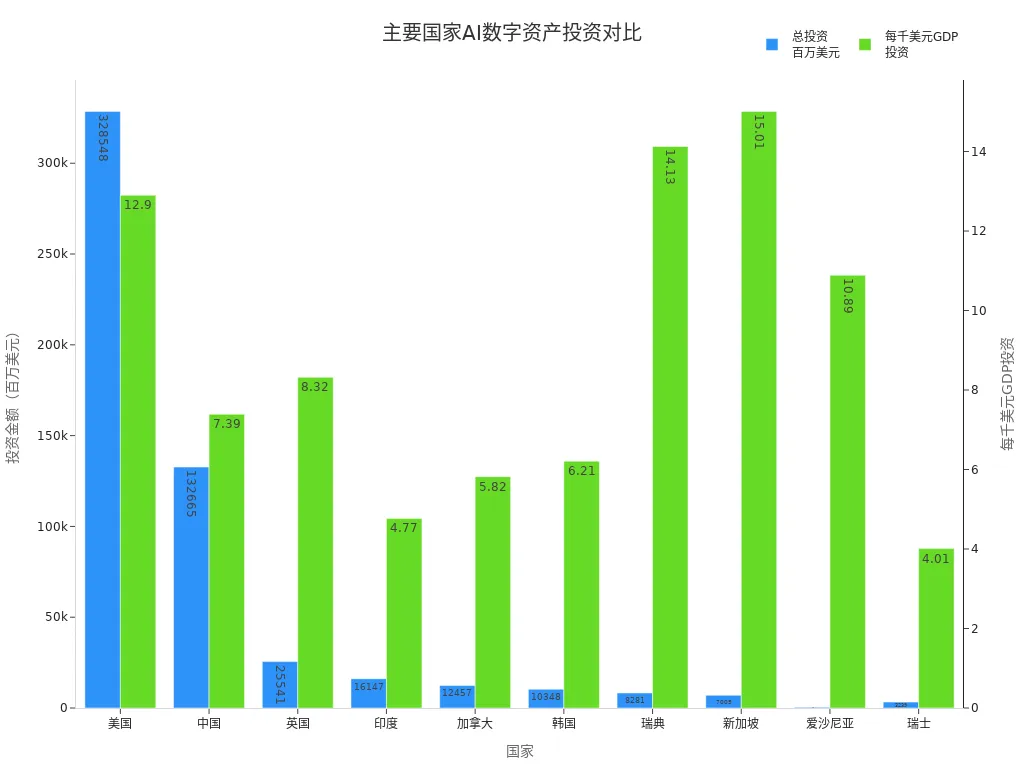
In 2023, total global artificial intelligence market investment reached $142.3 billion, demonstrating strong corporate focus on the AI sector. You can refer to the table below to understand digital asset investment in AI across major countries over the past five years:
| Country | Total Investment in Past Five Years (USD million) | Investment per $1,000 GDP | Comparison with US Investment (per $1,000 GDP) |
|---|---|---|---|
| United States | 328,548 | 12.90 | 100.00% |
| China | 132,665 | 7.39 | 57.24% |
| United Kingdom | 25,541 | 8.32 | 64.46% |
| India | 16,147 | 4.77 | 36.97% |
| Canada | 12,457 | 5.82 | 45.12% |
| South Korea | 10,348 | 6.21 | 48.16% |
| Sweden | 8,281 | 14.13 | 109.53% |
| Singapore | 7,005 | 15.01 | 116.30% |
| Estonia | 415 | 10.89 | 84.44% |
| Switzerland | 3,239 | 4.01 | 31.08% |
Lower Barriers and Costs
You can significantly lower the entry threshold for participating in AI projects by utilizing digital asset investment. Asset tokenization enables retail investors and those in developing markets to participate in asset classes previously accessible only to institutional investors. You can divide assets into smaller units, reducing the investment amount per transaction.
- Traditional financial systems involve complex processes and high costs
- Tokenization simplifies processes through smart contracts and improves efficiency
- You can complete fund transfers at lower service fees and faster speeds
Flexibility and Developer-Friendliness
Digital asset investment brings you extremely high flexibility. You can implement self-executing agreements through smart contracts, reducing reliance on traditional legal and banking services. Blockchain technology enables integration of smart contracts with AI systems to meet real-world needs. You can also participate in decentralized autonomous organizations (DAOs), directly advancing AI projects without depending on traditional managers or fiat funding.
83% of enterprises have already incorporated artificial intelligence into their business strategies. Digital asset investment provides you with more flexible financing and management methods.
Types of On/Off-Ramp Channels
During digital asset investment, you can choose from multiple on/off-ramp channels.If your goal is not just to complete a single deposit or withdrawal, but to keep development funding, cross-border settlement, and later asset management within one clearer workflow, then channel integration matters as much as fees. A multi-asset wallet such as the BiyaPay website, which covers payment, trading, and fund-management scenarios, can fit developers who want to manage crypto-to-fiat movement in one place.
Before using a route in practice, you can also use its exchange rate converter to compare conversion costs across currencies. If team payouts or project distribution are involved later, its remittance service can be included in the funding path design. For developers who also track related assets, the stock information page can be used as a supporting reference. Each channel has its unique principles, applicable scenarios, and risk control mechanisms. You need to reasonably select the most suitable method based on your own needs and project scale. The following sections detail three mainstream channel types and analyze them in combination with BiyaPay’s business scope.
OTC Over-the-Counter Trading
OTC over-the-counter trading provides you with an exclusive channel for large-amount fund flows. You can negotiate prices and terms directly with counterparties through OTC platforms, avoiding price volatility in public markets. BiyaPay supports global payment & receipt and digital currency trading services, suitable for users requiring large fund transfers or international remittances.
Common application scenarios include:
- Institutional and high-net-worth activity: Asset management firms and family offices typically configure Bitcoin through OTC trading desks.
- Miners seeking liquidity: Miners holding large Bitcoin amounts conduct bulk sales via OTC to avoid sharp market price fluctuations.
- Cross-border payments and fund transfers: Investors in certain regions use OTC channels for international capital movement, bypassing regulatory barriers.
In OTC trading, you can obtain higher confidentiality and liquidity control. Platforms are usually designed for compliance and fund security, but lack of standardized delivery may lead to settlement gaps.
The table below compares user experience between manual OTC trading and automated API channels:
| Trading Method | Features | User Experience |
|---|---|---|
| Manual OTC Trading | Transactions conducted via quote requests or negotiation under specific terms. | Requires more personal interaction and negotiation. |
| Automated API Channels | Allows users to trade directly via API, usually more efficient and without manual intervention. | Provides faster transaction speed and less human intervention. |
When selecting an OTC platform, focus on the platform’s compliance qualifications and fund security measures. BiyaPay, as a global payment & receipt service provider, adopts multi-factor authentication and fund custody mechanisms to ensure transaction security.
API Interface Channels
API interface channels provide you with automated, batch-oriented on/off-ramp solutions. Through API interfaces, you can achieve real-time fiat-to-crypto conversion, USDT to USD or HKD exchange, and on/off-ramp support for US stocks and Hong Kong stocks trading.
Advantages of API channels include:
- Increased productivity: APIs offer pre-configured functions, reducing repetitive tasks so you can focus on complex business logic.
- Faster integration: APIs enable quick service integration with third parties, promoting automation and scalability.
- Improved security: APIs act as gatekeepers for data access, effectively controlling permissions and enhancing security.
- Transformed customer experience: API integration helps businesses create a single customer view and improve experience.
- Competitiveness: APIs allow enterprises to integrate features faster and maintain market competitiveness.
- Reusability and repeatability: API functions facilitate code reuse and promote innovation.
- Flexibility and cost reduction: APIs enable seamless addition of new features without high development costs.
- Efficiency: APIs automatically publish content, ensuring smooth information flow.
With API channels, you can achieve efficient, automated fund management — ideal for AI projects requiring frequent trading and batch processing. BiyaPay supports multi-currency real-time conversion and international remittances to meet global user needs.
Third-Party Platforms
Third-party platforms provide you with convenient digital asset on/off-ramp services. Through platforms like BiyaPay, you can achieve global payment & receipt, digital currency trading, and international remittances. DeFi platforms leverage blockchain and smart contracts to allow trading without traditional financial intermediaries.
When using third-party platforms, pay attention to the following risks:
- Operational risk: Contracted services and vendors must have effective control measures to reduce related risks.
- Technical risk: Vendor technical reliability must be evaluated; access controls for critical systems are especially important.
- Custody and security risk: Asset security controls must be in place to prevent wallet theft and asset loss.
While DeFi platforms bring convenience, they also introduce governance and compliance risks. You need to carefully assess information reliability and choose platforms with compliance qualifications and strong security protections. BiyaPay adopts multiple security mechanisms and compliance processes to safeguard user funds.
When selecting on/off-ramp channels, focus on platform security and compliance. Compliance and robust security are closely related requirements that support trust and growth in the digital asset ecosystem. As rules tighten and customer expectations rise, partnering with experienced security providers is critical.
The table below compares security and compliance standards across different channel types:
| Type | Security | Compliance |
|---|---|---|
| Definition | Processes and tools to protect digital assets | Rules or standards for organizational information technology |
| Objective | Prevent cyberattacks, data breaches, and unauthorized access | Ensure adherence to industry best practices and reduce fine risks |
| Managing Team | IT security team | Compliance team |
| Incentives | Internal motivation | Third-party requirements (e.g., government or industry bodies) |
| Importance | Requires strong security measures to protect data | Following compliance requirements to avoid legal consequences and fines |
Choosing channels with high security and compliance can effectively avoid fines and legal consequences, protect platform trust and reputation, and enhance fraud detection capabilities. As a global payment & receipt and digital currency trading service platform, BiyaPay consistently upholds compliant operations and fund security, providing you with professional and reliable digital asset investment on/off-ramp solutions.
Operation Process and Common Issues

Image Source: pexels
Channel Selection Method
During digital asset investment, you need to select the appropriate on/off-ramp channel based on project needs, fund scale, and trading frequency. BiyaPay provides global users with multi-currency real-time conversion, international remittances, USDT to USD or HKD exchange, and on/off-ramp support for US and Hong Kong stock trading. You can prioritize API interface channels for automated batch processing — suitable for high-frequency trading and fund management needs. OTC over-the-counter trading is appropriate for large fund transfers and cross-border payments. Third-party platforms offer convenient digital currency trading and global payment & receipt services. When choosing a channel, focus on platform security, compliance, and fund custody mechanisms to ensure asset safety.
Steps for Funding Inflows and Outflows
When handling fund inflows and outflows, you can follow this process:
- Complete registration and bind identity information on the BiyaPay platform.
- Fund distributors submit subscription requests on the DTA request management contract.
- Chainlink NAVLink retrieves NAV data from trusted sources and publishes it on-chain.
- The fund administrator processes the distributor’s request.
- The DTA request management contract obtains the latest NAV data and calculates the number of shares to issue.
- The DTA request management contract sends settlement instructions to the settlement contract.
- Fund tokens are issued to the settlement contract; payment tokens and fund tokens are atomically transferred to your wallet.
- You can use BiyaPay to achieve real-time fiat-to-crypto conversion and complete fund outflows or withdrawals.
Common Problems and Solutions
During digital asset investment operations, you may frequently encounter the following issues:
| Issue | Specific Problem | Impact | Root Cause | Stakeholders |
|---|---|---|---|---|
| Metadata inconsistency | Inconsistent metadata tagging, difficult retrieval | Project delays, duplicated work | Lack of standardized architecture, insufficient user training | Content creators, project managers |
| Inefficient approval workflows | Slow approval processes, frequent bottlenecks | Delayed asset approvals, marketing impact | Lack of automation, unclear approval responsibilities | Content managers, approvers |
| Limited access controls | Insufficient access measures, risk of sensitive asset leakage | Data breaches, compliance issues | Inadequate role controls, lack of regular audits | IT security team, compliance officers |
| Low user adoption | Users underutilize new systems | Underutilized investment, low efficiency | Lack of training, insufficient awareness of system benefits | IT department, training coordinators |
| Data redundancy | Independent management by departments, high redundancy | Increased storage costs, difficult version control | Lack of centralized management, poor communication | Content creators, department managers |
You can effectively improve digital asset investment efficiency and reduce operational risks by strengthening user training, optimizing approval workflows, improving access controls, and centralizing asset management.
Digital Asset Investment Risks and Best Practices
Fund Security Recommendations
During digital asset investment, you must place high importance on fund security. Common security threats include private key theft, malicious smart contracts, fiat-crypto trading scams, email-based authentication attacks, rug-pull schemes, and AI-powered phishing attacks. You can adopt the following measures to reduce risks:
- Use two-factor authentication to protect wallets and exchange accounts.
- Withdraw cryptocurrencies to secure wallets instead of leaving them on exchanges long-term.
- Record wallet seed phrases on paper and store them securely; never enter them on any website.
- Use strong, unique passwords for each wallet and service.
- Prioritize hardware wallets for asset storage.
- Avoid public Wi-Fi; use a VPN when necessary.
- Stay vigilant against crypto-related emails and software to prevent phishing attacks.
You can also leverage AI and machine learning to analyze transaction data in real time, automatically identify emerging risks, and enhance security protection. Establishing security baselines and oversight mechanisms helps build investor trust.
Legal and Compliance Considerations
When selecting digital asset on/off-ramp channels, pay attention to regulatory policies in different jurisdictions. The EU MiCA framework is influencing product strategies in the European market; Ireland has become a common entry point for single-market clients, the Cayman Islands are favored for flexible structures and fast market entry, the British Virgin Islands attract token issuers, Bermuda supports prudent regulation, and Jersey and Guernsey lead in tokenization and trust structures respectively. You should rely on trusted investment centers to ensure clear regulatory structures and global interoperability. Compliance requirements cover not only fund flows but also anti-money laundering, identity verification, and asset transparency. During digital asset investment, regularly monitor policy changes and adjust strategies promptly.
Community and Resource Recommendations
You can improve your digital asset investment capabilities by studying professional books and industry reports. Recommended reading: “AI in Asset Management: Tools, Applications, and Frontiers”, which details how machine learning and data-driven modeling are reshaping the investment industry. You can also follow industry communities to understand how digital assets are transforming markets and portfolios, and gain practical insights. Participating in global professional forums and online courses helps you stay ahead and keep pace with the latest technological and regulatory developments.
Through digital asset investment, you can flexibly access global resources needed for AI projects. Choosing exclusive on/off-ramp channels helps improve capital efficiency and security. When planning funding for AI projects, focus on these key elements:
- Invest in AI computing resources (such as GPUs, TPUs) to meet computational needs
- Evaluate infrastructure sustainability and prioritize renewable energy
- Pay attention to compliance risks and emphasize AI ethics and data privacy
- Identify supply chain and geopolitical risks
You also need to continuously learn industry trends and keep up with the convergence of digital assets and AI. The table below shows major development forecasts for AI and digital assets in the coming years:
| Forecast Content | Data |
|---|---|
| Percentage of technology & service providers planning to invest over $1 million in 2022 | 33% |
| Multiple increase in AI investment since 2017 | Over 2× |
| Projected total global AI technology investment by 2025 | $200 billion |
| Potential contribution of AI to economic growth | 1% annual increase in labor productivity |
| AI contribution to GVA in three major industries by 2035 | $6 trillion |
Only by continuously improving security awareness and strictly complying with regulatory requirements can you seize opportunities in the wave of digital asset and AI convergence and achieve innovative breakthroughs.
FAQ
What are the main risks of digital asset investment?
You will face risks such as private key loss, platform security vulnerabilities, market volatility, and changes in compliance policies. Strengthen security measures, choose compliant platforms, and regularly monitor policy developments.
How to choose the right on/off-ramp channel?
Select channels based on fund size, trading frequency, and automation needs. Use OTC for large amounts, prioritize API for batch processing, and choose third-party platforms for convenience.
How does digital asset investment ensure fund security?
Adopt two-factor authentication, hardware wallets, and strong password management. Avoid operating on public networks, regularly back up wallet seeds, and guard against phishing attacks.
How can digital assets be used compliantly when investing in AI projects?
Understand regulatory policies in your jurisdiction, ensure compliance with identity verification and anti-money laundering processes. Choose platforms with compliance qualifications and adjust investment strategies promptly.
What are common issues during fund inflows and outflows?
You may encounter account verification failures, exchange rate fluctuations, withdrawal delays, etc. Mitigate impacts by completing identity information, monitoring real-time exchange rates, and selecting efficient platforms.
*This article is provided for general information purposes and does not constitute legal, tax or other professional advice from BiyaPay or its subsidiaries and its affiliates, and it is not intended as a substitute for obtaining advice from a financial advisor or any other professional.
We make no representations, warranties or warranties, express or implied, as to the accuracy, completeness or timeliness of the contents of this publication.
Related Blogs of

How Much Is Venmo Worth in the PayPal Acquisition Case? User Scale, Revenue, and Strategic Value


How Does Venmo Make Money? How Payments, Credit Cards, and Merchant Services Affect PayPal’s Valuation


Are SMH, SOXX, and Hardware Leaders Absorbing Outflows from Software Stocks?


Comparing the Beneficiaries of the AI Equipment Cycle: ASML, Applied Materials, Lam Research, and KLA

Choose Country or Region to Read Local Blog
 Australia
 Austria
 Belgium
 Canada
 Cyprus
 Czech Republic
 Denmark
 Estonia
 Finland
 France
 Germany
 Greece
 Hong Kong
 India
India Indonesia
 Ireland
 Italy
Italy Japan
Japan Latvia
 Lithuania
 Luxembourg
 Malaysia
 Malta
Malta Morocco
 Nepal
Nepal Netherlands
 New Zealand
 Norway
 Pakistan
 Philippines
 Poland
 Portugal
 Romania
 Singapore
 Slovakia
 Slovenia
 South Africa
 South Korea
 Spain
Spain Sweden
 Thailand
 United States
 Turkey
 United Arab Emirates
 United Kingdom
 Vietnam
Contact Us



