- More
- Download
Essential for High-Frequency Traders: Configure AI Agents to Monitor OTC Premiums and Fiat Withdrawal Losses in Real Time





Image Source: pexels
One of the essential capabilities for high-frequency traders is the ability to promptly track dynamic changes in OTC premiums and fiat withdrawal losses. In actual operations, you will find that manually monitoring these data is time-consuming and easy to miss market opportunities. Configuring AI agents for real-time monitoring allows you to automatically obtain key data and quickly respond to the market. You can experience the following practical advantages:
- AI agents can repeatedly process thousands of micro-trades per day, improving overall trading efficiency
- The system intelligently monitors each position, automatically adjusts risk exposure, and strengthens risk management
- 24/7 market coverage ensures you react immediately to global events
- Automation reduces human errors and maintains consistency in trading plans
- Continuous order placement improves market liquidity and enhances the trading environment
You only need to complete a few steps—hardware preparation, data integration, model configuration, and alert setup—to let AI agents continuously optimize your decisions and reduce losses.
Core Key Points
- Configuring AI agents enables real-time monitoring, improves high-frequency trading efficiency, and allows quick response to market changes.
- Select high-performance hardware and stable networks to ensure the system runs efficiently and stably during market volatility.
- Focus on the completeness and real-time nature of data integration to ensure accurate market information is obtained.
- Regularly evaluate and optimize AI agent configurations to adapt to market changes, improving trading performance and cost management.
- Establish a comprehensive alert system to promptly detect risk events and safeguard trading security.
Configuration Prerequisites
Hardware and Network Requirements
Before configuring AI agents, you first need to prepare high-performance hardware and a stable network for the high-frequency trading environment. Only in this way can the system remain efficient and stable during market volatility. The table below summarizes the recommended hardware and network specifications:
| Hardware/Network Specification | Description |
|---|---|
| Fast Error-Correcting Memory | Using DDR5 ECC memory, the system can verify speed and data integrity, processing large amounts of market data without corruption. |
| NVMe Storage | Gen 4 NVMe SSDs provide the read/write performance required for real-time data, logs, AI models, and backtesting workloads. |
| GPU Acceleration | Cards such as NVIDIA RTX A1000 accelerate inference, pattern detection, anomaly identification, and predictive analytics, ensuring accurate signal generation. |
| Enterprise-Grade Reliability | ECC memory, redundant power supplies, TAA compliance, and secure firmware help maintain system stability during market volatility and high-intensity operations. |
| Ultra-Low Latency Architecture | CPU, memory, storage, and network are optimized to minimize latency for instantaneous trade execution. |
| High-Core, High-Frequency CPU | CPUs such as AMD EPYC, Intel Xeon, and Threadripper PRO provide the per-core performance and throughput needed for real-time decisions. |
You also need to ensure the network connection has extremely low latency and high bandwidth. Co-locating servers with exchange data centers can significantly reduce signal transmission latency. Some high-frequency traders use FPGA boards and custom network cards to process data directly at the hardware layer, further improving response speed.
Software and API Preparation
At the software level, you need to select a high-frequency trading platform that supports AI agents and obtain the necessary API permissions. The following are common software and API preparation points:
- Direct Market Access (DMA) for sending orders and ensuring fast execution.
- Smart order routers scan multiple trading venues to find the best matching opportunities.
- Servers deployed near exchange data centers to reduce network latency.
- FPGA boards and custom network cards process data at the hardware layer to further reduce latency.
When integrating AI agents, you often encounter system compatibility challenges. Many high-frequency trading infrastructures rely on legacy systems with inflexible architectures, proprietary data formats, and limited scalability. You may need to re-engineer existing infrastructure, migrate data, or even redesign workflows to achieve seamless integration with modern AI models.
Tip: During the preparation phase, focus on the stability of data integration and system compatibility. Only with a solid foundation can subsequent AI agents efficiently and stably serve your high-frequency trading strategies.
Essential AI Agent Tool Selection for High-Frequency Traders

Image Source: pexels
Tool Comparison and Selection
When selecting essential AI agent tools for high-frequency traders, you need to focus on security, stability, and compatibility. Mainstream tools on the market include BiyaPay, Kite, Alpaca, and others. BiyaPay specializes in global payments, real-time fiat-digital currency conversion, USDT to USD or HKD conversion, support for US stock and Hong Kong stock fund flows, and digital currency trading services. You can compare the core features of these tools in the table below:
| Tool Name | Business Scope | Security Mechanism | Compatibility | Stability |
|---|---|---|---|---|
| BiyaPay | Global payments, fiat/digital conversion | Data anonymization, audit trail | Multi-currency, multi-market | High |
| Kite | US stock API trading | Audit logs | US stock market | Medium |
| Alpaca | US stock API trading | Audit logs | US stock market | Medium |
When choosing, prioritize data anonymization and audit trails to ensure compliant handling of sensitive information. BiyaPay supports data retention policies for secure storage and deletion of data. You also need to focus on real-time security monitoring and incident response protocols—these mechanisms help you promptly detect abnormal activity and respond quickly, reducing the risk of security incidents.
Tip: Essential AI agent tools for high-frequency traders should include a processing layer that converts raw data into structured, validated inputs to ensure data integrity. You can improve data quality through ETL pipelines, feature engineering, and quality checks.
You should also pay attention to the attack surface of AI agent tools. Once AI is integrated into every trading link, the attack surface expands. You can reduce risks from delegated control and third-party dependencies by implementing AI “circuit breakers” and appropriate oversight.
Deployment and Environment Setup
When deploying essential AI agent tools for high-frequency traders, ensure the system environment is compatible with the tool. You can choose cloud or on-premises server deployment. BiyaPay supports multi-currency and multi-market environments, suitable for Chinese-speaking users conducting global fund flows and digital currency trading. You need to configure the data integration layer to guarantee real-time data synchronization. You should also set security policies, including data encryption, access control, and log auditing, to ensure stable system operation.
You can adopt layered deployment to separate data processing, AI model, and trade execution modules, improving system maintainability. You should also regularly check system logs, promptly identify and fix potential issues, ensuring the essential AI agent tools for high-frequency traders continue to operate efficiently.
Key Monitoring Metrics
OTC Premium Data
In high-frequency trading, you must monitor OTC premiums in real time. OTC premium refers to the price difference between digital currencies on over-the-counter trading platforms and mainstream exchanges. You can measure premium levels through the following core data points:
- Spot prices on mainstream exchanges (e.g., BTC/USD, ETH/USD)
- Quotes on OTC trading platforms (bid price, ask price)
- Premium percentage (calculation formula:
(OTC price - exchange price) / exchange price * 100%) - Trading volume and depth
You can use APIs to automatically pull real-time quotes from mainstream exchanges and OTC platforms. You also need to monitor premium changes across different coins and fiat pairs—especially during market volatility, premium data can fluctuate dramatically. The essential monitoring system for high-frequency traders should support multi-platform, multi-currency data aggregation to help you quickly identify arbitrage opportunities.
Withdrawal Loss Data
During fiat withdrawals, you often face multiple layers of losses. The main ones include:
- Exchange rate losses (e.g., real-time exchange rate differences for USDT to USD, USD to HKD)
- Handling fees (platform withdrawal fees, bank deposit fees, all priced in USD)
- Fund arrival delay (time required for withdrawal to a licensed Hong Kong bank)
You can obtain real-time exchange rates and fee data published by platforms via APIs. You should also record the actual received amount and arrival time for each withdrawal to analyze loss sources. This allows you to optimize withdrawal paths and reduce overall costs.
At this stage, the monitoring target should include not only exchange quotes, but also the actual executable withdrawal path. For example, you can compare BiyaPay’s exchange rate comparison tool with its remittance cost structure, then break the result into FX spread, service fees, and settlement speed, instead of relying only on headline price gaps.
From a treasury perspective, BiyaPay is better treated as a reference execution layer for cross-border settlement and conversion. It works as a multi-asset trading wallet covering payments, investing, trading, and fund management, while supporting conversion between multiple fiat currencies and digital assets; when monitoring needs to translate into a real withdrawal decision, that path-level data is usually more useful than market quotes alone.
Data Real-Time Performance
In a high-frequency trading environment, data real-time performance requirements are extremely high. A delay of a few seconds may cause arbitrage opportunities to disappear. You should choose market data APIs that support millisecond-level pushes to ensure data synchronization. You can also set data anomaly alerts to promptly detect delays or abnormal fluctuations. The essential monitoring system for high-frequency traders should support automated data collection and anomaly detection to guarantee the timeliness and accuracy of decisions.
Tip: You can combine scheduled tasks and WebSocket pushes with local caching mechanisms to improve data processing efficiency and reduce the impact of network fluctuations.
Detailed Configuration Process
Data Integration
When configuring AI agents, the first step is to ensure the completeness and real-time nature of data integration. You need to connect to market data APIs of mainstream exchanges and OTC platforms to obtain multi-dimensional data including spot prices, OTC quotes, trading volume, and depth. You can combine WebSocket pushes with scheduled pulls to ensure data continuity and low latency. You should also establish independent access channels for each data source to prevent single points of failure from affecting overall monitoring.
In the data integration layer, focus on the following aspects:
- Data format standardization: You need to unify data from different platforms into a structured format for easy subsequent processing.
- Timestamp synchronization: Ensure all data records have accurate timestamps; infrastructure clocks should be synchronized to the millisecond level to facilitate subsequent analysis and backtracking.
- Logging and tracing: Save detailed time-series records for troubleshooting and performance evaluation.
You can use ETL pipelines to automatically complete data cleaning, feature extraction, and quality checks, improving data reliability. Essential systems for high-frequency traders typically cache key data locally to reduce the impact of network fluctuations.
Model Configuration
After completing data integration, you need to configure the AI agent models. You can select appropriate model types based on your own strategies, such as machine learning-based price prediction, anomaly detection, or multi-agent collaborative decision-making. You should configure training parameters, input features, and output targets for the models to ensure they accurately reflect market changes.
During the model configuration phase, it is recommended to validate model performance using the following methods:
- You can set safety and compliance metrics to ensure model outputs meet regulatory requirements.
- You should pay attention to model confidence metrics to judge reliability in different market environments.
- You can define custom evaluation metrics and conduct comprehensive assessments based on your strategy needs.
- You can refer to multi-agent LLM frameworks such as QuantAgent and backtest model performance using historical price data to improve decision speed and accuracy.
You should also periodically retrain and fine-tune model parameters to adapt to changes in market structure. Through automated backtesting and real-time monitoring, you can promptly detect model drift and ensure the effectiveness of trading strategies.
Alert Configuration
In a high-frequency trading environment, you must establish a comprehensive alert system to promptly detect risk events and abnormal fluctuations. You can configure dynamic alert parameters for AI agents, allowing the system to automatically adjust thresholds based on market conditions and improve alert relevance and timeliness. You can also set trading limits so that the system automatically notifies relevant personnel when thresholds are approached or breached.
The table below summarizes commonly used alert configuration parameters and monitoring methods for AI agents in high-frequency trading risk events:
| Key Parameter | Description |
|---|---|
| Dynamic Alert Parameter Setting | AI models can dynamically adjust alert parameters based on market conditions, improving relevance and timeliness. |
| Limit Compliance | Real-time monitoring of trading limits; automatic notification when approaching or breaching thresholds. |
| Monitoring Methodology | Detect abnormal trading patterns and promptly identify algorithm failures or potential market manipulation. |
| Algorithm Testing and Approval | Strict testing and approval for each trading algorithm to ensure safety and compliance. |
| Trading Monitoring and Alert System | Real-time tracking of all trading activities with automatic alert triggering. |
| Detailed Time-Series Record Keeping | Save time-series data for all key events to facilitate subsequent analysis and auditing. |
| Accurate Clock Synchronization Across Infrastructure | Ensure consistent time across all system components to avoid blind spots caused by time differences. |
You can push alerts through multiple channels (e.g., email, SMS, system pop-ups) to ensure immediate response. You should also regularly review alert rules, optimize parameters based on historical data, and reduce false positives and missed alerts. The essential alert system for high-frequency traders not only enhances risk prevention but also provides data support for strategy optimization.
Real-Time Monitoring and Automated Response
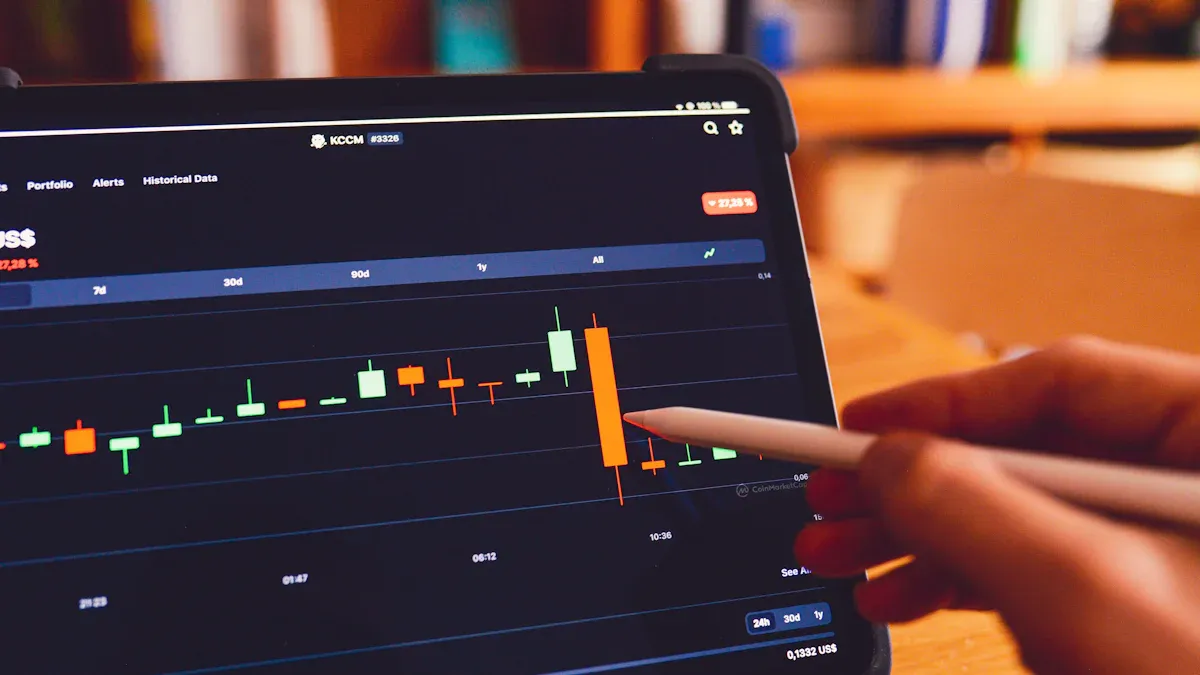
Image Source: unsplash
Automated Monitoring Process
In a high-frequency trading environment, you must rely on automated monitoring processes to ensure system efficiency and security. AI agents continuously collect market data and analyze changes in OTC premiums and fiat withdrawal losses in real time. The system automatically completes the following key steps:
- Data ingestion: The system acquires quotes, exchange rates, fees, and other information in real time from multiple exchanges and OTC platforms.
- Signal generation: AI models identify arbitrage opportunities or abnormal fluctuations based on set rules.
- Risk check: The system automatically verifies current positions and risk exposure to ensure they do not exceed preset limits.
- Order routing and execution: When conditions are met, the system automatically places orders and completes fund transfers.
Through these processes, you can achieve round-the-clock, uninterrupted market monitoring and capture every trading opportunity in a timely manner.
Strategy Adjustment
Market conditions change rapidly. You need to enable AI agents to autonomously adjust strategies. The system continuously evaluates market context, processes large amounts of data from various channels, and understands the current market state. AI agents use complex algorithms to weigh risk against return and automatically select the optimal action plan. You can set multiple strategy templates, and the system dynamically switches based on real-time data. For example, when market volatility intensifies, AI agents automatically tighten risk parameters and reduce high-risk operations. You can also set specific conditions so that the system pauses trading upon detecting anomalies, safeguarding fund security.
Tip: You should regularly review strategy execution results and optimize parameters using historical data to improve overall returns.
Result Tracking
After deploying automated monitoring and strategy adjustment, you must continuously track and evaluate results. The system automatically records every decision and execution outcome to help you analyze strategy performance. You can track results in the following ways:
- Real-time monitoring of market dynamics to observe market reactions after strategy execution.
- Checking compliance with strategy and risk limits to ensure the system operates within safe boundaries.
- Evaluating profit/loss for each trade and analyzing the effectiveness of model decisions.
- Continuous learning and strategy adjustment based on results to optimize AI models.
You can use these data to identify potential issues and make timely corrections, ensuring the essential AI agent system for high-frequency traders remains in optimal condition.
Effectiveness Evaluation and Optimization
Effectiveness Evaluation Methods
You need to periodically evaluate the monitoring effectiveness of AI agents to ensure the system accurately reflects market changes. You can adopt the following methods:
- Statistically analyze the hit rate and actual returns of arbitrage signals to evaluate model performance in different market environments.
- Track drawdowns and volatility to judge system stability in extreme market conditions.
- Compare historical data with real-time monitoring results to verify data synchronization and alert timeliness.
- Use out-of-sample testing to validate the model’s generalization ability on unseen data and avoid overfitting.
You can record key metrics before and after each strategy adjustment in a table for horizontal comparison and trend analysis.
| Evaluation Dimension | Monitoring Metric | Evaluation Frequency |
|---|---|---|
| Return Performance | Total return, drawdown | Daily/weekly |
| Data Real-Time Performance | Latency, packet loss rate | Real-time/daily |
| Risk Control | Risk exposure, abnormal alerts | Daily/monthly |
Problem Troubleshooting
When running the essential AI agent system for high-frequency traders, you may encounter issues such as data delays, model failures, or false alert triggers. You can follow these steps for troubleshooting:
- Check the data integration layer to confirm whether market data APIs and withdrawal data are synchronized in real time.
- Review model logs to locate parameter drift or training data anomalies.
- Re-examine alert rules and analyze specific scenarios of false positives or missed alerts.
- Compare historical backtests with real-time performance to identify model overfitting or survivorship bias.
Tip: You should periodically include delisted or failed assets in historical testing to avoid focusing only on well-performing coins, improving system robustness.
Optimization Recommendations
You should continuously optimize AI agent configurations to maintain a competitive edge. You can refer to the following suggestions:
- Continuously monitor market volatility and return consistency, update training data or recalibrate parameters in a timely manner.
- Periodically retrain models with the latest data to adapt to changes in market structure.
- Adopt strict train/test splits to prevent data leakage from affecting evaluation results.
- Use walk-forward optimization and out-of-sample testing to improve model generalization.
- Regularly review and upgrade system architecture, optimizing data processing and alert mechanisms.
You can establish automated processes to periodically evaluate and optimize system configurations, ensuring the essential AI agent tools for high-frequency traders always remain in optimal condition.
By configuring AI agents, you can significantly improve the efficiency and returns of high-frequency trading. Multi-agent systems such as QuantAgent can transform raw data into robust signals, identify market patterns, and optimize risk-return analysis. You continuously optimize and dynamically adjust AI agent configurations to adapt to market changes, improving trading performance and cost management. You can also customize AI parameters flexibly based on your own risk preferences and historical behavior to achieve personalized strategies.
- Multi-agent systems transform data, identify patterns, and optimize risk analysis
- Machine learning algorithms support personalized risk models and strategy adjustments
| Evidence Point | Impact |
|---|---|
| Reinforcement learning agents adapt to market dynamics | Improve trading performance for high-frequency traders |
| Agents learn behavior of other market participants | Effectively manage execution costs |
| Performance improvement during TWAP buying phases | Demonstrates agents can exploit predictable order flow |
You should continuously evaluate and optimize AI agents, combine them with your own needs, maintain strategy leadership, and achieve higher market competitiveness.
FAQ
How to minimize data latency when configuring AI agents?
You can choose servers co-located with exchange data centers and adopt WebSocket pushes combined with local caching mechanisms. This effectively reduces data transmission latency and ensures real-time synchronization of market information.
How to ensure the security of AI agent monitoring?
You should enable data encryption, access control, and log auditing. Regularly check system security policies and promptly detect abnormal activity. Adopt multi-factor authentication and the principle of least privilege to effectively prevent data breaches and unauthorized access.
Which mainstream exchanges and OTC platforms does the AI agent support?
You can connect to mainstream exchanges (e.g., US market) and OTC platforms that support APIs. The system typically supports multi-currency, multi-market quote aggregation to meet the diverse needs of high-frequency traders.
How to reduce losses when withdrawing fiat to a licensed Hong Kong bank?
You should monitor real-time exchange rates and fees, select the lowest-cost withdrawal path, record the actual received amount and arrival time for each withdrawal, analyze loss sources, and optimize withdrawal strategies to improve capital utilization efficiency.
How often should the AI agent model be updated?
You can set periodic model retraining based on market volatility frequency and strategy needs. In a high-frequency trading environment, it is recommended to update weekly or monthly to ensure the model adapts to market changes.
*This article is provided for general information purposes and does not constitute legal, tax or other professional advice from BiyaPay or its subsidiaries and its affiliates, and it is not intended as a substitute for obtaining advice from a financial advisor or any other professional.
We make no representations, warranties or warranties, express or implied, as to the accuracy, completeness or timeliness of the contents of this publication.
Related Blogs of

How Much Is Venmo Worth in the PayPal Acquisition Case? User Scale, Revenue, and Strategic Value


How Does Venmo Make Money? How Payments, Credit Cards, and Merchant Services Affect PayPal’s Valuation


Understanding Net Interest Margin and Provision Changes Through JPM, BAC, and Citi


AI Revenue Quality at IBM, Oracle, and ServiceNow: Breaking Down Subscription, Cloud, and Consulting Businesses
Choose Country or Region to Read Local Blog
 Australia
 Austria
 Belgium
 Canada
 Cyprus
 Czech Republic
 Denmark
 Estonia
 Finland
 France
 Germany
 Greece
 Hong Kong
 India
India Indonesia
 Ireland
 Italy
Italy Japan
Japan Latvia
 Lithuania
 Luxembourg
 Malaysia
 Malta
Malta Morocco
 Nepal
Nepal Netherlands
 New Zealand
 Norway
 Pakistan
 Philippines
 Poland
 Portugal
 Romania
 Singapore
 Slovakia
 Slovenia
 South Africa
 South Korea
 Spain
Spain Sweden
 Thailand
 United States
 Turkey
 United Arab Emirates
 United Kingdom
 Vietnam
Contact Us



