How Much Does It Cost to Deploy High-Concurrency Agents? A Big Comparison of Overseas Payment Gateway Fees





Image Source: unsplash
When deploying high-concurrency Agents, your overall investment usually ranges from hundreds of thousands to millions of USD. Factors affecting costs include concurrency volume, region, service provider selection, and system complexity. In high-load or multi-agent scenarios, systems often face scalability challenges and maintenance difficulties. You also need to pay attention to API integration difficulty and performance optimization issues. High-concurrency Agents have extremely high requirements for low latency and high reliability, and China’s mobile payment system performs excellently in high-concurrency processing.
Core Points
- Deployment costs for high-concurrency Agents are mainly influenced by concurrency volume, region choice, and service provider. Reasonable estimation of concurrency can avoid resource waste.
- When choosing cloud service providers, compare pricing and performance. Cloud service fees vary significantly across different regions, affecting overall costs.
- Bandwidth costs are ongoing expenses; select appropriate billing models based on actual data transfer volume to avoid excess charges.
- Software licensing and operations & maintenance costs cannot be ignored; enterprise-grade features and technical support usually require additional investment to ensure system stability.
- When selecting payment channels, pay attention to the fee structure, plan cash flow rationally, and use batch transfers to reduce costs.
High-Concurrency Agent Deployment Cost Structure
Main Cost Components
When deploying high-concurrency Agents, you must clearly understand the specific distribution of each cost item. Usually, the overall investment is mainly divided into three major parts: LLM inference, tool execution, and total latency overlap. The table below shows the typical proportion of each part in total costs:
| Component | Proportion |
|---|---|
| LLM Inference | 69.4% |
| Tool Execution | 30.2% |
| Total Latency Overlap | 18.2% |
LLM inference costs occupy the vast majority of the budget. You need to invest massive resources in model inference capabilities, especially when concurrency is high, GPU and compute resources are consumed enormously. The tool execution part involves external API calls, database operations, and third-party service integration—this portion of costs cannot be overlooked either. Total latency overlap reflects performance bottlenecks under high concurrency, directly affecting user experience and system stability.
Key Factors Influencing Costs
When planning the budget for high-concurrency Agent deployment, you must focus on the following key factors:
- Concurrency volume: The higher the number of concurrent requests, the greater the required hardware and bandwidth investment. You need to reasonably estimate concurrency based on business peak periods to avoid resource waste or performance bottlenecks.
- Region selection: Cloud service prices vary significantly across different regions. When deploying in the US, Europe, or Asia, the billing standards of cloud providers and network latency will directly impact overall costs and user experience.
- Service provider selection: Mainstream cloud providers such as AWS, Azure, and Google Cloud each have advantages in pricing, performance, and service guarantees. You need to combine your own needs to choose the optimal solution.
- System complexity: The more complex the system architecture, the higher the development, testing, and operations & maintenance costs. When designing high-concurrency Agents, you should balance feature richness with maintainability and avoid over-design that leads to cost overrun.
You need to pay special attention that high-concurrency Agents have extremely high requirements for low latency and high reliability. Industry practice shows that if concurrency or latency performance does not meet standards, teams often choose to over-provision GPU resources to guarantee p99 latency, leading to a sharp increase in costs. Latency peaks (such as TTFT or p99) make users feel the system is sluggish, reduce trust, and affect activation and retention. Improper configuration can also cause inference errors and increase business risks.
During actual deployment, it is recommended to regularly conduct benchmark tests, focus on latency and reliability metrics, and adjust resource allocation promptly. This way, you can effectively control overall costs while ensuring user experience.
Server and Cloud Service Costs

Image Source: unsplash
Cloud Service Provider Price Comparison
When choosing cloud service providers, you must pay attention to the pricing and configurations of different platforms. The table below shows the typical price ranges for Oracle Cloud and Alibaba Cloud in the Chinese and international markets. You can select appropriate configurations based on actual needs to reasonably control infrastructure investment for high-concurrency Agents.
| Cloud Service Provider | Price (monthly) | CPU | RAM | SSD | Bandwidth Limit | Monthly Data Transfer |
|---|---|---|---|---|---|---|
| Oracle Cloud | USD 3.5-70 | 1-4 | 0.5GB-16GB | 20GB-320GB | 4-30 Mbit/s | 1-6 TB |
| Alibaba Cloud | USD 11-110 | 1-4 | 1GB-16GB | 40GB-320GB | 4-30 Mbit/s | 1-6 TB |
You can obtain more detailed pricing information through the Oracle Cloud Cost Estimator and Alibaba Cloud Simple Application Server Pricing.
Physical Server vs. Cloud Server Selection
When deploying, you need to weigh the pros and cons of physical servers and cloud servers:
- Physical servers have higher initial investment and require ongoing payment for electricity, cooling, and other operating expenses.
- Cloud servers have lower initial investment, with basic configurations costing about USD 250 per month; when resource demands increase, costs can reach USD 20,000.
- Remote desktop server costs are affected by the number of users and performance; small deployments cost about USD 1,500, while large organizations may exceed USD 10,000.
- You also need to consider ongoing expenses such as software licenses and hardware maintenance, all of which are part of the total cost.
Impact of Region on Costs
The geographic location of servers directly affects costs and performance:
- When deploying in mainland China or overseas, telecom operators often cooperate with content providers to directly deploy CDNs in the infrastructure, reducing latency.
- Servers close to users can reduce data transmission distance, improve content delivery speed, and enhance user experience.
- Different jurisdictions have different data residency and compliance requirements. For example, the EU AI Act requires high-risk system logs to be retained for many years, and the financial and healthcare industries also have strict data retention regulations. When choosing server regions, you must fully consider these compliance costs.
Bandwidth and Traffic Costs
Bandwidth Billing Models
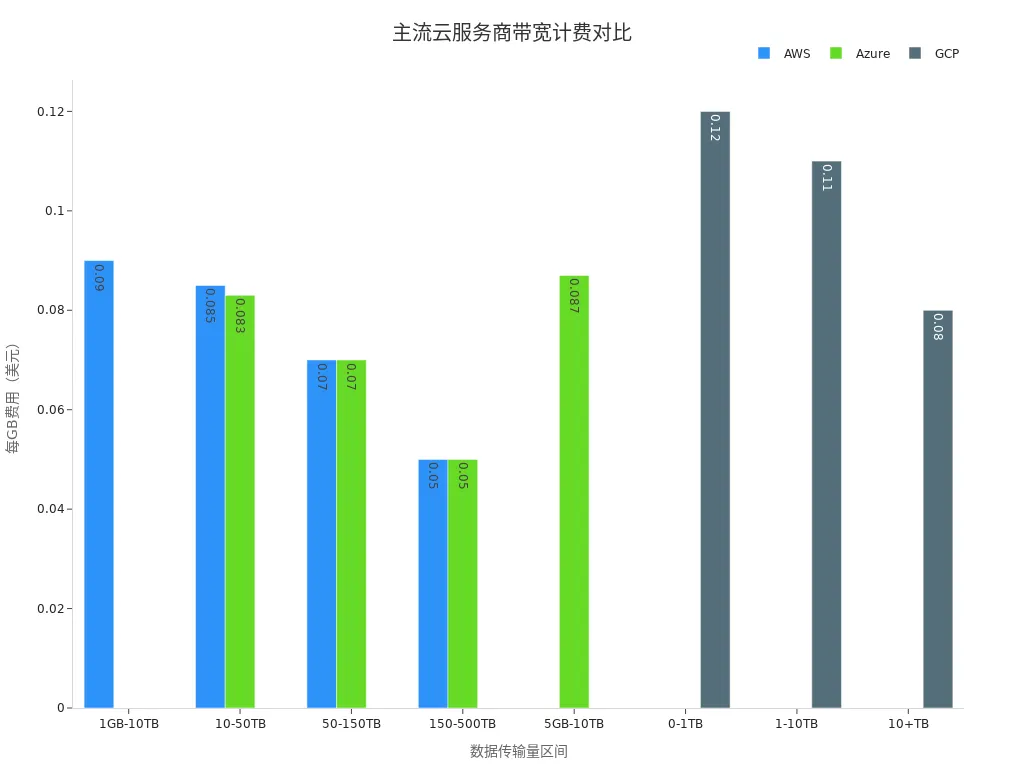
When deploying high-concurrency Agents, bandwidth costs become an important ongoing expense. Mainstream cloud providers usually adopt a “pay-per-traffic” model. You need to pay based on actual data transfer volume. Billing standards vary among different cloud providers. The table below shows the per-GB bandwidth unit prices (in USD/GB) for AWS, Azure, and GCP across different data transfer volume ranges:
| Cloud Service Provider | Data Transfer Volume Range | Cost per GB (USD) |
|---|---|---|
| AWS | 1GB-10TB | $0.09 |
| 10-50TB | $0.085 | |
| 50-150TB | $0.07 | |
| 150-500TB | $0.05 | |
| 500+TB | Contact Amazon | |
| Azure | 5GB-10TB | $0.087 |
| 10-50TB | $0.083 | |
| 50-150TB | $0.07 | |
| 150-500TB | $0.05 | |
| 500+TB | Contact Microsoft | |
| GCP | 0-1TB | $0.12 |
| 1-10TB | $0.11 | |
| 10+TB | $0.08 |
By comparing prices in different ranges, you can choose the data transfer plan most suitable for your business. The figure below shows the bandwidth billing comparison of mainstream cloud providers across different data transfer volume ranges:
Traffic Budgeting in High-Concurrency Scenarios
In high-concurrency scenarios, traffic consumption increases significantly. Each user request may involve model inference, API calls, and data return. You need to budget traffic based on daily average concurrency, data volume per request, and business peak periods. For example, assuming each request consumes an average of 1MB of traffic and there are 100,000 requests per day on average, daily traffic is about 100GB. You can quickly estimate monthly bandwidth costs by combining the per-GB rates of cloud providers.
You also need to pay attention to traffic peaks and burst bandwidth demands. Some cloud providers support bandwidth packages or traffic packages, which are suitable for businesses with large traffic fluctuations. Choosing billing models and traffic packages rationally can help you effectively control bandwidth expenditure for high-concurrency Agents.
It is recommended to regularly monitor bandwidth usage, adjust bandwidth configuration promptly, and avoid additional fees due to traffic overrun.
Software and Operations & Maintenance Costs
Licensing and Third-Party Component Fees
When deploying high-concurrency Agents, you must consider software licensing and third-party component costs. Although common open-source components are free, enterprise-grade features, technical support, and security updates usually require payment. You may need to purchase commercial licenses for databases, message queues, monitoring systems, etc. For example, enterprise-grade database licensing fees can reach USD 2,000–10,000 per year. Some API services are charged based on call volume, with monthly expenses ranging from USD 100 to thousands of dollars. You also need to pay attention to ongoing investment in security components and compliance tools—these are all non-negligible operating costs.
Operations & Maintenance and Technical Support
In high-concurrency scenarios, investment in operations & maintenance and technical support increases significantly. You need to configure high-availability architectures, including doubled application servers, load balancers, redundant backup databases, and real-time monitoring tools. You also need to arrange dedicated personnel for system monitoring and fault response. The table below shows the main cost structure at different operations & maintenance levels:
| Cost Type | Description |
|---|---|
| High Availability Cost | Requires doubled application servers, load balancers, redundant backup databases, monitoring tools, and operators. |
| Fault Tolerance Cost | Three times or more infrastructure cost of basic redundancy, cross-region data transfer fees, dedicated database licenses, and engineering maintenance teams. |
| Return on Investment | Fault tolerance investment is usually 5–10 times that of simple deployment, suitable for key components to avoid downtime affecting revenue or security. |
When selecting service providers, you should weigh high availability and fault tolerance investment based on business continuity needs. High-availability solutions can reduce single points of failure and improve system stability. Fault-tolerance solutions are suitable for businesses highly sensitive to revenue and security. You need to reasonably allocate operations & maintenance resources based on actual budget and risk tolerance to ensure long-term stable operation of high-concurrency Agents.
Overseas Payment Gateway Fee Comparison

Image Source: pexels
When choosing overseas payment gateways, you must thoroughly understand the fee structure of each platform. The fee composition of different channels is complex, involving fixed fees, percentage fees, currency conversion fees, withdrawal fees, and many other items. In high-concurrency Agent business scenarios, even small differences in fees directly affect overall profit. You need to scientifically select the optimal payment solution based on your business model, transaction frequency, and cash flow direction.
PayPal Fees
PayPal, as a globally well-known payment platform, has a relatively transparent fee structure. When receiving international payments, you usually need to pay a fixed fee of 0.09 USD per transaction plus 2.29% of the transaction amount. If currency conversion is involved, PayPal charges additional fees based on its own exchange rate, with actual costs higher than the official rate. In addition, PayPal may also charge extra fees when withdrawing to a local bank account. In high-concurrency Agent business, if there are many transactions with large amounts, the cumulative fees will be very considerable.
| Item | Fee Structure |
|---|---|
| Fixed Fee | 0.09 USD per transaction |
| Percentage Fee | 2.29% |
| Currency Conversion Fee | Exchange rate difference + additional fees |
| Withdrawal Fee | Varies by country and bank |
You need to pay attention to PayPal’s hidden costs, especially exchange rate differences and additional expenses in the withdrawal process.
Stripe Fees
Stripe is known for being developer-friendly and global, widely used in SaaS, subscription, and cross-border e-commerce scenarios. When using Stripe to collect payments, you need to pay a fixed fee of 0.30 USD per transaction plus 2.9% of the transaction amount. If international cards or currency conversion are involved, Stripe will additionally charge 1%–2% fees. Stripe supports automatic settlement to multi-currency accounts, but withdrawing to a local bank still incurs certain fees and exchange rate losses.
| Item | Fee Structure |
|---|---|
| Fixed Fee | 0.30 USD per transaction |
| Percentage Fee | 2.9% |
| International Card Surcharge | 1%–2% |
| Currency Conversion Fee | Exchange rate difference |
| Withdrawal Fee | Varies by country and bank |
In high-concurrency Agent scenarios, if transaction amounts are large, you need to focus on the cumulative impact of percentage fees and international card surcharges.
Wise Fees
Wise is known for low transparent fees and mid-market exchange rates, suitable for frequent cross-border transfers and multi-currency settlement. After opening a global account with Wise, you can hold multiple currencies for free, and receiving account information is paid once. Wise international transfers use mid-market exchange rates with no hidden fees; fees consist of fixed fees and percentage fees, with specific amounts depending on currency and transfer speed. You can also batch process multiple payments for high-concurrency Agents, saving operation time.
| Feature | Description |
|---|---|
| Mid-Market Exchange Rate | Provides real exchange rates with no hidden fees |
| Fixed Fee + Percentage Fee | Specific amounts depend on currency and transfer method |
| Global Account | Free to open, no minimum balance or monthly fee |
| Batch Transfer | Pay up to 1000 invoices at once, suitable for high-concurrency business |
| Main Cost Drivers | Exchange rate, fixed fee, percentage commission, transfer speed |
When using Wise, you need to pay attention to fee changes under different currencies and transfer methods and plan cash flow rationally.
Payoneer Fees
Payoneer is suitable for cross-border e-commerce, freelancers, and enterprise batch collections. Receiving payments through Payoneer is usually free, and transfers between users also have no fees. When withdrawing funds to a local bank account, each transaction requires 1.50–3.00 USD. If currency conversion is involved, Payoneer charges 1%–2% conversion fees. You also need to pay attention to monthly maintenance fees for prepaid cards and inactive account fees.
| Service | Description | Typical Fee |
|---|---|---|
| Currency Conversion | Charged when converting funds to local currency | 1%–2% per transaction |
| Withdrawal to Bank Account | Transfer from balance to local bank | 1.50–3.00 USD per transaction |
| Receiving Payments | Receiving from clients or platforms | Usually free |
| Prepaid Card Fee | Physical/virtual card monthly maintenance fee | 2.95 USD/month (waivable under conditions) |
| Inactive Fee | Charged monthly after 12 months of no activity | 15 USD/month |
In high-concurrency Agent business, if you frequently withdraw or involve multi-currency settlement, you need to focus on currency conversion and withdrawal fees.
Fee Comparison
In actual operations, you must comprehensively consider the fixed fees, percentage fees, and hidden costs of each payment channel. The table below compares the core fee structures of mainstream channels:
| Payment Platform | Fixed Fee | Percentage Fee |
|---|---|---|
| PayPal | 0.09 USD per transaction | 2.29% |
| Stripe | 0.30 USD per transaction | 2.9% |
| Wise | Depends on feature | Fixed + percentage |
| Payoneer | Free (between users) | 1% (depending on payment method) |
You also need to pay attention to additional costs in cross-border payments, such as exchange rate differences, bank transfer fees, and withdrawal fees. The figure below shows a comparison of various fees across major overseas payment channels:
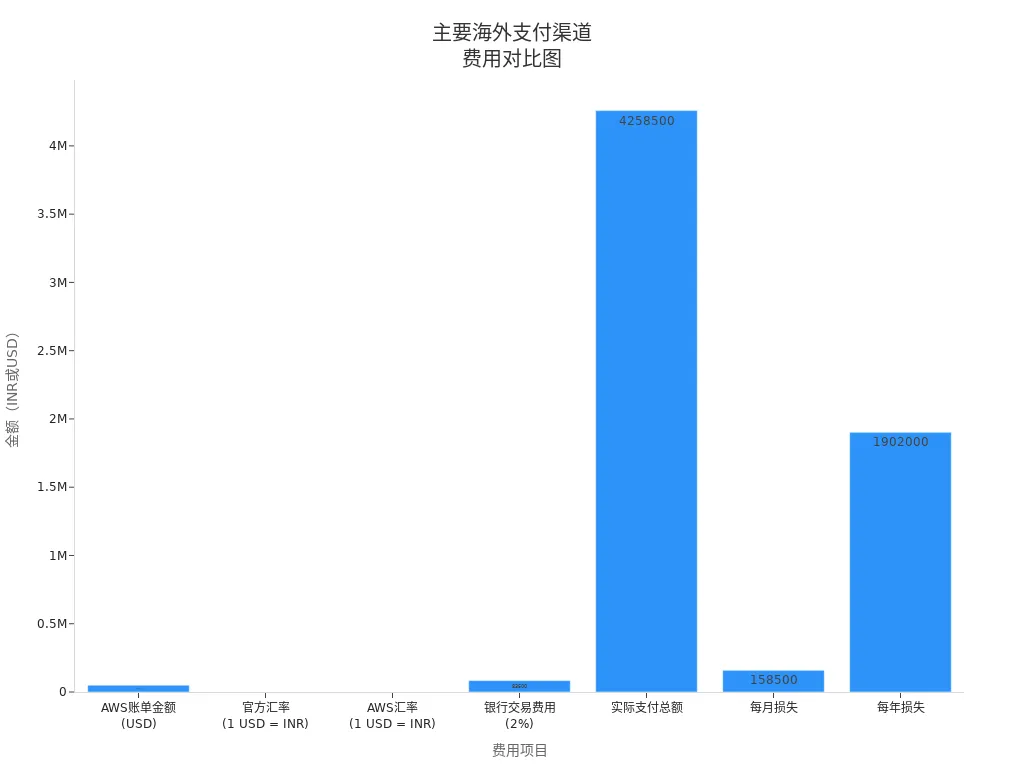
In high-concurrency Agent business scenarios, the complexity and diversity of fee structures require detailed comparative analysis. Cross-border payments also involve compliance risks in different legal and jurisdictional areas. Small businesses may face delays and high fees, and funds transferred between banks also incur additional costs. You should flexibly choose the optimal payment channel based on your own business needs, transaction frequency, and cash flow direction to minimize overall costs to the greatest extent.
Payment Channel Selection and Cost Optimization
Business Scenarios and Channel Preferences
When selecting payment channels, you must combine your own business model and customer distribution. BiyaPay provides global payment and international remittance services for Chinese-speaking users, supporting real-time exchange between fiat and cryptocurrency, suitable for high-concurrency Agent scenarios that require multi-currency settlement and flexible cash flow. If you mainly serve the European and American markets, Stripe and PayPal, with their broad credit card support and automated settlement functions, can meet needs such as SaaS subscriptions and digital content sales. Wise is suitable for frequent cross-border transfers and multi-currency account management, while Payoneer is suitable for batch collections and freelancer settlements. You should prioritize platforms with transparent fee structures and short settlement cycles based on transaction frequency, amount size, and customer location.
Fee-Saving Recommendations
You can reduce payment fees in multiple ways. First, prioritize platforms that match the transaction currency with customers to reduce currency conversion losses. Second, utilize batch transfer functions—Wise and BiyaPay support processing multiple payments at once, significantly reducing per-transaction costs. You can also regularly evaluate rate changes across channels and switch to better solutions promptly. Some platforms offer discounts for large transactions; if you have high-frequency or large-amount settlement needs, you can proactively negotiate exclusive rates with service providers. It is recommended to pay attention to withdrawal fees and hidden costs to avoid total costs rising due to frequent small-amount withdrawals.
At this stage, it helps to separate FX loss from the headline processing fee. If your revenue, cloud expenses, and overseas subscriptions involve USD, HKD, or digital assets, you can first review the available services on the BiyaPay website, then use its exchange-rate comparison tool to estimate the real settlement gap under different payout paths. That makes it easier to judge which payment channel has the lower all-in cost. For teams that also need cross-border payouts, it is practical to compare the fees and arrival time of the remittance service in the same cost sheet.
If your cash flow covers collections, FX conversion, and outbound payouts at the same time, comparing gateway fees alone is usually not enough. You also need to account for exchange-rate slippage, settlement speed, and the cost of moving funds afterward. In this type of workflow, it helps to check live pricing first with BiyaPay’s exchange-rate comparison tool, then combine that with its remittance service to evaluate whether the full fund path is actually more efficient.
As a multi-asset wallet, BiyaPay is better understood at the layer of cross-border fund coordination, covering payments, remittance, USD- or HKD-related asset trading, as well as spot and futures digital-asset trading. Where trust context is needed, its compliance background, including U.S. MSB and New Zealand FSP registration, can be mentioned naturally, but that should not replace your own evaluation of fees, risk controls, and settlement design.
Multi-Channel Combination Strategy
Adopting a multi-channel combination can effectively diversify risks and optimize overall costs. You can set the main settlement channel as the platform with the lowest fees and use backup channels for special currencies or to cope with platform risk controls. BiyaPay supports real-time exchange between fiat and cryptocurrency, suitable for flexible fund allocation. Stripe and PayPal can serve as supplements for international credit card collections, while Wise and Payoneer are suitable for cross-border transfers and batch operations. You should regularly analyze each channel’s arrival speed, customer experience, and compliance requirements, dynamically adjust the combination strategy, and ensure safe and efficient cash flow for high-concurrency Agent business.
When deploying high-concurrency Agents, costs are mainly influenced by call volume, language support, system integration, and workflow customization. You can refer to the table below to choose the optimal deployment and payment channel solution:
- Call volume and concurrency determine overall investment
- Multi-language and complex integration increase budget
- Workflow customization requires additional design and testing
| Feature | Latenode | Comparison with Other Platforms |
|---|---|---|
| Cost Structure | Tiered pricing, free plan 300 times per month | May have hidden fees |
| Scalability | Supports cloud deployment and load balancing | May not support high-concurrency needs |
| Multi-Agent Orchestration | Supports collaboration among multiple AI agents | Other platforms may lack this feature |
You need to focus on actual operation details, regularly optimize resource allocation, rationally select payment channels, and improve capital efficiency.
FAQ
How to choose the optimal payment channel when deploying high-concurrency Agents?
You should select the optimal channel based on business scenarios, customer distribution, and settlement currency. BiyaPay supports global payments and real-time exchange between fiat and cryptocurrency, suitable for multi-currency needs. You also need to pay attention to fees, arrival speed, and compliance.
How to effectively control overseas payment fees?
You can choose platforms that match the transaction currency with customers to reduce currency conversion losses. You can also utilize batch transfer functions to lower per-transaction costs. Regularly evaluate fee rates across channels and switch to better solutions promptly.
Are there big cost differences when deploying servers in different regions?
When deploying in the US, Europe, or Asia, cloud service prices, bandwidth fees, and compliance requirements vary significantly. You need to combine user distribution and business needs to choose the region with the best cost-performance ratio.
What special requirements does high-concurrency Agent have for bandwidth budgeting?
You need to scientifically estimate bandwidth consumption based on concurrency volume and data volume per request. You can adopt bandwidth packages or traffic packages to flexibly handle traffic fluctuations and avoid additional fees due to overrun.
How to ensure system stability for high-concurrency Agents?
You should configure high-availability architecture, deploy load balancing and redundant backups. You also need to regularly monitor latency and faults, adjust resources promptly, and ensure stable system operation.
*This article is provided for general information purposes and does not constitute legal, tax or other professional advice from BiyaPay or its subsidiaries and its affiliates, and it is not intended as a substitute for obtaining advice from a financial advisor or any other professional.
We make no representations, warranties or warranties, express or implied, as to the accuracy, completeness or timeliness of the contents of this publication.
Related Blogs of

How Is China’s Memory Supply Chain Different from Overseas Memory Leaders? A Comparison with Micron, SanDisk, Western Digital, and Seagate


How to View HBM Advanced Packaging Equipment Stocks? ASMPT’s Opportunities and Cyclical Risks


How Should You View Seagate’s HAMR Technology? Nearline HDD Capacity Upgrades and the Supply-Demand Cycle


HBM/DRAM, NAND, and HDD in AI Storage: A Comparison of Elasticity, Cycles, and Risks

Choose Country or Region to Read Local Blog
 Australia
 Austria
 Belgium
 Canada
 Cyprus
 Czech Republic
 Denmark
 Estonia
 Finland
 France
 Germany
 Greece
 Hong Kong
 India
India Indonesia
 Ireland
 Italy
Italy Japan
Japan Latvia
 Lithuania
 Luxembourg
 Malaysia
 Malta
Malta Morocco
 Nepal
Nepal Netherlands
 New Zealand
 Norway
 Pakistan
 Philippines
 Poland
 Portugal
 Romania
 Singapore
 Slovakia
 Slovenia
 South Africa
 South Korea
 Spain
Spain Sweden
 Thailand
 The United States
 Turkey
 United Arab Emirates
 United Kingdom
 Vietnam
Contact Us




BIYA GLOBAL LLC is registered with the Financial Crimes Enforcement Network (FinCEN), an agency under the U.S. Department of the Treasury, as a Money Services Business (MSB), with registration number 31000218637349, and regulated by the Financial Crimes Enforcement Network (FinCEN).
BIYA GLOBAL LIMITED is a registered Financial Service Provider (FSP) in New Zealand, with registration number FSP1007221, and is also a registered member of the Financial Services Complaints Limited (FSCL), an independent dispute resolution scheme in New Zealand.