Visa and Mastercard Stock Analysis: Massive Transaction Fee Revenue from Cross-Border Payments During the World Cup




Image Source: pexels
During the World Cup, global cross-border payment transaction volumes rise significantly. A large number of fans choose to make payments through online sports betting platforms, driving a surge in transaction volumes. For example, it is expected that in 2026, 60% of global fans will engage in related transactions, with strong payment demand in key markets such as the United States, Brazil, Peru, Italy, and the United Kingdom. Visa and Mastercard leverage their cross-border payment networks to capture this growth, leading to a substantial increase in transaction fee revenue. Visa and Mastercard stock analysis shows that optimized transaction structures and payment innovations have become key drivers of company performance growth, while industry risks also deserve close attention.
Key Takeaways
- During the World Cup, global cross-border payment transaction volumes rise significantly, and Visa and Mastercard gain considerable revenue by optimizing their payment networks.
- Changes in fan spending behavior drive demand for online payments, with digital wallets combined with traditional payment methods increasing transaction frequency.
- International tourists increasingly prefer contactless payments and digital wallets, and Visa and Mastercard provide secure and convenient cross-border payment experiences.
- Both companies rely on transaction service fees and international transaction revenue to drive overall revenue and profit growth while maintaining high profit margins.
- Investors should focus on cross-border transaction volumes, transaction service fee revenue, and digital payment innovations to evaluate the long-term value of Visa and Mastercard.
Reasons for the Surge in Transaction Volumes

Image Source: pexels
Global Fan Spending Behavior
During the World Cup, global fans’ spending behavior changes significantly, directly driving growth in cross-border payment transaction volumes. Many fans are more willing to spend on sponsor brands during the event, increasing the frequency of interactions between brands and consumers. Specific manifestations include:
- 36% of fans hold a more positive attitude toward brands sponsoring the FIFA World Cup.
- 33% of fans will visit sponsor websites, and 28% of fans may purchase sponsor merchandise.
- On World Cup opening day, global streaming app installations surged 46%, with installations in the first week 41% higher than the November average and a 70% increase on key match days in the EMEA region.
- Fans prefer watching matches via mobile apps, increasing digital payment scenarios.
These behaviors drive online consumption and mobile payment demand. Visa and Mastercard further expand transaction coverage and increase transaction volumes and transaction fee revenue by integrating with digital wallets such as WeChat Pay and Alipay.
International Tourist Payment Demand
Payment methods used by international tourists during the World Cup have also shifted. More and more tourists choose contactless payments, digital wallets, and mobile payments, reducing cash usage. Taking Mexico as an example, it is expected to receive about 5.5 million tourists during the World Cup, with average tourist spending expected to increase by 48%. Many businesses, especially small and medium-sized enterprises, need to address challenges in the security and seamlessness of receipt methods. Visa and Mastercard’s global networks and risk control capabilities provide tourists and merchants with efficient and convenient cross-border payment experiences, driving continuous growth in transaction volumes.
Event Commercial Activities Drive
The World Cup is not only a major sports event but also a peak period for global commercial activities. During the event, host cities and related enterprises attract a large number of tourists and consumers through various promotions, sponsorships, and digital marketing activities. According to statistics, during the FIFA World Cup, the 11 host cities in the United States received more than 5 million tourists, generating over $5 billion in economic impact. In peak months, Visa and Mastercard transaction volumes grow by 20-30%. The table below shows the main data:
| Event | Date | U.S. Impact | Payment Boost |
|---|---|---|---|
| FIFA World Cup | June 11 – July 19 | 11 host cities, 5 million+ tourists, $5 billion economic impact | Transaction volume growth 20-30% |
The combination of event commercial activities and digital payment innovations significantly increases cross-border payment transaction volumes, bringing considerable transaction fee revenue to Visa and Mastercard.
Business Model and Revenue Structure
Image Source: pexels
Core Position of Transaction Fees
The revenue structures of Visa and Mastercard heavily rely on transaction service fees and international transaction revenue. Whenever a user completes a cross-border payment through their network—whether fans purchasing tickets or souvenirs during the World Cup, or Chinese-speaking users making purchases through third-party payment platforms like Biyapay—the platforms charge a certain percentage of transaction service fees. Data shows that transaction service fees and international transaction-related revenue account for more than 70% of the two companies’ total revenue, becoming the core driver of performance growth. The stability and high profit margins of transaction service fees give Visa and Mastercard a significant economic moat in the global payments industry. During large international events like the World Cup, the surge in transaction volumes further amplifies the scale of this revenue source.
Cross-Border Payment Profit Model
Visa and Mastercard have distinct profit models in the cross-border payment field. The table below compares the main business models and market strategies of the two:
| Feature | Visa | Mastercard |
|---|---|---|
| Business Model | Primarily focused on card issuance and transaction volume | More aggressive in expanding account payments and open banking |
| Revenue Sources | Value-added services revenue $280 million, up 27.3% | Value-added services revenue $320 million, up 23.3% |
| Market Strategy | Leading in global transaction volume and card issuance | More focused on international business and high-margin services |
Mastercard stands out more in credit transactions and cross-border transactions, benefiting from high transaction volumes brought by the recovery of international travel. Its value-added services and solutions bring diversified revenue to the company. Visa continues to optimize its payment network and improve cross-border payment efficiency through cooperation with fintech companies and licensed banks in Hong Kong. Innovative payment platforms like Biyapay meet the needs of Chinese-speaking users for convenient, secure, and low-cost cross-border payments, driving overall transaction volume growth. During the World Cup, Visa deployed 5,300 contactless payment terminals at official venues and piloted facial recognition technology and digital prepaid cards for the first time, further enriching payment scenarios.
Visa and Mastercard Stock Analysis Perspective
Visa and Mastercard stock analysis needs to focus on their business models, revenue generation methods, market positioning, and competitive advantages. Both companies operate global payment networks with strong economic moats.
If you want to turn this payment-theme discussion into actual stock tracking, a practical approach is to separate the industry thesis from the company comparison. For names such as Visa and Mastercard, you can first use BiyaPay’s stock information lookup to review basic market data, tickers, and related company information, then cross-check those with cross-border volume trends, transaction service fee revenue, and the share of international business. If you later want to continue from research into execution, the same workflow can extend through the trading portal. BiyaPay is positioned as a multi-asset trading wallet covering cross-border payments, investing, and fund management scenarios, and its service details and compliance disclosures can be reviewed further on the official website.
The table below summarizes the main analysis points:
| Key Factor | Description |
|---|---|
| Operational Similarity | Visa and Mastercard both operate global payment networks with significant economic moats. |
| Revenue Generation Methods | The two companies generate revenue through different channels and customer groups, including consumers, small and medium-sized enterprises, and government entities. |
| Market Positioning | Visa and Mastercard have different positioning in the market, affecting their strategic focus and growth plans. |
| Competitive Advantages | The two companies each have unique advantages in competition, affecting their market performance and investment attractiveness. |
Driven by large international events like the World Cup, Visa and Mastercard continue to expand payment networks and enhance cross-border payment service capabilities through cooperation with local banks and fintech companies. Visa and Mastercard stock analysis shows that innovation capabilities and the breadth of cooperation networks have become key variables for future performance growth. When evaluating the value of their stocks, investors should focus on transaction service fee revenue, international transaction growth, innovative technology applications, and the completeness of the cooperation ecosystem.
Revenue Growth and Performance
Income and Profit Pull
During the World Cup, Visa and Mastercard’s cross-border payment businesses experience significant growth. The spending enthusiasm of global fans and international tourists directly drives a surge in transaction volumes. The two companies capture the transaction dividends brought by the event through optimized payment networks and improved service efficiency.
Visa and Mastercard stock analysis shows that transaction service fees and international transaction revenue become the core drivers pulling overall revenue and profit. During the event, the popularity of contactless payments and digital wallets further increases transaction frequency. U.S. market data shows that peak consumption activities in host cities are directly reflected in the revenue growth of payment platforms.
The two companies continue to expand cross-border payment scenarios and enhance service capabilities for high-net-worth clients and corporate clients through cooperation with licensed banks in Hong Kong and other financial institutions. Diversified revenue structures and strong risk control systems bring stable profit growth to the companies.
Latest Financial Report Data
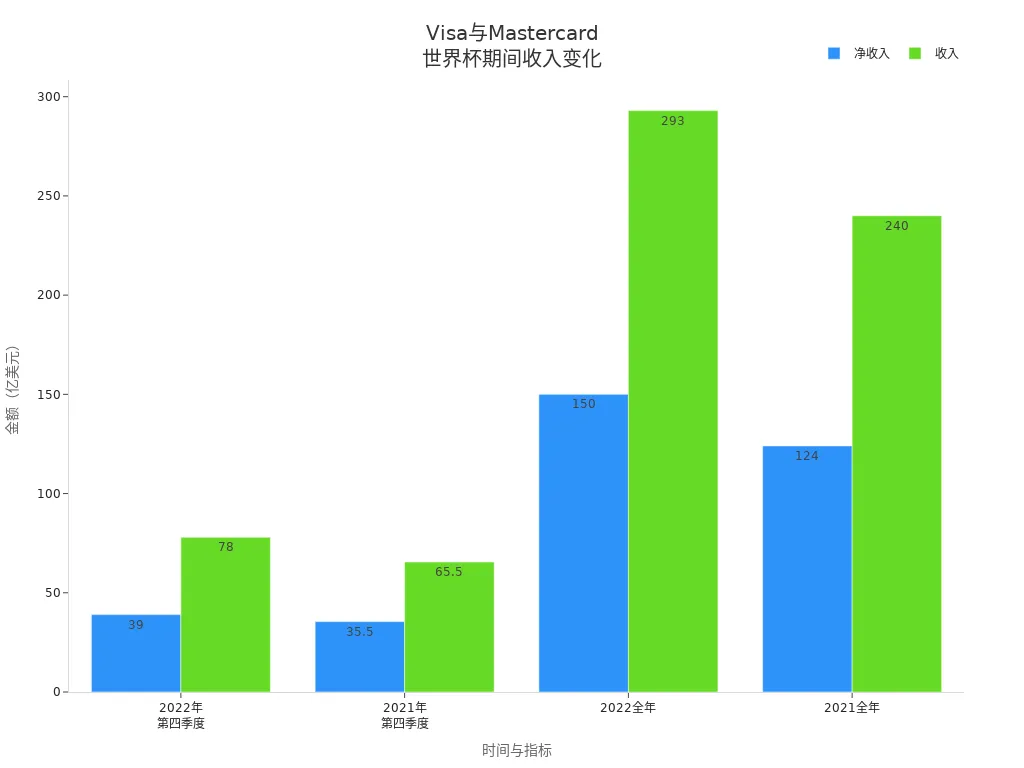
In the fourth quarter of 2022, the financial report data of Visa and Mastercard fully demonstrated the pull effect of the surge in transaction volumes during the World Cup on performance. The table below shows the year-over-year changes in the main financial indicators of the two companies:
| Financial Indicator | Q4 2022 | Q4 2021 | Growth Rate |
|---|---|---|---|
| Net Income | $3.9 billion | $3.55 billion | 10% |
| Revenue | $7.8 billion | $6.55 billion | 19% |
| Full-Year Net Income | $15 billion | $12.4 billion | 21% |
| Full-Year Revenue | $29.3 billion | $24 billion | 22% |
In 2022, Visa and Mastercard achieved double-digit growth in both full-year revenue and net income, demonstrating strong performance resilience. During the World Cup, the increase in cross-border payment transaction volumes became the main driving force.
The high growth in transaction service fees and international transaction revenue is directly reflected in the quarterly and annual financial reports. Through continuous innovation and optimization of payment networks, the two companies have consolidated their leading position in the global payments industry.
Profit Margin and Cash Flow Changes
During the World Cup, Visa and Mastercard not only achieved simultaneous growth in revenue and net profit but also maintained high profit margins and ample cash flow. The two companies further enhanced profitability by improving operational efficiency and optimizing cost structures.
Data shows that in 2022, the net profit margins of both companies remained above 50%, far higher than the industry average. Strong cash flow provides strong support for the companies’ continued investment in innovation and global expansion.
Visa and Mastercard stock analysis points out that stable profit margins and healthy cash flow structures provide a solid foundation for the companies to withstand market fluctuations and industry risks. When evaluating their long-term value, investors should focus on transaction service fee revenue, international transaction growth, and cash flow performance.
In the future, with the continued growth in cross-border payment demand and continuous innovation in payment technology, Visa and Mastercard are expected to maintain high-level performance.
Visa and Mastercard Stock Analysis: Valuation and Investment Outlook
Revenue Growth Drives Valuation
During the World Cup, Visa and Mastercard drove an increase in overall company valuation through significant improvements in cross-border payment transaction volumes. The two companies continue to expand market share through optimized payment networks and innovative services. Data shows that during the 2022 World Cup, Visa and Mastercard’s cross-border transaction volumes grew 12% year-over-year, payment transaction volumes grew 8%, total processed transactions reached 69.4 billion, up 9% year-over-year. Company revenue reached $10.9 billion, with adjusted earnings per share at $3.17. The table below shows the main financial indicators:
| Indicator | Value |
|---|---|
| Adjusted Earnings Per Share | $3.17 |
| Revenue | $10.9 billion |
| Cross-Border Transaction Volume Growth | 12% |
| Payment Transaction Volume Growth | 8% |
| Total Processed Transactions | 69.4 billion |
| Year-over-Year Growth | 9% |
The high growth in cross-border transactions directly improves profit margins. Visa and Mastercard maintain leading positions in the global payments industry, relying on strong cash flow and high profit margins to continuously attract institutional investor attention. Visa and Mastercard stock analysis shows that transaction peaks brought by large international events like the World Cup have become important catalysts for driving company valuation increases.
Market Expectations and Stock Performance
The market generally expects Visa and Mastercard to continue benefiting from the growth in global cross-border payment demand. Analysts believe that sustained strong consumer spending and cross-border transaction volumes provide long-term growth momentum for the companies. Visa’s revenue continues to exceed market expectations, with cross-border and digital services as the main drivers. Mastercard has achieved double-digit revenue growth, with cross-border and premium consumption performing particularly strongly.
In Visa and Mastercard stock analysis, investors generally focus on the following core indicators:
- The direct pull effect of continued growth in cross-border transaction volumes on revenue and profitability.
- Cross-border transactions typically have higher profit margins, and growth will further improve the companies’ overall profitability.
- The positive impact of digital payment and mobile payment solutions (such as Apple Pay, Google Pay) on transaction volumes.
- The potential impact of emerging payment technologies and alternative payment systems on the market landscape.
Analysts assess the competitive pressure brought by emerging payment technologies by studying the market positioning of Visa and Mastercard. The popularity of digital payments and mobile payments continues to change consumer payment habits. Innovative payment platforms like Biyapay, with convenient, secure, and low-cost cross-border payment experiences, meet the diversified needs of Chinese-speaking users globally and further enrich the payment ecosystem. Visa and Mastercard continue to enhance cross-border payment service capabilities and consolidate competitive advantages in the high-end client and corporate client markets through deep collaboration with partners such as licensed banks in Hong Kong.
Investment Opportunities and Risks
Visa and Mastercard still have strong long-term growth prospects in the cross-border payment market. The companies continue to expand high-margin international businesses by relying on globalized networks and innovation capabilities. When evaluating Visa and Mastercard stock analysis, investors should focus on the following risks and opportunities:
- Major retailers and tech giants launching stablecoin payment networks may divert transaction volumes from traditional card networks, affecting company revenue growth.
- The U.S. Department of Justice’s regulatory scrutiny of Visa and Mastercard’s market dominance, accusing them of maintaining high merchant fees, may restrict future pricing power.
- Ongoing litigation and proposed settlements may affect the companies’ long-term profitability and market confidence.
- Industry changes brought by emerging payment technologies and alternative payment systems (such as stablecoins and blockchain payments) require the companies to continue increasing investment in innovation.
Investor Recommendations:
- Continuously monitor core financial indicators such as cross-border transaction volumes, transaction service fee revenue, profit margins, and cash flow.
- Evaluate the companies’ layout and competitiveness in digital payments, mobile payments, and innovative payment solutions.
- Pay attention to changes in regulatory policies and progress in industry litigation, and adjust investment strategies in a timely manner.
- Monitor the penetration rate of emerging payment platforms like Biyapay among Chinese-speaking users and their potential impact on traditional payment giants.
Visa and Mastercard stock analysis indicates that despite challenges from emerging payment technologies and regulatory pressures, the two companies still possess long-term investment value due to their globalized networks, strong risk control capabilities, and continuous innovation. Investors should rationally assess risks and opportunities based on market dynamics and company fundamentals to make informed investment decisions.
Visa and Mastercard achieved significant transaction fee revenue through the surge in cross-border payment transaction volumes during the World Cup, driving increases in company revenue and valuation. Visa has performed well since becoming a FIFA sponsor, with a positive investment outlook. Investors can focus on the following suggestions:
- Continuously track changes in cross-border transaction volumes and transaction service fee revenue
- Pay attention to digital payment innovations and industry changes brought by emerging payment technologies
- Evaluate the impact of regulatory policies and market competition on the companies’ long-term profitability
FAQ
How do Visa and Mastercard increase revenue through cross-border payments during the World Cup?
The two companies rely on their global payment networks to capture opportunities from surging transaction volumes during the event. Cross-border payment service fees and international transaction revenue increase significantly, directly driving overall revenue growth.
What impact does the binding of digital wallets with traditional bank cards have on transaction volumes during the World Cup?
After digital wallets are bound with Visa and Mastercard, payment scenarios are greatly expanded. Users complete payments via mobile devices, achieving substantial increases in both transaction volumes and transaction frequency.
Which core financial indicators should investors focus on to evaluate Visa and Mastercard’s performance?
Investors need to focus on cross-border transaction volumes, transaction service fee revenue, profit margins, and cash flow performance. These indicators directly reflect the companies’ profitability and market competitiveness.
Will emerging payment technologies such as stablecoins pose a threat to Visa and Mastercard?
Stablecoins and blockchain payments have the potential to divert transaction volumes from traditional card networks. The two companies need to continue innovating and improving payment network security and service diversity to address challenges.
What role do licensed banks in Hong Kong play in cross-border payment cooperation?
Licensed banks in Hong Kong provide compliant and secure cross-border payment channels for Visa and Mastercard. Cooperation between both parties optimizes fund settlement processes and enhances the payment experience for international clients.
*This article is provided for general information purposes and does not constitute legal, tax or other professional advice from BiyaPay or its subsidiaries and its affiliates, and it is not intended as a substitute for obtaining advice from a financial advisor or any other professional.
We make no representations, warranties or warranties, express or implied, as to the accuracy, completeness or timeliness of the contents of this publication.
Related Blogs of

Why Is HDD Supply and Demand Tightening? AI Data Centers, Long-Term Agreements, and Western Digital/Seagate Pricing Power


AI Storage Supply Chain Map: Chips, HDDs, SSDs, Packaging Equipment, and Enterprise Storage Systems


What Are NOR Flash, SLC NAND, and EEPROM? Why They Help Explain Hong Kong-Listed Memory-Related Stocks

What Is the Difference Between DRAM Contract Price and Spot Price? Which Indicator Should Investors Watch?

Choose Country or Region to Read Local Blog
 Australia
 Austria
 Belgium
 Canada
 Cyprus
 Czech Republic
 Denmark
 Estonia
 Finland
 France
 Germany
 Greece
 Hong Kong
 India
India Indonesia
 Ireland
 Italy
Italy Japan
Japan Latvia
 Lithuania
 Luxembourg
 Malaysia
 Malta
Malta Morocco
 Nepal
Nepal Netherlands
 New Zealand
 Norway
 Pakistan
 Philippines
 Poland
 Portugal
 Romania
 Singapore
 Slovakia
 Slovenia
 South Africa
 South Korea
 Spain
Spain Sweden
 Thailand
 The United States
 Turkey
 United Arab Emirates
 United Kingdom
 Vietnam
Contact Us




BIYA GLOBAL LLC is registered with the Financial Crimes Enforcement Network (FinCEN), an agency under the U.S. Department of the Treasury, as a Money Services Business (MSB), with registration number 31000218637349, and regulated by the Financial Crimes Enforcement Network (FinCEN).
BIYA GLOBAL LIMITED is a registered Financial Service Provider (FSP) in New Zealand, with registration number FSP1007221, and is also a registered member of the Financial Services Complaints Limited (FSCL), an independent dispute resolution scheme in New Zealand.