Stop Blindly Guessing the Hang Seng Index Trend: Learn This Technique to Steadily Seize Opportunities




Image Source: unsplash
Have you ever felt confused staring at candlestick charts, guessing whether the Hang Seng Index trend will rise or fall?
In fact, understanding charts is not that mysterious. You just need to learn one of the most basic and powerful tools—trend lines. They can help you clearly judge whether the market is currently “going up,” “going down,” or “standing still.” This is the first step in making all your investment decisions and the key to saying goodbye to blind guessing.
Key Points
- Trend lines are an important tool for analyzing the Hang Seng Index trend; they help you judge whether the market is rising, falling, or consolidating.
- Uptrend lines connect price lows, providing support; downtrend lines connect price highs, forming resistance.
- When price pulls back near an uptrend line, it may be a buying opportunity; when price rebounds near a downtrend line, you need to be vigilant about risks.
- Trend line breaks are important signals, but combine with volume to judge true or false breaks.
- Trend lines are not the only analysis tool; you also need to combine other indicators and strict risk management for investment decisions.
First Step in Chart Reading: Understand Candlestick Charts and Trend Lines

Image Source: pexels
To understand charts, you first need to recognize two basic elements: candlestick charts and trend lines. Candlestick charts are the basic building blocks of charts, while trend lines are like a ruler helping you measure market direction. Let’s learn step by step.
Candlestick Chart Basics: Understand the Meaning of Red and Green Bars
Those red and green bars you see on charts are candlestick charts (also called candlestick charts). Each candlestick records price changes over a period, containing four key pieces of information: open, close, high, and low.
Simply put, you can understand it this way:
- Red candlesticks: Represent rises, close higher than open.
- Green candlesticks: Represent falls, close lower than open.
A complete candlestick consists of two parts:
- Body: The thick rectangular part in the middle. It shows the price gap between open and close. Longer bodies represent stronger rise/fall forces.
- Wicks (shadows): Thin lines above and below the body. The top of the upper wick is the period high, the bottom of the lower wick is the period low.
(Note: Placeholder for illustration; replace with image link in actual use)
Uptrend Line: Connect Increasing Lows
When you see price lows continuously rising, it means the market may be in an uptrend. At this time, you can draw your first “ruler”—an uptrend line.
The drawing method is very simple: Find at least two successively higher lows and connect them with a straight line.
This line acts like “support”; when price pulls back near this line, it often gains support and continues rising. A clear uptrend line indicates sustained price rises and strong market performance.
Downtrend Line: Connect Decreasing Highs
Conversely, when you see price highs continuously falling, this is usually a downtrend signal. At this time, you need to draw a downtrend line to confirm direction.
The drawing method is equally intuitive: Find at least two successively lower highs and connect them with a straight line.
This downward-sloping line acts like “resistance,” defining the current Hang Seng Index trend pressure level. When price rebounds and touches this line, it often meets strong resistance and likely turns down. It helps you identify potential risks and avoid blindly buying during downtrends.
Core Techniques: How to Use Trend Lines to Judge Buying and Selling
Drawing trend lines is just the first step; the real value lies in using them to guide trading decisions. Mastering this “ruler” lets you more clearly measure market “support” and “pressure,” finding potential opportunities and risks.
Uptrend: Pullbacks Touching Line Are Potential Opportunities
When you draw a clear uptrend line for the Hang Seng Index trend, this line plays the role of “support level.” You can imagine it as a spring or safety net.
Markets don’t rise straight; there are always brief pullbacks. When price falls from highs and first or second touches this uptrend line, it often gains support and regains upward momentum.
A Basic Trading Idea:
- Confirm Trend: You have drawn a valid uptrend line.
- Wait for Pullback: Be patient, wait for price to pull back near the trend line. Don’t chase highs when price is far from the trend line.
- Look for Signals: When price touches the trend line and shows stopping fall/stabilizing candlestick patterns (e.g., long lower wick candlesticks), this is a potential buying opportunity signal.
This simple strategy helps you avoid emotional chasing highs, letting you operate along the trend at relatively safe positions.
Downtrend: Rebounds Touching Line Are Potential Risks
Opposite to uptrends, downtrend lines play the role of “pressure level” or “ceiling.” They tell you the market’s main direction is currently downward.
In downtrends, prices don’t fall straight either; there are brief rebounds. When price rebounds and touches this downtrend line, it usually meets strong resistance and likely turns down again. Therefore, this position is a potential risk point needing vigilance, not a bottom-fishing opportunity.
Advanced Tip: How to Confirm Resistance Validity?
Relying solely on trend lines may not be enough. You can combine other technical indicators for higher judgment accuracy. When price rebounds to the downtrend line, risk signals are stronger if:
- Moving Averages: Price simultaneously approaches 50-day or 200-day moving averages, these averages also form additional resistance.
- Relative Strength Index (RSI): RSI enters overbought area (usually above 70), indicating rebound momentum may soon exhaust.
- Moving Average Convergence Divergence (MACD): MACD shows bearish crossover (fast line crossing slow line downward), signaling downside momentum may restart.
Combining these tools lets you more confidently judge if rebound is ending, avoiding risks.
Key Signal: What If Trend Line is Broken
Trend lines are not forever valid. When price finally crosses your drawn trend line, this is a very important signal—breakout.
- Downward break of uptrend line: May mean end or pause of uptrend, market may turn sideways or down.
- Upward break of downtrend line: May signal end of downtrend, market likely welcoming a rise.
When you apply “breakout vs. false breakout” to the HSI or Hong Kong-listed names, it helps to anchor your chart read to checkable data: whether the close is firmly outside the line, whether volume expands on the break, and whether the key level is retested rather than instantly rejected. Instead of relying on a single chart view, you can use BiyaPay’s stock information lookup to cross-check live quotes, key levels, and trading activity; and if you’re comparing assets across different quote currencies, BiyaPay’s fiat FX converter & comparison tool can standardize the reference currency so FX doesn’t blur your P&L read.
On execution, a safer workflow is to define a watchlist and triggers first, then act only when conditions are met. You can review the order interface via BiyaPay’s trading entry and complete registration so your account settings and risk preferences stay consistent for later post-trade review. If compliance signals matter for your decision process, the latest disclosures can be referenced on the official site, including updates related to registrations such as US MSB and NZ FSP.
However, you need to be especially wary of a market trap—false breakout.
False breakout is a market “deception” behavior. Price appears to strongly break the trend line but soon reverses back to original trend direction, catching all breakout chasers off guard. This is usually when inexperienced traders impulsively enter based on feeling and get “harvested” by professional forces in reverse.
So, how to distinguish valid true breakouts from deceptive false ones? You can focus on these features:
| Feature | Valid Breakout | False Breakout |
|---|---|---|
| Momentum | Strong force on breakout, candlestick bodies usually long. | Hesitant on breakout, candlestick bodies short or long wicks. |
| Volume | Accompanied by significantly amplified volume, indicating high market participation. | Volume unchanged or shrinking, indicating lack of support. |
| Price Action | Price stabilizes beyond trend line after breakout. | Price soon returns within trend line after breakout. |
| Confirmation | Wait for candlestick close clearly beyond trend line before judging. | Price briefly breaks intraday but closes back in original position. |
Remember This Key Point: Volume is the Touchstone for Breakouts
Analyzing volume is core to evaluating trend line breakout validity. A breakout without volume support has greatly reduced reliability.
- High Volume Breakout: When price breaks trend line, if volume far exceeds recent average (e.g., 50% or more higher), this indicates strong market force pushing new direction, greatly increasing breakout authenticity.
- Low Volume Breakout: If volume ordinary or below average on breakout, this indicates market lacks enthusiasm for new direction, likely a false breakout—you need high vigilance.
Therefore, when you see a trend line break, don’t act immediately. Spend a little more time observing volume and next candlestick trend, waiting for clearer confirmation signals—this helps you filter most market noise and traps.
Practical Analysis: Hang Seng Index Chart
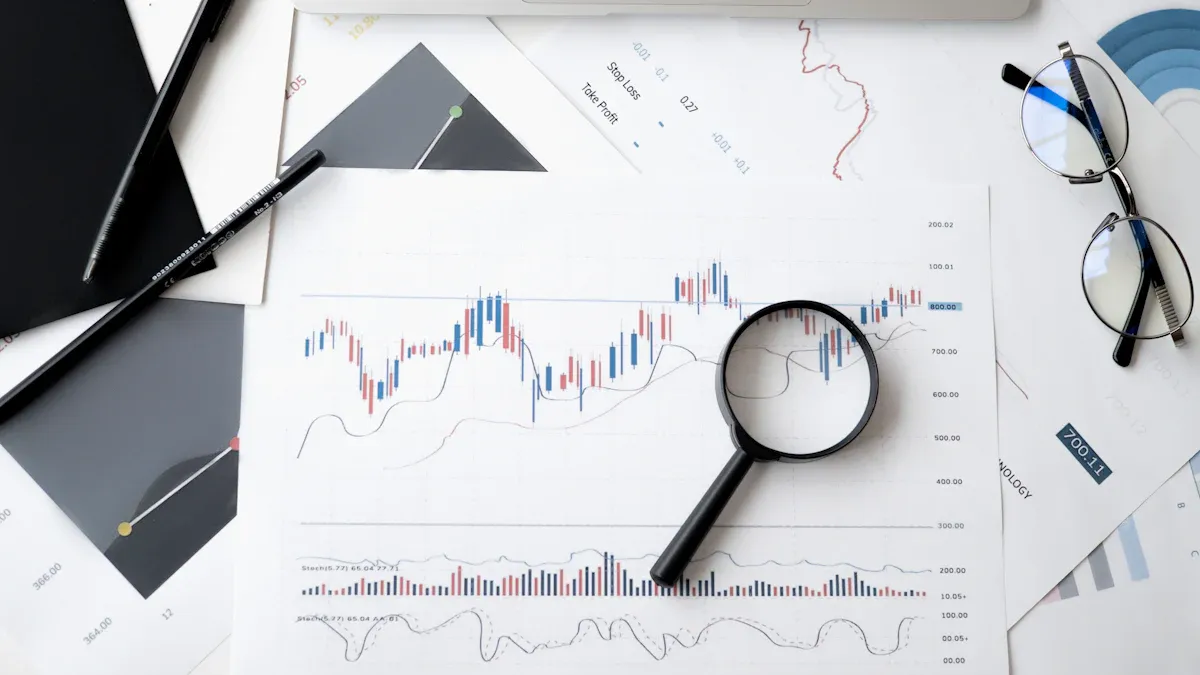
Image Source: pexels
Theory knowledge mastered, now time to hands-on. This section will guide you step by step to open charting software and draw your first trend line on the real Hang Seng Index chart. You will find this much simpler than imagined.
Prepare Tools: Find the Line Drawing Function in Software
No matter which charting software you use, line drawing is the most basic feature. Usually, you can find an icon like “pen” or “line” in the sidebar or top toolbar of the candlestick chart interface.
Quick Start Tips:
After opening line drawing tool, you usually see several very practical auxiliary functions; recommend prioritizing enabling:
- Snap Function: This function is magical. It lets your mouse automatically snap to candlestick highs or lows, ensuring precise line start/end points.
- Continuous Drawing: Allows drawing multiple lines at once, convenient for analyzing different trends simultaneously.
- Multi-Timeframe Display: Lets your drawn lines display on daily, weekly, etc., different timeframe charts.
Familiar with these tools, you can start your analyst journey.
Case Practice: Draw Your First Trend Line
Now, let’s open the Hang Seng Index daily candlestick chart and complete a practical exercise together.
- Select Chart: Set chart timeframe to “daily,” display recent 6 months to 1 year data for clear midterm trend view.
- Identify Trend: Observe chart, find a clear downtrend with continuously lower highs.
- Start Drawing:
- Click line drawing tool, select “trend line.”
- Move mouse to first obvious high in this downtrend, left-click to set start point.
- Move mouse to second successively lower high, click again—a downtrend line is born!
- Interpret Meaning: Your drawn line is current market “pressure line.” Per earlier learning, when price rebounds and touches this line, you need vigilance as it is a potential risk signal.
Line Drawing Key Points: Two Details Determine Success or Failure
To make your trend lines more professional and reliable, you must note the following two key details. Many beginners draw invalid trend lines precisely because they ignore them.
- Detail One: Connect Wicks or Bodies? You may wonder whether to connect candlestick highs/lows (wicks) or close/open (bodies) when drawing. Actually no absolute right/wrong, but consistency is crucial. A widely accepted principle: Prefer connecting wick ends, letting the line gain most touches while avoiding line body crossing candlestick bodies. If a line crosses multiple candlestick bodies, its validity greatly discounts.
- Detail Two: What Timeframe to Choose? Will you draw on 5-minute, daily, or weekly charts? Remember one principle: Longer timeframes, higher trend line reliability. Weekly and monthly trend lines define long-term direction, most solid. For beginners, recommend starting practice on daily charts. Daily charts help filter short-term noise, letting you focus on clearer, more important midterm trends.
Congratulations! Mastering trend lines is your decisive step from “blind guessing” to “analysis.” Though simple, it is the cornerstone of technical analysis. Act now, open your charting software, draw your first trend line on the Hang Seng Index trend, feel the certainty of measuring the market with a “ruler.”
Important Risk Warning
Trend lines are not 100% accurate “crystal balls.” As investor Fred McAllen emphasized: “Always use stops to protect your capital.” In actual operations, you must combine volume changes to confirm trend strength, and strictly execute risk management:
- Stop-Loss Orders: Preset prices for automatic close to limit losses.
- Position Sizing Adjustment: Adjust single-trade fund amount to avoid excessive risk.
FAQ
What if I can’t draw a clear trend line?
This indicates the market may be in sideways consolidation with no clear direction. The best strategy at this time is patience, waiting for price to break out clear trend. Don’t force drawing lines to avoid wrong judgments.
How many touches make a trend line valid?
Two points determine a line, but third point touch is valid confirmation of the trend. The more times a trend line is touched and validated, the higher its reliability and stronger market consensus.
Are trend lines useful in sideways markets?
In sideways markets, you can draw two horizontal lines connecting highs (resistance) and lows (support), forming a “box.” Price breaking box upper/lower boundaries is also an important trading signal.
Is looking only at trend lines enough?
Absolutely not. Trend lines are basic tools but not omnipotent. You must combine volume to confirm breakout validity and always set stops. Treat them as analysis tools, not future-predicting crystal balls.
*This article is provided for general information purposes and does not constitute legal, tax or other professional advice from BiyaPay or its subsidiaries and its affiliates, and it is not intended as a substitute for obtaining advice from a financial advisor or any other professional.
We make no representations, warranties or warranties, express or implied, as to the accuracy, completeness or timeliness of the contents of this publication.
Related Blogs of

Tap and Go A Beginner's Guide to Cardless ATM Withdrawals


How to Fill Out a CVS Money Order A 2026 Guide


Why Is Canada's Country Code 1


The Easiest Way to Find the Code for Calling France

Choose Country or Region to Read Local Blog
 Australia
 Austria
 Belgium
 Canada
 Cyprus
 Czech Republic
 Denmark
 Estonia
 Finland
 France
 Germany
 Greece
 Hong Kong
 India
India Indonesia
 Ireland
 Italy
Italy Japan
Japan Latvia
 Lithuania
 Luxembourg
 Malaysia
 Malta
Malta Morocco
 Nepal
Nepal Netherlands
 New Zealand
 Norway
 Pakistan
 Philippines
 Poland
 Portugal
 Romania
 Singapore
 Slovakia
 Slovenia
 South Africa
 South Korea
 Spain
Spain Sweden
 Thailand
 The United States
 Turkey
 United Arab Emirates
 United Kingdom
 Vietnam
Contact Us




BIYA GLOBAL LLC is a licensed entity registered with the U.S. Securities and Exchange Commission (SEC No.: 802-127417); a certified member of the Financial Industry Regulatory Authority (FINRA) (Central Registration Depository CRD No.: 325027); regulated by the Financial Industry Regulatory Authority (FINRA) and the U.S. Securities and Exchange Commission (SEC).
BIYA GLOBAL LLC is registered with the Financial Crimes Enforcement Network (FinCEN), an agency under the U.S. Department of the Treasury, as a Money Services Business (MSB), with registration number 31000218637349, and regulated by the Financial Crimes Enforcement Network (FinCEN).
BIYA GLOBAL LIMITED is a registered Financial Service Provider (FSP) in New Zealand, with registration number FSP1007221, and is also a registered member of the Financial Services Complaints Limited (FSCL), an independent dispute resolution scheme in New Zealand.