Hong Kong, US & Taiwan Stock Market Trading Hours Comparison Chart 2025 – Never Get Confused Again




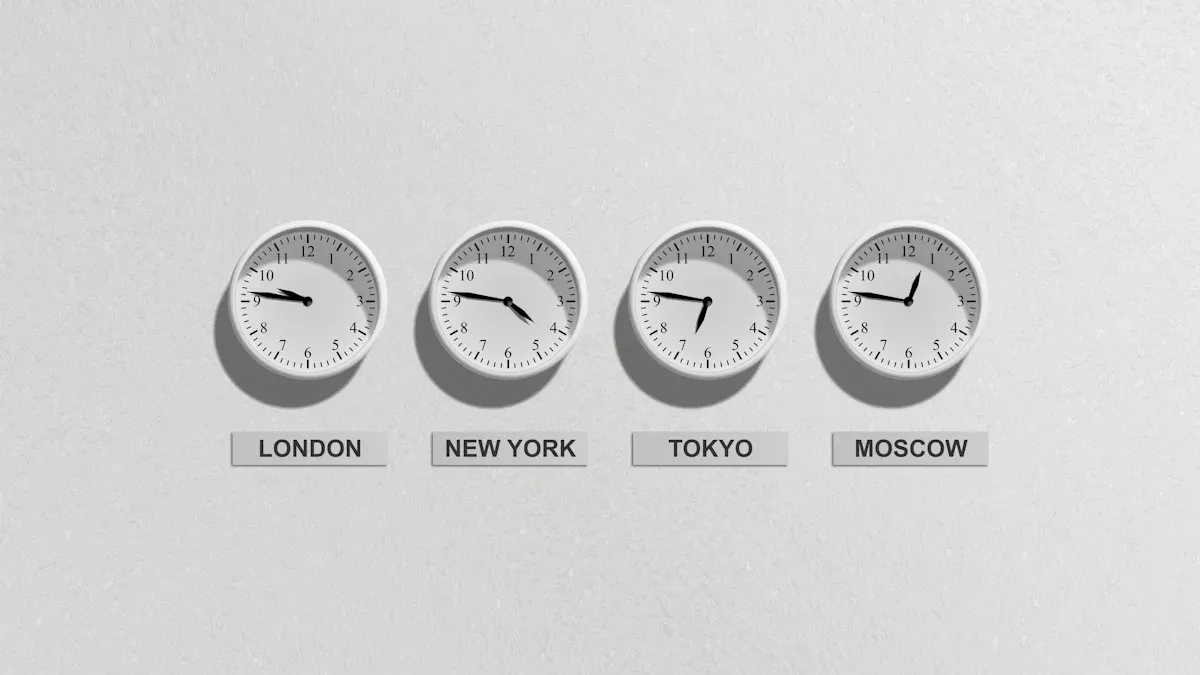
Image Source: pexels
Want to trade flexibly across different markets but always get confused by complicated schedules? One master chart solves everything. The table below shows the complete trading sessions for Taiwan (TWSE), Hong Kong (HKEX), and US markets.
| Market | Local Trading Hours | Taiwan Time (GMT+8) |
|---|---|---|
| HKEX | 09:30–12:00 / 13:00–16:10 | 09:30–12:00 / 13:00–16:10 |
| US (Summer) | 09:30–16:00 ET | 21:30–04:00 (next day) |
| US (Winter) | 09:30–16:00 ET | 22:30–05:00 (next day) |
| TWSE | 09:00–13:30 | 09:00–13:30 |
Mastering the three major market schedules — including Hong Kong market opening hours — is the first step to precise positioning. Whether you day-trade or invest long-term, knowing the exact entry/exit windows dramatically improves your win rate.
Key Takeaways
- Understanding Taiwan, Hong Kong, and US trading hours helps you invest with precision.
- HKEX is split into morning and afternoon sessions with a lunch break.
- US markets switch between summer (DST) and winter time and offer pre-market, regular, and after-hours sessions.
- Taiwan market is straightforward — continuous trading from morning to early afternoon with no break.
- Each market has different lot sizes, price limits, and order rules — always check before trading.
Full Overview of Taiwan, Hong Kong & US Stock Market Hours

Image Source: pexels
After the quick overview, you probably want more detailed rules. Below we break down each market’s sessions in depth to help you plan your strategy accurately.
If you switch between TWSE, HKEX, and US markets often, it helps to keep one consistent place for quick checks. For market/ ticker lookups and basic stock details, you can use the BiyaPay stock info search as a simple reference alongside this timetable.
When you’re planning around pre-market or after-hours, it’s also useful to keep research and execution close together. If you prefer a single flow from “check” to “trade,” you can open the BiyaPay trading entry without bouncing across multiple sites.
BiyaPay is positioned as a multi-asset trading wallet that covers cross-border payments, investing, and fund management. If you want to save your commonly used pages under one account, start from Sign up or return to the official site to manage entry points.
For readers who care about trust and compliance, BiyaPay holds relevant MSB credentials in the US and is registered as an FSP in New Zealand—best treated as background context when you’re building a long-term cross-market routine.
Hong Kong (HKEX) Opening Hours & Sessions
Hong Kong has the same time zone as Taiwan, so it’s very intuitive for Taiwanese investors. However, HKEX splits the day into finer segments you must know. Understanding the full HKEX schedule and rules is the first step to successful trading.
HKEX trading is divided into morning session, lunch break, and afternoon session.
| Session | Taiwan Time (GMT+8) | Description |
|---|---|---|
| Pre-opening Auction | 09:00 – 09:30 | Orders can be placed; the system calculates the opening price. |
| Morning Session | 09:30 – 12:00 | Continuous trading – buy/sell anytime. |
| Lunch Break | 12:00 – 13:00 | Market closed – no trading allowed. |
| Afternoon Session | 13:00 – 16:00 | Continuous afternoon trading. |
Advanced Note: Closing Auction Session (CAS / U-Phase) Trading doesn’t end sharply at 16:00 — HKEX enters a Closing Auction Session that runs until around 16:10.
- Coverage: Applies to most major stocks, including Hang Seng Composite constituents, H-shares with A-share counterparts, and all ETFs.
- Random Close: Exact close time is randomized between 16:08–16:10 to prevent last-second manipulation.
- Warrants and CBBCs do not participate in this session.
US Stock Market Hours: Regular, Pre-Market & After-Hours
The biggest thing to watch with US markets is the switch between Daylight Saving Time (summer) and Standard Time (winter) — it directly affects your sleep and trading schedule.
- Daylight Saving Time: Starts on the second Sunday of March each year.
- Standard Time: Starts on the first Sunday of November each year.
Quick Tip for 2025–2026 DST in 2025 begins on March 9 and ends on November 2. Mark your calendar now!
One of the biggest attractions of US markets is the extremely long trading day, divided into pre-market, regular, and after-hours sessions — giving global investors flexible windows.
| Session | Taiwan Summer Time | Taiwan Winter Time | Description |
|---|---|---|---|
| Pre-Market | 16:00 – 21:30 | 17:00 – 22:30 | Lower volume, higher volatility — often reacts to earnings or major news. |
| Regular Hours | 21:30 – 04:00 | 22:30 – 05:00 | Most active period with best liquidity — where the majority of volume occurs. |
| After-Hours | 04:00 – 08:00 | 05:00 – 09:00 | Lower volume again — continues regular-session sentiment or reacts to fresh earnings. |
Taiwan (TWSE) Trading Hours: Regular & After-Hours Fixed-Price
Taiwan market is the simplest — continuous trading from 09:00 to 13:30 with no lunch break, perfect for office workers to check during lunch.
| Session | Taiwan Time (GMT+8) | Description |
|---|---|---|
| Regular Session | 09:00 – 13:30 | Main continuous matching session on Taiwan Stock Exchange. |
| After-Hours Fixed-Price | 14:00 – 14:30 | Allows trading at the day’s closing price via batch matching. |
If you miss placing an order before 13:30 close, the after-hours fixed-price session is your second chance — you trade exactly at the official closing price, great for investors who hate chasing highs or cutting lows.
Overlapping Sessions & Major Holiday Closures Across Markets

Image Source: pexels
After understanding each market’s standalone hours, put them together. You’ll see that somewhere in the world, a market is almost always open 24 hours. Analyzing overlaps and holiday closures helps you allocate time and capital more efficiently.
Session Overlap Analysis
If you line up all three markets on a 24-hour timeline, their “relay” relationship becomes crystal clear — crucial for building a round-the-clock strategy.
- 09:30 – 12:00: Taiwan + Hong Kong overlap The most active period in Asia. HKEX opens shortly after TWSE, creating high volume and cross-influence — perfect for watching both markets at once.
- 13:00 – 16:10: Hong Kong solo + European pre-open After Taiwan closes, HKEX afternoon session continues. European markets are also open — watch Europe to gauge potential US direction.
- 21:30 – 04:00 (summer): HK closes → US takes over After a short break following HK close, the world’s core session begins — US regular hours. Pre-market often already prices in the day’s big news.
Trading Rhythm Summary Simply put: focus on Taiwan + Hong Kong during the day, hand over to US markets at night. Use the global relay to keep your portfolio active non-stop.
Major Annual Holiday Closures for the Three Markets
Beyond daily hours, always check national holidays — no trading is possible on those days. Plan ahead to avoid missing key windows. Here are the most important annual closures.
- Taiwan (TWSE) major holidays: Lunar New Year (long break), Peace Memorial Day (Feb 28), Children’s Day + Tomb Sweeping, Dragon Boat Festival, Mid-Autumn Festival, National Day.
- Hong Kong (HKEX) major holidays: Lunar New Year (long break), Good Friday & Easter Monday, Buddha’s Birthday, HKSAR Establishment Day, National Day, Christmas.
- US major holidays: Martin Luther King Jr. Day, Presidents’ Day, Good Friday, Memorial Day, Juneteenth, Independence Day (July 4), Labor Day, Thanksgiving, Christmas.
Friendly reminder Exact dates shift slightly each year due to weekends. Always double-check the official exchange calendars when planning longer-term trades.
Key Rule Differences You Must Know for Cross-Market Trading
Once you’re comfortable with hours, learn the “devil-is-in-the-details” rules. Lot sizes, price limits, and order timing differ significantly — ignoring them can wreck your strategy.
Trading Unit Differences: Shares vs Lots vs Boards
Minimum order size varies completely across markets.
- US (per share): Most flexible — you can buy just 1 share.
- Taiwan (per board): 1 board = 1,000 shares. Anything below must go through the odd-lot/ fractional market.
- Hong Kong (per lot): 1 lot size is set by each company — can be 100, 500, or 2,000 shares. Always check the board lot before ordering.
Price Limit & Circuit Breaker Comparison
Daily price movement limits directly affect your potential P&L.
| Market | Daily Price Limit | Market-Wide Circuit Breaker |
|---|---|---|
| Taiwan | ±10% limit per stock | None |
| HK | No daily limit, but Volatility Control Mechanism (VCM) triggers 5-minute cooling period on extreme moves | None |
| US | No daily limit | Market-wide halt triggered when S&P 500 drops 7%, 13%, or 20% |
For example, if a Taiwan stock closed at $100 yesterday, today it can only move between $90–$110. In HK and US markets, theoretically there is no cap on single-day movement.
Order Placement Windows & Extended Hours Rules
Beyond regular hours, know when you can actually place orders and the differences in pre/after-hours activity.
A major difference is that Taiwan and Hong Kong do not have the active pre/after-hours sessions that US markets offer — most volume is concentrated in regular hours.
Practical Tips
- HKEX: Orders placed between 09:15–09:20 in the pre-opening auction cannot be canceled or amended — triple-check before submitting.
- US: Limit orders or conditional orders placed via most brokers are usually sent to the exchange around 18:00 Taiwan time and enter the pre-market queue.
Settlement is also changing fast. The US moved to T+1 settlement in May 2024 — you get cash the next business day after selling. Hong Kong plans to follow soon, greatly improving capital efficiency.
Mastering cross-market trading is really about building a rhythm that fits you. A simple plan: Taiwan + Hong Kong during the day, hand over to US at night.
Build Your Own Rhythm Use this guide’s charts and timeline to identify your most alert hours for primary trading. For other windows, consider using conditional orders and automation tools so investing and life stay balanced.
Hope this guide clears up all your timing confusion. Bookmark this page — it will be your best companion for cross-market trading whenever you need a quick reference.
FAQ
When exactly does US Daylight Saving Time switch?
US Daylight Saving Time starts on the second Sunday of March and ends on the first Sunday of November each year. Mark your calendar in advance so you never miss the opening bell.
Hong Kong uses “lots” — can I buy fewer shares than one lot?
Yes. Anything below one full lot is called “odd lot” or “broken lot.” You can trade via the odd-lot market, but pricing is usually slightly worse and liquidity lower.
Can anyone trade US pre-market and after-hours?
Most brokers offering US stocks allow participation in pre-market and after-hours. Simply select the correct session when placing your order. Keep in mind volume is much lower and price swings can be sharper.
*This article is provided for general information purposes and does not constitute legal, tax or other professional advice from BiyaPay or its subsidiaries and its affiliates, and it is not intended as a substitute for obtaining advice from a financial advisor or any other professional.
We make no representations, warranties or warranties, express or implied, as to the accuracy, completeness or timeliness of the contents of this publication.
Related Blogs of

Run Local Large Models or Call APIs? 2026 AI Development Cost and Payment Method Comparison

Patreon/OnlyFans and Other Overseas Creator Platforms Payout: Ultimate Tricks to Bypass Domestic Bank Forex Review for Withdrawal


Pay for Perplexity Pro Subscription with USDT: Bypass Regional Payment Restrictions

Virtual Card Binding to AWS/GCP for AI Agent Deployment Frequently Flagged by Risk Control? Compliance Card Opening Guide to Avoid Pitfalls

Choose Country or Region to Read Local Blog
 Australia
 Austria
 Belgium
 Canada
 Cyprus
 Czech Republic
 Denmark
 Estonia
 Finland
 France
 Germany
 Greece
 Hong Kong
 India
India Indonesia
 Ireland
 Italy
Italy Japan
Japan Latvia
 Lithuania
 Luxembourg
 Malaysia
 Malta
Malta Morocco
 Nepal
Nepal Netherlands
 New Zealand
 Norway
 Pakistan
 Philippines
 Poland
 Portugal
 Romania
 Singapore
 Slovakia
 Slovenia
 South Africa
 South Korea
 Spain
Spain Sweden
 Thailand
 The United States
 Turkey
 United Arab Emirates
 United Kingdom
 Vietnam
Contact Us




BIYA GLOBAL LLC is registered with the Financial Crimes Enforcement Network (FinCEN), an agency under the U.S. Department of the Treasury, as a Money Services Business (MSB), with registration number 31000218637349, and regulated by the Financial Crimes Enforcement Network (FinCEN).
BIYA GLOBAL LIMITED is a registered Financial Service Provider (FSP) in New Zealand, with registration number FSP1007221, and is also a registered member of the Financial Services Complaints Limited (FSCL), an independent dispute resolution scheme in New Zealand.