How Cross-Border E-commerce Sellers Use AI Assistants to Automatically Report Offshore Fiat Account Balances Daily?





Image Source: pexels
When managing offshore accounts, you often find manual recording of fiat balances tedious and error-prone. For cross-border e-commerce sellers with frequent fund flows, failing to track account balances in time may cause you to miss investment or payment opportunities. Now, by combining an AI assistant with API interfaces, you can automatically fetch and report account balances on a scheduled basis. This not only reduces human operation errors but also significantly improves work efficiency, allowing you to focus on business growth.
Core Key Points
- Using an AI assistant to automatically report offshore account balances can significantly reduce manual errors and improve work efficiency.
- Choose an AI assistant platform that supports global payments and multi-currency management to ensure flexibility and stability in fund management.
- When obtaining API permissions, follow compliance requirements to ensure data security and avoid potential risks.
- Regularly check the API integration status to ensure data accuracy and promptly detect and correct anomalies.
- Flexibly select reporting channels to ensure timely delivery of fund information and improve team collaboration efficiency.
Solution and Tools

Image Source: unsplash
Overall Automated Reporting Process
You can achieve automatic scheduled reporting of offshore account fiat balances through an AI assistant. The overall process includes: selecting a suitable AI assistant platform, obtaining API access permissions for the offshore account, configuring API integration, setting up scheduled tasks, and choosing appropriate reporting channels. Many cross-border e-commerce sellers prioritize platforms that support global payments and multi-currency management, such as global payment tools like BiyaPay, combined with offshore accounts from Hong Kong licensed banks, to meet daily fund management needs. You only need to configure the API parameters in the AI assistant, and the system will automatically fetch the account balance and send scheduled reports via email, message push, enterprise WeChat, or other methods.
AI assistant automated reporting not only saves a great deal of manual operation time but also significantly reduces errors caused by manual entry. You can refer to the following data to understand the advantages of AI systems in financial management:
| Evidence Description | Result |
|---|---|
| AI systems have achieved 60-90% reduction in operational errors across industries | 60-90% |
| AI systems achieve 99.95% accuracy in processing financial transactions | 99.95% |
| AI-driven analysis can analyze entire datasets and identify anomalous patterns | Improved audit quality |
AI Assistant and API Integration
When selecting an AI assistant and API integration solution, you need to focus on the following key technical elements:
- Ensure the API has global availability and supports international fund flows.
- Check the API’s service level agreement to guarantee high availability (e.g., 99.9% uptime).
- Understand the API’s rate limits and quotas to ensure they meet the business needs of cross-border e-commerce sellers.
- Choose APIs that comply with security standards, such as supporting OAuth2 authentication and data encryption.
- Evaluate API compatibility to ensure support for common data formats like XML and JSON.
- Refer to API documentation and sample code to simplify the integration process.
Through efficient integration of AI assistant and API, you can achieve fully automated data fetching and anomaly detection. AI-driven analysis covers the entire dataset, promptly identifying anomalous patterns and improving the accuracy and efficiency of financial reporting. This automated solution brings higher fund management efficiency and decision support capabilities to cross-border e-commerce sellers.
Operation Steps for Cross-Border E-commerce Sellers

Image Source: unsplash
Selecting an AI Assistant Platform
You should first choose an AI assistant platform that supports automated financial operations for cross-border e-commerce. The platform’s features directly affect the efficiency and accuracy of automated reporting. Current mainstream platforms such as Intuit Assist, Xero Jora, and Agentic AI offer advantages including intelligent data extraction, automated financial operations, and multi-language support. You can refer to the table below for a quick comparison of the main features of each platform:
| Platform | Main Features |
|---|---|
| Intuit Assist | Natural language queries, task execution, intelligent data extraction, predictive expense categorization, supports automated financial operations. |
| Xero Jora | Performs financial tasks through conversational interaction, automatically generates invoices, intelligently categorizes expenses, improves financial management efficiency. |
| Agentic AI | Provides 24/7 customer support, supports multiple languages, enhances customer interaction, improves customer satisfaction and retention. |
As a cross-border e-commerce seller, you can prioritize platforms that support global payments, international remittances, and multi-currency management based on your business needs. For example, BiyaPay excels in global payments, international remittances, real-time conversion between fiat and cryptocurrency, and USDT to USD/HKD conversion, making it suitable for users who need efficient fund flows and multi-currency management. The choice of AI assistant platform will directly impact the stability and scalability of subsequent automated processes.
If your treasury workflow already involves multi-currency collection, conversion, and cross-border settlement, BiyaPay can be treated as one of the balance checkpoints in that reporting chain. The AI assistant does not need to control transactions directly; it only needs scheduled access to your organized balance sources, inflow and outflow records, and outputs from the exchange rate comparison tool to normalize different currency balances into one reporting view.
From an execution perspective, this structure is practical for cross-border e-commerce sellers. BiyaPay works as a multi-asset trading wallet covering cross-border payments, fund management, and international remittance, while supporting conversion between multiple fiat currencies and digital assets; when you need a daily view of offshore balances, FX costs, and usable funds, that kind of multi-currency path is easier for an AI assistant to summarize and flag.
Obtaining Offshore Account API Permissions
You need to apply for API access permissions from the selected Hong Kong licensed bank or global payment platform. The standard process includes:
- Submit necessary documents such as business qualifications and business descriptions to ensure compliance requirements are met.
- After the bank or payment platform approves the application, they will issue account credentials, API keys, and related access instructions.
- During the application process, the platform usually requires you to follow international security authentication standards such as OAuth 2.0 and OpenID Connect to ensure that only authorized applications can access the API.
- If you serve the EU, UK, or US markets, you must also comply with local regulations such as PSD2/SCA, GDPR, GLBA, etc., to protect data security and privacy compliance.
When obtaining API permissions, be sure to properly store key information to avoid leakage risks. A compliant API access process provides a secure foundation for subsequent automated reporting.
Configuring API Integration
After obtaining API permissions, you need to configure API parameters in the AI assistant platform to achieve data integration with the offshore account. Specific operations include:
- Enter the API key, account ID, and other necessary information in the AI assistant backend to complete identity verification.
- Configure data fetching frequency and data format to ensure the platform can correctly parse account balance information.
- If you encounter system compatibility issues, such as legacy systems not being compatible with modern APIs, you can contact platform technical support or choose an AI assistant platform that supports multiple data formats (such as XML, JSON).
- Pay attention to data accuracy and ensure consistency of data formats from different sources to avoid errors caused by format inconsistencies. You can use the platform’s built-in data validation features to improve data quality.
Tip: The effectiveness of automated reporting highly depends on data accuracy and consistency. You should regularly check the API integration status and promptly detect and correct anomalies.
Setting Up Scheduled Reporting
You can set up scheduled tasks in the AI assistant platform to achieve daily automatic reporting of offshore account fiat balances. Common setup methods include:
- Select the reporting frequency (such as daily, weekly) and set specific time points.
- Configure reporting content, including account balances, fund inflow/outflow details, etc.
- Set anomaly alert rules, such as automatically sending alerts when the balance falls below a warning threshold.
- Some platforms support custom reporting templates, allowing you to adjust the reporting format according to actual needs.
Automated scheduled reporting helps you keep track of fund status in real time and avoid missing business opportunities due to manual delays or oversights. You can use the reporting results for fund allocation, financial analysis, and risk alerts, improving overall fund management efficiency.
Selecting Reporting Channels
You can flexibly choose reporting channels based on team collaboration and management needs. Common channels include:
- Email: suitable for formal financial report archiving and multi-department synchronization.
- Enterprise WeChat, Slack, and other instant messaging tools: convenient for team members to view in real time and respond quickly.
- In-platform message push: suitable for personal management and real-time mobile reminders.
You can combine multiple channels according to business scale and team structure to ensure fund information is delivered to relevant personnel in a timely and accurate manner. Automated reporting not only improves information flow efficiency but also provides cross-border e-commerce sellers with greater fund transparency and decision support.
Security and Compliance
Data Security Measures
When automating offshore account fiat balance reporting, you must attach great importance to data security. Data breaches can lead not only to financial losses but also to legal risks. You can adopt the following measures to enhance system security:
- Encrypt data to ensure sensitive information cannot be read by unauthorized parties during transmission and storage. You should prioritize Advanced Encryption Standard (AES), an encryption algorithm widely recognized by global financial institutions.
- Implement strict access controls so that only authorized personnel can access the automated reporting system. You can further reduce internal risks through multi-factor authentication and permission grading.
- Regularly audit system activity logs to promptly detect potential security vulnerabilities or unauthorized access. You should establish automated monitoring mechanisms to ensure abnormal operations are detected and handled immediately.
- Use secure file transfer protocols such as SFTP or HTTPS to protect data security during network transmission.
- Regularly update systems and software to patch known security vulnerabilities and prevent hackers from exploiting system weaknesses.
- Conduct data security training for employees to improve team members’ awareness and response capabilities against cyber threats.
In actual operations, you must treat data encryption and access control as the primary security strategies. Only in this way can you effectively prevent sensitive financial information from being stolen or leaked during automated processes.
Information Protection and Compliance
When handling offshore account data, you must strictly comply with the regulatory requirements of various countries and regions. Different markets have different regulations regarding data privacy and financial compliance. You should pay attention to the following aspects:
- Research the legal, tax, and product safety requirements of each country where you plan to sell. Regulatory differences may directly affect your operations and fund flows.
- Ensure that cross-border transmission of customer information and account data complies with the data privacy laws of each market. You can adopt internationally recognized data transfer frameworks or contractual clauses to safeguard personal data security during cross-border flows.
- Track various compliance deadlines, including registration, certification, environmental, and trade rule reporting obligations. Ignoring these requirements may result in fines or market access restrictions.
In the automated reporting process, you must treat data security and compliance as the core of system design and operation. Only in this way can you develop steadily in the global market and avoid legal and economic risks caused by information leakage or compliance failures.
Common Issues and Solutions
API Permission Challenges
When applying for offshore account API permissions, you may encounter long review cycles, complex documentation requirements, or incomplete interface documentation. Some banks or payment platforms impose strict restrictions on API access, especially concerning fund security and compliance. You can prepare business qualifications, business descriptions, and compliance proof materials in advance, proactively communicate with the platform’s account manager to understand the latest API access policies. When technical documentation is unclear, it is recommended to directly contact platform technical support for official sample code and integration suggestions. You can also follow the platform’s developer community and refer to other sellers’ experiences to improve API application and integration efficiency.
Reporting Delays and Anomalies
During automated reporting, occasional delays or data anomalies may occur. You need to promptly troubleshoot to ensure accurate fund information delivery. You can adopt the following methods:
- Investigate whether there are manual entries or system failures causing errors, and analyze the timing and frequency of anomalies.
- Identify whether there are common factors associated with these anomalies, such as specific time periods or specific account types.
- After identifying the root cause, immediately implement corrective measures and adjust system configurations to prevent similar issues from recurring.
- Work closely with relevant department heads or IT personnel to quickly locate and fix problems in the system or process.
- Regularly compare budgets with actual expenditures to promptly detect potential discrepancies and anomalies.
You should establish a standardized anomaly handling process to ensure long-term stable operation of the automated reporting system.
Data Accuracy Assurance
In automated financial reporting, you must ensure data accuracy and reliability. You can start from the following aspects:
- Ensure that data from all sources is clean, consistent, and free of duplicates to improve the accuracy of the automated system.
- Use machine learning algorithms to analyze historical data and promptly identify potential errors or fraudulent behavior.
- Regularly monitor and optimize the performance of the automated system to ensure it efficiently and effectively supports daily fund management.
Through these measures, you can significantly reduce financial risks caused by data errors and improve the professionalism of cross-border fund management. You can also continuously optimize data validation and anomaly detection mechanisms according to business development to ensure every automated report provides a solid data foundation for decision-making.
By adopting AI assistants to automatically report offshore account balances, you can significantly improve fund management efficiency. You will find that automated solutions not only reduce processing time and error rates but also enhance customer satisfaction and revenue growth. The table below shows commonly used KPI metrics:
| KPI Type | Specific Metric | Description |
|---|---|---|
| Operational Efficiency | Processing time, error rate, automation level | Measures the impact of AI on improving business process efficiency |
| Customer Satisfaction | Response time, service quality, customer retention rate | Evaluates the impact of AI tools on improving customer service quality and satisfaction |
| Revenue Growth | Newly generated leads, upsell rate, sales contribution | Quantifies the financial benefits of AI in driving sales and marketing |
By combining AI tools with offshore professional teams, enterprise productivity improves, with employees completing tasks 25% faster and result quality improving by 40%. The combination of automation and 24/7 human oversight achieves true continuity. When adjusting automated solutions, you need to pay attention to global compliance, tariffs, taxation, and transparency factors. The chart below illustrates the adjustment factors of concern to cross-border e-commerce sellers:
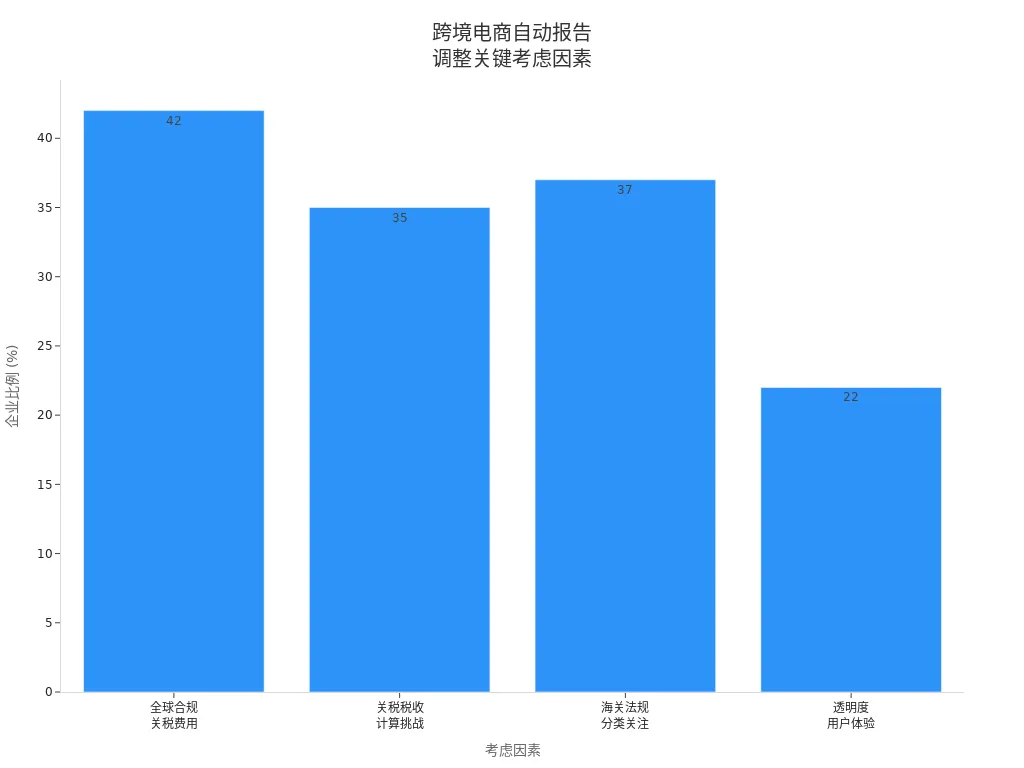
You need to continuously monitor technological and policy changes, flexibly adjust automated processes, and improve fund management efficiency. Automated customs procedures and transparent fee information can enhance customer trust, while technical support helps you address complex compliance requirements. As a cross-border e-commerce seller, implementing an AI automated reporting solution based on your own needs will bring you higher fund transparency and competitive advantages.
FAQ
How to Ensure the Security of Offshore Account API Keys?
You should store API keys in an encrypted environment. It is recommended to use dedicated key management tools and change keys regularly to prevent unauthorized access.
What to Do If There Is a Delay in AI Assistant Reporting Data?
You can first check the API connection status and platform server operation. If necessary, contact technical support to troubleshoot network or system anomalies.
Which Mainstream Reporting Channels Does Automated Reporting Support?
You can choose channels such as email, enterprise WeChat, Slack, etc. Some platforms also support app push notifications and in-platform messages to meet different team needs.
Can the Reporting Content Be Customized?
You can customize reporting templates according to actual needs. Most AI assistant platforms allow you to select content such as balances, transaction details, anomaly alerts, etc.
How to Address Data Compliance Requirements in Different Countries?
You need to understand the data privacy regulations of target markets. It is recommended to adopt internationally standardized data encryption and transmission protocols to ensure compliant operations.
*This article is provided for general information purposes and does not constitute legal, tax or other professional advice from BiyaPay or its subsidiaries and its affiliates, and it is not intended as a substitute for obtaining advice from a financial advisor or any other professional.
We make no representations, warranties or warranties, express or implied, as to the accuracy, completeness or timeliness of the contents of this publication.
Related Blogs of

HBM/DRAM, NAND, and HDD in AI Storage: A Comparison of Elasticity, Cycles, and Risks


Why Is Western Digital’s Gross Margin Changing? Nearline HDDs, Long-Term Pricing, and Cloud Customer Demand


How to Read NAND Contract Prices and Spot Prices? Why Enterprise SSDs and Consumer SSDs Do Not Move in Sync


How to View HBM Advanced Packaging Equipment Stocks? ASMPT’s Opportunities and Cyclical Risks

Choose Country or Region to Read Local Blog
 Australia
 Austria
 Belgium
 Canada
 Cyprus
 Czech Republic
 Denmark
 Estonia
 Finland
 France
 Germany
 Greece
 Hong Kong
 India
India Indonesia
 Ireland
 Italy
Italy Japan
Japan Latvia
 Lithuania
 Luxembourg
 Malaysia
 Malta
Malta Morocco
 Nepal
Nepal Netherlands
 New Zealand
 Norway
 Pakistan
 Philippines
 Poland
 Portugal
 Romania
 Singapore
 Slovakia
 Slovenia
 South Africa
 South Korea
 Spain
Spain Sweden
 Thailand
 The United States
 Turkey
 United Arab Emirates
 United Kingdom
 Vietnam
Contact Us




BIYA GLOBAL LLC is registered with the Financial Crimes Enforcement Network (FinCEN), an agency under the U.S. Department of the Treasury, as a Money Services Business (MSB), with registration number 31000218637349, and regulated by the Financial Crimes Enforcement Network (FinCEN).
BIYA GLOBAL LIMITED is a registered Financial Service Provider (FSP) in New Zealand, with registration number FSP1007221, and is also a registered member of the Financial Services Complaints Limited (FSCL), an independent dispute resolution scheme in New Zealand.