Is Coca-Cola (KO) Worth Holding Long-Term? Analysis of Defensive Attributes as a Core Sponsor of Major Events





Image Source: pexels
You want to know if Coca-Cola is worth holding? Coca-Cola (KO) performs steadily in the U.S. market and is a core asset in the consumer staples sector. When focusing on long-term holding value and defensive attributes, you can refer to the following data:
| Time Period | Coca-Cola (KO) Growth | S&P 500 Growth |
|---|---|---|
| Past Year | 11.9% | 14.9% |
| Past Six Months | 6.3% | 9.2% |
Coca-Cola outperforms the industry average growth in the Beverages—Soft Drinks sector, while the overall consumer staples sector has seen declines. You can see that Coca-Cola is worth holding primarily due to its stable growth and risk resistance capabilities.
Key Takeaways
- Coca-Cola’s stable growth and risk resistance make it an ideal choice for long-term holding.
- The company has paid dividends continuously since 1963 with high dividend stability, providing investors with reliable cash flow.
- Coca-Cola’s brand influence is strengthened through global sponsorships and marketing strategies, ensuring its competitive edge.
- During market volatility, Coca-Cola exhibits lower volatility, suitable for investors seeking defensive positions.
- Pay attention to industry changes and shifts in consumer preferences, adjusting investment strategies promptly to address potential risks.
Core Logic for Holding Coca-Cola Long-Term
Image Source: unsplash
Fundamentals and Dividends
When evaluating whether Coca-Cola is worth holding, you first focus on its fundamentals and dividend performance. As a global leading beverage company, Coca-Cola (KO) consistently ranks among the Fortune 500. In 2025, Coca-Cola’s annual dividend reached $2.04, with a current dividend yield of 2.8%. The payout ratio is 67.3%, indicating the company returns a large portion of profits to shareholders. You can clearly understand its dividend situation through the table below:
| Metric | Coca-Cola (KO) | Industry Average |
|---|---|---|
| Payout Ratio | 67.3% | N/A |
| Annual Dividend | $2.04 | N/A |
| Current Dividend Yield | 2.8% | N/A |
You will find that Coca-Cola’s dividend stability is extremely high. The company has paid dividends continuously since 1963 and has increased dividends every year. Even during economic fluctuations, Coca-Cola maintains stable dividend policies, providing you with long-term cash flow security. If you focus on long-term asset allocation, dividend blue-chip stocks like Coca-Cola are worth holding. Through global layout and efficient operations, the company continuously improves profitability, ensuring dividend sustainability.
You can also see that Coca-Cola holds strong market share worldwide. By establishing franchise models with local bottling partners, the company enhances flexibility in global expansion. When selecting long-term holding targets, you often prioritize companies with global competitiveness and stable cash flows. Coca-Cola perfectly meets these conditions.
Brand Influence
When analyzing the logic behind holding Coca-Cola long-term, brand influence is an indispensable core factor. Coca-Cola achieves precise coverage of consumers across different geographic regions, behavioral traits, and psychological characteristics through multi-dimensional market segmentation. The company conveys the brand concepts of “happiness” and “connection” globally, greatly enhancing its worldwide appeal.
You can understand the composition of Coca-Cola’s brand influence from the following aspects:
- Coca-Cola enhances global expansion flexibility and adaptability through franchise models with local bottling companies.
- The company maintains consistent brand image and culturally resonant advertising strategies to ensure worldwide brand recognition.
- The product portfolio continues to expand, covering low-calorie, sugar-free, and other diversified beverages to meet varied consumer needs.
- Continuous innovation in flavors, packaging, and business models keeps products relevant in the market.
- Advanced data analytics optimize sales and profits, driving sustained revenue growth.
- Social media campaigns encourage user-generated content and localized stories, strengthening personal connections with consumers.
| Key Factor | Description |
|---|---|
| Strategic Global Partnerships | Coca-Cola enhances global expansion flexibility and adaptability through franchise models with local bottling companies. |
| Strong Marketing and Brand Strategy | Unified brand image and culturally resonant advertising ensure global recognition and impulse purchases. |
| Product Diversification | Expanded portfolio including low-calorie options and other beverages to meet diverse consumer needs. |
| Innovation | Strategic innovation in flavors, packaging, and business models to maintain product relevance and market share. |
| Revenue Growth Management | Advanced data analytics optimize sales and profits for sustained financial growth. |
In real life, you will find that many Chinese-speaking users tend to choose companies with high brand recognition and comprehensive service systems in cross-border payment or consumption scenarios. For example, Biyapay provides multi-currency settlement and convenient payment experiences to meet consumption needs in different countries and regions. Similarly, Coca-Cola continuously consolidates its market position through global branding and localized operations. When you consume in the U.S. market or other international markets, Coca-Cola products are almost everywhere—this brand penetration brings stable cash flows and risk resistance to the company.
If you focus on long-term investment value, brand influence and dividend stability are important bases for choosing to hold Coca-Cola. The company’s continuous innovation and efficient operations in global markets ensure its leading position in the consumer staples industry. You can view Coca-Cola as a core target in long-term asset allocation, enjoying the stable returns and defensive attributes it provides.
Major Event Sponsorship and Defensive Attributes

Image Source: pexels
Stability Brought by Sponsorship
When evaluating whether Coca-Cola is worth holding, you cannot ignore the brand exposure and market stability brought by its role as a core sponsor of major international events over the years. Coca-Cola has been a global partner of the FIFA World Cup since 1974, continuing for more than half a century. In 2023, the company signed a new 7-year sponsorship agreement valued at $400 million, ensuring sustained high-frequency global brand exposure. You can understand the structure and strategy of Coca-Cola’s major event sponsorship through the table below:
| Sponsorship Structure | Details |
|---|---|
| Duration | 1974 - 2030 |
| Sponsorship Cost | Latest deal in 2023: 7 years, $400 million |
| Sponsorship Goals | Global brand visibility, fan engagement, market penetration, sales uplift |
| Activation Strategies | FIFA World Cup Trophy Tour, “Believe in Magic” campaign, Share a Coke, “This Coke Is Ours”, Panini sticker partnership, Coca-Cola Music Events (2010 World Cup) |
You will find that Coca-Cola’s sponsorship extends beyond top-tier events to grassroots programs like Copa Coca-Cola and partnerships with over 100 professional football clubs, confederations, and national teams worldwide. Through multi-level, multi-dimensional sponsorship systems, the company continuously strengthens emotional connections between the brand and consumers.
- Coca-Cola’s cooperation with football has a long history, dating back to participation in the 1958 Sweden World Cup.
- Innovative marketing through World Cup Trophy Tours, music events, etc., has elevated global brand influence.
- Sponsorship activities drive global fan participation and interaction, further consolidating market position.
You can see that this long-term, systematic sponsorship investment has enabled Coca-Cola to maintain extremely high brand recognition and market penetration worldwide. During major events like the World Cup and Olympics, the company leverages event popularity to achieve dual boosts in sales and brand. For example, during the 2010 World Cup, Coca-Cola’s global sales grew by 5%; during the 2018 Russia World Cup, Coca-Cola Hellenic Bottling Company reported 6.4% revenue growth in the first half. These data fully demonstrate that the sponsorship strategy brings stable performance growth and risk resistance to the company.
Historical Performance Comparison
When analyzing Coca-Cola’s defensive attributes, you should pay attention to comparisons with other major event sponsors. Coca-Cola not only leads significantly in sponsorship volume but also shows stronger stability during market volatility. The table below compares market capitalization and stability of Coca-Cola with major sponsors:
| Company | Market Capitalization | Stability |
|---|---|---|
| KO | Approximately $220 billion | More stable, less affected by market fluctuations |
| COKE | Approximately $2 billion | More volatile, heavily influenced by local market changes |
You can see that as a global consumer staples giant, Coca-Cola’s market cap far exceeds that of similar sponsors. The company has 938 sports sponsorships globally, far surpassing competitor Pepsi’s 499. The chart below shows the distribution of Coca-Cola’s sponsorship types by quantity:
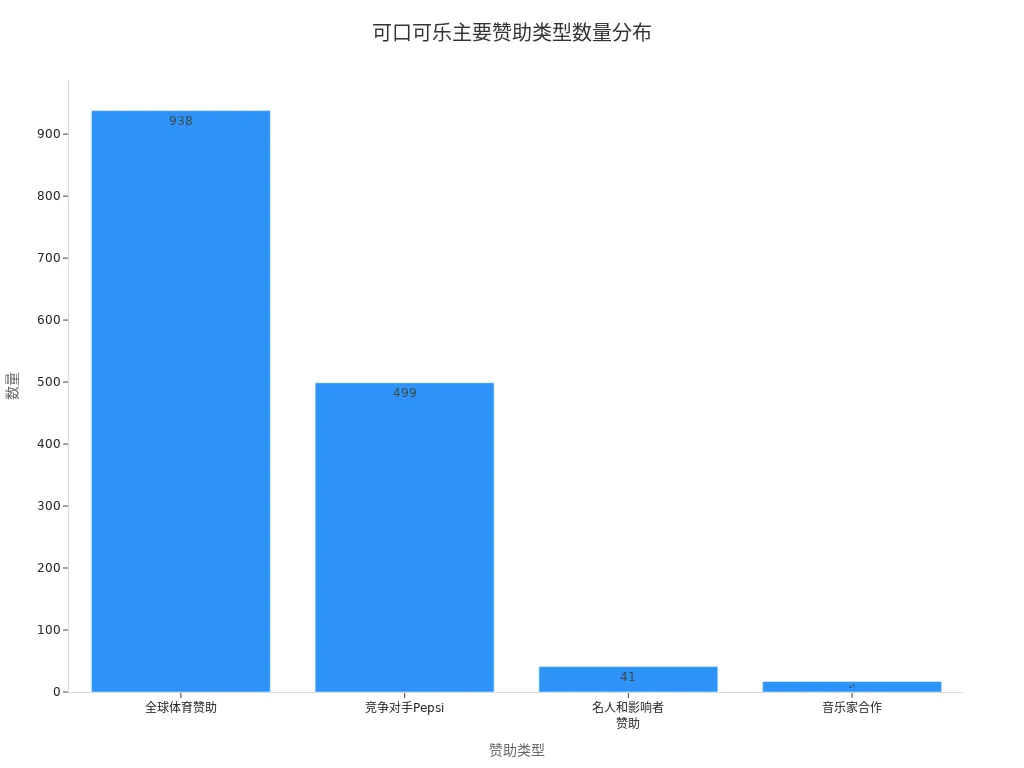
During actual market fluctuations, you will find that Coca-Cola’s stock price and performance are more stable. In contrast, local sponsors like COKE are more volatile due to reliance on single markets. Through global layout and diversified sponsorship strategies, Coca-Cola effectively disperses regional risks and enhances overall risk resistance.
If you focus on brand comparisons, you can also reference the cooperation strategies of cross-border payment brands like Biyapay in global events. Biyapay meets diverse needs of Chinese-speaking users in different countries and regions through multi-currency settlement and localized services. Similarly, Coca-Cola continuously consolidates its market position and brand influence through global sponsorship and localized operations. This combination of globalization and localization brings long-term stable cash flows and defensive attributes to the company.
Overall, one of the core logics for holding Coca-Cola long-term is the brand exposure, market penetration, and risk resistance achieved through major event sponsorships. In asset allocation, you can view Coca-Cola as a long-term high-quality target with defensive attributes.
Coca-Cola During Market Volatility
Defensive Attributes Analysis
When facing sharp market fluctuations, you often look for assets with defensive characteristics. As a representative of the consumer staples industry, Coca-Cola demonstrates extremely strong risk resistance. Historical data shows that during the 2008 global financial crisis, Coca-Cola’s stock price fell from $30 to $20, yet company revenue remained at $31.9 billion and earnings per share reached $2.49. In 2009, the stock price quickly recovered to $28.50, with revenue and profits showing no significant decline.
| Year | Stock Price Change | Revenue (billion USD) | Earnings Per Share (USD) |
|---|---|---|---|
| 2008 | From $30 to $20 | 31.9 | 2.49 |
| 2009 | Recovered to $28.50 | 31.0 | 2.93 |
You can see that Coca-Cola is known as a “Dividend King,” attracting investors seeking stable income. The company maintains cash flow and pricing strategies even under inflationary pressure. Allocating Coca-Cola in a diversified portfolio helps achieve risk-adjusted returns. Year-to-date, Coca-Cola stock price has risen 11.68%, with total shareholder return of 11.75% over the past year. Even when overall market performance is mediocre, Coca-Cola still demonstrates long-term resilience. Coca-Cola is worth holding, especially during periods of economic uncertainty.
- Coca-Cola attracts income-seeking investors, strengthening its position as a stable asset.
- The company maintains stable cash flow and pricing strategies, enhancing resilience.
- Defensive investment helps you achieve risk-adjusted returns amid market uncertainty.
Comparison with Consumer Staples Giants
When selecting targets in the consumer staples industry, you often focus on volatility and pricing power. Compared with giants like PepsiCo and Nestlé, Coca-Cola exhibits lower volatility. The consumer staples sector is non-cyclical, with demand remaining stable during economic fluctuations. Investors view consumer staples as safe havens, enhancing overall industry stability.
| Company | Stability Description | Pricing Power Description |
|---|---|---|
| Coca-Cola (KO) | Due to sustained consumer demand for essentials, Coca-Cola shows lower volatility in the consumer staples sector. | During economic slowdowns, consumers prefer familiar and affordable products, strengthening Coca-Cola’s pricing power. |
You can further compare returns data:
| Metric | Coca-Cola (KO) | Consumer Staples Select Sector SPDR Fund (XLP) |
|---|---|---|
| Past Three Months Return | 5.3% | -3.7% |
| Year-to-Date Return | 16.6% | N/A |
| Past 52 Weeks Return | 12.8% | -5.1% |
You will find that Coca-Cola achieves positive returns even during market downturns, far outperforming the industry average. If you focus on asset allocation, choosing Coca-Cola can effectively reduce portfolio volatility and improve overall returns. Coca-Cola is worth holding, especially for investors seeking long-term stable returns.
If you are considering KO as a long-term watchlist name, it helps to separate brand strength from portfolio execution. A practical way is to use Stock Information to compare Coca-Cola with other consumer staples names on price range, basic company data, and market performance, then decide whether it fits better as a defensive position or as a dividend-oriented core holding. That usually leads to a more grounded conclusion than relying only on sponsorship narratives or short-term price moves.
In that process, BiyaPay is better understood as a supporting tool for market viewing and fund planning. As a multi-asset trading wallet covering cross-border payments, investing, trading, and fund management, it can help keep different asset paths in one place for follow-up tracking, while its business scope and compliance details are best checked on the official site.
Risks and Challenges
Impact of Industry Changes
When considering long-term holding of Coca-Cola, you must pay attention to structural changes in the beverage industry. The industry is facing multiple challenges including health consumption preferences, cost pressures, regulatory policies, and geopolitical factors. The table below summarizes the main trends currently affecting Coca-Cola:
| Industry Trend | Impact Description |
|---|---|
| Shift in consumer preference toward healthier options | Consumers increasingly prefer healthy beverages; Coca-Cola needs to continuously adjust its product portfolio to meet market demand. |
| Inflationary pressures | Significant cost increases; Coca-Cola maintains margins through price adjustments and portfolio optimization. |
| Regulatory challenges | Stricter sugar taxes and packaging regulations require greater flexibility in innovation and marketing. |
| Geopolitical risks | Global operations face supply chain and market access uncertainties; the company must adapt to regional policies and consumption habits. |
You will find that health and wellness trends have profound impacts on Coca-Cola’s product structure. The company is actively launching low-sugar and sugar-free beverages, with Coca-Cola Zero Sugar achieving 14% growth in Q3 2025. You can also see that Coca-Cola continues to expand into emerging categories such as energy drinks and alcoholic beverages, planning to extend Costa Coffee to 10-15 new markets by 2026. Facing inflation and forex pressures, the company achieved 5%-6% organic revenue growth through innovative products and pricing strategies, despite slight global volume declines. You can understand that Coca-Cola demonstrates strong adaptability and resilience amid industry changes, but the next five years still require close monitoring of health consumption, regulatory policies, and global market environment shifts.
Holding Considerations
When holding Coca-Cola long-term, you need to pay attention to the following key risks:
- Coca-Cola faces changes in consumer preferences, especially declining demand for carbonated beverages in developed markets; execution of new product strategies will directly affect performance.
- The company is sensitive to price fluctuations in commodities like aluminum; rising raw material costs may compress profit margins.
- With about two-thirds of revenue from international markets, currency exchange fluctuations can cause earnings instability.
- Stricter global sugar taxes, environmental regulations, and other policies may increase compliance costs and operational difficulty.
- Geopolitical risks and supply chain disruptions may affect sales and distribution efficiency in certain markets.
You should closely monitor the company’s dynamics in product innovation, cost control, and global market strategies. Coca-Cola maintains robust free cash flow growth through continuous innovation and flexible adjustments, providing financial buffers against industry challenges. In asset allocation, you need to rationally evaluate the feasibility of long-term holding KO based on your risk tolerance and market changes.
You can see that Coca-Cola possesses multiple advantages for long-term holding. As a defensive stock, it performs steadily during economic downturns. Its diversified beverage portfolio, strong brand recognition, and global distribution network bring sustained cash flows and lower volatility risk. Over the past 12 months, KO stock rose about 15.52%, reflecting investor confidence. The company actively addresses industry changes through health-oriented products and regional diversification strategies. When making decisions, combine your needs, monitor company innovation and market environment changes, and rationally assess the feasibility of long-term holding.
FAQ
Has Coca-Cola’s dividend policy changed?
You can follow Coca-Cola’s annually announced dividend policy. The company has grown dividends continuously since 1963, with the 2025 annual dividend at $2.04. The dividend policy remains stable, with very few adjustments historically.
How does Coca-Cola perform during economic recessions?
You will find that Coca-Cola maintains stable revenue and cash flows during recessions. During the 2008 financial crisis, the stock price recovered quickly and performance showed no major decline, demonstrating strong defensive attributes.
How does Coca-Cola respond to health consumption trends?
You can see that Coca-Cola continuously launches low-sugar and sugar-free beverages. The company actively adjusts its product portfolio, with zero-sugar products achieving 14% growth in 2025. Health trends drive ongoing innovation.
Does international market volatility have a big impact on Coca-Cola?
You need to pay attention to exchange rate fluctuations and geopolitical risks. About two-thirds of Coca-Cola’s revenue comes from international markets, so currency changes affect earnings. The company reduces regional risks through diversified layout.
What impact does Coca-Cola’s sponsorship strategy have on performance?
You can observe that Coca-Cola enhances brand exposure through sponsorship of major events like the World Cup. Sponsorship activities drive sales growth, with related revenue increasing 6.4% during the 2018 World Cup. The sponsorship strategy strengthens market penetration.
*This article is provided for general information purposes and does not constitute legal, tax or other professional advice from BiyaPay or its subsidiaries and its affiliates, and it is not intended as a substitute for obtaining advice from a financial advisor or any other professional.
We make no representations, warranties or warranties, express or implied, as to the accuracy, completeness or timeliness of the contents of this publication.
Related Blogs of

How Is China’s Memory Supply Chain Different from Overseas Memory Leaders? A Comparison with Micron, SanDisk, Western Digital, and Seagate


How to Read Pure Storage and NetApp Earnings? ARR, Cloud Revenue, Gross Margin, and Cash Flow Metrics


How Does NAND Price Increase Affect SanDisk? Enterprise SSDs, Consumer Storage, and Margin Leverage


How to Read NAND Contract Prices and Spot Prices? Why Enterprise SSDs and Consumer SSDs Do Not Move in Sync

Choose Country or Region to Read Local Blog
 Australia
 Austria
 Belgium
 Canada
 Cyprus
 Czech Republic
 Denmark
 Estonia
 Finland
 France
 Germany
 Greece
 Hong Kong
 India
India Indonesia
 Ireland
 Italy
Italy Japan
Japan Latvia
 Lithuania
 Luxembourg
 Malaysia
 Malta
Malta Morocco
 Nepal
Nepal Netherlands
 New Zealand
 Norway
 Pakistan
 Philippines
 Poland
 Portugal
 Romania
 Singapore
 Slovakia
 Slovenia
 South Africa
 South Korea
 Spain
Spain Sweden
 Thailand
 The United States
 Turkey
 United Arab Emirates
 United Kingdom
 Vietnam
Contact Us




BIYA GLOBAL LLC is registered with the Financial Crimes Enforcement Network (FinCEN), an agency under the U.S. Department of the Treasury, as a Money Services Business (MSB), with registration number 31000218637349, and regulated by the Financial Crimes Enforcement Network (FinCEN).
BIYA GLOBAL LIMITED is a registered Financial Service Provider (FSP) in New Zealand, with registration number FSP1007221, and is also a registered member of the Financial Services Complaints Limited (FSCL), an independent dispute resolution scheme in New Zealand.