In-Depth Analysis: Why Do Institutions Position in World Cup Sponsor Stocks Six Months in Advance?





Image Source: unsplash
Institutional investors typically position in World Cup sponsor stocks six months in advance, mainly because the event can greatly enhance brand influence and market share. Research shows a positive correlation between FIFA sponsorship and company performance, with sponsors poised to achieve financial returns exceeding the S&P 500 index:
| Research Topic | Key Findings |
|---|---|
| Economic Returns of FIFA Sponsorship | There is a positive correlation between FIFA sponsorship and company performance; sponsorship can improve stock returns, revenue growth, financing conditions, etc. |
| Impact of the 2022 Qatar World Cup | The event significantly promoted infrastructure development, indicating the positive economic impact of major sports events. |
| Investment Returns from FIFA Sponsorship | Some sponsors outperformed the S&P 500 index, demonstrating the potential financial returns of sponsorship. |
In addition, during the World Cup, increased fan engagement and rising club valuations bring short-term and long-term dividends to sponsors. In-depth analysis of institutional positioning behavior helps understand the investment logic behind it.
Key Takeaways
- Institutional investors position in World Cup sponsor stocks six months in advance to leverage the event for increased brand exposure and market share.
- World Cup sponsor stocks typically outperform non-sponsors; investors can seize opportunities by analyzing historical data.
- During the event, changes in market sentiment and advertising budgets affect sponsor stock liquidity; investors need to closely monitor these factors.
- Early positioning helps avoid short-term market volatility, increases the investment margin of safety, and maximizes long-term returns.
- When selecting high-quality sponsors, focus on brand influence, financial health, and historical performance to optimize investment decisions.
In-Depth Analysis of Reasons for Early Institutional Positioning
Brand Effect and Market Share Enhancement
Institutional investors position in sponsor stocks ahead of the World Cup primarily due to the brand effect and market share enhancement. The FIFA World Cup, as one of the world’s most influential sports events, provides sponsors with unprecedented brand exposure opportunities. Compared to other sports events, the World Cup has a larger audience scale and higher commercial value, attracting numerous top international brands to participate.
- Some companies have significantly increased revenue through sports sponsorship (Blake et al., 2019).
- Sponsorship of sports activities enhances brand visibility and product consumption (Kelly et al., 2017).
- Sponsoring sports activities can increase corporate value (Kwon and Cornwell, 2020).
- Consumers participating in sports activities increase brand engagement and brand experience, improving positive attitudes and brand awareness toward sponsoring companies (Wang and Kaplanidou, 2013).
During the World Cup, brands achieve global exposure through multiple channels such as advertising, on-site events, and social media, further consolidating their market position. Data shows that FIFA sponsors outperform non-sponsors on multiple economic indicators, including stock returns, revenue growth, trade credit, and cost of capital. The table below presents relevant research conclusions:
| Evidence Type | Description |
|---|---|
| Economic Returns | Research shows that FIFA sponsors outperform non-sponsors on multiple economic indicators, including stock returns, revenue growth, trade credit, and cost of capital. |
| Brand Exposure | The FIFA World Cup provides global exposure opportunities, enhancing sponsors’ brand image and market demand. |
| Investor Reaction | Sponsor stock returns reflect investors’ positive response to the brand reputation and visibility brought by FIFA sponsorship. |
Performance Expectations and Price Fluctuations
Performance expectations for World Cup sponsors typically undergo significant changes before and after the event. Institutional investors, through in-depth analysis of historical data, find that brands like Nike and Adidas experience significant sales increases during the World Cup, with effective inventory clearance. Nike’s stock performance outperforms Adidas, demonstrating stronger market positioning. Analysts note that Nike stock exhibits cyclical fluctuations during the World Cup, usually peaking a few months before the event, slightly pulling back during the event, and rebounding strongly afterward.
| Company | Stock Performance Pattern | Expected Growth |
|---|---|---|
| Nike | Exhibits cyclical pattern in World Cup years, usually peaking in April and May, then declining during the match, with strong rebound after the match | Historical average rebound of 37.2% |
| Adidas | Sales growth, inventory clearance | Sales acceleration due to the World Cup, strong performance |
This cyclical fluctuation provides institutional investors with a clear operational window. Positioning six months in advance helps capture price dividends before performance realization, avoiding opportunity losses due to information lag.
Capital Liquidity and Market Sentiment
The World Cup not only affects sponsors’ fundamentals but also has a profound impact on market capital liquidity and investor sentiment. During the event, advertising budgets and market attention surge, driving enhanced liquidity in related stocks. However, market sentiment can also be influenced by macroeconomic environments and advertising market changes. For example, in some years when the World Cup is held in winter, advertisers may not increase additional budgets, leading to declines in some media company stock prices. ITV’s stock fell more than 6% due to investor concerns over the advertising market, with declining ad revenue reflecting the impact of overall economic conditions on market sentiment.
Institutional investors, through in-depth analysis of market sentiment changes, can better grasp capital flows and market fluctuations to optimize portfolio structure.
Avoiding Uncertainty
Positioning in World Cup sponsor stocks six months in advance helps institutional investors avoid uncertainty from short-term market volatility and information lag. As the event approaches, market expectations for sponsor performance and brand effects gradually materialize, intensifying stock price fluctuations. By positioning early, institutional investors can build positions at low levels before market sentiment fully reflects fundamental changes, increasing the investment margin of safety.
In addition, in-depth analysis of historical cases shows that some sponsors experience brief stock price declines during the event due to unexpected incidents or macroeconomic fluctuations, but in the long term, enhancements in brand value and market share ultimately drive sustained company performance growth. Institutional investors achieve long-term return maximization while effectively avoiding short-term risks through scientific positioning strategies.
Positioning Logic and Investment Drivers
World Cup Event Influence
As one of the world’s most influential sports events, the World Cup greatly enhances the global visibility of sponsoring brands. During the event, audience engagement and media coverage reach their peak, with significant advertising economic effects.
- Audience engagement
- Media coverage
- Co-sponsorship
These factors jointly drive the elevation of sponsoring brand value. Broadcasters usually sell out most advertising inventory a year in advance, with advertising costs comparable to the Super Bowl, creating multiple “mini-Super Bowl” opportunities. Brands gain unparalleled coverage and cultural resonance through the event, further enhancing brand recognition and market penetration.
Sponsor Performance Elasticity
Sponsors exhibit strong performance elasticity during the World Cup. Sports-themed products stand out in sales due to event atmosphere, athlete endorsements, and unique designs. Companies increase advertising investment to reach large audiences, but advertising effectiveness varies by brand.
| Research Topic | Key Findings |
|---|---|
| Advertising Investment and Sales Growth | Companies increase advertising investment during major sports events to reach large audiences, but advertising effectiveness varies by brand. |
| Advertising Expenditure and Market Share | Increasing advertising expenditure can significantly enhance market share, helping mitigate the negative impact of competitive interference. |
| 2022 Qatar World Cup sponsorship revenue reached $1.7 billion, and 2023 Women’s World Cup sponsorship revenue was $300 million, demonstrating the direct pull on sponsor revenue from the event. |
Industry Prosperity and Policy Environment
Industry prosperity and policy environment directly affect sponsor stock performance. FIFA categorizes sponsors into different tiers, with top-tier agreements valued at hundreds of millions of dollars, improving financial forecasts for related companies. High-profile brands partnering with FIFA enhance organizational reputation, making stocks more attractive. Announcements of new sponsorship agreements typically trigger positive market reactions, driving company stock prices higher.
- Sponsorship revenue increase
- Brand credibility enhancement
- Positive market sentiment
However, negative news or ethical controversies may damage FIFA’s image, leading to declining investor confidence and pressure on industry valuations.
Market Expectation Management
Institutional investors manage market expectations through in-depth analysis of event impacts and early positioning. Multiple dimensions such as match start times, audience cultural perceptions, consumer preferences, media consumption habits, and brand awareness influence sponsor stock performance. Younger fans prefer online live streaming with high social media discussion, requiring brands to develop diverse participation strategies to enhance market influence.
| World Cup Year | Projected Revenue (USD Billion) | Revenue Growth Rate |
|---|---|---|
| 2022 | 7.0 | 32% |
| 2026 | 10.9 | 56% |
| These data reflect the sustained driving effect of the event on sponsor revenue and market expectations. |
Operational Strategies and Processes
Screening High-Quality Sponsors
When screening World Cup sponsors, institutional investors typically use multi-dimensional indicators for in-depth analysis. They first focus on the company’s brand influence, financial health, historical sponsorship performance, and global market coverage. Investors prioritize companies with continuous innovation capabilities, rich product lines, and the ability to achieve sales breakthroughs through the event. For example, Biyapay, as a cross-border payment solution, serves as a reference case in fintech sponsor screening due to its high penetration among Chinese-speaking users and compliance. Institutions screen high-growth potential and risk-controlled premium targets through data analysis and industry comparisons.
For ordinary investors, a more practical approach is usually not to decide first which stock must go up, but to compare candidate names within the same framework. You can start with BiyaPay stock information lookup to review sector background, basic price data, and related information, then combine that with sponsorship status, valuation range, and historical volatility to judge whether this kind of event-driven opportunity is more suitable for short-term observation or medium-term tracking.
If you later decide to trade, you can not only use the BiyaPay trading entry on the web for viewing and execution, but also access the same workflow after downloading BiyaPay, with even broader functions available, including stock and digital-asset trading as well as remittance and wealth-management scenarios. This makes it easier to keep research, execution, and fund management within one connected system.
Entry Timing and Holding Period
Entry timing selection is crucial. Institutions usually build positions gradually six months before the event, utilizing low-level positioning when market expectations have not fully reflected sponsor performance elasticity. The holding period is dynamically adjusted based on historical data and market sentiment. U.S. market data shows significant fluctuations in premium sponsor stocks before and after the event; institutions flexibly adjust position ratios by combining macroeconomic conditions, advertising budgets, and sales data. Some investors adopt batch entry strategies to reduce single-point risks.
Exit and Risk Control
Exit strategies need to combine event progress and market fluctuations. Institutions gradually reduce positions during or after the event based on performance realization and market sentiment changes. For risk control, investors effectively avoid losses from unexpected events or macroeconomic fluctuations through diversified investment, stop-loss points, and dynamic asset allocation adjustments. In Hong Kong licensed bank scenarios, investors can use USD-denominated financial products for risk hedging to enhance fund security.
Information Acquisition and Judgment
Information acquisition channels are diversified. Institutions track sponsor dynamics in real time through official announcements, industry reports, third-party data platforms, and social media sentiment monitoring. In-depth analysis of historical cases and market feedback, combined with big data analysis tools, improves judgment efficiency. Fintech products like Biyapay provide real-time cross-border capital flow data for Chinese-speaking users, helping investors accurately seize market opportunities. Institutions optimize investment decision processes through continuous tracking and review.
Returns and Risk Analysis

Image Source: pexels
Returns Expectation Logic
Institutional investors typically position based on World Cup sponsors’ brand premium, market share enhancement, and sales growth expectations. During the event, sponsors significantly increase global awareness through advertising exposure and product linkages. U.S. market data shows that some sponsors achieve dual growth in sales and profits before and after the event. By analyzing historical data, investors find that premium sponsors often outperform the broader market during World Cup cycles, especially with optimistic market attitudes toward performance realization before and after the event. Institutions tend to build positions six months in advance to capture excess returns from performance expectation realization.
Main Risk Points
Although World Cup sponsors have high return potential, multiple risk factors must still be monitored during investment:
- Many sponsors have strong historical performance, but not all companies can consistently outperform the market, with some potentially underperforming due to debt pressure or management issues.
- Increased fiscal burdens on host cities may affect future event hosting rights allocation, indirectly impacting sponsors’ market layouts.
- Ticket sales exempt from sales tax lead to reduced city fiscal revenue, affecting the overall economic environment.
- Exploitative pricing models trigger ethical controversies, potentially causing sponsors to face reputational risks and subsequent stock price impacts.
Investors need to effectively control the above risks through diversified allocation, dynamic position adjustments, and stop-loss points.
Post-Event Performance
After the World Cup, sponsor stock performance shows clear differentiation. Some companies achieve returns exceeding the broader market by leveraging brand momentum and market share accumulated during the event. For example, Mengniu and KIA recorded 63% and 82% gains respectively after the event, far surpassing the contemporaneous S&P 500 ETF’s -30% and 63%. However, some sponsors like Hyundai showed negative growth, demonstrating industry differentiation characteristics. The table below shows the post-event performance comparison of major sponsors with the S&P 500 ETF:
| Company | Stock Performance (%) | Benchmark Comparison (S&P 500 ETF) |
|---|---|---|
| Mengniu | 63 | -30 |
| Hisense | 11 | -30 |
| Hyundai | -18 | 63 |
| KIA | 82 | 63 |
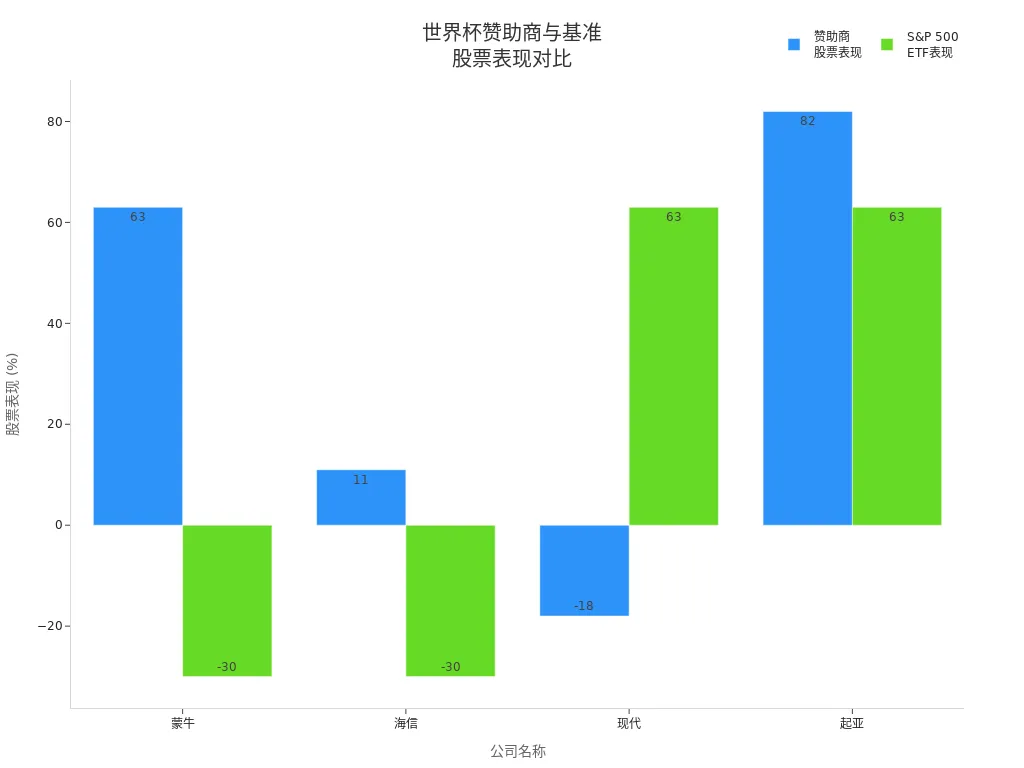
Institutional investors need to dynamically assess holding strategies by combining industry prosperity, company fundamentals, and market sentiment to improve overall investment returns.
Case Analysis

Image Source: unsplash
Historical Performance Review
Historical data shows significant differentiation in World Cup sponsor stock performance during event cycles. Some U.S. market brands like Nike and Adidas achieved dual growth in sales and profits before and after the event. Nike’s stock price gradually rose in the six months before the 2018 World Cup, slightly pulled back during the event, and rebounded strongly afterward. Adidas drove inventory clearance and significant sales growth through event marketing. Some Asian brands like Mengniu and Hisense recorded gains higher than the broader market after the event. U.S. market data shows sponsor stocks outperforming the S&P 500 ETF, reflecting the event-driven effect.
Positioning Effectiveness Verification
Institutional investors capture price dividends before performance realization through six-month-early positioning. U.S. market cases show premium sponsors building positions before the event, holding during the event, and gradually reducing after, with significant overall returns. In Hong Kong licensed bank scenarios, investors use USD-denominated financial products for risk hedging to enhance fund security. Data shows Mengniu and KIA recording 63% and 82% gains respectively after the event, far surpassing contemporaneous S&P 500 ETF. Institutions effectively avoid short-term fluctuations and maximize long-term returns through diversified allocation and dynamic position adjustments.
Research indicates that early positioning can effectively avoid information lag and market sentiment fluctuations, increasing the investment margin of safety.
Success and Failure Comparison
Success cases mainly concentrate on sponsors with strong brand influence, rich product lines, and broad market coverage. For example, Nike and Mengniu achieve returns exceeding the broader market through brand momentum and market share enhancement during the event. Failure cases are more common in companies with insufficient management capabilities or declining industry prosperity. Hyundai showed negative growth after the event, mainly due to macroeconomic fluctuations and intensified market competition. Institutional investors dynamically adjust investment strategies through in-depth analysis of company fundamentals and industry trends to improve overall returns. The table below shows the post-event performance comparison of major sponsors with the S&P 500 ETF:
| Company | Stock Performance (%) | S&P 500 ETF (%) |
|---|---|---|
| Mengniu | 63 | -30 |
| Hisense | 11 | -30 |
| Hyundai | -18 | 63 |
| KIA | 82 | 63 |
Institutions position in World Cup sponsor stocks six months in advance, with the core logic being capturing the window of brand premium, market share enhancement, and performance elasticity release. Historical data shows excellent performance from global brands like Visa, Coca-Cola, and McDonald’s, while Adidas, AB InBev, etc., delivered suboptimal investment returns due to multiple factors.
| Company Name | Investment Performance (%) | Notes |
|---|---|---|
| Visa | 100 | Global brand, strong economic performance |
| Coca-Cola | 59 | Global brand, strong economic performance |
| McDonalds | 78 | Global brand, strong economic performance |
| Mengniu | 63 | Listed in Hong Kong, outperforms Chinese market |
| Hisense | 11 | Average performance |
| Adidas | -35 | Poor investment performance |
| AB InBev | -48 | Affected by multiple factors, poor performance |
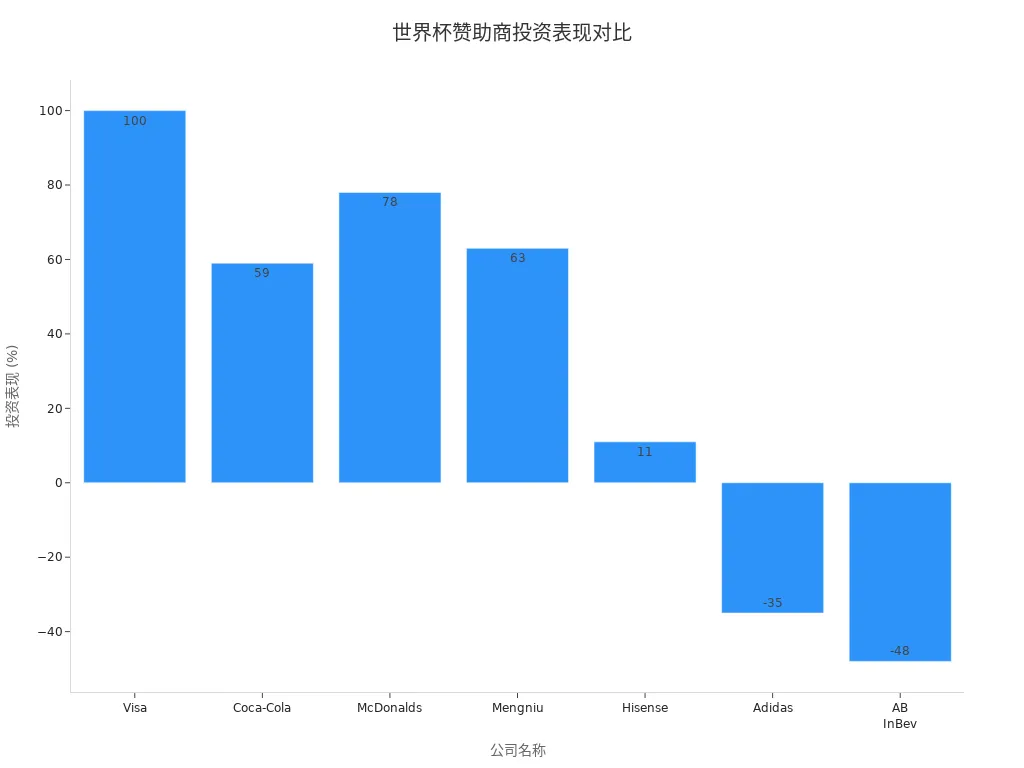
Rational analysis, risk control, and market sentiment grasp are key to improving investment win rates. In the future, institutions can focus on structural opportunities brought by global events like the Olympics, combining multi-dimensional data and macroeconomic environments to formulate scientific investment strategies.
FAQ
Why do institutions choose to position in World Cup sponsor stocks six months in advance?
Institutions can build positions at low levels when market sentiment and performance expectations have not fully materialized by positioning six months in advance, increasing the investment margin of safety and capturing price dividends before performance realization.
What are the main fluctuation factors for World Cup sponsor stocks?
Main fluctuation factors include brand exposure, sales growth during the event, advertising budget changes, macroeconomic environment, and market sentiment fluctuations; these factors jointly influence sponsor stock performance.
How to evaluate the investment value of sponsors?
Institutions typically combine multiple dimensions such as brand influence, financial health, historical sponsorship returns, and global market coverage, using data analysis and industry comparisons to screen premium targets.
What characteristics does sponsor stock performance show after the event?
Some sponsors achieve returns exceeding the broader market by leveraging brand momentum and market share accumulated during the event, but some companies experience negative growth due to industry differentiation or management issues, requiring dynamic position evaluation.
What are the main risks in investing in World Cup sponsor stocks?
Main risks include macroeconomic fluctuations, advertising market changes, brand reputation events, policy environment adjustments, etc.; institutions effectively control potential losses through diversified allocation and dynamic position adjustments.
*This article is provided for general information purposes and does not constitute legal, tax or other professional advice from BiyaPay or its subsidiaries and its affiliates, and it is not intended as a substitute for obtaining advice from a financial advisor or any other professional.
We make no representations, warranties or warranties, express or implied, as to the accuracy, completeness or timeliness of the contents of this publication.
Related Blogs of

How Is China’s Memory Supply Chain Different from Overseas Memory Leaders? A Comparison with Micron, SanDisk, Western Digital, and Seagate


HBM/DRAM, NAND, and HDD in AI Storage: A Comparison of Elasticity, Cycles, and Risks


How to Read NAND Contract Prices and Spot Prices? Why Enterprise SSDs and Consumer SSDs Do Not Move in Sync


Why Can’t HBM Exist Without Advanced Packaging? The Role of TSV, CoWoS, and Packaging Equipment

Choose Country or Region to Read Local Blog
 Australia
 Austria
 Belgium
 Canada
 Cyprus
 Czech Republic
 Denmark
 Estonia
 Finland
 France
 Germany
 Greece
 Hong Kong
 India
India Indonesia
 Ireland
 Italy
Italy Japan
Japan Latvia
 Lithuania
 Luxembourg
 Malaysia
 Malta
Malta Morocco
 Nepal
Nepal Netherlands
 New Zealand
 Norway
 Pakistan
 Philippines
 Poland
 Portugal
 Romania
 Singapore
 Slovakia
 Slovenia
 South Africa
 South Korea
 Spain
Spain Sweden
 Thailand
 The United States
 Turkey
 United Arab Emirates
 United Kingdom
 Vietnam
Contact Us




BIYA GLOBAL LLC is registered with the Financial Crimes Enforcement Network (FinCEN), an agency under the U.S. Department of the Treasury, as a Money Services Business (MSB), with registration number 31000218637349, and regulated by the Financial Crimes Enforcement Network (FinCEN).
BIYA GLOBAL LIMITED is a registered Financial Service Provider (FSP) in New Zealand, with registration number FSP1007221, and is also a registered member of the Financial Services Complaints Limited (FSCL), an independent dispute resolution scheme in New Zealand.