
Currency Exchange Spread Explained: Buy and Sell Rates, Markups, and Costs





When the exchange rate you find online differs from your actual quote, it does not necessarily mean your calculation is wrong. Reference rates, providers' buy and sell rates, and conversion costs including fees answer different questions. Start by identifying which currency you are giving up and which you will receive, then check the quote direction, separate fees, and net amount received. The bid-ask spread is not automatically the fee rate for a single conversion, and “fee-free” does not guarantee a conversion without costs. Whether you are buying foreign cash, converting an account balance, or paying a foreign-currency bill, you can assess the price through your total spending and net proceeds.
Key Takeaways
- Buy and sell rates are usually named from the bank's or exchange provider's perspective.
- The full bid-ask spread differs from the markup on a single conversion relative to a reference rate.
- Neither mid-market rates nor central bank reference rates guarantee an executable price.
- Fee-free conversions may still involve exchange rate markups and other applicable charges.
- Compare quotes using either a fixed total budget or a fixed amount you need to receive.
How Do Currency Exchange Buy and Sell Rates Work?
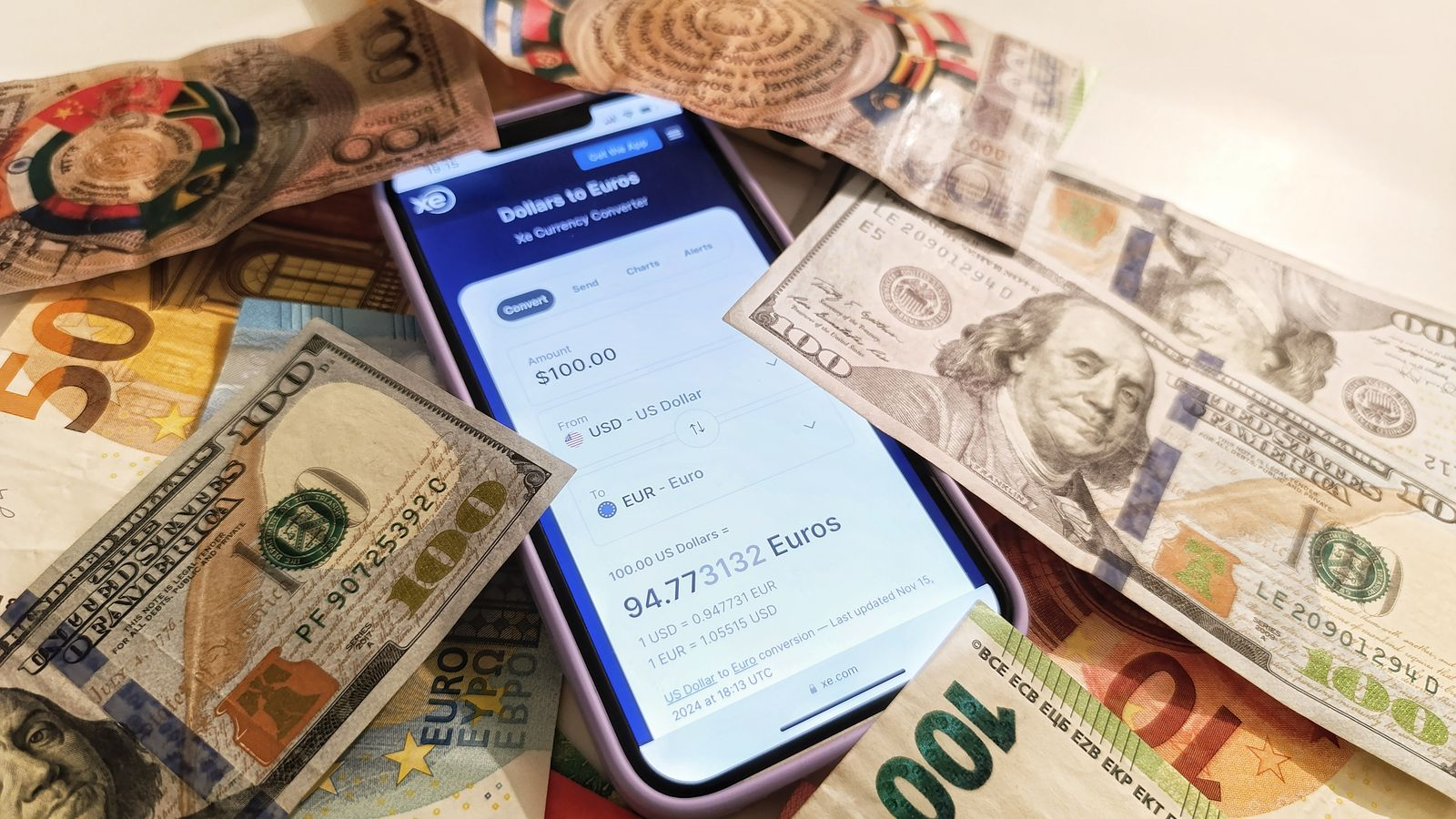
Buy and sell rates usually describe the provider's actions: it buys the foreign currency you hand over or sells foreign currency to you. When you purchase foreign currency, the provider's sell rate generally applies; when you sell it back, the buy rate generally applies. Before comparing prices, also identify the currency units and whether the quote covers cash or an account conversion. A higher or lower number becomes meaningful only when those conditions match.
Who Is Buying and Who Is Selling?
For example, HSBC Philippines' foreign exchange rates use the column headings “Bank buys” and “Bank sells,” explicitly identifying the bank as the buyer or seller. Seeing “buy” on a rate board should not automatically lead you to read it as “I buy foreign currency.”
Suppose a provider offers the following euro-to-dollar quotes. All figures used in the examples are hypothetical and explain the calculations; they do not represent any provider's actual rates or charges.
| Provider's quote | U.S. dollars per EUR 1 | Your action | Result before other fees |
|---|---|---|---|
| Buys euros | $1.08 | Hand over euros and receive dollars | Sell EUR 1,000 and receive $1,080 |
| Sells euros | $1.12 | Hand over dollars and buy euros | Buy EUR 1,000 and pay $1,120 |
Both transactions use the same quote units, but they run in opposite directions. If you want to buy euros, you cannot use the lower 1.08 rate to estimate your spending. An exchange app, meanwhile, may display “you pay” and “you receive,” or label buying and selling from your perspective. The conventions used on an institutional rate board do not apply automatically to every interface. Confirm the direction using the currencies you actually pay and receive.
Check the Currency Direction Before Comparing Numbers
“Dollars per euro” and “euros per dollar” are reciprocals. A price of $1.12 per euro can also be expressed as approximately EUR 0.892857 per dollar. These describe the same conversion price; the first is not more expensive simply because its number is larger.
When quotes are consistently expressed in dollars per euro, a lower price means you need fewer dollars to buy euros. If the quote instead shows how many euros each dollar buys, a higher number means you receive more euros. Writing out the units is more reliable than remembering a rule such as “choose the higher rate” or “choose the lower rate.”
Also check whether the rate is quoted per 1 or 100 units of foreign currency, and how many decimal places are shown. Cash buying, account-balance buying, and cash selling may appear separately. Finding the currency name alone is not enough to start multiplying.
What Is the Difference Between a Spread, a Markup, and a Fee?

The bid-ask spread measures the distance between a provider's prices in the two directions. An exchange rate markup measures how far the quote for your direction differs from a specified benchmark. A fee is a separately stated charge. All three can be relevant, but you cannot simply add them together. In particular, if the conversion rate already includes a markup, deducting a separate “spread charge” from the result would count the same cost twice.
Using the hypothetical buy rate of 1.08 and sell rate of 1.12, the full bid-ask spread per euro is:
Bid-ask spread = 1.12 − 1.08 = $0.04 per euro.
This shows the difference between the two directional quotes at the same point in time. It does not mean that buying euros costs an additional $0.04 on top of 1.12. For a single conversion, explain the cost by comparing the applicable side of the quote with a clearly identified benchmark.
Now suppose the reference benchmark at that same time is $1.10 per euro. If you buy euros at 1.12, the price markup relative to that benchmark is:
Quote markup when buying euros = (1.12 − 1.10) ÷ 1.10 ≈ 1.82%.
The denominator is the reference rate of 1.10. The calculation answers, “How much more am I paying per euro than the reference price?” Dividing the full spread of 0.04 by that same benchmark gives approximately 3.64%. That measures the width of the entire buy-sell range and should not be described as the markup on this one-way conversion.
The benchmark itself also needs explanation. A mid-market rate generally represents the midpoint of the relevant market's bid and ask quotes. The midpoint of one provider's retail rates does not necessarily equal that market midpoint. In the example, 1.10 happens to sit halfway between 1.08 and 1.12 because of the assumptions chosen for illustration. You cannot use that relationship to infer every provider's actual markup.
The European Central Bank's euro reference rates are expressly published for information, and their use for transactions is discouraged. They are not live executable prices for individual orders. When comparing a quote with a benchmark, check the currency direction, update time, and nature of the data, so that you do not attribute every difference caused by timing to a provider's markup.
A separate fee may be a fixed amount per transaction, a percentage of the amount converted, or a combination of the two. A minimum charge may also apply. Even when two providers offer the same conversion rate, their total costs can differ because of fees. Equally, waiving a fee does not mean the conversion rate equals the reference rate.
How Do You Calculate the Actual Cost of a Currency Exchange?

The most direct approach is to fix one side of the transaction. If you need to receive a specific amount, compare total spending. If your budget has a firm ceiling, compare the net amount received after fees. The Australian Competition and Consumer Commission (ACCC) also recommends assessing value through the total price and the amount the recipient receives. Assign each fee to the correct currency and deduction stage; dividing two numbers on a screen is not enough.
Calculate Total Spending When the Required Amount Is Fixed
Suppose you need to receive EUR 1,000, the conversion rate is $1.12 per euro, there is a separate $10 fee, and no other deductions apply. Your total spending is:
Total spending in USD = 1,000 × 1.12 + 10 = $1,130.
Effective conversion cost including fees = 1,130 ÷ 1,000 = $1.13 per euro.
The 1.13 figure is your effective cost after including the separate fee. It should not be described as the provider's quoted conversion rate. Using the same hypothetical reference rate of 1.10, the reference amount for EUR 1,000 is $1,100. You spend $30 more: $20 from the difference in the quoted rate and $10 from the separate fee.
Dividing 30 by 1,100 gives approximately 2.73%, the percentage by which total spending exceeds the reference amount. That differs from the earlier 1.82% measure, which covered only the quote markup. It is also not the provider's advertised fee rate.
If a deduction also applies in euros, you cannot continue estimating on the basis of converting exactly EUR 1,000. First increase the amount converted so that the net amount after the deduction meets your target, then calculate the dollar spending. Where intermediary or receiving charges remain uncertain, keep the result labeled as an estimate and check whether the provider guarantees a net amount received.
Calculate Net Proceeds When Your Total Budget Is Fixed
If your entire budget is $1,130 and the $10 fee must come out of that budget, only $1,120 is available for conversion. Because the quote is expressed in dollars required per euro, use division:
Net euros received = (total USD budget − USD fees deducted from that budget) ÷ USD price per euro − deductions in euros.
With no euro-side deductions, the example gives (1,130 − 10) ÷ 1.12 = EUR 1,000. Simply dividing 1,130 by 1.12 and ignoring the fee would overstate what you can receive.
Also distinguish the “amount to convert” from your “total budget.” If the $1,130 entered in an order is only the conversion principal and fees are charged on top, your total account debit will exceed $1,130. Conversely, if the platform already shows the amount available for conversion after fees, subtracting the fee again would deduct it twice.
Label every charge in dollars, euros, or its other applicable currency, and check whether it is already included in the preview. Retain sufficient precision during the calculation, then reconcile the result using the order's smallest currency unit and rounding rules. Banknote denominations may also cause the cash delivered to differ from the purely mathematical result.
What Factors Can Change a Currency Exchange Quote?
Quotes can change with the currency pair, market conditions, conversion time, and type of service. The amount, channel, and customer terms may also affect pricing. Different quotes from the same provider are not necessarily inconsistent. To understand the difference, compare equivalent services rather than mixing banknotes, account balances, and card settlement.
Currency pairs with greater liquidity generally have more continuous pricing. For less frequently traded pairs or during volatile markets, providers may widen the buy-sell range. Changes in market reference rates can also feed through to retail quotes. Do not calculate a markup difference using one provider's morning price and another's afternoon quote, or you may mistake market movement for a difference in charges.
Timing can also determine whether an order goes through at the original price. Some quotes remain valid only during a countdown; others require payment to arrive by a specified deadline. Missing the deadline may trigger repricing. Some providers charge an additional weekend fee or offer a less favorable rate to account for possible market changes, but this is not a universal rule. Distinguish the time of confirmation, the actual conversion time, and the time funds are credited.
The service format matters too. Physical cash involves banknote handling, inventory, and delivery, whereas an account conversion does not require the same cash-handling steps. Card conversions may involve issuer fees and transaction-processing dates. If you are comparing different uses, consider the scope of currency exchange through banks, exchange services, and cards before comparing their respective quotes.
Transaction size and customer terms may affect the price, but a larger amount is not automatically cheaper. Tiered pricing, minimum charges, plan allowances, and new-customer offers can all change the result. An offer may cover only a limited amount or apply once. Calculate the eligible portion and any excess separately rather than applying an advertised minimum rate to your entire budget.
The conversion route can add further stages. If a currency must first be converted into a third currency before reaching the target currency, differences from reference rates and applicable fees at both stages may affect the net amount. Looking at just one stage is insufficient. If a card terminal or ATM offers dynamic currency conversion (DCC), check whether the terminal or your card issuer will handle the conversion. Choosing settlement in your card's currency does not automatically remove other applicable issuer charges.
How Can You Avoid Misreading Exchange Quotes?
Align the currency direction, intended use, amount, payment method, and quote time before comparing total spending or net proceeds. A low fee without the corresponding conversion price does not establish the full cost. Likewise, a converted account balance should not automatically be treated as the final usable amount without checking collection or onward-transfer conditions.
Start with a specific need. If you must pay a EUR 1,000 bill, ask each provider to quote for “the recipient receiving a net EUR 1,000.” If you can spend no more than $1,130, ask how many euros that total budget will ultimately deliver. Keep payment channels and delivery methods consistent so that differences between card-funding and bank-transfer charges do not distort the comparison.
Before submitting an order, keep a record of:
- The total amount you will pay, its currency, and any deductions outside that budget.
- The final amount of target currency, and whether it represents cash, an account balance, or the recipient's net credit.
- Whether the conversion rate and fees are already included in the preview, and which external charges remain uncertain.
- When the quote expires, the conditions for execution at that price, and when funds will be delivered.
Do not lose sight of the order's outcome while trying to isolate every markup. If total spending and net proceeds are confirmed for both quotes and the service conditions match, comparing the results is generally more useful than trying to reverse-engineer the providers' profits. A further breakdown into reference-rate differences, separate fees, and other deductions becomes useful when explaining a discrepancy or checking a statement.
For an initial estimate, you can use the Biya currency converter to check the relationship between amounts, then compare it with the actual order quote. Note the currency direction, update time, and whether the result is an indicative conversion or an executable quote. A calculator result alone does not establish the final conversion price or net amount received. Availability of specific conversion or transfer services depends on your location, identity-verification results, platform rules, and applicable laws and regulations.
Even after a rate is locked, continue checking the fund-delivery arrangements. A rate lock addresses the conversion price; it does not necessarily cover every external deduction or mean that the receiving account has been credited. Keep the confirmation and reconcile the actual debit and credit after completion to establish whether the cost you compared is the cost you ultimately paid.
Frequently Asked Questions
Does Fee-Free Currency Exchange Mean There Are No Conversion Costs?
No. Costs may be built into the conversion rate. Even if an order does not list a separate fee, the quote may differ from a reference benchmark at the same time. Funding, receiving, or subsequent withdrawal charges may also apply. Compare the complete result using a fixed total budget or a fixed target net amount.
Why Do Cash and Account Conversion Rates Differ for the Same Currency?
Cash and account conversions involve different handling and delivery processes, so they do not necessarily use the same rate. Banknotes require inventory, transport, and counting, while foreign-currency account balances are handled through different processes. Also distinguish the buying and selling directions: a cash buy rate cannot be compared directly with an account conversion sell rate.
Why Can Converting Back Reduce My Money Even When Rates Have Not Changed?
Buying and selling usually use different prices, so a round trip can reduce your funds even when the quotes stay unchanged. Under the hypothetical rates, spending $1,120 buys EUR 1,000. Selling those euros back at $1.08 per euro returns only $1,080, a $40 reduction before any separate fees.
How Do You Calculate Conversion Costs When a Bank Quotes per 100 Units of Foreign Currency?
First divide the quoted price by 100 to obtain the price per unit, then calculate using the applicable conversion direction. For example, if the provider's sell price is $112 per 100 units of foreign currency, buying 1,000 units requires $1,120 in conversion principal. Separately stated fees still need to be included.
Do Weekend Currency Conversions Always Carry an Extra Charge?
No. Additional charges depend on the provider, product, and applicable time period. Some providers list a weekend fee, some adjust the quote, and some products do not apply such charges. Check the order breakdown and relevant time-zone definitions before confirming. An unchanged reference rate does not establish that the actual quote is unchanged.
Does Locking an Exchange Rate Also Lock the Final Amount Received?
Not necessarily. A rate lock usually has conditions, such as a payment deadline, and may exclude intermediary or receiving-provider deductions. Rely on a stated net amount only where the order expressly commits to it and the applicable conditions are met. A locked price also does not mean that funds have settled or are immediately available.
*This article is provided for general information purposes and does not constitute legal, tax or other professional advice from BiyaPay or its subsidiaries and its affiliates, and it is not intended as a substitute for obtaining advice from a financial advisor or any other professional.
We make no representations, warranties or warranties, express or implied, as to the accuracy, completeness or timeliness of the contents of this publication.
Related Blogs of
Crypto Off-Ramp Services vs. Exchanges: Fees, Payouts, and Trade-Offs


Buying US Stocks from Overseas: Broker Options, Funding, and Costs



Choose Country or Region to Read Local Blog
 Australia
 Austria
 Belgium
 Canada
 Cyprus
 Czech Republic
 Denmark
 Estonia
 Finland
 France
 Germany
 Greece
 Hong Kong
 India
 Indonesia
 Ireland
 Italy
 Japan
 Latvia
 Lithuania
 Luxembourg
 Malaysia
 Malta
 Morocco
 Nepal
 Netherlands
 New Zealand
 Norway
 Pakistan
 Philippines
 Poland
 Portugal
 Romania
 Singapore
 Slovakia
 Slovenia
 South Africa
 South Korea
 Spain
 Sweden
 Thailand
 United States
 Turkey
 United Arab Emirates
 United Kingdom
 Vietnam