
Bank International Remittance Fee Calculation and Common Issues




Image Source: pexels
International remittance fees are costs incurred during cross-border fund transfers, comprising base fees, telegraph fees, and intermediary bank charges. Base fees are typically calculated as a percentage of the transfer amount, with Bank of China charging around 0.1%, subject to minimum and maximum limits. Telegraph fees are fixed, varying by region. Intermediary bank fees arise from additional banks involved in the transfer process. These fees vary by bank, transfer method, and amount. Understanding their structure and impact helps you plan international remittances effectively.
Components of International Remittance Fees
International remittance fees consist of multiple components, each affecting the total cost. Knowing these helps you plan transfer expenses accurately.
Base Fees
Base fees are the most common component, charged as a percentage of the transfer amount. Typical standards include:
| Fee Type | Charge Standard |
|---|---|
| Base Fee | 0.1% of transfer amount, min 50 CNY, max 260 CNY |
For example, a 10,000 CNY transfer at 0.1% yields a 10 CNY fee, but the minimum 50 CNY applies, so you pay 50 CNY. Base fees vary by bank or platform, requiring careful comparison when selecting a service.
Telegraph Fees
Telegraph fees cover communication costs for notifying the receiving bank, typically fixed but varying by destination. Common standards per Bank of China are:
| Fee Type | Charge Standard |
|---|---|
| Hong Kong/Macau/Taiwan | 80 CNY/transfer |
| International | 150 CNY/transfer |
Originating from traditional telegraph services, these fees persist despite modern technology. In 1979, China’s postal and telegraph revenue was 1.255 billion CNY, with a 5.9% growth rate. Though actual costs have decreased, banks retain this charge.
Intermediary Bank Fees
Intermediary bank fees arise when transfers pass through multiple banks, each potentially charging a fee based on their standards and transfer complexity. These fees are often not disclosed upfront and are deducted from the recipient’s amount.
Tip: Opt for banks or platforms supporting direct transfers to reduce intermediary steps and fees.
Other Fees
Beyond base, telegraph, and intermediary fees, other charges may apply, varying by bank policy, transfer method, and destination. Understanding these helps assess total costs comprehensively.
Common Other Fees
- Currency Conversion Fees
For transfers involving different currencies, banks charge conversion fees, adding a markup to market exchange rates.
Tip: Compare real-time exchange rates and bank fee structures to select cost-effective options.
- Account Maintenance Fees Some banks charge maintenance fees for international transfer accounts, especially if balances fall below thresholds. These may be monthly, annual, or deducted during transfers.
- Return Fees If a transfer fails due to errors, banks may charge return fees, typically fixed but varying by amount.
Growth Trends in Other Fees
Recent data shows a modest rise in other fees:
| Fee Type | Growth Rate |
|---|---|
| Other Fees | 3.1% |
Though growth is low, vigilance is needed. Review fee terms to avoid unexpected costs when selecting banks or platforms.
Reducing Other Fees
- Choose Transparent Platforms: Online services often list all fees clearly, avoiding hidden charges.
- Verify Transfer Details: Accurate recipient information prevents return fees.
- Leverage Promotions: Banks and platforms may offer fee waivers during campaigns.
Managing these fees effectively lowers overall remittance costs.
Calculation Methods for International Remittance Fees

Image Source: pexels
Remittance fees are calculated via fixed amounts, percentages, or hidden charges. Understanding these methods helps control costs and avoid overspending.
Fixed Amount Calculation
Some banks or platforms charge a fixed fee, ideal for small transfers as costs remain constant. This method is straightforward, suiting users needing quick cost estimates.
Example bank standards:
| Bank Name | Calculation Method | Min Fee | Max Fee |
|---|---|---|---|
| ICBC | 0.10% of amount | 50 CNY | 260 CNY |
| Bank of Communications | 0.10% of amount | 20 CNY | 250 CNY |
| Bank of China | 0.10% of amount | 50 CNY | 260 CNY |
| Agricultural Bank | 0.10% of amount | 20 CNY | 200 CNY |
| China Construction Bank | 0.10% of amount | 20 CNY | 300 CNY |
Differences in min/max fees allow tailored bank selection based on transfer size.
Percentage-Based Calculation
Percentage-based fees, common for larger transfers, charge a proportion of the amount, often with min/max caps. For a 10,000 CNY transfer at 0.10%, the fee is 10 CNY, but a 50 CNY minimum applies, resulting in a 50 CNY charge. Features include:
- Flexibility: Fees scale with transfer size, accommodating various needs.
- Transparency: Banks disclose rates, aiding cost forecasting.
This method is also used elsewhere, like public transit payment platforms with fees of 0.08%–1.25%, highlighting its versatility.
Hidden Fees
Hidden fees, not disclosed upfront, reduce the recipient’s amount. Common types:
- Cash Advance Fees: Credit card transfers may incur advance fees, charged as a percentage, increasing costs.
- Currency Conversion Fees: Banks or forex services add markups to exchange rates, reducing received amounts.
Tip: Review terms, especially for forex, to anticipate hidden fees and plan budgets.
Understanding these methods—fixed, percentage, and hidden—enables better cost management and selection of optimal transfer options.
Fee Comparison Across Banks and Platforms

Image Source: pexels
Major Chinese Banks’ Fee Standards
Chinese banks vary in international remittance fee structures:
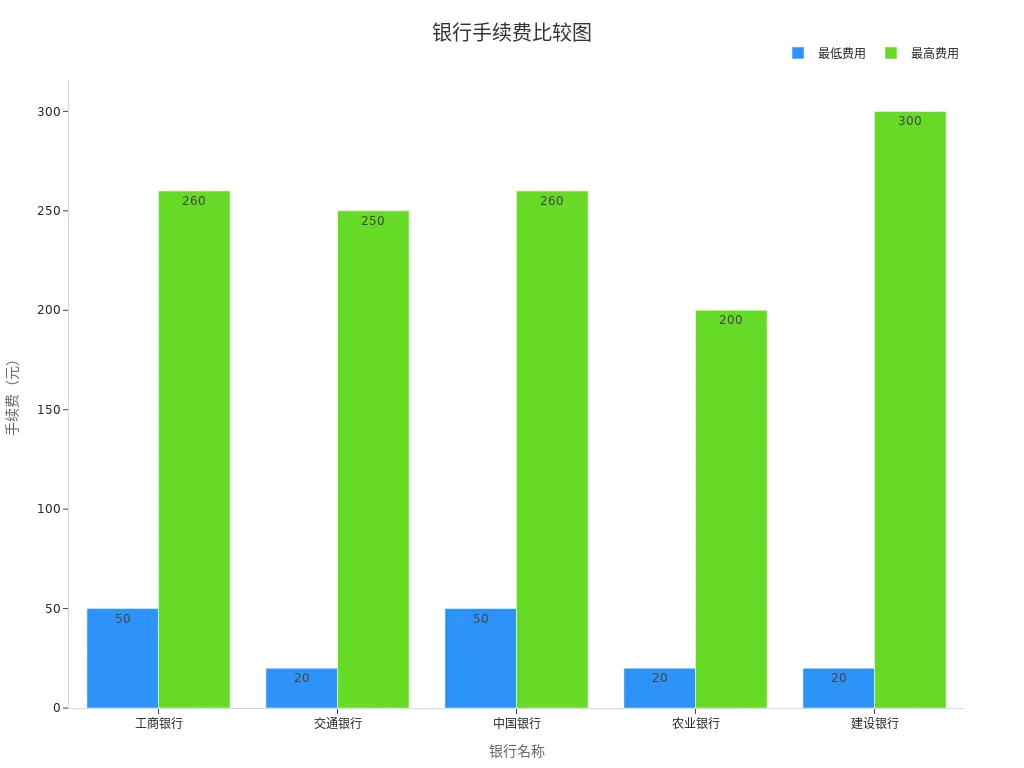
| Bank Name | Fee Calculation | Min Fee | Max Fee |
|---|---|---|---|
| ICBC | 0.10% of amount | 50 CNY | 260 CNY |
| Bank of Communications | 0.10% of amount | 20 CNY | 250 CNY |
| Bank of China | 0.10% of amount | 50 CNY | 260 CNY |
| Agricultural Bank | 0.10% of amount | 20 CNY | 200 CNY |
| China Construction Bank | 0.10% of amount | 20 CNY | 300 CNY |
Fee variations allow cost optimization based on transfer size. Some banks offer promotional fee reductions.
Online Platform Fee Standards
Online platforms offer flexible fee structures, often lower than banks. For example, Wise charges:
- Account Opening: Free
- Currency Conversion: From 0.33%
- USD Wire: 6.11 USD
- CAD Wire: 10 CAD
- Overseas Transactions: Free
Online platforms typically offer lower international remittance fees, especially for currency conversion. The following bar chart illustrates a comparison of fees across different platforms:
Pros and Cons
Banks offer widespread branches, ideal for users unfamiliar with online systems, but fees are higher and processes complex. Platforms provide transparency and ease, perfect for frequent small transfers, though large transfers may face limits.
Tip: Choose platforms for frequent small transfers and banks for secure large transfers.
Comparing banks and platforms helps select cost-effective remittance options tailored to your needs.
Tips for Saving on International Remittance Fees
Compare Fees Across Banks and Platforms
Comparing fees is key to saving costs, using methods like:
- Metric Comparison Analysis: Evaluate fee rates, minimums, and additional charges for cost-effectiveness.
- Group Analysis: Compare banks vs. platforms to identify fee trends.
- Time Series Analysis: Track fee changes over time to transfer during low-cost periods.
For instance, Bank of China’s fixed fees contrast with Wise’s lower conversion rates. These analyses pinpoint optimal services.
Choose the Right Transfer Method
Selecting the appropriate method reduces fees and risks. Common methods:
| Method | Credit Basis | Key Risks | Risk Level | Use Case |
|---|---|---|---|---|
| T/T (Wire) | Commercial | Pre-T/T: Inventory pileup; Post-T/T: Loss | Pre: Low; Post: High | Trusted clients; small orders |
| L/C (Letter of Credit) | Bank | Soft clause, document mismatch, regional risks | Medium | New clients; high-risk regions |
| D/P (Documents Against Payment) | Commercial | Buyer refusal, goods detention | Medium | Moderate trust; fast-turnover |
Use T/T for trusted partners to minimize fees, or L/C for new or risky regions for safety. Match methods to transaction contexts.
Avoid Peak Periods or Urgent Services
Peak times and urgent services inflate fees. Avoid extra costs by:
- Planning Ahead: Steer clear of holidays or busy banking periods.
- Using Standard Services: Urgent options carry premiums; standard services save money.
- Monitoring Exchange Rates: Transfer during favorable rates to cut conversion costs.
For example, Lunar New Year increases banking volumes and fees. Non-peak transfers lower costs.
These strategies—comparing fees, choosing methods, and avoiding peaks—reduce expenses and enhance efficiency.
International remittance fees are complex, encompassing base, telegraph, intermediary, and other charges. Fee standards vary significantly, as shown in this comparison:
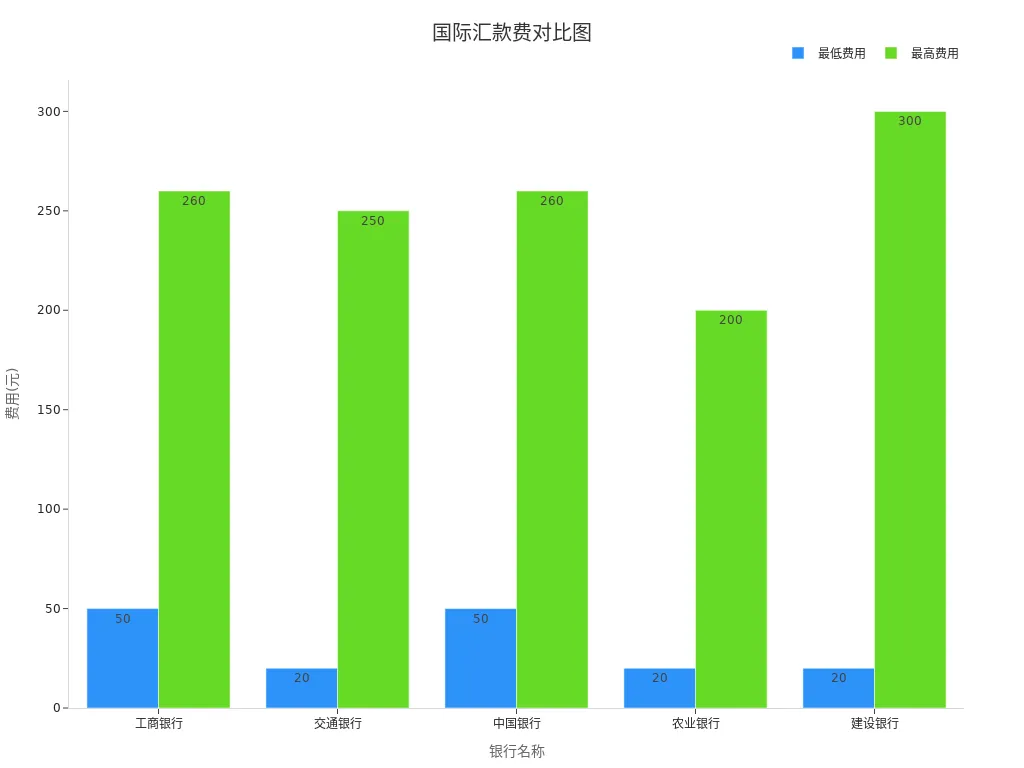
| Bank Name | Fee Standard | Min Fee | Max Fee |
|---|---|---|---|
| ICBC | 0.10% of amount | 50 CNY | 260 CNY |
| Bank of Communications | 0.10% of amount | 20 CNY | 250 CNY |
| Bank of China | 0.10% of amount | 50 CNY | 260 CNY |
| Agricultural Bank | 0.10% of amount | 20 CNY | 200 CNY |
| China Construction Bank | 0.10% of amount | 20 CNY | 300 CNY |
Optimized schemes have reduced account service, CNY transfer, and card swipe fees:
| Fee Type | Status |
|---|---|
| Account Service Fees | Reduced |
| CNY Transfer Fees | Reduced |
| Card Swipe Fees | Reduced |
When selecting the optimal remittance solution, you should compare options based on your personal needs. Online platforms generally offer transparent fees, making them suitable for small transfers, while banks are better suited for large transactions. The following bar chart shows a comparison of minimum and maximum international remittance fees across banks:
By strategically planning your remittance method, you can effectively save on fees while ensuring fund security. Making thorough comparisons and choosing the service that best fits your needs is key to reducing costs.
Frustrated with high fees and complicated traditional international transfers? BiyaPay offers a better solution!
- Same-day arrival: Through localized transfer networks, remittances can reach 200+ countries within the same day
- Zero hidden spreads: Mid-market exchange rates with just one small, transparent fee - costs 50%+ lower than banks
- 30+ fiat currencies supported: Send money directly in local currency to avoid multiple conversion losses
Sign up for BiyaPay now to experience streamlined transfers with no intermediary bank fees - faster and more efficient fund flows!
FAQ
1. How long do international remittances take to arrive?
Typically 1–5 business days, depending on bank processing, transfer path, and destination bank efficiency. Some platforms offer faster arrivals.
Tip: Opt for express services for urgent needs, but expect higher fees.
2. What information is needed for remittances?
Provide:
- Recipient name and account number
- Receiving bank name and SWIFT code
- Transfer amount and currency
Accurate details prevent returns or delays.
3. Are there limits on remittance amounts?
Most banks and platforms impose caps, varying by policy. Confirm limits beforehand to comply.
Note: Check specific restrictions with your bank or platform.
4. What if a remittance fails?
Failures may stem from errors, account issues, or system faults. Contact bank/platform support with the transaction ID to resolve.
Tip: Double-check details before sending to reduce failure risks.
5. How can I track remittance status?
Use:
- Bank/platform online systems
- Customer service with transaction IDs
- SMS/email notifications
Prepare transaction details for quick tracking.
See Also
Complete Guide to International Remittances via Mobile Banking
*This article is provided for general information purposes and does not constitute legal, tax or other professional advice from BiyaPay or its subsidiaries and its affiliates, and it is not intended as a substitute for obtaining advice from a financial advisor or any other professional.
We make no representations, warranties or warranties, express or implied, as to the accuracy, completeness or timeliness of the contents of this publication.
Related Blogs of

Multi-Currency Digital Wallets Compared: Fees, Currency Support, and Cross-Border Payments


Using a Virtual Visa Card: Online Payments, Subscriptions, and Declined Transactions




Choose Country or Region to Read Local Blog
 Australia
 Austria
 Belgium
 Canada
 Cyprus
 Czech Republic
 Denmark
 Estonia
 Finland
 France
 Germany
 Greece
 Hong Kong
 India
 Indonesia
 Ireland
 Italy
 Japan
 Latvia
 Lithuania
 Luxembourg
 Malaysia
 Malta
 Morocco
 Nepal
 Netherlands
 New Zealand
 Norway
 Pakistan
 Philippines
 Poland
 Portugal
 Romania
 Singapore
 Slovakia
 Slovenia
 South Africa
 South Korea
 Spain
 Sweden
 Thailand
 United States
 Turkey
 United Arab Emirates
 United Kingdom
 Vietnam