Essential Futures Market Terminology for Dummies



Image Source: pexels
You might feel overwhelmed by the language of futures trading. The complex words can seem confusing. Think of it like learning a new sport. You need to understand the basic rules and terms before you can play confidently. This trading glossary helps you learn those rules. It explains the most important trading terms you need to know, from a futures contract to futures stock quotes. Learning these essential terms is your first step toward understanding the market.
Key Takeaways
- A futures contract is an agreement to buy or sell something later at a price you agree on today.
- You can make money if prices go up (going long) or down (going short) in futures trading.
- Leverage lets you control a large investment with a small amount of money, but it also increases your risk.
- A stop-loss order helps you limit how much money you can lose on a trade.
- Understanding terms like bid, ask, and volume helps you make smart trading choices.
Fundamentals of Futures Trading
Image Source: unsplash
Now you can start building your foundation. These fundamental terms are the building blocks for understanding how futures trading works. You will see how a single agreement can represent a large amount of a commodity and how you can trade it.
Futures Contract
A futures contract is the central instrument in futures trading. Think of it as a binding agreement to buy or sell something at a future date for a price you lock in today. The U.S. Commodity Futures Trading Commission (CFTC) defines a futures contract as a standardized, legally binding agreement to make or take delivery of a commodity at a predetermined price and time.
Key Idea: With a futures contract, you are not buying the asset today. You are agreeing on the terms of a future transaction. Most traders do not actually deliver or receive the physical item; instead, they typically close out their position before the contract ends to realize a profit or loss.
Every futures contract is standardized. This means the exchange sets the rules, including the quantity, quality, and delivery date. This standardization ensures that every contract for a specific asset is identical, making them easy to trade.
Underlying Asset
The underlying asset is the “something” in your futures contract. It is the actual commodity or financial instrument that the contract represents. The range of underlying assets is vast and includes:
- Commodities: Physical goods like crude oil, corn, gold, and coffee.
- Financial Instruments: Things like stock market indexes (e.g., the S&P 500), currencies, and interest rates.
When you trade a futures contract, your goal is to profit from the price changes of its underlying asset.
Spot Price
The spot price is the current market price of an underlying asset. It is the price you would pay if you wanted to buy the asset “on the spot” and receive it immediately.
You should not confuse the spot price with the futures price. The futures price is the price agreed upon in a futures contract for delivery at a later date. The futures price of an asset, like gold, can be higher or lower than its spot price. This difference reflects the market’s expectations about what the price will be in the future.
Long vs. Short Position
In futures trading, you can make money whether the market goes up or down. Your strategy determines which “position” you take.
- Going Long (A Long Position): You “go long” when you buy a futures contract. You do this when you believe the price of the underlying asset will increase. Your goal is to buy the contract at a lower price and sell it later at a higher price.
- Example: Imagine historical data shows strong support for oil futures around $83 per contract. If the price drops to this level and you see signs of decreasing selling pressure, you might open a long position. If the price then rises to $83.90, you could sell your contract and profit from the difference.
- Going Short (A Short Position): You “go short” when you sell a futures contract. You do this when you believe the price of the underlying asset will decrease. Your goal is to sell the contract at a higher price and buy it back later at a lower price.
- Example: Suppose a stock index futures contract appears overpriced relative to the actual index value. A trader could short-sell the futures contract, anticipating its price will fall to align with the index. By buying it back at the lower price, the trader profits from the decline.
Leverage and Margin
Leverage and margin are two of the most important concepts in futures trading. They work together to allow you to control a large investment with a small amount of capital.
Margin: Your Good-Faith Deposit Margin is not a down payment. Think of it as a security deposit or good-faith money that you must have in your account to open and maintain a futures position. Both buyers and sellers of a futures contract must post margin. The initial margin requirement is the minimum amount needed to open a trade. This amount typically ranges from 3% to 12% of the contract’s total value. For example, the initial margin for an E-mini S&P 500 (ES) futures contract might be around $5,500.
Leverage: The Double-Edged Sword Leverage is the power your margin gives you. It allows you to control a large contract value with a relatively small amount of capital. That $5,500 margin might let you control an ES contract worth over $200,000. This amplification is what makes futures trading so powerful.
However, leverage magnifies both gains and losses. A small, favorable price move can lead to a large return on your margin. Conversely, a small, unfavorable move can lead to significant losses, potentially wiping out your margin quickly. Effective risk management is crucial when using leverage.
Contract Size and Value
Every futures contract has a defined size and value, which you need to understand to know what you are trading.
Contract Size This is the standardized quantity of the underlying asset in one futures contract. You cannot change this size. For example, one standard WTI Crude Oil futures contract always represents 1,000 barrels.
| Product | Asset Class | Standard Contract Size |
|---|---|---|
| WTI Crude Oil (CL) | Energy | 1,000 barrels |
| E-mini S&P 500 (ES) | Equity Index | $50 x S&P 500 Index |
| Corn (ZC) | Agriculture | 5,000 bushels |
Contract Value (Notional Value) This is the total cash worth of a single futures contract. You calculate it with a simple formula:
Contract Value = Current Futures Price x Contract Size
For example, if a WTI Crude Oil futures contract is trading at $80 per barrel, its notional value is:
$80 (Price) x 1,000 barrels (Size) = $80,000
Understanding this value helps you appreciate the true scale of the position you are controlling with your margin.
Key Trading Terms: Orders and Prices
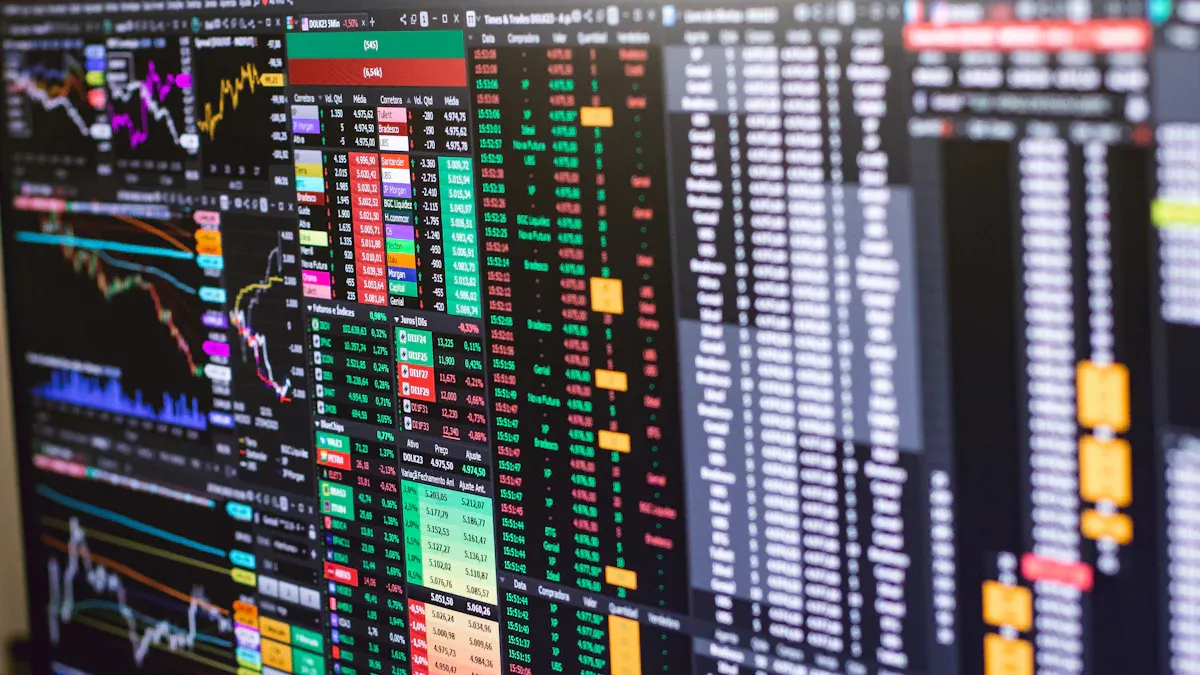
Image Source: pexels
You now understand the basic components of a futures contract. The next step is learning how to actually trade them. This section covers the essential terms you will use to place orders and interpret prices. These are the action words of futures trading.
Essential Trading Terms: Bid vs. Ask
When you look at futures stock quotes, you will always see two prices: the bid and the ask. Understanding them is key to knowing the cost of a trade.
- Bid Price: This is the highest price a buyer is currently willing to pay for a futures contract. If you want to sell immediately, you will sell at the bid price.
- Ask Price: This is the lowest price a seller is currently willing to accept for a futures contract. If you want to buy immediately, you will buy at the ask price.
The difference between these two prices is called the bid-ask spread. You can think of this spread as a hidden transaction cost. It is an immediate expense you pay for entering and exiting a trade. For a trade to become profitable, the price must move enough in your favor to cover this spread and any commissions. For example, a 0.25-point spread on an E-mini S&P 500 contract translates to a $12.50 cost to enter and another $12.50 to exit. This totals a $25 round-trip cost before you even make a profit.
Note: The size of the spread is not fixed. It changes based on market conditions.
- Spreads often get wider during periods of high volatility or major news events.
- Contracts with lower trading volume, such as those for later months, also have wider spreads.
- Overnight trading sessions typically have wider spreads due to fewer active traders.
Active day traders must carefully manage these costs. Even position traders need to consider the spread when planning their entry and exit points. You can manage these costs by using specific order types and trading during high-volume periods.
Reading Futures Stock Quotes
Futures stock quotes provide a snapshot of market activity for a specific futures contract. At first, they might look like a jumble of numbers, but they are simple to read once you know what to look for.
Here is a breakdown of a typical quote you might see on a trading platform:
| Element | Description | Example (E-mini S&P 500) |
|---|---|---|
| Symbol | The unique ticker for the futures contract. It includes the asset, month, and year. | ESZ4 |
| Last | The price of the most recently completed trade. | 5105.50 |
| Change | The price difference from the previous day’s settlement price. | +10.25 |
| Bid | The highest price buyers are willing to pay right now. | 5105.25 |
| Ask | The lowest price sellers are willing to accept right now. | 5105.50 |
| Volume | The total number of contracts traded during the session. | 1,200,000 |
Learning to quickly read futures stock quotes helps you make faster and more informed trading decisions.
When you’re practicing quotes, focus on mapping “symbol—contract month—last—volume” before worrying about timing. If you watch related exposure across markets, BiyaPay’s stock lookup can help you double-check tickers and basic reference data so you’re not mixing symbols or quote conventions.
If your plan involves USD or HKD conversions, part of the “price difference” can come from FX and conversion costs. Using the FX converter & comparison to document your rate assumptions makes it easier to translate ticks, notional value, and risk into one consistent unit.
If you prefer a single workflow for research and execution, start from the BiyaPay website, complete registration, then use the unified trading entry for position management and risk controls. BiyaPay is positioned as a multi-asset wallet for trading and funds management, operating under compliance registrations such as US MSB and New Zealand FSP, with updates and disclosures accessible via the Events Center.
Market Order vs. Limit Order
When you decide to enter or exit a trade, you must place an order. The two most basic order types are market orders and limit orders.
- Market Order: You use this order to buy or sell immediately at the best available price. It prioritizes speed of execution over a specific price. You will buy at the current ask price or sell at the current bid price.
Warning: During high volatility, real-time futures stock quotes can lag behind the actual market. If you use a market order in these conditions, your trade might execute at a price that is significantly different from what you saw on your screen. This is known as “slippage.”
- Limit Order: You use this order to set a specific price at which you are willing to buy or sell. A limit order gives you complete control over your execution price. Your order will only execute if the market reaches your specified price or a better one. For example, if you place a limit order to buy at $50, your order will only fill if the ask price drops to $50 or lower. The trade-off is that your order might never be filled if the market does not reach your price.
Your choice between a market and limit order depends on your trading strategy. If getting into a trade quickly is most important, a market order is useful. If getting a specific price is your priority, a limit order is the better choice.
Stop-Loss Order
A stop-loss order is one of your most important risk management tools in futures trading. It is an order you place to automatically exit a trade if the price moves against you by a certain amount. Its purpose is to limit your potential loss on a single trade.
The Golden Rule: You should place your stop-loss at a price level where your original reason for entering the trade is no longer valid. Managing your losses is more critical than managing your profits.
There are several common types of stop-loss orders:
- Fixed Price Stop-Loss: You set the order at a specific, static price. If you buy a contract at $100 and want to risk no more than $10, you would place a stop-loss order to sell at $90.
- Percentage Stop-Loss: You set the stop-loss based on a percentage of the asset’s value. A 5% stop on a $200 position would trigger a sale if the price falls to $190.
- Trailing Stop-Loss: This is a dynamic order. It automatically moves up with the price on a long position but stays fixed if the price falls. This helps you lock in profits while still protecting against a reversal.
Many traders also use technical indicators, like moving averages or natural swing points in the market, to help them decide where to place their stop-loss orders.
Tick Size and Value
Every futures contract has a minimum price fluctuation called a tick. Understanding the tick is crucial because it determines how much money you make or lose on each small price movement.
- Tick Size: The smallest amount the price of a futures contract can move.
- Tick Value: The specific dollar amount that one tick movement is worth.
These values are standardized for each contract. For example, let’s look at the E-mini Nasdaq 100 (NQ) futures contract:
| Contract | Tick Size | Tick Value |
|---|---|---|
| E-mini Nasdaq 100 (NQ) | 0.25 index points | $5.00 |
This means for every 0.25 point move in the NQ index, the value of one futures contract changes by $5.00. If you are long one NQ contract and the price moves up by four ticks (1 full point), you have made $20.00.
Volume
Volume is one of the most important indicators you will see on futures stock quotes. It represents the total number of contracts traded during a specific period, usually a single day.
Volume tells you how much activity and interest there is in a particular futures contract.
- High Volume: Indicates strong market activity and high liquidity. High liquidity means you can easily buy or sell the contract quickly without causing a major price change. This is ideal for traders.
- Low Volume: Indicates weak market activity and low liquidity. In low-volume markets, it can be harder to enter and exit trades, and the bid-ask spread is often wider.
Traders use metrics like Average Daily Volume (ADV) to gauge a contract’s liquidity. Reports from exchanges like the CME Group provide daily summaries of trading volume, offering a clear overview of market activity. Watching volume helps you confirm price trends and choose the most liquid contracts for your trading. These are the last of the key terms you need to know for now.
Managing a Trade from Open to Close
You have learned how to place orders. Now you need to understand the lifecycle of a trade. This section explains how to manage your position from the moment you open it until you decide to close it.
Open Interest
Open interest is a key piece of data. It tells you the total number of outstanding futures contracts that have not been settled. You can think of it as the number of active positions in the market. It is different from volume, which resets to zero each day. Open interest carries over from the previous day.
This table shows the main differences between open interest and volume.
| Feature | Open Interest | Trading Volume |
|---|---|---|
| Measures | Total active contracts at day’s end | Total trades within a day |
| Resets | Carries over daily | Resets to zero daily |
| Indicates | Long-term trader commitment | Short-term market excitement |
| Analogy | An odometer (how many traders are on the road) | A speedometer (how fast the market is moving) |
Expiration Date
Every futures contract has an expiration date. This is the last day you can trade that specific contract. After this date, the contract expires, and trading stops. If you hold a futures contract until its expiration, it will proceed to final settlement. This means you will either exchange cash or handle the physical asset, depending on the contract’s rules. Most traders close their positions before this date to avoid settlement.
Rollover
Many traders want to maintain their market exposure beyond a single contract’s expiration. You can do this through a process called a rollover. This lets you move your position from the expiring contract to the next active one.
Here is how you can roll over a position:
- Check contract volume. You should see when the next month’s contract becomes more active.
- Close your current position. You will exit your trade in the expiring contract.
- Open the new position. You then enter the same position in the next active contract.
- Adjust your trading plan. You may need to update your stop-loss and profit targets.
For example, a trader with a long position in a September E-mini S&P 500 contract would sell it. Then, the trader would buy a December E-mini S&P 500 contract to continue the trade.
Settlement: Cash vs. Physical
Settlement is the final step for any futures contract held to expiration. There are two types.
- Physical Settlement: The seller must deliver the actual underlying asset to the buyer.
- Cash Settlement: The two parties exchange the cash difference between the contract price and the asset’s market price on the settlement day. No physical goods change hands.
The type of settlement depends on the contract.
| Settlement Type | Example Futures Contracts |
|---|---|
| Physically Delivered | Agricultural products (Corn, Soybeans), Cattle (/LE) |
| Cash-Settled | Stock Indexes (E-mini S&P 500), Lean Hogs (/HE) |
The Market Players and Places
Futures trading does not happen in a vacuum. A few key organizations work behind the scenes to make sure the market is fair, orderly, and secure. You need to know who these players are and the roles they perform.
The Exchange
The exchange is the official marketplace where you trade futures contracts. Think of it as the central hub where all buyers and sellers meet. Exchanges like the CME Group create and regulate the market.
Their main jobs include:
- Standardizing Contracts: The exchange sets all the rules for a contract, including its size, quality, and expiration date. This ensures every contract for a specific asset is identical.
- Regulating Trading: They establish the rules of conduct to ensure fair and ethical trading practices.
- Providing a Platform: They bring buyers and sellers together on a single platform, which promotes high liquidity and helps you enter or exit trades easily.
The Clearinghouse
The clearinghouse is the ultimate guarantor for every trade. It acts as a middleman between the buyer and the seller to eliminate the risk of one party failing to meet their obligation. This is called counterparty risk.
The clearinghouse becomes the buyer to every seller and the seller to every buyer. This means you do not have to worry about the financial stability of the person on the other side of your trade. The clearinghouse guarantees the position.
To make this guarantee, the clearinghouse requires all traders to post margin. It then marks all positions to market daily, transferring funds from losing accounts to winning accounts to settle profits and losses in real time. This process ensures the entire system remains financially sound.
The Broker
You cannot trade directly on an exchange. You need a broker to act as your gateway to the futures market. The broker is the firm that facilitates your trades and manages your account.
A broker provides you with the essential tools and services you need to trade, including:
- A software platform, such as Biyapay, where you can view prices and place your orders.
- Management of your deposits and the flow of money between your account and the clearinghouse.
- Access to customer support and market research to help inform your decisions.
Choosing the right broker is a critical step. You should look for one with reliable technology, fair commission rates, and strong customer support.
Mastering this vocabulary is your foundation. It improves your ability to interpret market conditions and make faster, more precise decisions. Success in trading begins with understanding the language that shapes analysis and execution.
You should bookmark this post as a quick reference guide.
You have taken a significant first step on your trading journey. You are now better equipped to explore strategies, manage your trades, and continue learning with confidence.
FAQ
How much money do I need to start trading futures?
The amount you need varies by contract. You must have enough money to cover the initial margin requirement. This good-faith deposit can range from a few hundred to several thousand dollars. Your broker can provide the specific amount.
Can I lose more than the money in my account?
Yes. Because futures use leverage, your losses can exceed your account balance if a trade moves significantly against you. This makes risk management, like using a stop-loss order, an essential skill for every trader to learn and practice.
Do I have to accept 1,000 barrels of oil?
No. Most traders close their positions before the contract’s expiration date. This allows you to take a profit or loss without ever handling the physical asset. This process applies to both cash-settled and physically-delivered contracts.
How are futures different from stocks?
When you buy a stock, you own a small piece of a company. A futures contract is an agreement to buy or sell an asset at a future date. Futures use significant leverage and have expiration dates, which stocks do not.
*This article is provided for general information purposes and does not constitute legal, tax or other professional advice from BiyaPay or its subsidiaries and its affiliates, and it is not intended as a substitute for obtaining advice from a financial advisor or any other professional.
We make no representations, warranties or warranties, express or implied, as to the accuracy, completeness or timeliness of the contents of this publication.
Related Blogs of

Why Is Canada's Country Code 1

The 18 Best Apps to Earn Real Cash This Year

Zelle Wire Transfer or ACH? Clearing Up the Confusion

SoFi Checking and Savings A Deep Dive Review

Choose Country or Region to Read Local Blog
 Australia
 Austria
 Belgium
 Canada
 Cyprus
 Czech Republic
 Denmark
 Estonia
 Finland
 France
 Germany
 Greece
 Hong Kong
 India
India Indonesia
 Ireland
 Italy
Italy Japan
Japan Latvia
 Lithuania
 Luxembourg
 Malaysia
 Malta
Malta Morocco
 Nepal
Nepal Netherlands
 New Zealand
 Norway
 Pakistan
 Philippines
 Poland
 Portugal
 Romania
 Singapore
 Slovakia
 Slovenia
 South Africa
 South Korea
 Spain
Spain Sweden
 Thailand
 The United States
 Turkey
 United Arab Emirates
 United Kingdom
 Vietnam
Contact Us




BIYA GLOBAL LLC is a licensed entity registered with the U.S. Securities and Exchange Commission (SEC No.: 802-127417); a certified member of the Financial Industry Regulatory Authority (FINRA) (Central Registration Depository CRD No.: 325027); regulated by the Financial Industry Regulatory Authority (FINRA) and the U.S. Securities and Exchange Commission (SEC).
BIYA GLOBAL LLC is registered with the Financial Crimes Enforcement Network (FinCEN), an agency under the U.S. Department of the Treasury, as a Money Services Business (MSB), with registration number 31000218637349, and regulated by the Financial Crimes Enforcement Network (FinCEN).
BIYA GLOBAL LIMITED is a registered Financial Service Provider (FSP) in New Zealand, with registration number FSP1007221, and is also a registered member of the Financial Services Complaints Limited (FSCL), an independent dispute resolution scheme in New Zealand.