Must-Read for Investors: Key Differences Between Traditional and Emerging Hong Kong Stock Account Models





Image Source: pexels
In recent years, Hong Kong stock accounts have gained increasing attention from investors. According to a report by Donghai Securities, the IPO financing scale in the Hong Kong stock market reached HK$107.1 billion in the first half of 2025, a sevenfold increase compared to the same period last year, indicating a significant rise in account openings and trading volume. The daily average turnover of Hong Kong securities ETFs exceeded HK$15 billion, reaching a historical high. Industry experts point out that market trading remains highly active, with significant growth in brokerage performance. When choosing a Hong Kong stock account, investors should consider their needs and market trends, focusing on the practical impacts of different account opening models.
Key Points
- Emerging Hong Kong stock accounts support fully online account opening, with a simple process and short time, suitable for investors seeking efficiency and convenience.
- Internet brokers offer low trading fees with transparent commissions, effectively reducing investment costs and increasing return potential.
- Blockchain and AI technologies enhance fund security and transaction transparency, ensuring the safety of investors’ funds.
- Multi-device support allows investors to manage accounts anytime, anywhere, flexibly seizing market opportunities.
- Choosing a Hong Kong stock account should align with personal needs; traditional models suit investors prioritizing fund security and offline services, while emerging models are better for those valuing efficiency and technological innovation.
Account Opening Process

Image Source: pexels
Convenience
Traditional Hong Kong stock accounts are typically provided by local Hong Kong brokers. Investors need to visit physical branches to complete identity verification and related procedures. Some foreign brokers’ interfaces are primarily in English, differing from the preferences of Chinese investors. The mobile experience is average, and the process is relatively complex. Emerging internet brokers significantly simplify the process. Investors only need to download the client, follow the instructions to upload identity proof and related documents, and complete account opening online. The fully online process is user-friendly, suitable for individual investors. Many emerging platforms also support multi-language switching, enhancing user experience.
Documents and Procedures
Under the traditional model, investors need to prepare multiple documents, including ID, proof of address, and bank statements. The account opening process involves scheduling appointments, submitting documents in person, signing agreements, and waiting for review, making it cumbersome. In the emerging model, investors only need to upload identity proof and some supporting documents. Platforms use video witnessing or facial recognition to verify identity. The process is streamlined, with clear steps, reducing unnecessary procedures.
Time Cost
The account opening time for traditional Hong Kong stock accounts is longer. From scheduling to completing the process, investors typically need several days or even over a week. Some procedures are limited to business days and hours. Emerging internet brokers significantly shorten the account opening time. Investors can complete the entire process in as little as a day, with some platforms offering minute-level reviews. The emerging model supports cross-border fund flows, with faster fund arrivals, greatly improving account opening efficiency.
Tip: Choosing an emerging internet broker for account opening can save significant time and effort, especially for investors eager to quickly enter the Hong Kong stock market.
Trading Experience
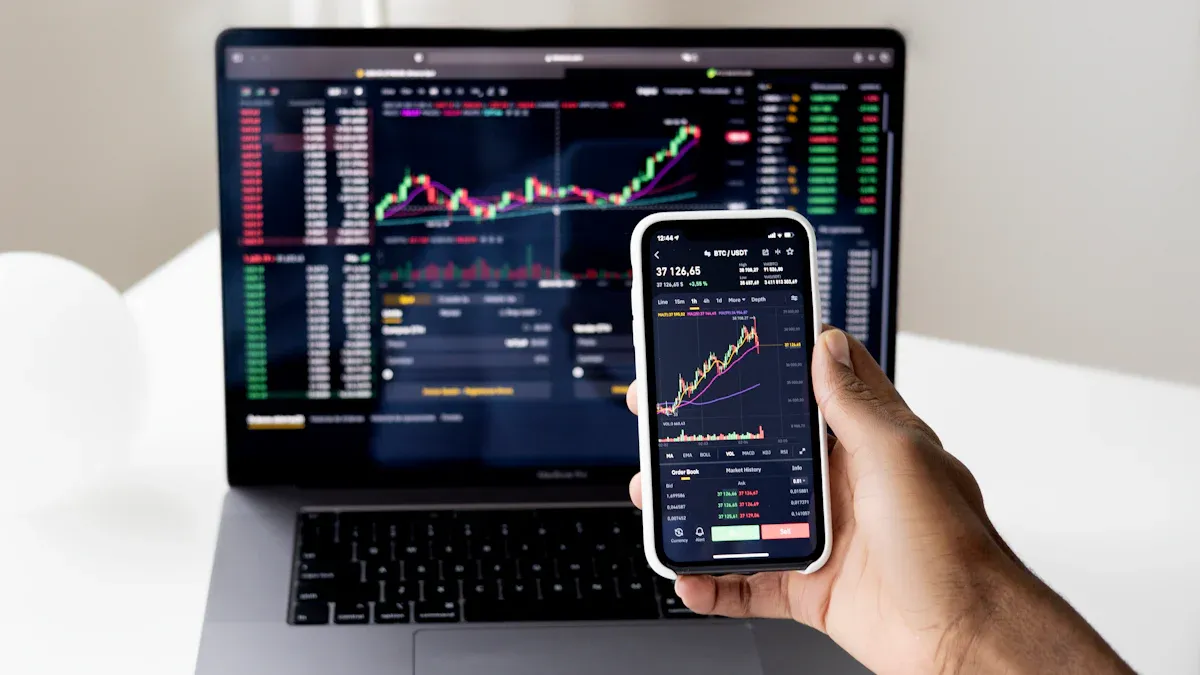
Image Source: pexels
Platform Operation
Traditional brokers rely heavily on physical branches, requiring investors to visit in person for account opening and trading, making the process cumbersome. The interface is often in English, with some functions less intuitive. Internet brokers provide online services through websites or apps, allowing investors to operate anytime, anywhere. The platform interface is clean, with well-organized functions and a good user experience. Internet brokers also introduce smart trading systems and big data analytics, helping investors quickly access market information and make decisions. Many platforms offer online customer service and investment education modules, improving overall service quality.
- Internet brokers have no physical branches, saving on rent and labor costs, resulting in lower trading fees.
- Investors can easily complete transactions through online platforms without visiting physical branches, saving time and effort.
- Online trading platforms are simple to operate, suitable for users with some investment experience and independent decision-making ability.
Features and Innovation
Emerging Hong Kong stock account platforms continuously drive technological innovation. For example, VSTAR Financial, through acquisitions and technological upgrades, has built a one-stop brokerage cloud service covering front, middle, and back offices, lowering investment thresholds and costs. The platform introduces AI-driven risk control models and smart customer service, improving risk management and service efficiency. AI and big data analytics help investors better seize market opportunities. Blockchain and digital asset technologies are also gradually applied to the Hong Kong stock market. Stablecoin platforms enhance compliance and transaction security through on-chain fund tracking and anomaly detection. Asset digitization and smart contract technology improve asset liquidity and transparency, driving the internationalization and innovation of the Hong Kong stock market.
- Brokerage cloud services enable low-cost, high-efficiency digital transformation.
- AI and big data enhance investment decision-making and risk management capabilities.
- Blockchain and digital asset technologies improve transaction security and asset liquidity.
Multi-Device Support
Emerging internet brokers prioritize multi-device experiences. Investors can access Hong Kong stock accounts via smartphones, tablets, and computers. For example, VSTAR Securities uses facial recognition and identity verification technology, allowing users to complete account opening and investing in as little as three minutes. Multi-device support enables investors to stay updated on market trends and trade flexibly. Technological innovation also brings lower trading commissions, with Hong Kong stock trading commissions as low as 0.03% (approximately $0.0039 at 1 USD = 7.8 HKD), far below traditional brokers. Teams leverage big data and AI to continuously optimize systems, ensuring platform stability and compliance to meet diverse investor needs.
Tip: Multi-device support and technological innovation make Hong Kong stock account operations more flexible and efficient, allowing investors to choose the most suitable trading method based on their habits.
Fee Structure
Commissions and Transaction Fees
Traditional brokers typically charge higher commissions and transaction fees for Hong Kong stock account trading. Investors need to pay a fixed percentage fee for each stock purchase or sale. At an exchange rate of 1 USD = 7.8 HKD, traditional brokers’ commission rates generally range from 0.25% to 0.5%, with a minimum fee of about $5. Emerging internet brokers significantly reduce commissions, with some platforms offering rates as low as 0.03% and minimum fees around $1. Investors should focus on actual trading costs to effectively manage investment expenses.
Management Fees
Management fees are a key concern for investors holding Hong Kong stock accounts long-term. Under the traditional investment advisor model, management fees typically exceed 1%, with numerous fee items, making it hard for investors to fully understand all costs. Emerging smart advisory platforms adopt a single, transparent management fee rate, usually between 0.15% and 0.5%. Investors can clearly see each fee item, facilitating rational decision-making.
Hidden Costs
Hong Kong stock accounts under different models have various hidden costs. In the traditional model, investors may face multiple opaque fees, such as deposit/withdrawal fees, portfolio adjustment fees, and hidden service fees. The service process is complex, relying on manual services with insufficient information disclosure. Emerging models streamline processes through automation and internet operations, offering a more transparent fee structure. Investors can compare the hidden costs of both models in the table below:
| Fee Category | Traditional Investment Advisor | Smart Advisory |
|---|---|---|
| Management Fee Rate | Above 1%, opaque | 0.15%-0.5%, transparent |
| Deposit/Withdrawal Fees | Present and opaque | Usually no additional fees |
| Hidden Fees | Numerous and hard to detect | Transparent fee structure |
| Service Process | Complex, manual services | Automated, streamlined process |
| Transparency | Low | High |
Tip: Investors should focus on fee structures and transparency when choosing a Hong Kong stock account to avoid hidden costs impacting returns.
Fund Security and Compliance
Fund Custody
Traditional Hong Kong stock accounts typically rely on major Hong Kong banks like Standard Chartered, HSBC, or Bank of China Hong Kong for fund custody. These banks have strong capital strength and robust risk control systems, providing high safety assurances for investors’ funds. Emerging models introduce blockchain and stablecoin technologies. Experts note that blockchain lowers investment thresholds and enhances transaction efficiency and transparency through asset tokenization. Stablecoins are pegged to HKD cash or short-term treasuries, custodied by traditional financial institutions like Hong Kong banks, ensuring fund safety. Wallet systems and multi-party computation technologies further enhance the security of digital asset storage and transfers. When choosing a Hong Kong stock account, investors should consider the strength of the custodial institution and technological innovations based on their needs.
Regulatory Compliance
Hong Kong regulators continuously improve compliance requirements for Hong Kong stock accounts. On August 1, 2024, the Hong Kong Monetary Authority implemented a stablecoin issuer licensing regime, requiring issuers to comply with core responsibilities like reserve management, redemption assurances, and risk management. Hong Kong also established a stablecoin issuer sandbox to support compliant pilots and promote innovative financial products. The SFC has strengthened oversight of cross-border internet brokers, prohibiting unlicensed solicitation of Chinese investors to ensure compliant fund inflows. When New Third Board companies list in Hong Kong, they must focus on compliant operations and financial stability. Through the Stablecoin Ordinance and Virtual Asset Service Provider regime, Hong Kong advances digital asset regulation, boosting investor confidence.
- The Hong Kong Monetary Authority implements a stablecoin issuer licensing regime, strengthening reserve and risk management.
- The SFC enhances compliance oversight of internet brokers, protecting investor rights.
- The Virtual Asset Service Provider regime elevates the compliance level of digital assets.
Risk Control
Risk control is the core of Hong Kong stock account safety. Traditional brokers rely on capital strength, compliance history, and professional teams for risk management, focusing on technological security, anti-money laundering, and anti-terrorism financing measures. Emerging models emphasize technical infrastructure security, using anti-hacking storage and trading systems. Blockchain technology and smart contracts support automated execution and tamper-proof transactions, enhancing fund flow transparency and security. Industry experts believe future competition will focus on compliance capabilities and service system development. Emerging models need to continuously improve operational and technical capabilities to build robust, compliant trading channels, ensuring investor fund safety.
Tip: Innovative technologies like blockchain and stablecoins are becoming key tools for enhancing Hong Kong stock account fund safety and transparency; investors should focus on platforms’ technical strength and compliance capabilities.
Customer Service
Customer Support Response
Broker customer support response speed directly impacts the trading experience. High-quality brokers typically respond to customer inquiries within 5-10 minutes, helping investors promptly resolve trading issues. Lower-quality brokers may take hours to respond, causing investor anxiety. Internet brokers, with higher technological investment, often have faster response times. Investors can consult existing users or call customer service to test efficiency. Fast-responding support can effectively reduce losses from unresolved issues.
Research Support
Emerging Hong Kong stock account platforms excel in research support. Many platforms leverage the extensive overseas market experience of major Hong Kong financial institutions to offer dedicated Hong Kong stock research services. For example, some platforms push daily Hong Kong market updates, regularly publish investment strategies and industry reviews, and provide in-depth reports. Investors can receive updates via WeChat, SMS, email, and other channels. High-net-worth clients can access “1+1” advisory services, participate in listed company surveys, and join client events. Platforms also host investment strategy meetings and seminars to enhance investors’ expertise.
Value-Added Services
Emerging Hong Kong stock accounts continuously innovate value-added services. Platforms integrate domestic and international resources to offer one-stop wealth management services. High-net-worth clients can receive dedicated advisors and comprehensive services through partnerships with Hong Kong private banks and wealth management centers. Investors can achieve cross-border asset allocation via Stock Connect, Investment Free Travel, and QDII funds. Backed by international teams and global branches, platforms provide access to premium global investment products. Research teams track Hong Kong and Chinese markets long-term, offering strong support for investment decisions.
Tip: Choosing platforms with fast service responses, strong research support, and rich value-added services enhances the Hong Kong stock investment experience and asset allocation efficiency.
Hong Kong Stock Account Investment Opportunities
A+H Dual Markets
The A+H dual markets offer rich investment opportunities. The Hong Kong Stock Exchange collaborates with Chinese regulators to introduce policies that simplify filing procedures and relax cross-border fund flow restrictions. These measures create an inclusive and predictable regulatory environment, attracting more companies and investors to the Hong Kong stock market. Listing regime reforms lower listing thresholds, supporting rapid listings of hard-tech companies and enhancing the appeal of Hong Kong IPOs. Chinese investment banks integrate A-share and Hong Kong stock resources, building dual-track business models to offer tailored listing solutions. As an international financial hub, Hong Kong has strong market liquidity, ideal for international placements and M&A financing. The A+H share premium gap is gradually narrowing, reducing corporate financing costs and improving efficiency. Chinese brokers, through Hong Kong subsidiaries, expand into virtual asset trading and comprehensive wealth management, meeting corporate global expansion needs. Emerging Hong Kong stock account models leverage technological empowerment, developing 24/7 trading platforms to enhance service efficiency and support diversified asset allocation.
Placement Mechanisms
The Hong Kong Stock Exchange continues to optimize directed placements and allocation mechanisms. Recent IPO pricing and allocation reforms require issuers to allocate at least 40% of shares to the book-building placement portion, primarily targeting institutional investors. This adjustment increases institutional investors’ influence in placements. After revising the clawback mechanism, the public subscription portion has greater flexibility. Issuers can choose Mechanism A or Mechanism B, affecting retail and institutional investors’ allocation probabilities. Under Mechanism A, the maximum clawback ratio for the public subscription portion is reduced to 35%, increasing retail allocation difficulty. Mechanism B allows issuers to flexibly set the public subscription ratio without a clawback mechanism, enhancing issuance structure flexibility. Institutional investors gain more opportunities to invest in quality IPOs through placement mechanisms, actively participating in pricing and improving market transparency. Emerging Hong Kong stock account platforms support investor participation in various placements and directed offerings, meeting diverse investment needs. Technological innovation facilitates cross-border fund flow convenience, enriching asset categories and enhancing market vitality.
Emerging Hong Kong stock account models provide investors with channels for global investment and diversified asset allocation. Investors can participate in A+H dual-market investments, directed placements, and allocations through Hong Kong stock accounts, seizing international market opportunities and improving asset allocation efficiency.
Suitable Audiences
Traditional Model Suitable Audiences
The traditional model is better suited for investors prioritizing fund security and compliance. Many high-net-worth clients prefer major Hong Kong brokers, valuing bank-level fund custody and strict risk management. Some investors have a higher demand for offline services, preferring face-to-face interactions and dedicated account managers. Older investors or those less familiar with internet operations also lean toward the traditional model. Corporate and institutional clients often require tailored services and complex asset allocation solutions, which traditional brokers can better support.
Emerging Model Suitable Audiences
The emerging model suits individual investors seeking high efficiency and low costs. Younger users and those with internet proficiency are more likely to adopt online account opening and mobile operations. Many investors want to quickly enter the Hong Kong stock market, benefiting from convenient account opening and flexible trading experiences. Emerging platforms support multi-device operations, ideal for frequent travelers or those needing real-time market updates. Some investors focus on innovative technologies like blockchain and smart contracts, preferring the digital services offered by emerging Hong Kong stock accounts. For users with smaller capital and a focus on fee transparency, the emerging model is more appealing.
Selection Recommendations
When choosing a Hong Kong stock account, investors should align with their needs and investment habits. Those valuing offline services and fund safety should consider the traditional model. Users seeking efficiency, low costs, and technological innovation are better suited for the emerging model. Investors can list their primary needs, such as account opening speed, service methods, fee structures, and technical support. By comparing different brokers’ services and platform strengths, investors can make better choices. It’s recommended to focus on platforms’ compliance credentials and fund custody safety to ensure a smooth investment experience and fund security.
Tip: Choosing the right Hong Kong stock account enhances investment efficiency and asset allocation outcomes.
The traditional Hong Kong stock account model emphasizes fund safety and offline services, suitable for investors needing high compliance assurances. The emerging model excels in efficiency, low costs, and technological innovation, catering to those valuing convenience. The Hong Kong stock market shows a clear trend toward technological innovation, with AI, cloud computing, and new consumption sectors as key growth drivers. Investors should align with their needs and risk preferences, focusing on new opportunities from technological innovation, and choose the right Hong Kong stock account to capitalize on market growth dividends.
FAQ
What Basic Documents Are Needed to Open a Hong Kong Stock Account?
Investors typically need identity proof, proof of address, and bank account information. Emerging internet brokers support online document uploads, simplifying the process.
Are Trading Fees for Emerging Hong Kong Stock Accounts Really Lower?
Emerging internet brokers’ commissions are as low as 0.03% (approximately $0.0039 at 1 USD = 7.8 HKD), with minimum fees around $1. Traditional brokers’ commissions typically exceed 0.25%.
How Is Fund Safety Ensured?
Emerging models use blockchain and multi-factor authentication. Hong Kong banks custody funds, and platforms operate compliantly, enhancing fund safety and transparency.
Which Devices Can Be Used to Operate Hong Kong Stock Accounts?
Investors can use smartphones, computers, or tablets to operate emerging Hong Kong stock accounts. Multi-device support enables flexible trading anytime, anywhere.
How Can Investors Get Help When Facing Issues?
- Online Customer Service: Most emerging platforms offer 24/7 online support.
- Phone Support: Some brokers provide dedicated hotlines for quick responses to client needs.
This article provides investors with a detailed comparison of traditional and emerging Hong Kong stock account models, aiming to help users make an informed choice. The article conducts an in-depth analysis from multiple dimensions, including account opening process, trading experience, fee structure, fund security and compliance, and customer service. The traditional model emphasizes fund security and offline services, suitable for high-net-worth clients who value compliance. The emerging model, with its convenient and efficient online account opening, low trading fees, and technological innovation, attracts numerous investors who seek efficiency and cost-effectiveness. The article concludes that investors should choose the most suitable Hong Kong stock account model based on their needs and risk tolerance to effectively seize market opportunities.
However, despite the detailed content of the article, a core challenge for many Chinese investors remains: the flow of cross-border funds. Traditional funding methods, such as international bank wire transfers, are not only complex and time-consuming but also come with high fees and opaque exchange rate spreads. These issues can directly impact investment returns and increase transaction costs.
BiyaPay was created to solve these cross-border financial pain points. We offer a smoother, more cost-effective channel for your investments. We support the conversion between various fiat and digital currencies, allowing you to easily manage global assets, and provide a real-time exchange rate query feature to ensure you always get the best rates. What’s more, our remittance fees are as low as 0.5% with same-day delivery, significantly cutting down your transaction costs and time.
Now, you don’t need a complex overseas account to invest in both U.S. and Hong Kong stocks on one platform. Say goodbye to the hassle of cross-border payments and start your efficient financial journey. Register with BiyaPay today to make fund management as smooth as trading.
*This article is provided for general information purposes and does not constitute legal, tax or other professional advice from BiyaPay or its subsidiaries and its affiliates, and it is not intended as a substitute for obtaining advice from a financial advisor or any other professional.
We make no representations, warranties or warranties, express or implied, as to the accuracy, completeness or timeliness of the contents of this publication.
Related Blogs of

Capital Preparation in Early Stages of Cross-Border M&A: How Enterprises Safely Transfer Millions in USD Deposits to Overseas Trust Escrow Accounts?


Pay for Perplexity Pro Subscription with USDT: Bypass Regional Payment Restrictions

How Do European International Students Pay the Final Installment for a Used Car? Digital Payment Methods to Avoid SEPA Transfer Delays Caused by Weekend Bank Closures


Run Local Large Models or Call APIs? 2026 AI Development Cost and Payment Method Comparison
Choose Country or Region to Read Local Blog
 Australia
 Austria
 Belgium
 Canada
 Cyprus
 Czech Republic
 Denmark
 Estonia
 Finland
 France
 Germany
 Greece
 Hong Kong
 India
India Indonesia
 Ireland
 Italy
Italy Japan
Japan Latvia
 Lithuania
 Luxembourg
 Malaysia
 Malta
Malta Morocco
 Nepal
Nepal Netherlands
 New Zealand
 Norway
 Pakistan
 Philippines
 Poland
 Portugal
 Romania
 Singapore
 Slovakia
 Slovenia
 South Africa
 South Korea
 Spain
Spain Sweden
 Thailand
 The United States
 Turkey
 United Arab Emirates
 United Kingdom
 Vietnam
Contact Us




BIYA GLOBAL LLC is registered with the Financial Crimes Enforcement Network (FinCEN), an agency under the U.S. Department of the Treasury, as a Money Services Business (MSB), with registration number 31000218637349, and regulated by the Financial Crimes Enforcement Network (FinCEN).
BIYA GLOBAL LIMITED is a registered Financial Service Provider (FSP) in New Zealand, with registration number FSP1007221, and is also a registered member of the Financial Services Complaints Limited (FSCL), an independent dispute resolution scheme in New Zealand.