Xiaomi first old and then new allotment of 800 million shares, 42.50 billion Hong Kong dollars, where are the opportunities for retail investors?



In the past year, Xiaomi’s stock price has skyrocketed like a rocket, with an increase of over 300% in the past year. On March 19, 2025, it rose to a historical high of HKD 59.4. Many favorable factors have become strong boosters for its stock price rise. The mobile phone business has gradually stabilized, and the shipment volume of intelligent electric vehicles has been increasing steadily. The layout of the “people, cars, and homes” ecosystem is steadily advancing.
However, just as everyone was immersed in the continuous rise of stock prices, a heavyweight news hit the stock market, causing a sensation.
This morning, Xiaomi Group announced on the Hong Kong Stock Exchange that it plans to place 800 million shares of existing stock in a new way, with a placement price of HKD 52.80-HKD 54.60 per share, and an expected net fundraising of about HKD 42.50 billion.
As soon as this news was announced, it instantly sparked intense discussions among all parties in the market. Investors were full of doubts: what is the operation of financing and rights issue with old shares before new shares? Why did Xiaomi choose this financing method? Is this a blessing or a curse for ordinary retail investors? What will happen to Xiaomi’s stock price in the future?
What is the operation of financing and allotment of old shares before new ones?
New financing and rights issue is still a common financing method in the Hong Kong stock market.
The specific operation is as follows: The large shareowner of Listed Company first sells a portion of their old stocks to investors or institutions participating in the allocation. After these investors or institutions give the money to Listed Company, Listed Company then issues the same amount of new stocks to the large shareowner. In this way, when the entire process is completed, the number of stocks held by the large shareowner is basically the same as before, and Listed Company can also quickly get the money.
Let me give you an example to make this easier to understand.
Assuming Mr. Lei holds 1 billion shares of Xiaomi stock, in this placement, he first sells 750 million of them to institutions at a price of HKD 53.7 per share, and the company can get about $5.30 billion.
Then, the company issued 750 million new shares to Mr. Lei, so that Mr. Lei’s shareholding returned to the original number. However, Xiaomi’s total share capital increased from 25.10 billion shares to 25.85 billion shares, and the total share capital was diluted by about 3%.
Then why not just issue new shares directly?
Because compared to the traditional issuance of new shares, there are more benefits to financing and allotting shares after the old issue.
First, the financing speed is particularly fast. It does not need to go through the lengthy approval process of the shareowner meeting like traditional methods. Usually, financing can be completed in one day, which allows enterprises to quickly obtain the funds needed for development and saves a lot of time.
Secondly, because the institution that takes over the stock can immediately sell the stock in the market, the risk is relatively low. Therefore, when pricing, the discount is relatively small, usually only around 92% to 95%. However, for ordinary new stock issuance, the discount is often between 80% and 90%. If the discount is too much, the short-term impact on the company’s stock price will be greater.
Echoes of history: Xiaomi and other companies have had similar operations
In fact, this is not the first time Xiaomi has used the financing and rights issue method of old before new.
Going back to December 2020, Xiaomi Group planned to allocate nearly 1 billion shares in the old-to-new way, which was about 4.1% of the total number of published stocks at that time.
At that time, Xiaomi was at an important juncture in the high-end market, and the most typical sign was the release of the Xiaomi 10 series phones. It should be noted that the competition in the mobile phone market was too fierce at that time. Xiaomi wanted to stand out in it, expand overseas markets, increase investment in technology research and development, and spend money everywhere, especially in need of funds. Therefore, this financing strategy was chosen.
As soon as the news was released, Xiaomi’s stock price fell by more than 10% on the day of resumption of trading. However, in the long run, that financing also helped Xiaomi a lot and laid a good foundation for its high-end strategy. Later, Xiaomi’s market share in the global market continued to rise, and for a period of time, it even reached the second place in the world. The stock price also slowly rose back afterwards, and recently set a new high.
Moreover, besides Xiaomi, many companies in the Hong Kong stock market have also adopted the financing method of old before new. For example, some property stocks such as JiaZhaoYe MeiMei and YongSheng Life Services have used this model in financing. After announcing the placement news, the company’s stock price often opens lower near the placement price the next day. This also shows that the market has a strong reaction to this financing news in the short term.
The impact on us retail investors: not very good in the short term
In a short period of time, Xiaomi’s financing and rights issue in the old-then-new way also has an impact on us ordinary retail investors.
The allocation price is HKD 53.25 per share, which is slightly cheaper than the Closing Price of HKD 57 on March 24th. This means that new investors can buy Xiaomi stocks at a lower price.
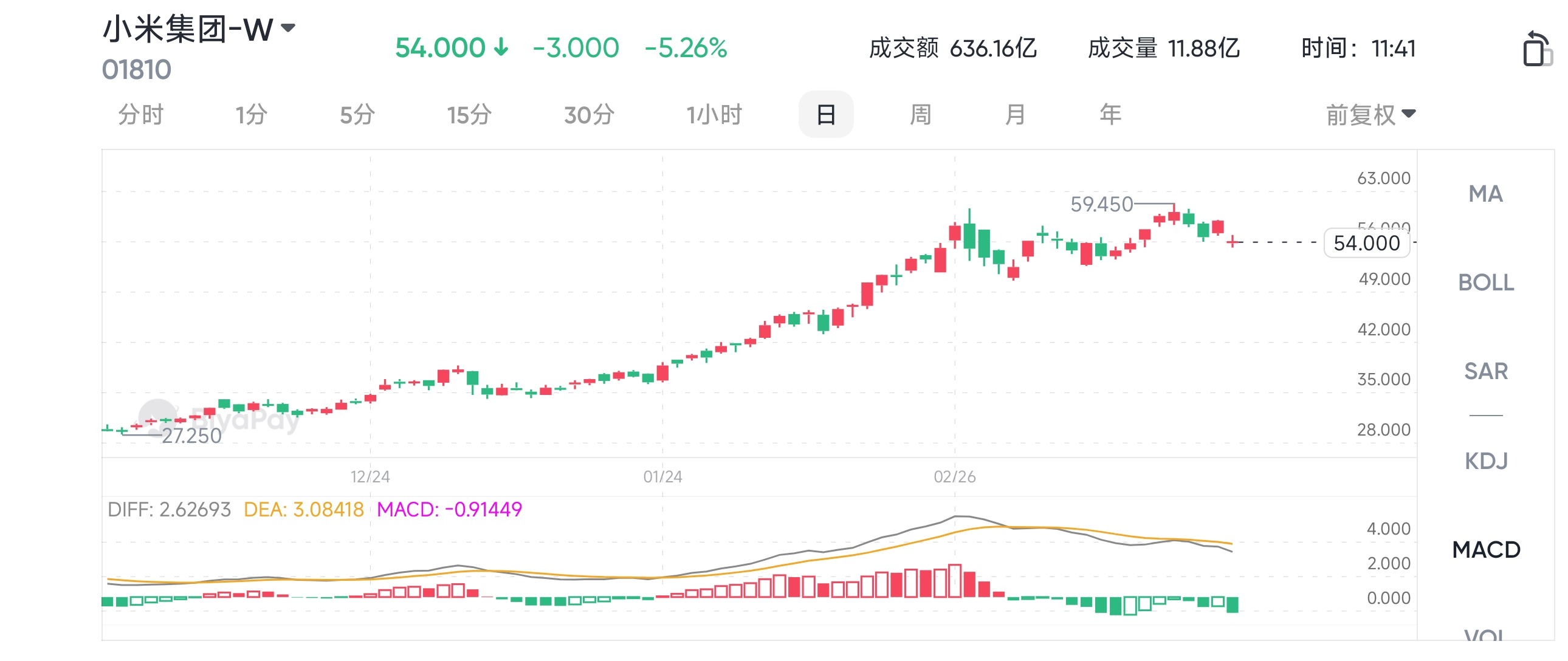
Moreover, after these newly added stocks enter the market, the supply of stocks increases. If the number of people who want to buy stocks in the market does not change, according to the supply and demand relationship, the stock price is likely to fall. Look at Xiaomi’s stock price on the day of resumption of trading, which fell more than 10% on the day of the last financing issue in 2020. Therefore, this time, Xiaomi’s stock price is likely to fall a bit in the short term, and the assets in our ordinary retail accounts will also decrease accordingly.
In addition, although the large shareowner shareholding ratio financing has basically returned to its original state, the total share capital of the company has increased. This is like a big cake. Originally, when it was cut into 100 pieces, you had 1 piece, accounting for 1%; now that the cake is cut into 110 pieces, you still only have 1 piece, so the proportion becomes less than 1%. Our equity stake in the company has been diluted, and in the future, when the company earns money and shares profits, the share we can get will also decrease.
Faced with the possible fluctuations in Xiaomi’s stock price in the short term and the complex and changing situation of Capital Markets, ordinary retail investors urgently need a capable assistant to better manage their investments. BiyaPay has significant advantages in this regard. BiyaPay has rich trading assets, which can not only trade Hong Kong stocks like Xiaomi, but also cover US stocks and various digital currencies. One account can achieve diversified asset allocation. In the current situation of Xiaomi’s stock price fluctuations, you can use BiyaPay’s multi-asset trading function to flexibly adjust your investment portfolio, risk diversification, and better respond to market changes.
Why are we being so harmonious this time?
There are several intuitive reasons for this Xiaomi distribution:
- Xiaomi’s own new energy vehicle orders surged, and the SU7 alone plans to deliver 350,000 units in 2025. In order to achieve the goal, it needs to expand the Wuhan factory, which also requires a lot of funds.
- Xiaomi wants to make a career in the AI field and plans to invest in large models and robots in the future. The plan is to invest up to 100 billion yuan in the next five years.
- Xiaomi wants to push new energy vehicles to the global market and plans to pilot them in South East Asia and Europe. However, going global with cars is not that simple. First, a large amount of funds need to be prepared for building the supply chain.
- The upfront investment in the new energy vehicle industry is huge, like a bottomless pit. Although the 2024 financial report shows that the company’s cash and similar cash reserves are about 140 billion, the current average loss for each car produced is 45,000 yuan, which requires continuous investment.
Many people don’t understand why Xiaomi, whose stock price is at a high level and has a large amount of cash in hand, still needs to issue financing at this time. They think that the company’s approach is not very authentic and harms the interests of small shareholders.
But from the perspective of the company’s strategy, financing makes sense at this time, and it can also be said to be a precautionary measure. The cyclical nature of the technology industry is obvious. Financing is relatively easy when the stock price is high, which can avoid being forced to sell assets at low prices to raise funds during the industry downturn. Just like Tesla encountered a production capacity crisis in 2016, if there had been better financing planning at that time, the situation might have been very different.
However, this kind of allocation behavior is negative news for the stock price in the short term. Institutions obtained stocks at a price of HKD 53.7. As long as the opening price is higher than this price, they are likely to sell the stocks to make a profit. For example, after the allocation in 2020, the stock price fell by more than 10% that day.
Looking ahead, if Xiaomi’s automobile production capacity expands smoothly and can achieve the delivery target of 350,000 vehicles, key achievements can also be made in AI research and development. When combined with IoT businesses such as smart homes and smart wearables, with the synergistic effect of Xiaomi’s Internet of Things, revenue can continue to rise. By then, Xiaomi’s technological strength will be fully demonstrated, and the market will re-recognize it. It is very likely that the company’s valuation will increase, even significantly.
Look at the 2020 distribution, it helped Xiaomi a lot, helping Xiaomi establish a foothold in the high-end smartphone market and reach second place in the global market share. As for the 2025 distribution, Xiaomi has bet on the automotive and AI fields, which have great potential but also significant risks.
If everything goes smoothly, Xiaomi may be able to create a new technology ecosystem that integrates transportation, intelligent interaction, and life services. At that time, the trillion-dollar market value may just be the beginning, and there is a lot of room for future development.
Lei Jun once said, “Standing on the wind, even a pig can fly.” Now Xiaomi is standing on the wind of technological change, but is this wind the era dividend that can bring about a major industrial change and full of opportunities, or the bubble that Capital Markets is too fanatical and creates that will soon dissipate? Can Xiaomi seize this opportunity, rely on its own technical skills and innovative spirit, fly in this strong wind, and open up a new market?
Do you think Xiaomi can succeed in this adventure?
*This article is provided for general information purposes and does not constitute legal, tax or other professional advice from BiyaPay or its subsidiaries and its affiliates, and it is not intended as a substitute for obtaining advice from a financial advisor or any other professional.
We make no representations, warranties or warranties, express or implied, as to the accuracy, completeness or timeliness of the contents of this publication.
Related Blogs of

Tap and Go A Beginner's Guide to Cardless ATM Withdrawals


How Safe Is Your Money With Ally Bank in 2026?


What Are the Daily Limits for Chase Accounts?


The 18 Best Apps to Earn Real Cash This Year

Choose Country or Region to Read Local Blog
 Australia
 Austria
 Belgium
 Canada
 Cyprus
 Czech Republic
 Denmark
 Estonia
 Finland
 France
 Germany
 Greece
 Hong Kong
 India
India Indonesia
 Ireland
 Italy
Italy Japan
Japan Latvia
 Lithuania
 Luxembourg
 Malaysia
 Malta
Malta Morocco
 Nepal
Nepal Netherlands
 New Zealand
 Norway
 Pakistan
 Philippines
 Poland
 Portugal
 Romania
 Singapore
 Slovakia
 Slovenia
 South Africa
 South Korea
 Spain
Spain Sweden
 Thailand
 The United States
 Turkey
 United Arab Emirates
 United Kingdom
 Vietnam
Contact Us




BIYA GLOBAL LLC is a licensed entity registered with the U.S. Securities and Exchange Commission (SEC No.: 802-127417); a certified member of the Financial Industry Regulatory Authority (FINRA) (Central Registration Depository CRD No.: 325027); regulated by the Financial Industry Regulatory Authority (FINRA) and the U.S. Securities and Exchange Commission (SEC).
BIYA GLOBAL LLC is registered with the Financial Crimes Enforcement Network (FinCEN), an agency under the U.S. Department of the Treasury, as a Money Services Business (MSB), with registration number 31000218637349, and regulated by the Financial Crimes Enforcement Network (FinCEN).
BIYA GLOBAL LIMITED is a registered Financial Service Provider (FSP) in New Zealand, with registration number FSP1007221, and is also a registered member of the Financial Services Complaints Limited (FSCL), an independent dispute resolution scheme in New Zealand.