A Simple Guide to Understanding the USA Stock Price




Image Source: unsplash
Many people wonder about the usa stock price. This term describes the overall market performance of stocks in the United States. Major stock market indexes measure this collective performance. In 2025, 62% of Americans reported owning stocks, making the market a key indicator of economic health.
The U.S. stock market is the largest in the world. Its total value highlights the scale of these combined stocks.
Country Market Capitalization (USD) United States 62,185,685 million
This massive market’s value reflects investor confidence in leading American companies.
Key Takeaways
- The USA stock market is very large. It shows how well American companies are doing.
- Market indexes like the S&P 500 help us measure the stock market’s health. They track groups of stocks.
- Things like company profits, economic news, and interest rates make stock prices go up or down.
- Investing in index funds is a good way to start. They let you own small parts of many companies, which spreads out risk.
- It is important to invest regularly and not make quick decisions based on fear or excitement.
How the US Market Is Measured
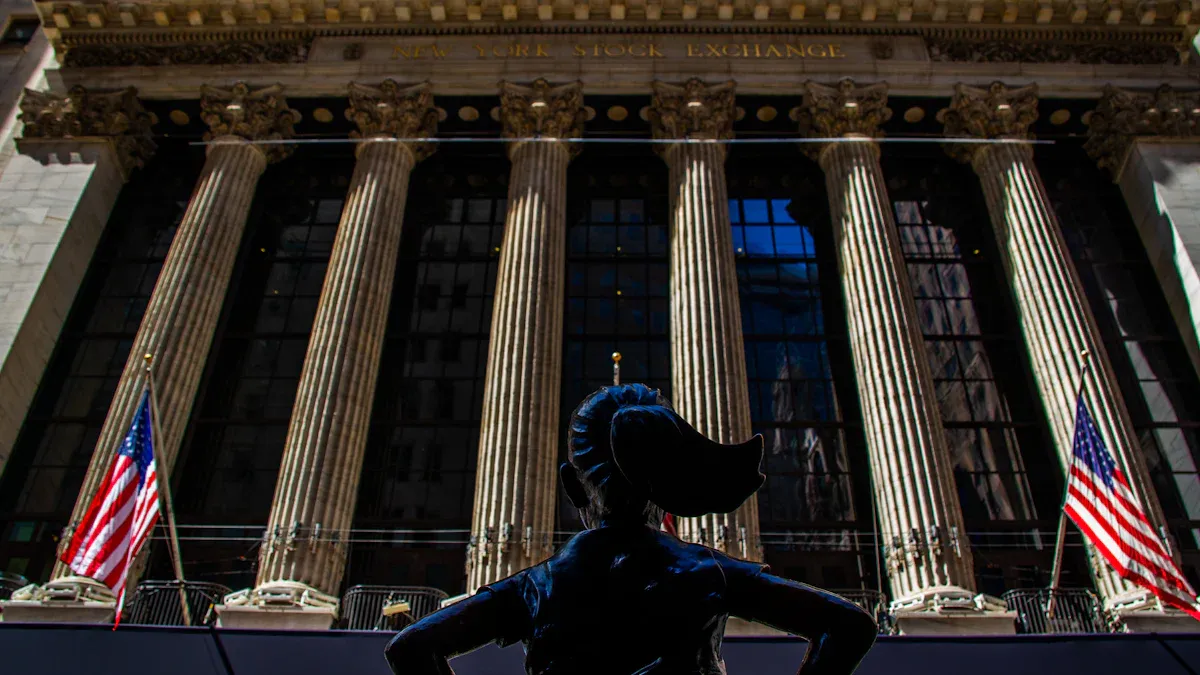
Image Source: unsplash
The vast U.S. stock market requires tools for measurement. Investors use market indexes to gauge performance. These indexes act like thermometers for the economy.
Understanding Market Indexes
A stock market index tracks a specific group of stocks. It offers a snapshot of a market segment’s health. An index fund is a type of investment that mirrors a market index. This allows people to invest in a broad portion of the market easily. An index fund provides instant diversification. Key functions of an index include:
- Informing investors about overall market performance.
- Serving as a benchmark to compare investment returns.
- Acting as the basis for products like an index fund or an exchange-traded fund (ETF).
An index fund simplifies investing. It follows a set index, such as the S&P 500 index. An ETF is a popular type of index fund.
The S&P 500 Index: A Market Benchmark
The S&P 500 index is a primary benchmark for the U.S. stock market. The S&P 500 index includes 500 of America’s largest and most influential public companies. Its performance is a key indicator of market health. The S&P 500 is a market-capitalization-weighted index. This means larger companies, like Nvidia (NVDA), have a greater impact on the S&P 500 index’s value. The S&P has strict criteria for inclusion. A company must be U.S.-based, have a large market capitalization, and show consistent profitability.
Investors can buy a piece of the entire S&P 500 index through an ETF. The SPDR S&P 500 ETF Trust (SPY) is a well-known ETF that tracks the S&P 500. This ETF is a popular index fund. Buying an ETF that tracks the S&P 500 is a common strategy. This type of index fund offers exposure to the broad market. The S&P 500 index is a cornerstone for many portfolios. An ETF tracking the S&P 500 index is a simple way to start.
The Dow Jones and Nasdaq
The Dow Jones Industrial Average is another famous market index. The Dow tracks 30 large, well-established American companies. Unlike the S&P 500, the Dow Jones Industrial Average is price-weighted. A stock with a higher price has more influence on the Dow, regardless of the company’s total size. The Dow Jones Industrial Average offers a focused look at blue-chip stocks. The Dow provides a different perspective on the market than the S&P.
The Nasdaq is a market known for its technology companies. The Nasdaq Composite Index includes thousands of stocks listed on the Nasdaq exchange. The Nasdaq is also market-cap-weighted, similar to the S&P 500. The Nasdaq-100 index is a subset of the Nasdaq. The Nasdaq-100 index tracks the 100 largest non-financial companies on the Nasdaq. This makes the Nasdaq-100 index a key benchmark for the tech sector. Many popular tech stocks like Apple (AAPL) and Microsoft (MSFT) heavily influence the Nasdaq and the Nasdaq-100 index. An ETF can track the Nasdaq-100 index, offering a tech-focused index fund. The Nasdaq-100 index is a go-to for tracking tech innovation. The Nasdaq gives a pulse on the growth-oriented part of the market.
What Drives the USA Stock Price?

Image Source: unsplash
Several key forces influence the overall usa stock price. These factors shape investor decisions and drive market movements. Understanding them provides insight into the market’s daily performance.
Economic Health and Data Reports
Economic data reports offer a crucial look into the nation’s financial health. Investors monitor these announcements closely.
- Gross Domestic Product (GDP): GDP growth influences inflation and interest rates. While initial GDP announcements have a minor effect, revised data can cause significant market reactions.
- Unemployment and Inflation: Monthly reports on jobs and prices heavily impact investor sentiment. High inflation and rising unemployment can reduce consumer spending. This shift affects business revenue and the outlook for many stocks. A weak labor market or persistent price pressures often lead to market uncertainty.
Corporate Profits and Earnings
The financial performance of individual companies is a primary driver of stock prices. When a company reports strong profits and revenue growth, investor confidence increases. This demand often pushes the price of its stocks higher. Conversely, poor earnings or a negative outlook can cause investors to sell, leading to a price decline. The collective earnings performance of major companies significantly sways the entire market.
Federal Reserve Interest Rates
The Federal Reserve’s monetary policy directly impacts the stock market. When the Fed changes its target interest rate, it affects borrowing costs for both companies and consumers. Higher rates can slow business activity and reduce corporate profits, which can negatively affect stocks. Historically, the market’s reaction varies.
| Period | Stock Market Performance During Cycle | Bear Market Within 1 Year |
|---|---|---|
| Since 1990 (5 tightening cycles) | Positive for the duration of each cycle | 1 instance |
| June 1999 Hike | N/A | Yes (within 9 months) |
This data shows that while rate hikes can create short-term fear, the long-term performance is not always negative.
Global Events and Investor Fear
Major global events, from financial crises to pandemics, create uncertainty. This uncertainty often leads to investor fear and rapid selling. The 2008 financial crisis and the COVID-19 pandemic both caused initial, sharp drops in the stock market. Investors use a specific tool to measure this fear.
The Cboe Volatility Index (VIX) is a real-time measure of stock-market volatility. It shows how much the market expects prices on the S&P 500 to change over the next 30 days. For this reason, the VIX is also commonly called the “fear index.”
A high VIX indicates that investors expect significant price swings, reflecting a fearful market. This makes the VIX a key barometer for the usa stock price environment.
Is Investing in Index Funds a Good Idea?
Deciding on an investment strategy can feel overwhelming. For many, investing in index funds offers a balanced approach to entering the stock market. This path provides broad market exposure, but it is essential to understand both the potential rewards and the inherent risks.
The Rewards: Historical Growth
The primary appeal of investing in index funds is their track record of long-term performance. An index fund that tracks a major benchmark like the S&P 500 allows an investor to own a small piece of hundreds of America’s leading companies. Over time, the U.S. market has consistently trended upward, rewarding patient investors.
The historical return of the S&P index demonstrates this growth. Even with market downturns, the long-term performance has remained strong. The dot-com boom of the late 1990s, for example, contributed to five consecutive years of high return rates for the S&P.
| Period | Average Annualized Return (Nominal) | Average Annualized Return (Inflation-Adjusted) |
|---|---|---|
| 5 years (2019-2024) | 13.6% | 8.9% |
| 10 years (2014-2024) | 11.3% | 8% |
| 20 years (2004-2024) | 8.4% | 5.7% |
| 30 years (1994-2024) | 9% | 6.3% |
The power of compounding returns makes this long-term performance even more compelling.
An initial investment of just $100 in an S&P 500 index fund at the start of 1990 would have grown to approximately $3,802.59 by the end of 2025, assuming all dividends were reinvested. This represents a total return of over 3,700% and an average annual return of 10.77%.
While an index fund captures the market’s average return, individual stocks can offer much higher gains. A company like Western Digital (WDC) can deliver huge returns for investors. However, picking the best-performing stocks is extremely difficult and carries significantly higher risk. An index fund provides a more stable path to growth.
The Risks: Market Volatility and Loss
No investment is without risk. The stock market experiences periods of volatility and decline, known as bear markets. Investing in index funds means an investor’s portfolio will fall when the overall market falls. History shows several major downturns.
| Event | Percentage Loss |
|---|---|
| Black Tuesday (1929) | 89% (from pre-crash high) |
| Black Monday (1987) | 22.6% (single-day) |
| Dotcom bubble crash (2000-2002) | Nearly 80% (Nasdaq) |
| Global Financial Crisis (2008-2009) | Nearly 60% (S&P 500) |
| COVID-19 pandemic (2020) | 34% (S&P 500) |
While an index fund exposes investors to broad market risk, the volatility is generally less extreme than that of individual stocks. Certain stocks, like USA Rare Earth (USAR) or Trump Media & Technology Group Corp. (DJT), can experience dramatic price swings based on news and speculation. An index fund diversifies this risk across hundreds of stocks. Some investors try to mitigate risk by choosing “safe” stocks like Johnson & Johnson (JNJ) or CME Group (CME), but for beginners, the diversification of an index fund is a simpler strategy. The key is understanding that the value of an index fund investment will fluctuate.
Avoiding Emotional Investing Mistakes
One of the biggest risks in investing comes from human psychology. Behavioral biases often lead investors to make poor decisions, especially during market volatility.
- Herd Mentality: This is the tendency for individuals to follow the actions of a larger group. It is driven by a fear of missing out (FOMO) or the perceived safety in numbers. This bias can cause investors to buy stocks at inflated prices during a market bubble or sell in a panic during a downturn.
- Loss Aversion: Investors often feel the pain of a loss more deeply than the pleasure of an equal gain. This can lead to panic selling when the market drops, locking in losses and preventing participation in the eventual recovery.
These emotional reactions often result in buying high and selling low—the opposite of a sound investment strategy. A disciplined approach helps overcome these pitfalls. One effective strategy is dollar-cost averaging (DCA).
Dollar-cost averaging is a preset investment approach. It involves investing a fixed amount of money at regular intervals, regardless of market conditions. For example, an investor might decide to put $500 into an S&P index fund on the first of every month. This disciplined habit removes emotion from the decision-making process.
This method helps manage risk and encourages healthy investing habits. When the market is down, the fixed dollar amount buys more shares. When the market is up, it buys fewer shares. DCA prevents investors from trying to “time the market,” a difficult task for even seasoned professionals. It turns investing into a routine rather than a reaction to fear or greed, supporting better long-term performance.
If you want to turn DCA into a repeatable routine, it helps to lock in two checks before each scheduled buy: confirm where the market (or your core holdings) sits within its recent range, and sanity-check FX costs so currency swings don’t quietly distort your plan. On BiyaPay, you can use the Stock info lookup to review index-linked names or key constituents, and the Fiat exchange rate converter to compare real-time quotes and spreads across currencies before you execute on your fixed date; if you don’t have an account yet, start with Sign up. BiyaPay is a multi-asset trading wallet for cross-border payments, investing, trading, and fund management, operating under relevant licensing/registration frameworks in places such as the U.S. and New Zealand—keeping “check data → price costs → execute” in one flow fits the discipline DCA is designed to build.
How to Start Investing
Starting an investment journey involves choosing the right vehicle for your goals. Investors have several options, from broadly diversified funds to individual company stocks. Each path offers a different balance of risk, effort, and potential reward.
Start with an Index Fund for Diversification
For many new investors, an index fund is an excellent starting point. An index fund is a type of mutual fund or exchange-traded fund (ETF) designed to mirror a specific market index, like the S&P 500. This strategy provides instant diversification. An investment in a single S&P 500 index fund gives an investor a small piece of 500 large U.S. companies. This diversification spreads risk.
A key advantage of an index fund is its low cost. Because an index fund passively tracks an index, it does not require expensive active management. This results in lower fees, known as expense ratios. A lower expense ratio means more of the investment return stays with the investor. Many popular ETF options exist.
An ETF is a type of index fund that trades on an exchange like a stock. This makes an ETF a flexible and popular choice. The goal of this investment is to match market performance, not beat it. This makes an index fund a reliable choice for long-term growth.
| Fund Name | Ticker | Expense Ratio |
|---|---|---|
| Fidelity ZERO Large Cap Index | FNILX | 0% |
| Schwab S&P 500 Index Fund | SWPPX | 0.02% |
| Vanguard S&P 500 ETF | VOO | 0.03% |
| iShares Core S&P 500 ETF | IVV | 0.03% |
| SPDR S&P 500 ETF Trust | SPY | 0.095% |
Understanding Mutual Funds
A mutual fund pools money from many investors to purchase a diversified portfolio of stocks, bonds, or other assets. While an index fund is a type of mutual fund, the term “mutual fund” often refers to actively managed funds. The primary difference lies in the management strategy. An actively managed mutual fund has a fund manager who actively picks stocks. The manager’s goal is to outperform a benchmark index. This active approach creates a different investment opportunity.
| Feature | Index Fund | Actively Managed Mutual Fund |
|---|---|---|
| Goal | Match a market benchmark | Outperform a market benchmark |
| Strategy | Passively holds stocks in an index | Actively selects stocks with research |
| Fees | Lower fees (e.g., 0.05%) | Higher fees (e.g., 0.64%) |
| Risk | Aligns with market risk | Adds risk of manager underperformance |
This active management comes at a higher cost. The average expense ratio for an actively managed equity mutual fund is significantly higher than that of a passive index fund. This fee difference can impact long-term returns. An investor in a mutual fund pays for the manager’s expertise. This presents a unique market opportunity. A successful mutual fund can deliver strong returns, but there is no guarantee it will beat a simple index fund. An ETF can also be actively managed, but most are passive. The choice between an index fund ETF and an active mutual fund depends on an investor’s belief in active management.
Buying Individual Stocks
Buying individual stocks offers the greatest potential for high returns but also carries the highest risk. This investment approach involves selecting specific companies an investor believes will perform well. This path requires significant time and research.
Key risks of buying individual stocks include:
- Lack of Diversification: An investment is tied to the fate of one company. Poor performance can lead to substantial losses.
- Time-Consuming Research: Investors must analyze companies thoroughly. This involves studying financial metrics like the Price-to-Earnings (P/E) ratio, Return on Equity (ROE), and debt levels.
- Emotional Decisions: The volatility of single stocks can cause stress, leading to poor choices like selling in a panic.
This path is a significant undertaking. It is an opportunity for investors who enjoy deep analysis and are comfortable with higher risk. Unlike an index fund ETF or a broad mutual fund, picking winning stocks consistently is extremely difficult. For most people, a diversified investment fund like an index fund ETF provides a more balanced approach to participating in the growth of the stock market.
The U.S. stock market experiences fluctuations. It has historically been a powerful tool for long-term wealth growth. The market shows resilience, often recovering strongly after downturns. For most people, a long-term investment is a sound strategy. A diversified investment helps manage market risk. An index fund offers this diversification simply. An index fund is a popular investment choice. This type of index fund helps investors participate in broad market growth.
The right investment depends on personal goals. A low-cost index fund is a practical first step into the market. Consider a low-cost index fund to begin your investment journey. This index fund can build a solid foundation.
FAQ
What is the best index fund for beginners?
A low-cost S&P 500 index fund is a great start. This type of index fund offers broad exposure. An S&P 500 ETF provides instant diversification. The S&P 500 index fund tracks 500 large companies. This ETF is a popular index fund choice for a solid return.
Is an ETF the same as a mutual fund?
An ETF and a mutual fund are similar. Both pool investor money. An ETF trades like a stock throughout the day. A mutual fund prices only once daily. An index fund can be an ETF or a mutual fund. The S&P 500 has many ETF and mutual fund options.
Can I lose money in an S&P 500 index fund?
Yes, an investment can lose value. The usa stock price fluctuates daily. An S&P 500 index fund follows the market. A market downturn will lower the S&P 500 index fund’s return. The Nasdaq can also see a negative return. The S&P 500 has historically recovered from downturns.
Why choose an S&P 500 ETF over a Nasdaq ETF?
The S&P 500 ETF offers broader market diversification. The Nasdaq ETF is tech-heavy. The S&P 500 index fund includes various sectors, reducing risk. An S&P 500 ETF provides a stable return foundation. The usa stock price reflects both the S&P and Nasdaq.
An index fund is a core holding for many. An ETF is a flexible index fund. A mutual fund can also be an index fund. The S&P 500 ETF offers a reliable return. This ETF tracks the S&P.
*This article is provided for general information purposes and does not constitute legal, tax or other professional advice from BiyaPay or its subsidiaries and its affiliates, and it is not intended as a substitute for obtaining advice from a financial advisor or any other professional.
We make no representations, warranties or warranties, express or implied, as to the accuracy, completeness or timeliness of the contents of this publication.
Related Blogs of

Zelle Wire Transfer or ACH? Clearing Up the Confusion


How to Fill Out a CVS Money Order A 2026 Guide


How Safe Is Your Money With Ally Bank in 2026?


What is the Dialing Code for the USA and How to Call?

Choose Country or Region to Read Local Blog
 Australia
 Austria
 Belgium
 Canada
 Cyprus
 Czech Republic
 Denmark
 Estonia
 Finland
 France
 Germany
 Greece
 Hong Kong
 India
India Indonesia
 Ireland
 Italy
Italy Japan
Japan Latvia
 Lithuania
 Luxembourg
 Malaysia
 Malta
Malta Morocco
 Nepal
Nepal Netherlands
 New Zealand
 Norway
 Pakistan
 Philippines
 Poland
 Portugal
 Romania
 Singapore
 Slovakia
 Slovenia
 South Africa
 South Korea
 Spain
Spain Sweden
 Thailand
 The United States
 Turkey
 United Arab Emirates
 United Kingdom
 Vietnam
Contact Us




BIYA GLOBAL LLC is a licensed entity registered with the U.S. Securities and Exchange Commission (SEC No.: 802-127417); a certified member of the Financial Industry Regulatory Authority (FINRA) (Central Registration Depository CRD No.: 325027); regulated by the Financial Industry Regulatory Authority (FINRA) and the U.S. Securities and Exchange Commission (SEC).
BIYA GLOBAL LLC is registered with the Financial Crimes Enforcement Network (FinCEN), an agency under the U.S. Department of the Treasury, as a Money Services Business (MSB), with registration number 31000218637349, and regulated by the Financial Crimes Enforcement Network (FinCEN).
BIYA GLOBAL LIMITED is a registered Financial Service Provider (FSP) in New Zealand, with registration number FSP1007221, and is also a registered member of the Financial Services Complaints Limited (FSCL), an independent dispute resolution scheme in New Zealand.