Sending Money from China to the US: The Secret Weapon to Halve Fees





Image Source: unsplash
Are you still troubled by the heavy fees when sending money to the US from China? Feeling like part of your hard-earned money “evaporates” along the way?
Now, you can say goodbye to this situation. In fact, you just need the right tool. Online remittance platforms like Wise are your “secret weapon,” helping you easily save significant expenses and ensure more funds arrive safely at the destination.
Key Points
- Traditional bank wire transfers have high fees, including service charges and exchange rate spreads, increasing remittance costs.
- Online remittance platforms like Wise are more economical choices, with transparent fees and exchange rates close to the market rate.
- Crypto stablecoin transfers have low costs but come with high risks and compliance issues, not recommended for ordinary users.
- Planning your remittance strategy is important; large amounts are suitable for banks, while small, frequent transfers suit online platforms.
- Remittances must comply with regulations in China and the US, such as annual personal limits and fund declaration requirements.
The Fee Traps of Traditional Wire Transfers
You might think bank wire transfers are the safest and most direct, but the hidden fees often exceed your imagination. These fees act like a bottomless pit, quietly swallowing your funds. Let’s take a $10,000 remittance as an example to see how the money “shrinks” along the way.
The Triple Overlap of Service Fees
Traditional bank wire transfer fees are not a single charge but a complex bundled package. They usually include the following parts:
- Outward Remittance Fee: The service fee charged by your remitting bank.
- Cable Fee: The communication fee for sending remittance instructions between banks.
- Intermediary Bank Fee: If the two banks have no direct cooperation, funds need to pass through one or more “intermediaries,” each charging a pass-through fee, usually $15-$30.
- Receiving Bank Fee: The U.S. receiving bank may also charge a fee for processing the deposit.
Case Calculation: Assume you make a $10,000 remittance from China to the US. Just for service fees, you might pay: outward fee + cable fee (about $30) + intermediary bank fee ($25) + receiving bank fee ($15), totaling about $70. This money is gone before even calculating exchange rate losses.
The “Hidden” Cost in Exchange Rates
The exchange rate provided by banks is not the real-time mid-market rate but their “cash selling rate.” You can think of the mid-market rate as the “wholesale price” for USD, while the bank’s selling price is the “retail price.” The spread between them is the bank’s profit and your hidden remittance cost. This spread is usually 0.5% to 1%. For a $10,000 remittance, this means you might pay an extra $50 to $100 in equivalent RMB.
Bank Rate Comparison Tips
To reduce exchange rate costs, you must learn to actively compare. Major banks like Bank of China (BOC), Industrial and Commercial Bank of China (ICBC), and China Merchants Bank (CMB) all publish real-time foreign exchange rates on their official websites. Spending a few minutes checking before remitting can help you lock in the best rate.
Before you remit, the practical “rate comparison” is less about chasing one bank’s quote and more about separating three variables: the FX reference you’re using, the channel fee, and the expected delivery time. You can start with BiyaPay’s FX converter to normalize key fiat rates under one consistent reference, then check the Send Money page to compare fee and timing notes across routes, and finally return to the BiyaPay website to confirm what currencies and regions are available to you.
This workflow helps you evaluate “spread” and “fees” as two different costs, which usually leads to more stable decisions. It fits best when you’re already working with supported fiat currencies or need cross-currency conversion and cross-border transfers; when compliance matters, you may also reference its multi-jurisdiction context (e.g., U.S. MSB and New Zealand FSP) as part of long-term routing planning.
Bank Selection Tips: Besides rates, service experience matters. If you prioritize speed, ICBC usually processes faster; if you value convenient online operations and promotions, CMB might suit you better. Although BOC has many branches, its operations may be slightly more complex.
Overall, sending $10,000 via traditional banks can easily cost over $120 ($70 in fees + $50 in exchange rate losses), and this is a conservative estimate.
Sending Money from China to the US: Detailed Guide to Three Cost-Saving Channels
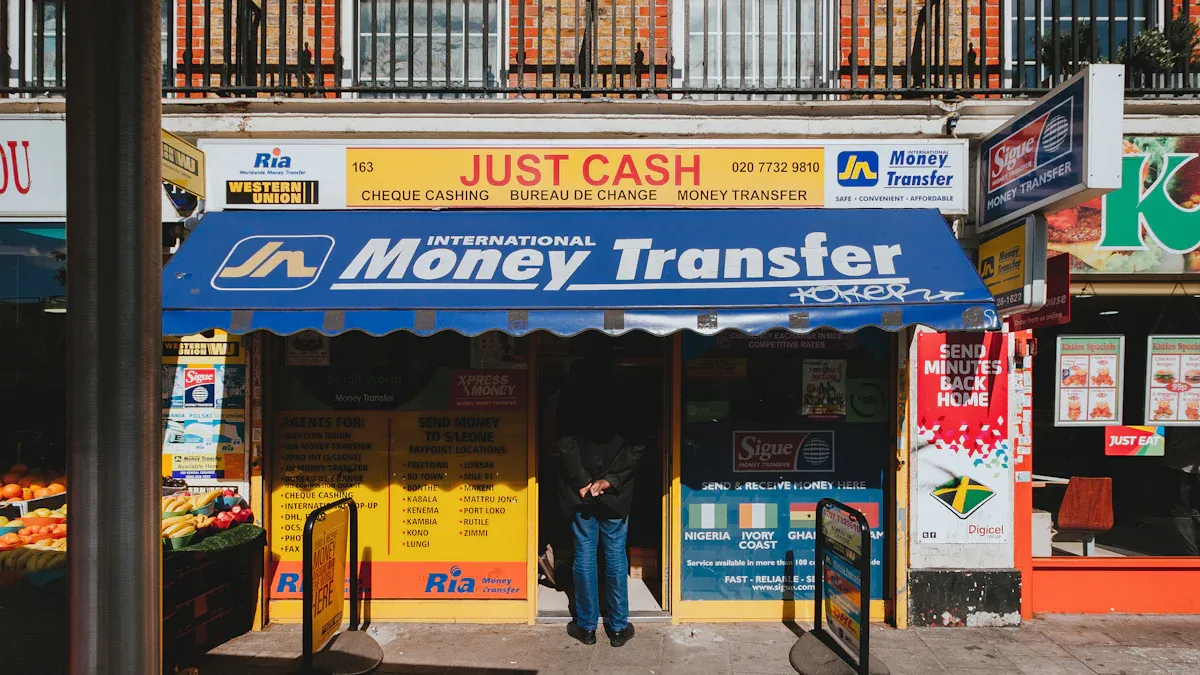
Image Source: unsplash
Say goodbye to bank’s heavy traps—now you have smarter, more economical choices. Sending money from China to the US doesn’t have to be so expensive. Below, we detail three mainstream cost-saving channels to help you find the “secret weapon” that suits you best.
Option One: Online Remittance Platforms
This is likely the best choice balancing speed, cost, and security. Platforms like Biyapay, Wise, or Remitly have completely revolutionized traditional remittance models.
Their success secret lies in bypassing the expensive SWIFT network.
How It Works Revealed
- You pay RMB to the platform’s local account in mainland China.
- After confirming receipt, the platform directly pays the equivalent USD from its local U.S. account to your recipient.
The entire process uses local transfers, with funds not truly “crossing borders,” thus avoiding high intermediary fees.
The biggest advantages of these platforms are transparent fees and fair exchange rates. You can clearly see all fees and the final arrival amount before initiating, and they typically use rates close to the mid-market rate, minimizing exchange losses. For most individual users, this is an efficient and highly cost-effective remittance method.
Option Two: Crypto Stablecoin Transfers
This is an extremely low-cost but extremely high-risk option—proceed with extreme caution. This method transfers funds by purchasing USD-pegged stablecoins (like USDT or USDC).
⚠️ Important Compliance Warning Before considering this option, you must clearly understand its legal risks in China.
- The People’s Bank of China has classified all crypto-related commercial activities as illegal financial activities.
- Financial institutions are strictly prohibited from providing any crypto-related services, including account opening and settlement.
- The State Administration of Foreign Exchange closely monitors cross-border fund flows to prevent capital flight via crypto.
- While personal crypto holding is in a legal gray area, related transaction contracts are not protected by law.
If you still decide to try, the basic process is:
- On platforms supporting P2P/OTC trading (like Biyapay), use RMB to buy USDT from merchants.
- Withdraw USDT from the platform to your compliant U.S. exchange account.
- Sell USDT on the U.S. exchange for USD and withdraw to your U.S. bank account.
The cost of this method is mainly hidden in P2P merchants’ quotes. Merchants usually don’t charge explicit “fees,” but their USDT selling price is slightly above the real-time rate—this spread is your main cost. For example, if the real-time rate is 1 USD to 7.30 RMB, merchants might sell at 7.32. Additionally, certain payment methods (like large Alipay transfers) may incur about 0.1% fees, while local transfers via Hong Kong licensed banks could be lower.
In summary, while theoretically the lowest cost, this option comes with extremely high compliance risks and operational complexity—not recommended for ordinary users.
Option Three: Bank Special Remittance Services
Don’t completely abandon banks. Besides standard wire transfers, some banks, especially certain city commercial banks, occasionally launch preferential remittance services for specific customers. This can serve as a backup for sending money from China to the US.
You can proactively inquire with banks about promotions waiving cable fees or intermediary fees. Additionally, if you meet conditions, you can handle compliant excess remittances through banks.
You need to prepare corresponding supporting documents. Here is a list for common scenarios:
| Service Type | Main Required Documents |
|---|---|
| Self-Funded Study Abroad | ID card, passport/visa, overseas school admission letter and fee notice |
| Overseas Medical Treatment | ID card, passport/visa, local municipal hospital proof, overseas hospital acceptance proof and fee notice |
| Immediate Family Emergencies | ID card, kinship proof, valid proof from overseas notary or Chinese embassy/consulate |
Bank Remittance Tips
- Foreign Exchange Savings Account Remittance: Cumulative outward remittances equivalent to $50,000 USD or less on the same day can be handled with valid ID.
- Foreign Currency Cash Remittance: Cumulative equivalent to $10,000 USD or less on the same day with valid ID; excess requires additional proof.
This method is more economical than standard wire transfers and fully compliant, but requires time to find promotions and prepare documents—suitable for those with specific needs and no urgency.
Remittance Strategy: How to Plan to Save Costs

Image Source: pexels
Choosing the right channel is just the first step. Planning your remittance frequency and amounts is equally key to saving costs. You need to wisely choose between “one-time large remittances” and “batched small remittances.”
Small Frequent vs Large Consolidated
These two strategies have pros and cons, mainly depending on your chosen channel.
If using traditional banks, large consolidated remittances are usually more cost-effective. Bank fees are often proportional but with minimum and maximum caps. For large amounts, fees hit the cap, meaning excess amounts incur no additional fees, effectively lowering average costs.
Bank Fee Structure Observation As shown below, different banks have varying maximum fee caps. A large remittance lets you fully utilize this “ceiling effect.”
Conversely, small frequent remittances suit online platforms better. These platforms’ fee structures are friendlier to small amounts, avoiding banks’ high minimum fees.
Pros and Cons of Batched Remittances
Splitting a large sum into multiple transfers has advantages and disadvantages.
**Main advantages lie in mitigating exchange rate risks. Exchange rates fluctuate daily. Sending all at once locks in one rate, potentially unfavorable. Batching lets you exchange at different times, averaging costs and avoiding single-remittance rate risks.
Benefits of Batched Remittances
- Risk Dispersion: No worry about completing all at the peak rate.
- Increased Flexibility: Choose more favorable timing based on rate trends.
Disadvantages are obvious too. First, each transfer incurs a fee. With banks, multiple minimum and cable fees can make total costs very high. Second, multiple operations require more time and effort.
Formulate Your Best Remittance Plan
So, how should you choose? Decide based on your specific situation.
| Your Situation | Recommended Strategy | Reason |
|---|---|---|
| Need to pay large tuition, home purchase, etc. | Large Consolidated Remittance | Easier to hit bank fee caps or get better bulk rates via online platforms. |
| Need regular living expenses for family | Small Frequent Remittances | Leverage online platforms’ low-fee advantages, disperse rate risks, and more flexible operations. |
| Uncertain future rate trends | Batched Remittances | Average costs over different times for a relatively stable overall rate. |
Ultimately, the best plan combines your fund needs, risk tolerance, and chosen channel’s fee structure.
Compliance and Security: The Uncompromising Red Line
Saving money is important, but ensuring every remittance is legal and compliant is the unshakable bottom line. No matter which channel you choose, you must understand and follow relevant regulations in China and the US. Ignoring these red lines can bring unnecessary trouble or even serious legal consequences.
Understanding the $50,000 Personal Annual Limit
According to China’s State Administration of Foreign Exchange, every Chinese citizen has an annual foreign exchange purchase limit equivalent to $50,000 USD. This limit, set in 2007, facilitates legitimate current account expenditures.
- Self-funded study abroad
- Overseas travel
- Visiting relatives and friends
- Overseas medical treatment
- Paying international organization membership fees, etc.
If your remittance exceeds $50,000, you must submit a written application and supporting documents to the local foreign exchange administration. Without approval, banks will not process excess exchanges. Never attempt to evade by “splitting” or borrowing others’ limits—this is illegal.
Declaration Requirements for Over $10,000
When funds arrive in the US, pay attention to U.S. declaration rules. A common misconception is that recipients must declare every transfer over $10,000.
The Fact Is: Under the U.S. Bank Secrecy Act, declaration duty mainly falls on financial institutions handling the transfer. Your U.S. bank automatically reports international remittances over $10,000 to authorities.
What you need to focus on is the Foreign Bank and Financial Accounts Report. If your total overseas (including mainland China and Hong Kong) financial accounts exceed $10,000 at any point in a year, you must proactively file a Foreign Bank and Financial Accounts Report with the U.S. Treasury. Intentional non-filing can face penalties up to 50% of account balance or $100,000.
Avoiding Triggering Anti-Money Laundering Alerts
Banks and remittance platforms have complex anti-money laundering monitoring systems. Some seemingly harmless patterns can trigger alerts, leading to account freezes or delayed transactions.
To ensure smooth remittances, avoid the following:
- Frequent short-term transfers to multiple unrelated personal accounts.
- Remittance notes clearly inconsistent with your situation (e.g., student account noted “business investment”).
- Relay transfers through multiple third-party accounts to obscure fund paths.
The best practice is to maintain transaction transparency. Prepare documents proving legitimate fund sources, such as your income proof, tax records, or bank statements. This way, even if questioned, you can quickly provide explanations proving compliance.
Sending money from China to the US doesn’t have to involve high fees. Simply choose the right online platform, plan your strategy, and comply with regulations to safely and efficiently save costs.
Your Top Choice For most individual users, tools like Wise are the preferred “secret weapon” balancing fees, speed, and security.
Take action now, assess your needs, choose the best option, and say goodbye to unnecessary fund losses.
FAQ
Which online remittance platform should I choose?
Choose based on your specific needs. Wise is usually friendly for small amounts with transparent fees. For larger amounts, compare Remitly or OFX fees and rates. Spending a few minutes comparing always helps find the most cost-effective option.
How long do remittances usually take?
Speed depends on the channel. Timelines vary significantly—refer to the table below:
| Remittance Channel | Expected Arrival Time |
|---|---|
| Online Remittance Platforms | Usually 1-2 business days |
| Bank Wire Transfer | May take 3-5 business days |
| Crypto Stablecoins | Minutes to hours (but extremely high risk) |
What if I’ve used up my $50,000 annual limit?
You must have legitimate excess purposes. For example, provide overseas school tuition bills or hospital medical bills to banks for additional limit approval. Never borrow others’ limits—this is illegal and risky.
If questioned, how do I prove fund sources?
Keeping Records is Key
Always prepare documents proving fund legitimacy. For example, your employment contract, payroll bank statements, or tax proofs. When banks or platforms require review, these can quickly prove your funds are clean.
*This article is provided for general information purposes and does not constitute legal, tax or other professional advice from BiyaPay or its subsidiaries and its affiliates, and it is not intended as a substitute for obtaining advice from a financial advisor or any other professional.
We make no representations, warranties or warranties, express or implied, as to the accuracy, completeness or timeliness of the contents of this publication.
Related Blogs of
Panda Remit Transfer Failed and Returned? In-Depth Comparison of Risk Control Strictness and Channel Stability Across Different Cross-Border Remittance Apps

Investing in Japanese Real Estate for Rental Yield: How to Convert JPY Rent to USD and Trade US Stocks Using the Same App?


Digital Currency Credit Card Comparison: Which Card Offers the Best POS Exchange Rate in China and Lowest Risk of Suspension?


Cross-Border Charity and International Rescue: How Digital Assets Enable Point-to-Point Ultra-Fast Fund Delivery in Major Global Events?
Choose Country or Region to Read Local Blog
 Australia
 Austria
 Belgium
 Canada
 Cyprus
 Czech Republic
 Denmark
 Estonia
 Finland
 France
 Germany
 Greece
 Hong Kong
 India
India Indonesia
 Ireland
 Italy
Italy Japan
Japan Latvia
 Lithuania
 Luxembourg
 Malaysia
 Malta
Malta Morocco
 Nepal
Nepal Netherlands
 New Zealand
 Norway
 Pakistan
 Philippines
 Poland
 Portugal
 Romania
 Singapore
 Slovakia
 Slovenia
 South Africa
 South Korea
 Spain
Spain Sweden
 Thailand
 The United States
 Turkey
 United Arab Emirates
 United Kingdom
 Vietnam
Contact Us




BIYA GLOBAL LLC is registered with the Financial Crimes Enforcement Network (FinCEN), an agency under the U.S. Department of the Treasury, as a Money Services Business (MSB), with registration number 31000218637349, and regulated by the Financial Crimes Enforcement Network (FinCEN).
BIYA GLOBAL LIMITED is a registered Financial Service Provider (FSP) in New Zealand, with registration number FSP1007221, and is also a registered member of the Financial Services Complaints Limited (FSCL), an independent dispute resolution scheme in New Zealand.