Demystifying the Hang Seng Index: Easily Grasp Industry Trends and Sector Dynamics




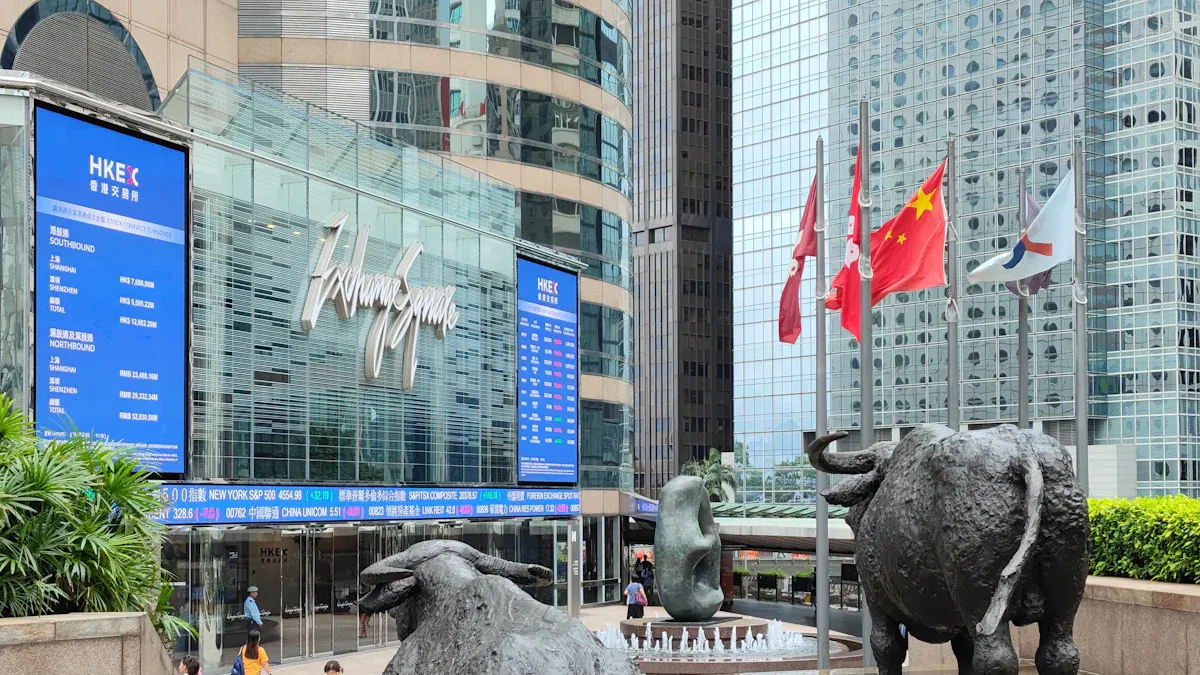
Image Source: unsplash
The Hang Seng Index is the key benchmark for measuring the performance of the Hong Kong stock market. Its constituent stocks are highly representative, currently accounting for 58% of the total market capitalization of the Hong Kong Stock Exchange with 82 companies. Understanding the composition of these companies is the first step to grasping market dynamics.
If your goal is to understand the HSI’s structure (not just memorize the list), it helps to align constituents with sector weights first, then check whether heavyweight price/volume action is consistent with the “rotation” story. For quick validation, BiyaPay Stock Info is a practical place to cross-check key quotes, liquidity signals, and basic references without over-relying on a single headline or chart.
When you want to move from observation to execution, keeping a consistent “check—confirm—act” flow is usually cleaner: start from the BiyaPay official site to confirm available market entry points and scope, then proceed via the unified Trading Entry. If you haven’t created an account yet, you can begin with Register. The product positioning is closer to a multi-asset wallet approach, which can make portfolio monitoring and capital planning more centralized.
For readers who also care about platform background checks, BiyaPay discloses multi-jurisdiction compliance references such as U.S. MSB and New Zealand FSP registration (available via the official site above). Treat this as a verification step for cross-market workflows, rather than as an investment thesis.
Latest Constituent Stock List
This article not only provides a clear constituent list but also dives deep into the underlying industry structure and investment implications, helping investors gain valuable insights.
Key Takeaways
- The Hang Seng Index is a vital indicator of the Hong Kong stock market, reflecting overall market performance.
- Financials and Information Technology are the two most important sectors in the Hang Seng Index; their performance significantly impacts the index.
- The Hang Seng Index periodically adjusts its constituents to include new growth companies and remove underperforming ones.
- Investors can assess whether their portfolio is balanced by understanding the industry distribution of the Hang Seng Index.
- New-economy stocks are becoming increasingly important in the Hang Seng Index, representing future economic growth trends.
Latest Hang Seng Index Constituent Stocks
The constituents of the Hang Seng Index are not fixed but are regularly reviewed to reflect the latest market structure. As of the most recent quarterly review, there are 88 constituent stocks. These companies are selected from those listed on the main board of the Hong Kong Stock Exchange based on multiple criteria such as market capitalization and trading volume.
Latest Index Update Hang Seng Indexes Company has announced that Innovent Biologics (stock code: 1801) will be officially included on December 8, 2024. At that time, the total number of Hang Seng Index constituents will increase to 89, further enhancing its representation in the biotechnology sector.
To help investors better understand the index composition, the major constituents are categorized below into four core sectors according to the Hang Seng Industry Classification System and presented in tables.
Financial Services Sector
The financial services sector is the cornerstone of the Hong Kong market and holds a pivotal position in the index. This category includes banks, insurance companies, and other financial institutions whose performance is closely tied to the macroeconomic environment.
| Company Name | Stock Code |
|---|---|
| HSBC Holdings | 0005 |
| AIA Group | 1299 |
| Hong Kong Exchanges and Clearing | 0388 |
| China Construction Bank | 0939 |
| Industrial and Commercial Bank of China | 1398 |
Information Technology Sector
The information technology sector has been the primary growth driver of the index in recent years. This category includes several mainland Chinese tech giants covering high-growth areas such as social media, e-commerce, cloud computing, and gaming.
| Company Name | Stock Code |
|---|---|
| Tencent Holdings | 0700 |
| Alibaba Group | 9988 |
| Meituan | 3690 |
| Xiaomi Corporation | 1810 |
| NetEase | 9999 |
Real Estate & Construction Sector
The real estate and construction sector directly reflects local economic activity and asset values in Hong Kong. Constituents are mainly large local property developers whose share prices are highly sensitive to interest rate policies and the property market cycle.
| Company Name | Stock Code |
|---|---|
| CK Hutchison Holdings | 1113 |
| Sun Hung Kai Properties | 0016 |
| Henderson Land Development | 0012 |
| Wharf Real Estate Investment Company | 1997 |
| China Overseas Land & Investment | 0688 |
Consumer Goods & Healthcare
This category covers discretionary consumer goods, consumer staples, and healthcare. From sporting goods and dining to pharmaceutical R&D, these companies reflect consumer spending power and quality-of-life pursuits, serving as an important window into domestic demand.
| Company Name | Stock Code |
|---|---|
| ANTA Sports | 2020 |
| Budweiser Brewing Company APAC | 1876 |
| Haidilao International | 6862 |
| CSPC Pharmaceutical | 1093 |
| Sino Biopharmaceutical | 1177 |
Hang Seng Index Sector Weight Analysis
Simply looking at the constituent list does not give investors a complete picture of the market. The real insight comes from understanding the “weight” of each sector in the index. Sectors with higher weights have a greater impact on index movements.
According to data released by Hang Seng Indexes Company, financials and information technology are currently the two most influential sectors, together accounting for more than half of the index weight.
Hang Seng Index Sector Weight Distribution (Overview)
- Financials: ~34%
- Information Technology: ~25%
- Discretionary Consumer Goods: ~11%
- Real Estate & Construction: ~7%
- Others (including utilities, healthcare, etc.): ~23%
(Note: The above are approximate figures; actual weights change daily)
For easy tracking, all constituents are officially divided into four classification indices that correspond to the 12 industry sectors we commonly see — excellent tools for analyzing sector rotation.
- Finance Classification Index
- Utilities Classification Index
- Property Classification Index
- Commerce & Industry Classification Index (covers IT, consumer goods, healthcare, industrials, etc.)
The Cornerstone Status of Financials
Financials are the lifeblood of the Hong Kong economy and act as a “stabilizer” in the index. This sector is dominated by large banks and insurers such as HSBC Holdings and AIA Group. Their profitability is closely linked to global macroeconomics and interest rate trends.
Investor Note
Financial stocks generally offer stable performance and are a core allocation in many portfolios. When interest rates are expected to rise, banks’ net interest margins tend to widen, often attracting market attention.
The Growth Engine of Information Technology
The information technology sector has been the core growth engine driving the index in recent years. Constituents are mainly large mainland Chinese tech companies, including Tencent, Alibaba, and Meituan, spanning social media, e-commerce, cloud computing, and digital entertainment — representing the direction of the new economy.
This sector exhibits relatively high volatility. Its growth potential is influenced by technological innovation, competition, and regulatory policy. For investors, it is a high-reward, high-risk area.
Discretionary vs. Staples Consumer Sectors
The consumer sector is an important window for observing household spending power and confidence.
- Discretionary Consumer Goods: Includes automobiles, sporting goods, dining, and gaming. These tend to grow first when the economy improves and incomes rise.
- Consumer Staples: Includes food, beverages, and personal care products that are daily necessities regardless of economic conditions, giving this sub-sector strong defensive characteristics.
The combination of these two sub-sectors allows investors to flexibly adjust strategies based on their economic outlook.
Real Estate and Utilities Weight
The real estate and construction sector directly reflects Hong Kong’s local economic health. Share prices of major developers are extremely sensitive to interest rate changes and property market policies.
Utilities are regarded as traditional “defensive” assets. Electricity and gas companies provide stable cash flows and dividends, often becoming safe havens when market uncertainty rises.
The table below clearly shows the correspondence between the four official classification indices and major industries:
| Four Major Classification Indices | Main Industries Included (Partial) | Characteristics |
|---|---|---|
| Finance Classification Index | Banks, Insurance, Diversified Financials | High correlation with macroeconomy |
| Utilities Classification Index | Electricity, Gas | Stable operations, defensive |
| Property Classification Index | Property Developers, REITs | Sensitive to interest rates and local policy |
| Commerce & Industry Classification Index | IT, Consumer Goods, Healthcare, Industrials | Broadest coverage, represents growth and diversification |
Recent Constituent Changes and Trends

Image Source: pexels
Hang Seng Index constituents are not static; regular reviews and adjustments are key clues to understanding market trends and economic structural changes. Each change reveals which industries are rising and which are fading.
Analysis of Newly Added Stocks
New members of the index often represent the growth areas currently most watched by the market. Recent additions such as Pop Mart, JD Logistics, and China Telecom are typical examples. Their inclusion reflects several important trends:
- Rise of New Consumption: Companies focused on trendy toys show that new-generation consumption patterns and cultural influence are gaining increasing capital market recognition.
- Deepening Tech Applications: The addition of logistics and telecom companies highlights the importance of digital economy infrastructure.
Lessons from Removed Stocks
Whenever new members are added, some existing ones are removed. Although reasons vary, the overall trend shows that the weighting of certain traditional industrials or cyclical stocks is gradually declining. This does not mean these companies have lost value; rather, it reflects the Hang Seng Index’s ongoing “metabolism” to more accurately capture economic vitality by shifting focus to new-economy sectors with greater growth potential.
Economic Signals Reflected by Index Changes
Changes in index constituents directly demonstrate the increasing linkage between Hong Kong and mainland China economies.
Liao Qun, Chief Economist at China CITIC Bank International, pointed out that new-economy stocks, especially mainland Chinese internet-related companies, are growing strongly and will gradually replace traditional blue-chip stocks in the index over the long term.
Currently, the technology sector has surpassed financials to become the single largest sector in the index. This structural shift clearly tells investors that mainland China’s new-economy forces have become the core engine driving the market.
Long-Term Impact of Index Expansion
To more comprehensively reflect market structure, Hang Seng Indexes Company has launched a long-term expansion plan with the following main objectives:
- Increase the number of constituents: Gradually expand from the current level to 100 companies.
- Lower single-stock weight cap: Reduce the maximum weight of any single constituent from 10% to 8% to enhance diversification.
- Shorten listing history requirement: Allow high-quality large new listings to be included faster.
These reforms aim to make the industry distribution of the index more balanced, reduce reliance on any single sector, and provide investors with a more representative and diversified market benchmark.
Key Constituent Outlook Scan
Image Source: unsplash
After understanding the overall index structure, in-depth analysis of several representative heavyweights helps investors more concretely grasp market dynamics. The strategies of these leading companies often foreshadow the future direction of their entire industries.
Tencent Holdings: Tech Giant’s Strategic Layout
As the tech giant in the Hang Seng Index, Tencent has a diversified business spanning gaming, social media, advertising, and fintech. The company is aggressively investing in artificial intelligence, integrating AI technology into core products and achieving 21% growth in advertising revenue through upgraded ad tools.
Tencent’s goal is clear: it plans to achieve average annual revenue growth of about 11% over the next three years. This growth will be driven by expanding its gaming pipeline, accelerating AI advertising development, growing fintech and cloud businesses, and expanding overseas markets.
Gaming remains a solid cash cow with growth both domestically and internationally, while fintech and payment businesses benefit from improving consumer spending in mainland China.
Alibaba Group: Dual Engines of E-commerce and Cloud
Alibaba’s core business revolves around e-commerce and cloud computing as dual engines. Despite intense competition, its core operations continue to show strong growth momentum.
| Business Segment | Revenue Growth | Revenue Amount |
|---|---|---|
| E-commerce | 16% | $18.6 billion |
| Cloud Computing | 34% | $5.6 billion |
The cloud computing segment is particularly noteworthy. Alibaba holds a 35.8% share of the mainland China cloud market, demonstrating its key position in the wave of enterprise digital transformation. The synergy between these two engines provides the company with a stable growth foundation.
AIA Group: Stabilizer in the Financial Sector
AIA Group is a leading pan-Asian insurance group and serves as a stabilizer in the Hang Seng Index’s financial sector. The company recently recorded 25% strong growth in new business value, with particularly outstanding contribution from mainland China.
AIA is actively pursuing its expansion strategy in mainland China:
- New business value in five developing regions grew 35% year-over-year.
- Contribution from newly developed geographic areas to new business value increased from 8% to 11%.
This shows AIA has successfully seized market opportunities, and its steady business expansion provides investors with a reliable value reference.
Techtronic Industries: Representative Industrial Stock
Techtronic Industries (TTI) is a global leader in the power tools market and an important industrial constituent in the Hang Seng Index. The company dominates the professional and DIY segments through its Milwaukee and RYOBI brands, respectively.
TTI’s success stems from its focus on cordless technology and continuous innovation. It pioneered lithium-ion battery-powered cordless tools and built a powerful product ecosystem around its battery platform. This strategy has fostered extremely high brand loyalty and enabled it to continuously gain market share from legacy brands. In 2024, the company achieved total sales of $14.6 billion with net profit growth of 14.9%, demonstrating strong profitability.
This analysis reveals that the current Hang Seng Index structure is dominated by financials and information technology. The weight distribution of these two major sectors serves as the foundation for investors to judge market direction. Based on this structure, investors can observe from the following perspectives:
- Monitor changes in financial and tech stock weights to balance risk in personal portfolios.
- Pay attention to newly added constituents, which often represent emerging trends in consumption or technology.
Investors should treat this analysis as a starting point and continue to follow the index’s quarterly reviews to dynamically adjust investment strategies.
FAQ
How often does the Hang Seng Index update its constituents?
Hang Seng Indexes Company conducts a constituent review every quarter. Results are usually announced in February, May, August, and November each year. This ensures the index continuously reflects the latest market changes.
Why is there a weight cap for individual stocks?
The weight cap (currently 8%) prevents any single company from exerting excessive influence on the index. This increases diversification, reduces concentration risk, and makes the index a more balanced representation of overall market performance.
How can investors use the industry distribution information of the index?
Investors can refer to the sector weights to assess whether their own portfolio is overly concentrated in certain industries. For example, if personal holdings deviate significantly from the index’s industry distribution, adjustments can be made to balance risk.
Why are new-economy stocks becoming increasingly important in the index?
New-economy stocks (such as IT and new consumption) represent future growth trends. Including more of these companies allows the Hang Seng Index to more accurately capture structural economic shifts and reflect the most dynamic parts of the market.
*This article is provided for general information purposes and does not constitute legal, tax or other professional advice from BiyaPay or its subsidiaries and its affiliates, and it is not intended as a substitute for obtaining advice from a financial advisor or any other professional.
We make no representations, warranties or warranties, express or implied, as to the accuracy, completeness or timeliness of the contents of this publication.
Related Blogs of

International Students Returning Home After Graduation: How to Most Conveniently and Cost-Effectively Bring Back the Few Thousand USD Left in Your US Bank Card?


Reasons for Cross-Border Payment Account Closure (Account Shutdown) and How to Respond: Essential Anti-Account-Ban Guide for Foreign Trade Professionals


Logic of Money Laundering Conviction: How Ordinary People Ensure Their Crypto Asset Cash-Out Activities Never Cross the Red Line


Digital Currency Credit Card Comparison: Which Card Offers the Best POS Exchange Rate in China and Lowest Risk of Suspension?
Choose Country or Region to Read Local Blog
 Australia
 Austria
 Belgium
 Canada
 Cyprus
 Czech Republic
 Denmark
 Estonia
 Finland
 France
 Germany
 Greece
 Hong Kong
 India
India Indonesia
 Ireland
 Italy
Italy Japan
Japan Latvia
 Lithuania
 Luxembourg
 Malaysia
 Malta
Malta Morocco
 Nepal
Nepal Netherlands
 New Zealand
 Norway
 Pakistan
 Philippines
 Poland
 Portugal
 Romania
 Singapore
 Slovakia
 Slovenia
 South Africa
 South Korea
 Spain
Spain Sweden
 Thailand
 The United States
 Turkey
 United Arab Emirates
 United Kingdom
 Vietnam
Contact Us




BIYA GLOBAL LLC is registered with the Financial Crimes Enforcement Network (FinCEN), an agency under the U.S. Department of the Treasury, as a Money Services Business (MSB), with registration number 31000218637349, and regulated by the Financial Crimes Enforcement Network (FinCEN).
BIYA GLOBAL LIMITED is a registered Financial Service Provider (FSP) in New Zealand, with registration number FSP1007221, and is also a registered member of the Financial Services Complaints Limited (FSCL), an independent dispute resolution scheme in New Zealand.