What Does Quadruple Witching Day Mean? Analyzing the Critical Moments of Market Turbulence



One-Sentence Definition
“Quadruple Witching” is a term used in the stock and derivatives markets, referring to the four times a year (the third Friday of March, June, September, and December) when multiple stock/index-related derivatives expire simultaneously. Think of it as “multiple highways merging at a toll booth,” where vehicles (trading orders) pile up, causing congestion (surging trading volume) and braking/acceleration (price volatility) to become more pronounced.
When Does It Happen? Which Contracts Are Involved?
- Fixed Timing: The third Friday of March, June, September, and December each year. For 2025, these are March 21, June 20, September 19, and December 19 (all in Eastern Time).
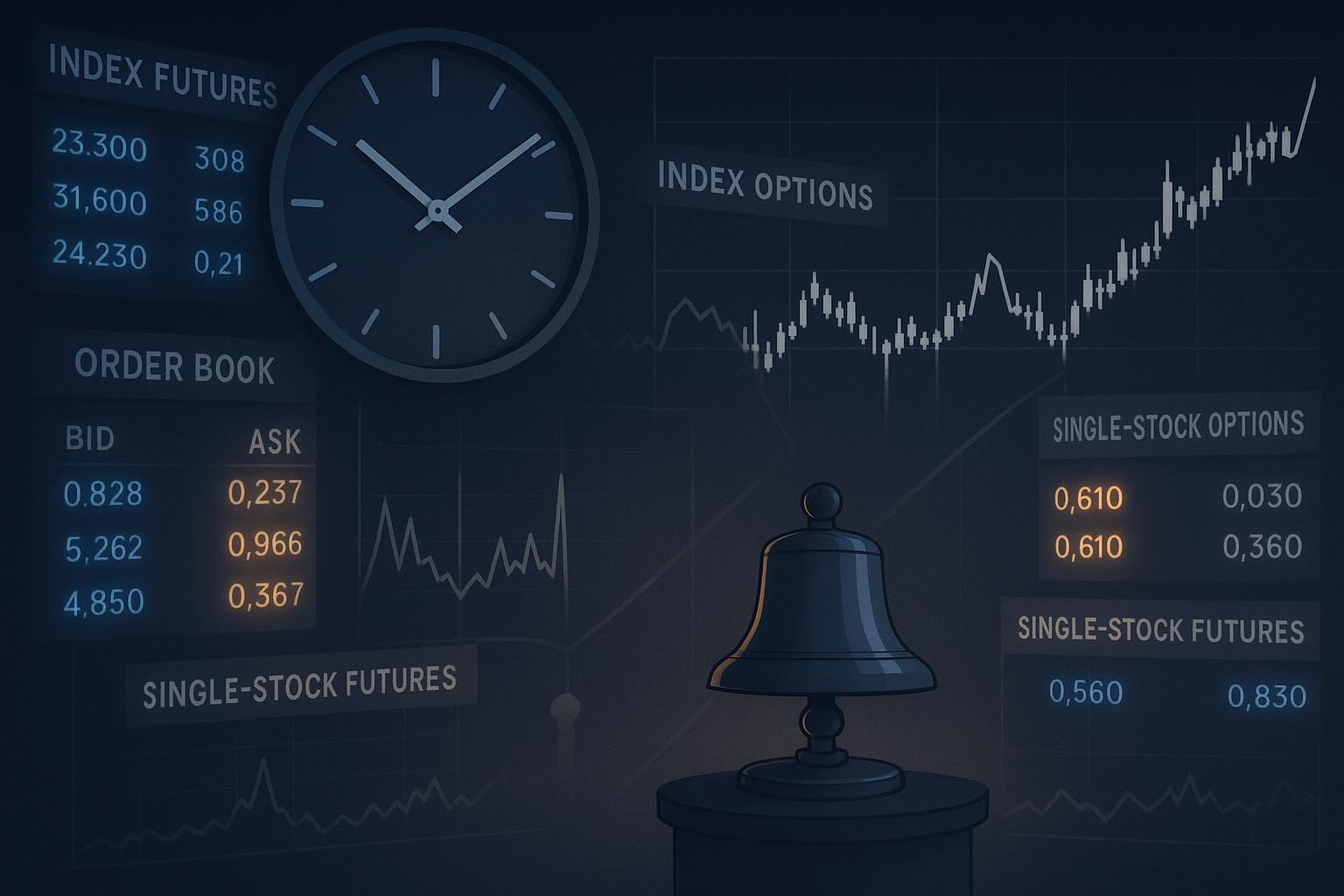
- Traditional “Four Types” of Contracts:
- Stock index futures;
- Stock index options;
- Individual stock options;
- Individual stock futures (historically present in the U.S. market but largely dormant since 2020).
- “Witching Hour”: The final hour of the trading day (typically the last hour before the U.S. stock market closes) is more likely to see concentrated changes in liquidity and price.
It’s worth emphasizing: “Surging volume” on these days is nearly a consensus, but the direction is not predetermined—it doesn’t necessarily mean a sharp rise or fall. This is clearly explained in Nasdaq’s educational article, which notes that “Triple/Quadruple Witching” is more notably characterized by rising trading volume and activity, not directional conclusions, see Nasdaq’s 2021 Analysis of Triple Witching Impact.
Why Does Volume Surge and Volatility Spike at the Close? Three Key Mechanisms
1) Closing Auction Pushes Liquidity to a Single Moment
The closing price of U.S. stocks is determined by the exchange’s closing auction (Closing Auction/Closing Cross). For example, at the NYSE, MOC/LOC (Market-on-Close/Limit-on-Close) orders face strict cancellation or modification restrictions after 15:50 (ET), and imbalance information is disclosed to the market, guiding counterparty orders to converge in the unified auction near 16:00. This compresses a large volume of hedging, closing, and rebalancing demands into the same time window at the close, amplifying trading volume and volatility. For the mechanism and time window, see NYSE Closing Auction Process Fact Sheet (2023).
2) Index and ETF Quarterly Rebalancing Often Coincides with Quadruple Witching
Index methodologies, such as those of S&P Dow Jones, typically adopt quarterly rebalancing, with adjustments effective after the close on the third Friday of the quarter-end. Passive index funds need to buy or sell near the closing auction to track new weights. When rebalancing coincides with Quadruple Witching, the hedging/rollover of expiring derivatives and passive index trading overlap in the same period, further amplifying closing volume and price impact. See S&P U.S. Indices Methodology (S&P DJI).
3) Concentrated Expirations Trigger Closing, Exercise, and Re-hedging
Options and futures expiring that week or month, when prices are near key strike/settlement prices, prompt hedging adjustments by market makers and institutions. Additionally, position holders decide whether to exercise or abandon options based on in-the-money/out-of-the-money status, with these trading actions converging temporally, leading to higher “stampede-like” liquidity demand, especially at the close. Nasdaq’s 2021 educational material highlights “rising trading volume” as a key feature (see link above).
Triple Witching vs. Quadruple Witching: A Historical Evolution
Historically, “Quadruple Witching” included individual stock futures. However, with the closure of the U.S. single-stock futures exchange OneChicago in 2020, the phenomenon is now closer to “Triple Witching” (stock index futures, stock index options, individual stock options). The term “Quadruple Witching” persists in markets, largely due to historical habit or as a general reference to “quarterly expiration day phenomena,” as explained in Nasdaq’s terminology discussion (2021 article, see link above).
What Does It Mean for Different Investors?
- Short-Term/Active Traders
- Pay attention to exchange closing auction rules and time windows. The NYSE imposes strict cancellation/modification limits after 15:50 (ET), and imbalances near 16:00 may lead to slippage and rapid volatility, see NYSE Closing Auction Process Fact Sheet (2023).
- Assess potential hedging demand using options open interest (OI) and expiration distribution to avoid blindly chasing orders at the close.
- Medium-to-Long-Term/ETF Holders
- Quarter-end (March, June, September, December) price and volume anomalies during Quadruple Witching, combined with index rebalancing, are often “technical” in nature, so avoid overreacting with trades. Index methodologies confirm rebalancing takes effect at this point, see S&P U.S. Indices Methodology.
- Options Holders
- Final instructions for exercising or abandoning options typically must be submitted to brokers by 17:30 (ET) on expiration day; some brokers may have earlier cutoffs. Regulatory reminders are available at FINRA 2021 Information Notice (Exercise Deadlines).
- Note the automatic exercise (Exercise by Exception, Ex-by-Ex) threshold. The Options Clearing Corporation (OCC) explains in multiple memos that in-the-money options by $0.01 trigger automatic exercise, see OCC Info Memo Example: Info Memo 55843, 2025-01-02. To abandon automatic exercise, follow your broker’s instructions promptly.
Common Misconceptions and Clarifications
- Misconception 1: “Quadruple Witching always leads to big gains or losses”
- Clarification: The consensus is “surging volume and increased activity,” but there’s no consistent directional pattern. News narratives may create “selection bias,” so don’t treat isolated cases as a rule.
- Misconception 2: “Only U.S. markets have Quadruple Witching”
- Clarification: Quadruple Witching is a U.S. market term, but the combined effect of “quarter-end multi-instrument expirations + passive rebalancing + closing auctions” may occur in other markets (e.g., some Asia-Pacific markets’ quarterly expiration or index futures settlement days), though terminology and rule details differ.
- Misconception 3: “Individual stock futures are still a standard part of Quadruple Witching”
- Clarification: U.S. single-stock futures have been dormant since 2020, making it more of a “Triple Witching” phenomenon; “Quadruple Witching” is often a retained term.
Summary
Think of “Quadruple Witching” as a “mechanistic congestion moment”: derivatives expirations, unified closing auctions, and index/ETF quarterly rebalancing converge temporally, leading to amplified trading volume and increased volatility at the close. For investors, the key is to distinguish technical from fundamental drivers and act per your strategy: short-term traders should manage slippage and position exposure, medium-to-long-term holders should avoid emotional trading, and options holders should clarify exercise and assignment rules before expiration. The above points and rules are based on publicly available information as of 2025.
Quadruple Witching is a moment of “liquidity congestion” driven by market mechanics. The concentrated surge in volume and price offers short-term opportunities for active traders to capture stocks spreads. However, this high volatility is accompanied by high slippage risk. If your trading costs (commissions, fees) are excessive, the profits you capture can be instantly eroded by friction. During critical market shakes, you need a global trading platform that ensures maximum cost efficiency.
BiyaPay provides robust support for navigating events like the Quadruple Witching. You can trade US and Hong Kong equities on one platform without a foreign account, benefiting from zero commission on contract order placement. This significantly reduces the transaction friction when capturing opportunities in highly volatile markets. Furthermore, BiyaPay offers real-time exchange rate checks and conversion services, supporting seamless exchange between 30+ fiat currencies and 200+ cryptocurrencies, with remittance fees as low as 0.5%, ensuring same-day transfer and arrival of funds. Register quickly with BiyaPay today to convert market volatility into your allocation advantage with zero-cost trading and efficient global capital management.
*This article is provided for general information purposes and does not constitute legal, tax or other professional advice from BiyaPay or its subsidiaries and its affiliates, and it is not intended as a substitute for obtaining advice from a financial advisor or any other professional.
We make no representations, warranties or warranties, express or implied, as to the accuracy, completeness or timeliness of the contents of this publication.
Related Blogs of

How to Fill Out a CVS Money Order A 2026 Guide


How Safe Is Your Money With Ally Bank in 2026?


Zelle Wire Transfer or ACH? Clearing Up the Confusion


The 18 Best Apps to Earn Real Cash This Year

Choose Country or Region to Read Local Blog
 Australia
 Austria
 Belgium
 Canada
 Cyprus
 Czech Republic
 Denmark
 Estonia
 Finland
 France
 Germany
 Greece
 Hong Kong
 India
India Indonesia
 Ireland
 Italy
Italy Japan
Japan Latvia
 Lithuania
 Luxembourg
 Malaysia
 Malta
Malta Morocco
 Nepal
Nepal Netherlands
 New Zealand
 Norway
 Pakistan
 Philippines
 Poland
 Portugal
 Romania
 Singapore
 Slovakia
 Slovenia
 South Africa
 South Korea
 Spain
Spain Sweden
 Thailand
 The United States
 Turkey
 United Arab Emirates
 United Kingdom
 Vietnam
Contact Us




BIYA GLOBAL LLC is a licensed entity registered with the U.S. Securities and Exchange Commission (SEC No.: 802-127417); a certified member of the Financial Industry Regulatory Authority (FINRA) (Central Registration Depository CRD No.: 325027); regulated by the Financial Industry Regulatory Authority (FINRA) and the U.S. Securities and Exchange Commission (SEC).
BIYA GLOBAL LLC is registered with the Financial Crimes Enforcement Network (FinCEN), an agency under the U.S. Department of the Treasury, as a Money Services Business (MSB), with registration number 31000218637349, and regulated by the Financial Crimes Enforcement Network (FinCEN).
BIYA GLOBAL LIMITED is a registered Financial Service Provider (FSP) in New Zealand, with registration number FSP1007221, and is also a registered member of the Financial Services Complaints Limited (FSCL), an independent dispute resolution scheme in New Zealand.