
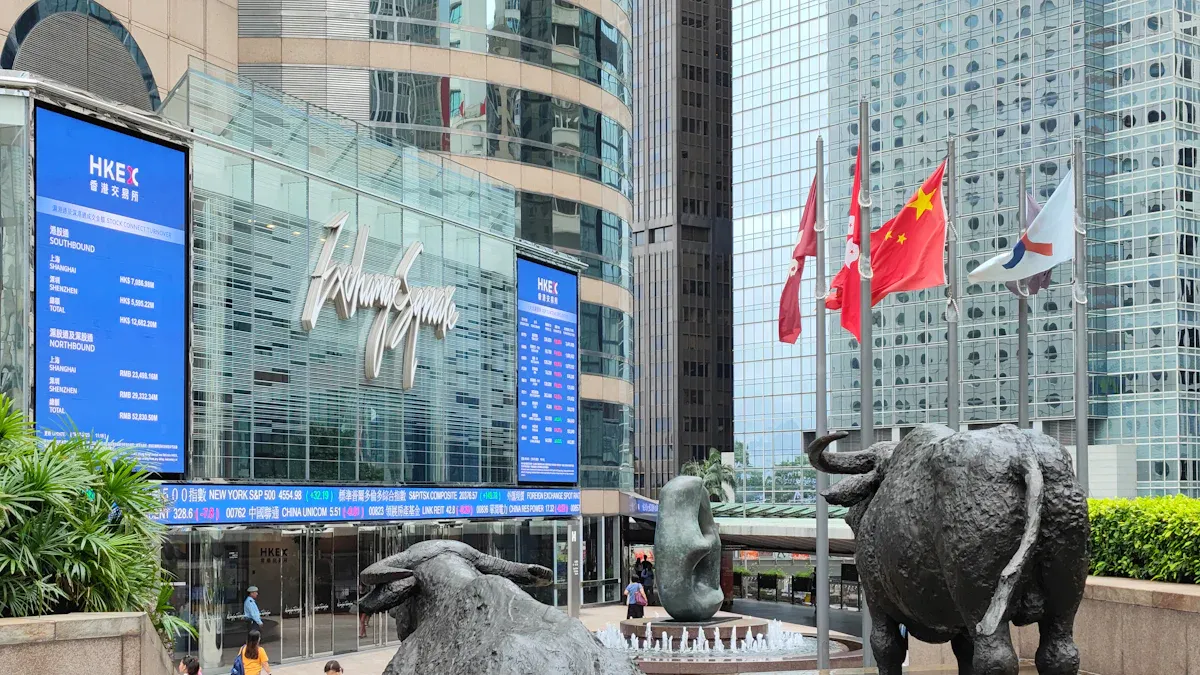
Hong Kong Stock Investing for Beginners
Learn the basics of Hong Kong stock investing, including account opening, market hours, fees, order types, Stock Connect, trading rules, and key risks.
Related Blogs

Mid-to-Late August 2026 U.S. and Hong Kong Earnings Calendar: What to Watch in Tencent, SMCI, Xiaomi, Baidu and More
A concise earnings calendar for mid-to-late August 2026, covering Tencent, SMCI, Xiaomi, Baidu and other key U.S. and Hong Kong stocks, with a focus on AI orders, advertising, auto margins and cash flow.

Matt
2026-08-10 18:59:35

What Are the Hong Kong AI Infrastructure Stocks? Investment Logic for SMIC, Hua Hong Semiconductor, and Lenovo Group
Hong Kong AI infrastructure stocks mainly cover wafer foundry, specialty processes, AI servers, storage, and liquid cooling. This analysis explains the business positioning, financial indicators, growth catalysts, valuation methods, and key investment risks of SMIC, Hua Hong Semiconductor, and Lenovo Group.

William
2026-07-15 17:09:25

Which Hong Kong-Listed Commercial Space Stocks Are Worth Watching? 2026 Beneficiaries of LEO Satellites, Rocket IPOs, and Space Computing
Explore Hong Kong-listed commercial space stocks in 2026, including companies exposed to low-Earth-orbit satellites, commercial rocket IPOs, direct-to-device satellite services, and space computing, with comparisons of business exposure, commercialization progress, and key risks.

Maggie
2026-07-10 17:04:56
Why Are U.S.-Listed Memory Stocks More “Pure”? How Should Hong Kong-Listed Memory-Related Companies Be Classified?
Why are U.S.-listed memory stocks usually more “pure” than Hong Kong-listed memory-related companies? This article compares DRAM, NAND, HBM, HDD, SSD, foundry services, non-volatile memory, advanced packaging, and AI data center demand to explain how investors can classify U.S. and Hong Kong memory-related stocks, valuation anchors, and key risks.

Neve
2026-07-08 17:43:24

Which Storage Chip Concept Stocks Are There in 2026? Classification of Related U.S. and Hong Kong Companies
Which storage chip concept stocks are worth watching in 2026? From DRAM, HBM, NAND Flash, enterprise SSDs, nearline HDDs, SSD controllers, and advanced packaging to Hong Kong-listed semiconductor companies, this guide classifies related U.S. and Hong Kong stocks by business exposure, AI demand drivers, financial sensitivity, and key risks.

Tomas
2026-07-03 18:15:12

How to Distinguish A-Share and Hong Kong Stock Memory-Related Companies? H-Shares, A-Shares, and Business Classification Explained
Learn how to distinguish memory-related A-share and Hong Kong stock companies, including H-shares, A+H listings, business classification, typical company categories, valuation differences, and investment risks.
William
2026-06-30 18:01:29

How to Choose Between U.S. Memory Leaders and Hong Kong-Listed Related Companies? A Comparison of Business Purity, Liquidity, and Risk
How should investors choose between U.S. memory leaders and Hong Kong-listed related companies? From Micron, Sandisk, Western Digital, and Seagate to Shanghai Fudan, ASMPT, SMIC, and Hua Hong Semiconductor, this article compares their business purity, liquidity, and risk differences across DRAM, NAND, HBM, HDD, eNVM, advanced packaging, and wafer foundry exposure.
Neve
2026-06-30 17:20:25

How to Classify Hong Kong AI Memory-Related Stocks? Breaking Down Chip Design, Packaging Equipment, and Foundry Companies
Hong Kong AI memory-related stocks should not be judged only by concept labels. This article breaks down Shanghai Fudan, ASMPT, SMIC, and Hua Hong Semiconductor across three supply-chain paths: chip design, advanced packaging equipment, and foundry manufacturing, and explains their links to HBM, DRAM, eNVM, NOR Flash, Chiplet, and AI server demand.

Reggie
2026-06-30 16:51:35

U.S. Storage Stocks vs. Hong Kong Storage-Related Stocks: How Do Purity, Upside Potential, and Risk Differ?
Compare U.S. storage stocks and Hong Kong storage-related stocks, including Micron, Western Digital, Seagate, Sandisk, ASMPT, Shanghai Fudan Microelectronics, and Lenovo. Learn how they differ in business purity, upside potential, risk structure, and suitable use cases for cross-market storage-sector research.
Matt
2026-06-26 16:53:48