Trading fees for digital currency against fiat currency

BiyaPay
Published on 2024-06-21 Updated on 2024-11-03



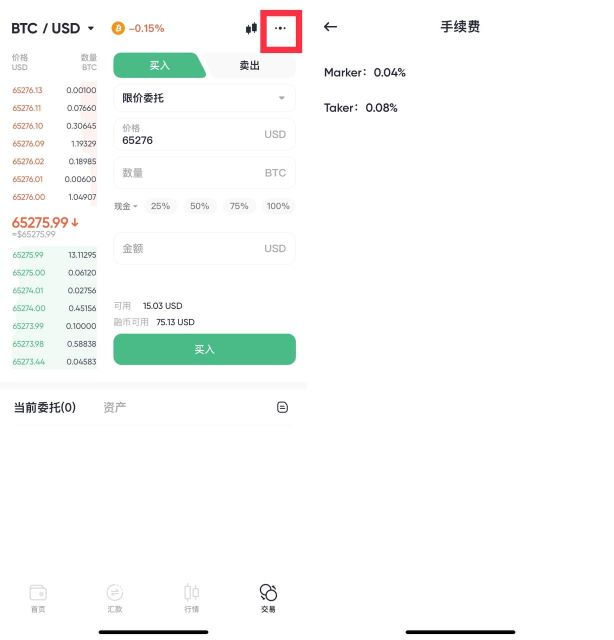
Click the icon in the upper right corner of the spot “transaction” page to view the digital currency spot transaction fees.
Marker:0.0008
Taker:0.0004
In digital currency trading, “Maker” and “Taker” are two different trading roles, representing participants who provide liquidity and consume liquidity respectively. Understanding these two roles is crucial for understanding transaction fees and processes. Here are their definitions and examples.
Maker
- Definition : Maker refers to users who place orders on the trading platform. These orders are not immediately executed, but enter the order book to wait for matching with other orders. Because these orders increase the liquidity of the market, users who place these orders are called Makers. Usually, Maker’s transaction fees are lower, and sometimes even get fee discounts to encourage more users to place orders.
- Features :
-
- Provides liquidity : Maker provides orders that go into the order book and wait to be matched with other orders, increasing the depth and liquidity of the market.
-
- Lower fees : Trading platforms usually charge lower fees to Makers because they help maintain and enhance liquidity.
- Example :
-
- If you place a limit sell order on the exchange, setting the price to be higher than the current market price for Bitcoin, the order will not be executed immediately, but will enter the order book. The order will only be executed when the market price reaches or exceeds your set price. At this point, you are a Maker.
Taker
- Definition : Taker is a user who accepts orders on a trading platform by immediately matching them with existing orders in the order book. Because these orders reduce market liquidity, users who accept these orders are called Takers. Taker’s transaction fees are usually higher because they consume market liquidity.
- Features :
-
- Consuming liquidity : Taker’s orders are directly matched with existing orders in the order book, reducing market liquidity.
-
- Higher fees : Since Taker consumes liquidity in the market, trading platforms usually charge Taker higher fees.
- Example :
-
- If you place a market buy order on the exchange and immediately buy Bitcoin at the current market price, the order will be executed immediately and matched with the sell order in the order book. At this point, you are a Taker.
Summary
- Maker : publishes orders that are not immediately executed, increases market liquidity, and usually enjoys lower transaction fees.
- Taker : Immediately matches trades with existing orders in the order book, consumes market liquidity, and usually incurs high transaction fees.
Understanding the roles of Maker and Taker is very important for optimizing trading strategies and cost control. On different trading platforms, these two roles may have different fee structures, so it is wise to understand the relevant fees before trading.

BiyaPay makes crypto more popular!
Contact Us
Mail: service@biyapay.com
Customer Service Telegram: https://t.me/biyapay001
Telegram Community: https://t.me/biyapay_ch
Digital Asset Community: https://t.me/BiyaPay666
Community




Regulation Subject
BIYA GLOBAL LLC
BIYA GLOBAL LLC is a licensed entity registered with the U.S. Securities and Exchange Commission (SEC No.: 802-127417); a certified member of the Financial Industry Regulatory Authority (FINRA) (Central Registration Depository CRD No.: 325027); regulated by the Financial Industry Regulatory Authority (FINRA) and the U.S. Securities and Exchange Commission (SEC).
BIYA GLOBAL LLC is a licensed entity registered with the U.S. Securities and Exchange Commission (SEC No.: 802-127417); a certified member of the Financial Industry Regulatory Authority (FINRA) (Central Registration Depository CRD No.: 325027); regulated by the Financial Industry Regulatory Authority (FINRA) and the U.S. Securities and Exchange Commission (SEC).
BIYA GLOBAL LLC
BIYA GLOBAL LLC is registered with the Financial Crimes Enforcement Network (FinCEN), an agency under the U.S. Department of the Treasury, as a Money Services Business (MSB), with registration number 31000218637349, and regulated by the Financial Crimes Enforcement Network (FinCEN).
BIYA GLOBAL LLC is registered with the Financial Crimes Enforcement Network (FinCEN), an agency under the U.S. Department of the Treasury, as a Money Services Business (MSB), with registration number 31000218637349, and regulated by the Financial Crimes Enforcement Network (FinCEN).
BIYA GLOBAL LIMITED
BIYA GLOBAL LIMITED is a registered Financial Service Provider (FSP) in New Zealand, with registration number FSP1007221, and is also a registered member of the Financial Services Complaints Limited (FSCL), an independent dispute resolution scheme in New Zealand.
BIYA GLOBAL LIMITED is a registered Financial Service Provider (FSP) in New Zealand, with registration number FSP1007221, and is also a registered member of the Financial Services Complaints Limited (FSCL), an independent dispute resolution scheme in New Zealand.
©2019 - 2026 BIYA GLOBAL LIMITED