How long does it take for digital currency to be credited to my account?(Web)




The arrival time of recharged digital currency varies depending on many factors. For example, the arrival time of USDT (Tether) mainly depends on the following key factors:
- Blockchain network
USDT can be issued and used on multiple blockchains, including:
- Ethereum (ERC-20): Transactions on the Ethereum network usually take 15 seconds to several minutes to confirm, depending on the congestion of the network and the gas fee paid.
- Bitcoin (Omni Layer): Transactions on the Bitcoin network generally take about 10 minutes to confirm a block, and multiple confirmations may take more time.
- Tron (TRC-20): The block generation time of the Tron network is about 3 seconds, and transactions can usually be confirmed within a few minutes.
- Solana (SPL): The Solana network is known for its high speed and low fees, and transactions can usually be confirmed within seconds.
- Confirmation requirements of BiyaPay wallet
You can view the recharge confirmation requirements of different digital currencies on the [On-chain Recharge] page
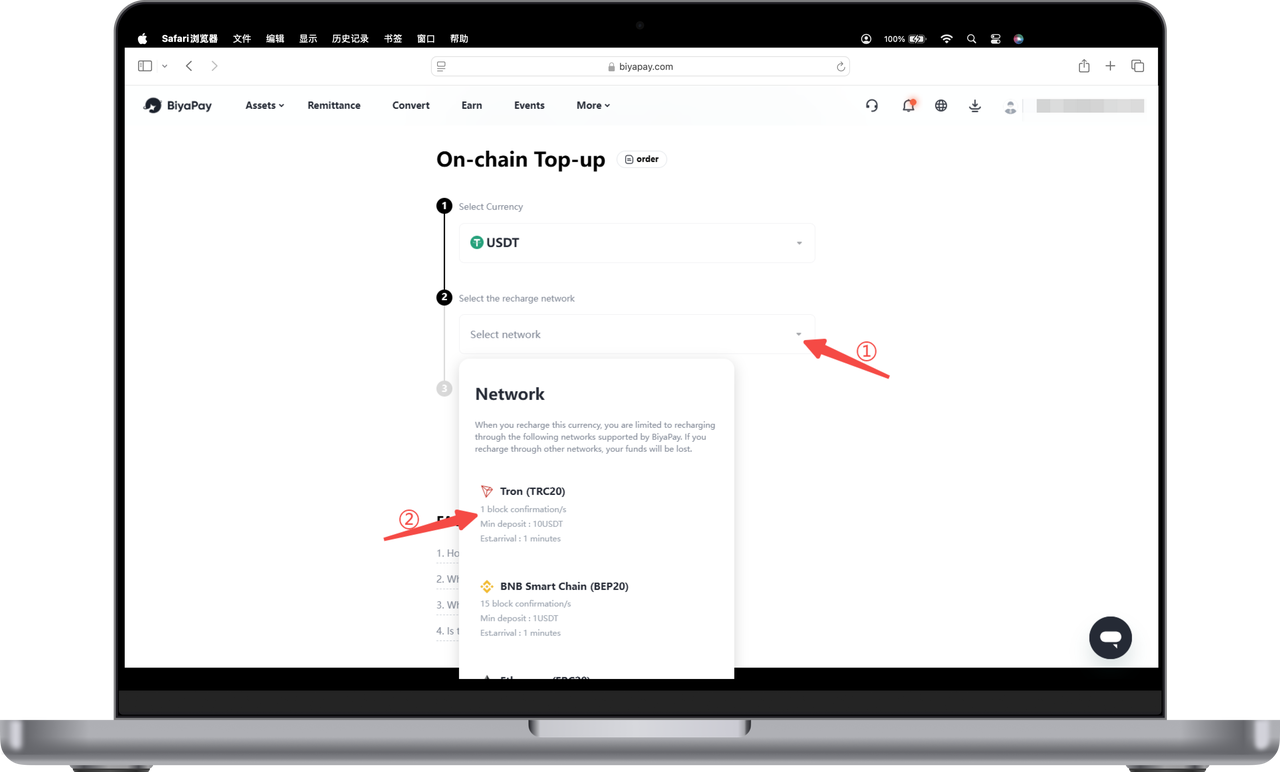
-
Network congestion
The congestion of the blockchain network will also affect the arrival time. If there are a large number of unconfirmed transactions on the network, the confirmation time will be longer. The Ethereum network may be congested when DeFi projects are active, while Tron and Solana are usually less congested due to their higher transaction processing capabilities. -
Transaction fees
Paying higher transaction fees can speed up the speed at which transactions are processed by miners. On Ethereum, paying higher gas fees can make transactions packaged faster. On Tron and Solana, this situation is usually less common because the transaction fees themselves are already low. -
Internal processing time of exchanges and wallets
Even if the blockchain confirms transactions quickly, exchanges and wallets still need some time to process and update users’ account balances. This processing time depends on the internal processes and work efficiency of each platform.
Assuming that you recharge USDT on an exchange, here are some common situations:
- ERC-20 USDT recharge: If the Ethereum network is not congested, it usually takes 10-30 minutes to complete. Paying higher gas fees can shorten it to a few minutes.
- Omni USDT top-up: Bitcoin network confirmation speed is slow, usually takes 30 minutes to 1 hour, may be longer.
- TRC-20 USDT top-up: Due to the high efficiency of the Tron network, it usually takes only a few minutes to complete.
- SPL USDT top-up: Solana network is extremely fast, usually completed within seconds to minutes.
How to speed up the USDT top-up arrival time
- Choose the right blockchain: Choosing Tron (TRC-20) or Solana (SPL) network can significantly speed up the USDT top-up speed.
- Pay enough transaction fees: When recharging on the Ethereum network, paying a higher gas fee can speed up the transaction confirmation speed.
- Avoid network peak hours: Try to avoid recharging when the blockchain network is congested, and choose to trade at a relatively idle time.
- Use an efficient trading platform: Choose an exchange or wallet with fast processing speed and efficient internal processes.
The USDT top-up arrival time is affected by many factors, including the type of blockchain network, confirmation requirements of exchanges and wallets, network congestion, transaction fees, and the internal processing time of the trading platform. In general, choosing Tron or Solana network to recharge USDT can usually be completed within a few minutes. Ethereum and Bitcoin networks may take more time. By choosing a reasonable blockchain and paying enough transaction fees, the recharge time of USDT can be effectively accelerated.

Contact Us




BIYA GLOBAL LLC is a licensed entity registered with the U.S. Securities and Exchange Commission (SEC No.: 802-127417); a certified member of the Financial Industry Regulatory Authority (FINRA) (Central Registration Depository CRD No.: 325027); regulated by the Financial Industry Regulatory Authority (FINRA) and the U.S. Securities and Exchange Commission (SEC).
BIYA GLOBAL LLC is registered with the Financial Crimes Enforcement Network (FinCEN), an agency under the U.S. Department of the Treasury, as a Money Services Business (MSB), with registration number 31000218637349, and regulated by the Financial Crimes Enforcement Network (FinCEN).
BIYA GLOBAL LIMITED is a registered Financial Service Provider (FSP) in New Zealand, with registration number FSP1007221, and is also a registered member of the Financial Services Complaints Limited (FSCL), an independent dispute resolution scheme in New Zealand.