- More
- Download




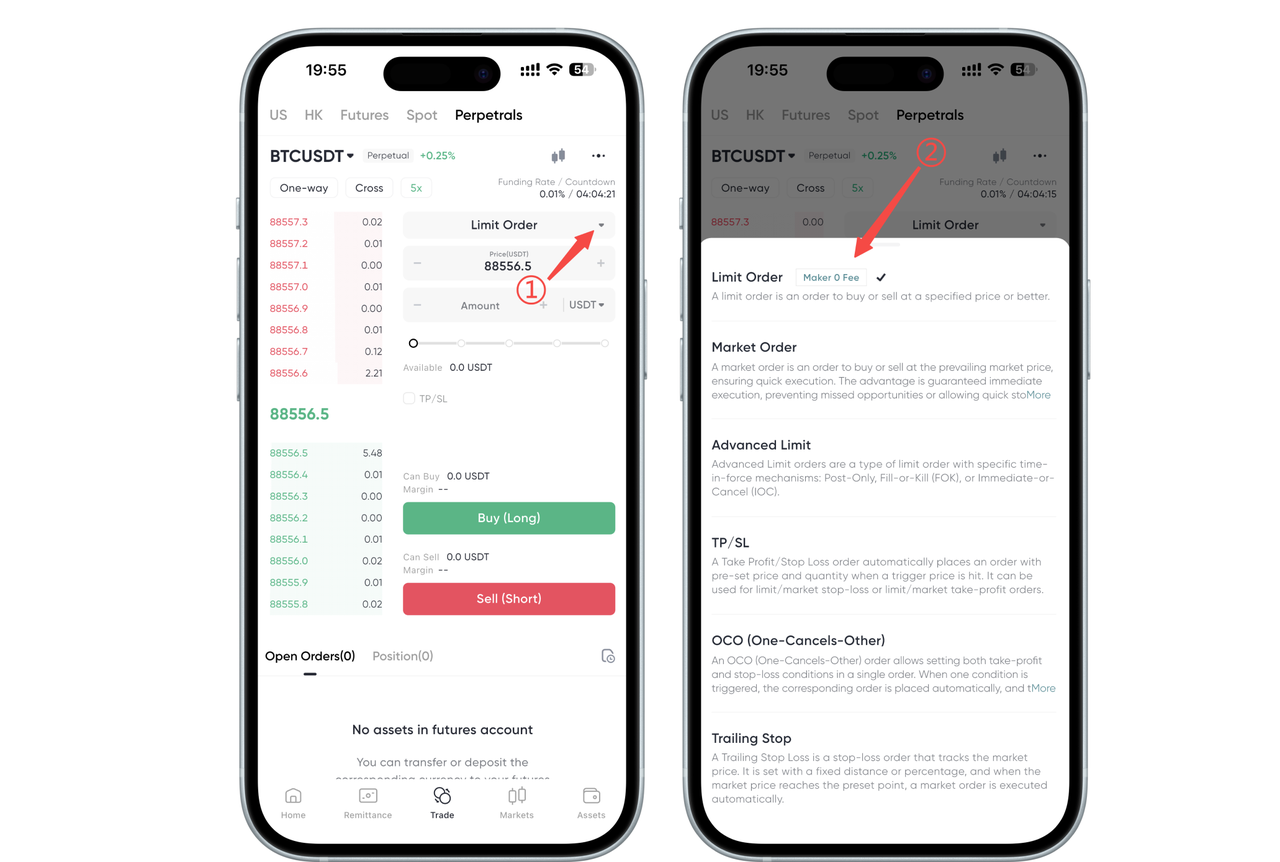
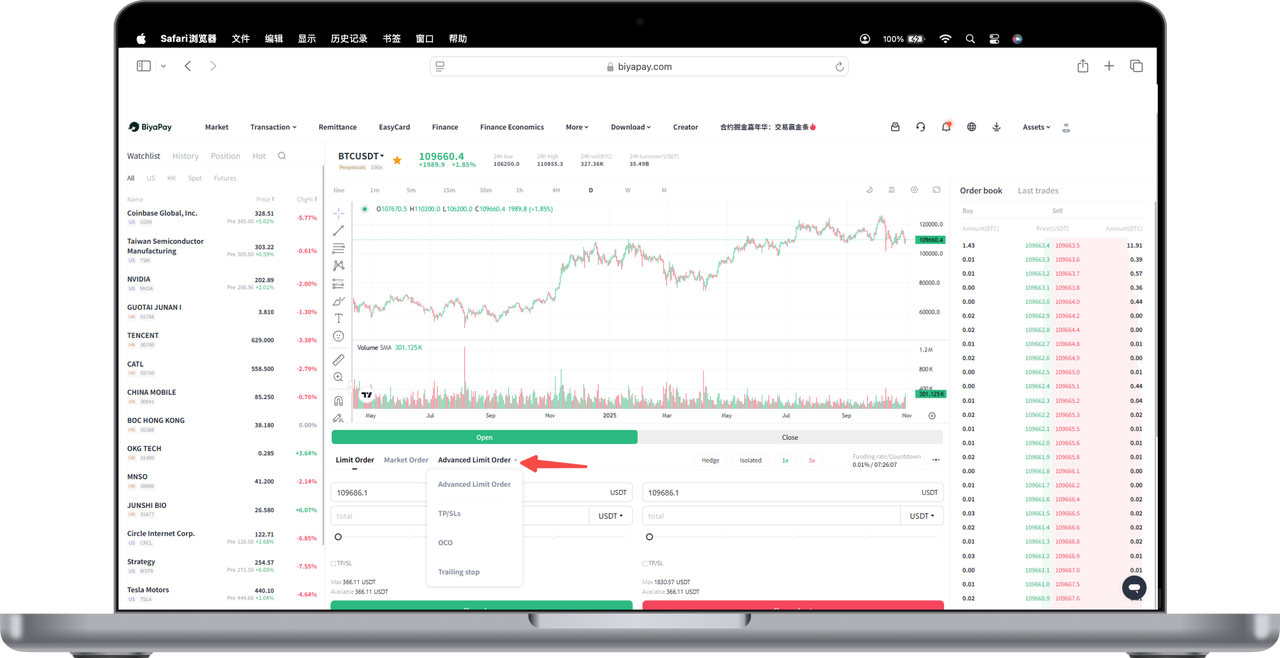
There are six main types of orders for trading digital currency contracts: Limit Order, Market Order, Advanced Limit, Take Profit/Stop Loss, Dual Take Profit/Stop Loss, and Trailing Stop Loss.
How to select digital currency contract trading orders on the App:
On the trading page, click the default limit order type to select other order types
How to select digital currency contract trading orders on the Web:
On the trading page, click the default advanced limit order type to select other order types
The rules for these six order types are introduced below:
I. Limit Order
A limit order is an order that is executed when a specific or better price is reached.
II. Market Order
A limit order is an order to buy or sell assets immediately at the current market price.
III. Advanced Limit
Order freezing is based on limit orders
- Maker Only
Can only place orders, not take orders. Orders enter the order book, and if they directly match with existing orders, the order is cancelled.
- Fill or Kill
Check the order quantity. If the order quantity is less than the currently available quantity, it will be executed. If the order quantity is greater than the currently available quantity, it will be cancelled.
- Immediate or Cancel
If an order is triggered and partially executed, the remaining quantity in the order is directly cancelled.
IV. Take Profit/Stop Loss
"Take Profit/Stop Loss" orders refer to pre-set trigger prices and post-trigger order prices and order quantities. When the latest price reaches the trigger price, orders will be placed at the pre-set order price, which can be market orders or limit orders. You can set take profit alone, stop loss alone, or take profit + stop loss.
- Take Profit/Stop Loss Buy. Can choose to execute by amount or quantity
Assets are frozen after placing the order. If the order price is market price and executed by quantity, freeze the amount of trigger price * quantity. If the order price is limit price and executed by quantity, freeze the amount of order price * quantity. If the order price is market price and executed by amount, freeze the amount. Buy at the take profit trigger price or buy at the stop loss trigger price. After triggering, place the order. If the available balance is insufficient when the take profit/stop loss ends, the buy cannot be executed.
- Take Profit/Stop Loss Sell. Can only execute by quantity
After placing the order, freeze the assets of the entered quantity. Sell at the take profit trigger price or sell at the stop loss trigger price. Whichever price is reached first, that order is triggered first. After triggering, place the order. If the available balance is insufficient when the take profit/stop loss ends, the sell cannot be executed.
V. Dual Take Profit/Stop Loss
- Dual Take Profit/Stop Loss Buy. Can choose to execute by amount or quantity
The take profit trigger price needs to be lower than the market price, and the stop loss trigger price needs to be higher than the market price. Assets are frozen after placing the order. If the order price is market price and executed by quantity, use the higher trigger price as the standard, freeze the amount of trigger price * quantity. If the order price is limit price and executed by quantity, use the higher order price as the standard, freeze the amount of order price * quantity. If the order price is market price and executed by amount, freeze the amount. Buy at the take profit trigger price or buy at the stop loss trigger price. Whichever price is reached first, that order is triggered first. After triggering, place the order. If the available balance is insufficient when the take profit/stop loss ends, the buy cannot be executed.
- Dual Take Profit/Stop Loss Sell. Can only execute by quantity
The take profit trigger price needs to be higher than the market price, and the stop loss trigger price needs to be lower than the market price. After placing the order, freeze the assets of the entered quantity. Sell at the take profit trigger price or sell at the stop loss trigger price. Whichever price is reached first, that order is triggered first. After triggering, place the order. If the available balance is insufficient when the take profit/stop loss ends, the sell cannot be executed.
VI. Trailing Stop Loss
Trailing stop loss is a take profit/stop loss that tracks market prices, pre-setting price distance or ratio, and automatically executes market orders when market prices reach preset points.
Trailing stop loss can only be market orders, can only take profit or stop loss, cannot take profit + stop loss.
You can choose an activation price, or not choose an activation price. If no activation price is selected, it is activated after placing the order. If an activation price is selected, the order is activated when the market price reaches or exceeds the activation price. When not activated, there is no trigger price.
Activation
If the set activation price = the latest transaction price when placing the order, activate immediately when placing the order
If activation price > latest transaction price when placing the order, activate the order when the new latest transaction price >= activation price
If activation price < latest transaction price when placing the order, activate the order when the new latest transaction price <= activation price
Trigger
Buy: Latest price ≥ Trigger price
Sell: Latest price ≤ Trigger price. The trigger price calculation:
Buy: Lowest price + Callback price distance; Lowest price * (1 + Callback ratio)
Sell: Highest price - Callback price distance; Highest price * (1 - Callback ratio)
Trailing stop loss buy can only be by amount, sell can only be by quantity. Neither buy nor sell freezes assets.
After placing the order, the trigger price changes with the price.
Buy trigger price = Historical lowest price - Callback ratio
Sell trigger price = Historical highest price - Callback ratio
If the buy and sell quantities and amounts are sufficient, execute according to the order quantity. If the sell assets are insufficient, sell all. If the buy amount is insufficient, buy all.
Example: User sets to sell 1 BTC, but only 0.5 BTC is available when triggering the order, then sell 0.5
User sets to buy 1000U of BTC, but only 500 USDT is available when triggering the order, then buy 500 USDT
Example 1 (Rapid Rise Exit): User wants to sell BTC, no activation price selected, latest transaction price is 30,000. Can set parameters as follows: 【Callback ratio】2,000 【Quantity】1 BTC. After placing the order, if BTC rises to the highest point of 40,000, then retraces to 38,000, reaching the retracement condition (40,000 - 2,000 = 38,000), the system helps the user sell at market price at 38,000.
Example 2 (Crash Bottom Fishing): User wants to buy BTC, current latest transaction price is 40,000. Can set parameters as follows: 【Callback ratio】5% 【Activation price】30,000 【Quantity】1 BTC. After placing the order, if BTC falls to 30,000, the order is activated, then continues to fall to 20,000, then rebounds to 20,000 * (1 + 5%) = 21,000, reaching the retracement condition (5%), the system helps the user buy at market price at 21,000.

Contact Us



