Detailed explanation of the options chain page and its key concepts?

BiyaPay
Published on 2026-02-12 Updated on 2026-02-13

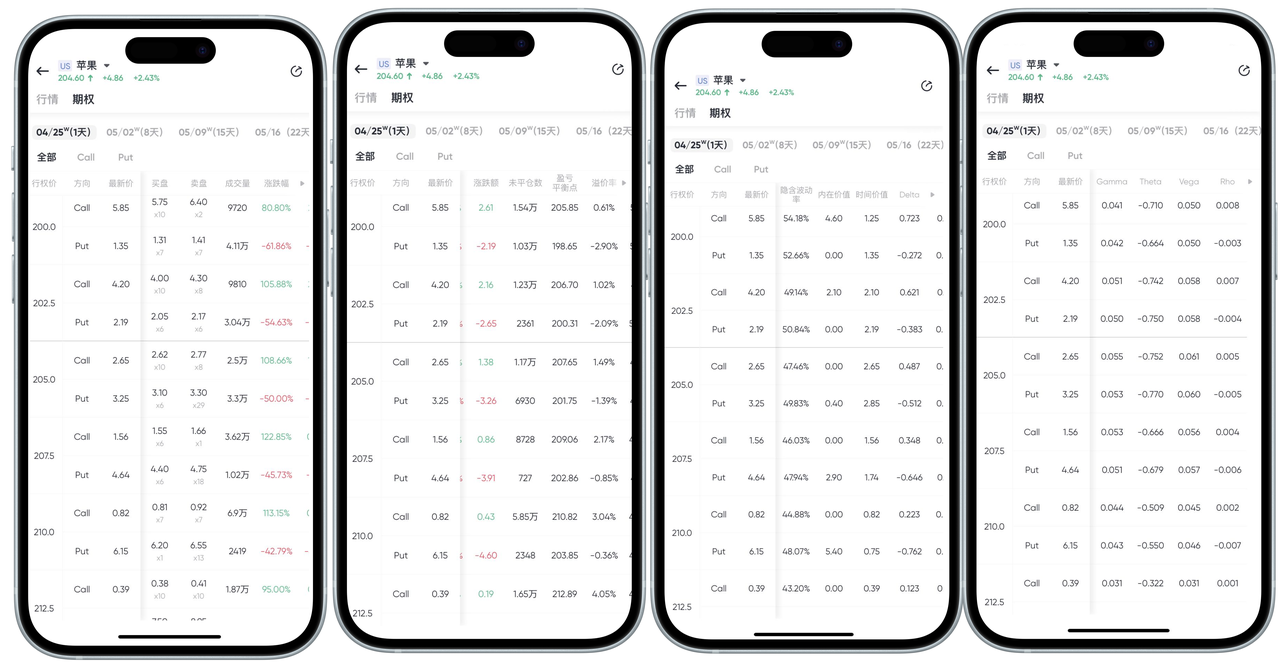
How to view the options chain page and its key concepts on the App:

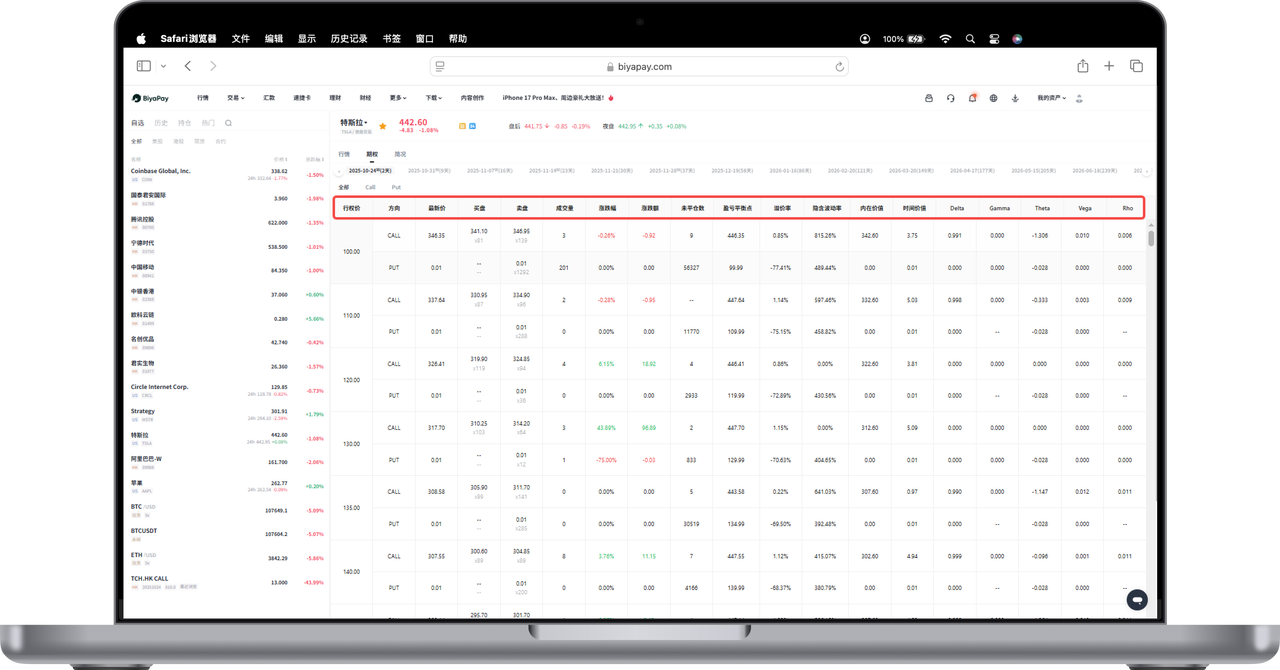
How to view the options chain page and its key concepts on the Web:

image.png

The following is a plain explanation of various data in the options trading page to help you quickly understand the options quote table and understand the composition and volatility principles of option prices.

  1. Option Type

Call (Call Option): The buyer has the right to buy the underlying asset at a fixed price at a future time. Suitable for bullish markets.

Put (Put Option): The buyer has the right to sell the underlying asset at a fixed price at a future time. Suitable for bearish markets.

  1. Strike Price

The strike price is the price at which the option agrees to buy or sell the underlying asset in the future. For example:

200.0 means exercising the right at $200.0 per share.

212.5 means exercising the right at $212.5 per share.

  1. Latest Price

The current trading price of the option in the market. For example:

The latest price of 200.0 Call is $5.85, meaning you need to pay $5.85 to buy one contract of this option.

  1. Bid and Ask

Bid: The highest price buyers in the market are willing to pay. For example:

The bid price of 200.0 Call is $5.75, quantity x10, indicating 10 buy orders waiting to be executed.

Ask: The lowest price sellers in the market are willing to accept. For example:

The ask price is $6.40, quantity x7, indicating 7 sell orders posted.

  1. Volume
    The total number of option contracts traded during the day, reflecting market activity. For example:

A volume of 9,720 means 9,720 contracts have been traded (i.e., 972,000 shares).

  1. Change %
    The percentage change in the option price compared to the previous trading day. For example:

A Change % of +80.80% indicates a significant price increase.

  1. Implied Volatility (IV)
    The market’s expectation of the underlying stock’s future price volatility. The higher the value, the greater the expected volatility. For example:

The implied volatility of the 200.0 Call is 54.61%, indicating relatively high volatility.

  1. Intrinsic Value
    The theoretical profit if the option were exercised immediately. For example:

If the current stock price is $204.60, the intrinsic value of the 200.0 Call is $4.60 ($204.60 − $200.0).

  1. Time Value
    The option’s total premium minus its intrinsic value. It reflects the market’s expectation of future volatility. For example:

If the total premium is $5.85 and the intrinsic value is $4.60, then the time value is $1.25.

  1. Delta (Δ)
    The theoretical change in the option price for every $1 change in the underlying asset’s price. For example:

Delta = 0.723 means that if the stock price rises by $1, the option price will increase by $0.723.

  1. Gamma (Γ)
    The rate of change of Delta, measuring how sensitive Delta is to changes in the underlying price. For example:

Gamma = 0.041 means that for every $1 increase in the stock price, Delta increases by 0.041.

  1. Theta (Θ)
    The change in the option’s value due to the passage of time (usually negative). For example:

Theta = -0.710 means that the option price decreases by $0.71 per day, all else being equal.

  1. Vega (ν)
    The change in the option price for every 1% change in implied volatility. For example:

Vega = 0.050 means that if IV increases by 1%, the option price will rise by $0.05.

  1. Rho (ρ)
    The impact of interest rate changes on the option price. For example:

Rho = 0.008 means that if interest rates rise by 1%, the option price increases by $0.008.

The option chain page provides Call and Put quotes for each strike price, along with trading activity, volatility levels, and risk sensitivity metrics. With this information, you can more scientifically:

Evaluate an option’s “value for money” (intrinsic value + time value)

Assess market expectations (implied volatility, volume)

Manage risk and optimize strategy combinations (Delta, Theta, Gamma, etc.)

BiyaPay
BiyaPay makes crypto more popular!

Contact Us

Mail: service@biyapay.com
Customer Service Telegram: https://t.me/biyapay001
Telegram Community: https://t.me/biyapay_ch
Digital Asset Community: https://t.me/BiyaPay666
BiyaPay的电报社区BiyaPay的Discord社区BiyaPay客服邮箱BiyaPay Instagram官方账号BiyaPay Tiktok官方账号BiyaPay LinkedIn官方账号
Regulation Subject
BIYA GLOBAL LLC
BIYA GLOBAL LLC is a licensed entity registered with the U.S. Securities and Exchange Commission (SEC No.: 802-127417); a certified member of the Financial Industry Regulatory Authority (FINRA) (Central Registration Depository CRD No.: 325027); regulated by the Financial Industry Regulatory Authority (FINRA) and the U.S. Securities and Exchange Commission (SEC).
BIYA GLOBAL LLC
BIYA GLOBAL LLC is registered with the Financial Crimes Enforcement Network (FinCEN), an agency under the U.S. Department of the Treasury, as a Money Services Business (MSB), with registration number 31000218637349, and regulated by the Financial Crimes Enforcement Network (FinCEN).
BIYA GLOBAL LIMITED
BIYA GLOBAL LIMITED is a registered Financial Service Provider (FSP) in New Zealand, with registration number FSP1007221, and is also a registered member of the Financial Services Complaints Limited (FSCL), an independent dispute resolution scheme in New Zealand.
©2019 - 2026 BIYA GLOBAL LIMITED