Beginner's Guide to US Individual Income Tax Rates: Understanding Minimum Filing Income Requirements





Image Source: pexels
In the United States, whether you need to file taxes mainly depends on your total income, filing status, and age.
? Quick Answer For the 2024 tax year (i.e., filing in 2025), if you are a single individual under 65 with total income below $14,600, you generally do not need to file a federal tax return.
Of course, thresholds vary by situation, and tax laws adjust annually. Every year, over a hundred million tax returns are submitted — understanding the latest US individual income tax rates and rules is crucial for you.
Key Takeaways
- Whether you need to file taxes depends on your total income, filing status, and age.
- Even if your income is below the filing threshold, if your employer withheld taxes or you qualify for a refund, you should file.
- Self-employed individuals with net income of $400 or more must file and pay self-employment tax.
- The US uses a progressive tax system — your income is taxed at different rates in brackets.
- Tax laws adjust annually — follow the latest information from the Internal Revenue Service (IRS).
Detailed 2024 Filing Income Thresholds

Image Source: pexels
To determine if you need to file taxes, the most direct way is to check the total gross income threshold set by the Internal Revenue Service (IRS) for your filing status and age. This threshold usually equals the standard deduction for your status. If you are 65 or older, you get an additional standard deduction, raising your filing threshold.
For quick reference, based on official IRS data for the 2024 tax year (used for the 2025 filing season), we organize the minimum filing income requirements for different situations as follows:
| Filing Status | Age (as of end of 2024) | Minimum Gross Income Requirement |
|---|---|---|
| Single | Under 65 | $14,600 |
| 65 and older | $16,550 | |
| Married Filing Jointly | Both under 65 | $29,200 |
| One 65 or older | $30,750 | |
| Both 65 or older | $32,300 | |
| Married Filing Separately | Any age | $5 |
| Head of Household | Under 65 | $21,900 |
| 65 and older | $23,850 | |
| Qualifying Widow(er) | Under 65 | $29,200 |
| 65 and older | $30,750 |
Next, we explain in detail what each filing status means.
Single Status
If by year-end you are unmarried, or legally divorced or separated under state law, you usually file as single. This is one of the most common filing statuses. Refer to the table above for the income threshold matching your age.
Married Filing Jointly
If you are married as of the last day of the tax year, you can choose to file a joint return with your spouse. This option usually provides lower tax rates and higher deductions than filing separately.
? Looking Ahead to 2025 Tax laws adjust for inflation. Projections indicate that for the 2025 tax year (filing in 2026), if both spouses are under 65, the married filing jointly filing threshold is expected to rise to $31,500.
Married Filing Separately
Married couples can also choose to file separate returns. While this has advantages in certain cases (e.g., one spouse has high medical expenses), the filing threshold is extremely low.
⚠️ Special Note If your total income exceeds $5, you must file. This very low threshold prevents couples from using separate filing to avoid certain tax responsibilities. Choosing this status usually means giving up many tax credits and deductions.
Head of Household Status (Head of Household)
If you are unmarried and paid more than half the household living expenses for the year, while having a qualifying child or relative living with you for more than half the year, you may qualify for head of household status. This status generally offers more favorable US individual income tax rates and higher standard deduction than single.
Qualifying Widow(er)
If your spouse died within the past two years, you have not remarried, and you have a qualifying dependent child, you can use this status for two years after the spouse’s death. It allows you to continue enjoying married filing jointly favorable rates and standard deduction. For example, if under 65 at end of 2024, your filing threshold is $29,200.
Special Situations Filing Rules
Beyond the gross income thresholds mentioned earlier, certain special situations require you to file taxes even if your gross income does not reach the standard. Understanding these rules helps you avoid unnecessary issues.
Dependent Thresholds
If you are listed as a dependent on someone else’s return (e.g., a child supported by parents), your filing rules differ. Rules mainly depend on income type: earned income or unearned income.
A simple way is to focus on unearned income, including interest, dividends, and capital gains. For 2024, if your unearned income exceeds $1,300, you must file your own return. Earned income rules are more complex, but the key is that even if not required, filing voluntarily may benefit you.
? Tax Filing Tip Even if not legally required to file, if your employer withheld federal income tax or you qualify for certain refundable tax credits, filing is the only way to get your refund.
Self-Employment IncomeRequirements
As a freelancer, contractor, or small business owner, your filing requirements differ greatly. Regardless of how you receive payments — through Biyapay or directly from clients — if your self-employment net income (gross income minus business expenses) reaches or exceeds $400, you must file.
This is not only for income tax but also to pay self-employment tax, covering Social Security and Medicare taxes. Note the following:
- Use Schedule C to calculate business income and expenses.
- Fill Schedule SE to calculate and pay self-employment tax.
- If expected annual total tax owed (including income and self-employment tax) reaches $1,000 or more, you usually need to pay estimated taxes quarterly.
Other Situations Requiring Filing
Beyond the above, other circumstances trigger filing obligations unrelated to total income but tied to specific financial activities or benefits. These rules are independent of regular US individual income tax rate calculations.
Common situations include:
- Received Health InsurancePremium Tax Credit: If you bought health insurance through Healthcare.gov and received advance premium tax credit, you must file to reconcile the credit amount.
- Withdrew fromHealth Savings Account: If you withdrew from a Health Savings Account (HSA) or similar Archer MSA, you must file regardless of whether the withdrawal is taxable.
- Need to Pay Special Taxes: For example, you may owe additional tax for early withdrawal from a qualified retirement plan (like 401(k) or IRA).
Checking these special rules is as important as checking income thresholds to ensure you meet all tax responsibilities.
Additional Knowledge: Understanding US Individual Income Tax Rates
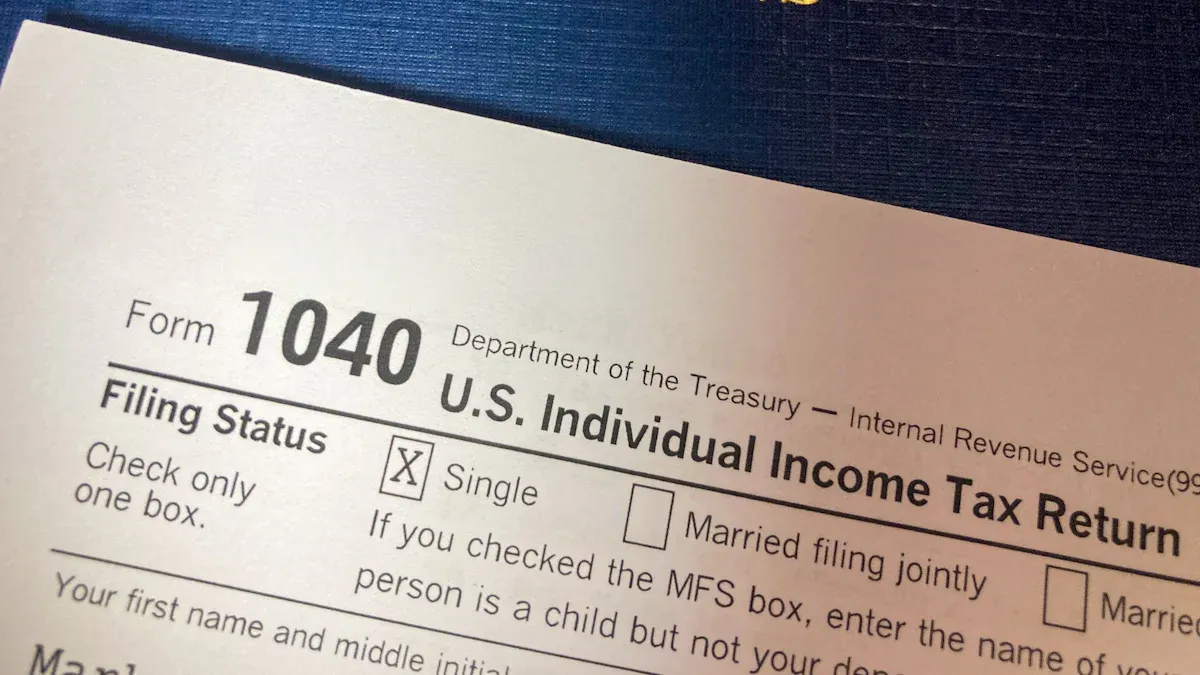
Image Source: pexels
After understanding whether you need to file, let’s briefly learn how US individual income tax rates are calculated. This helps you better plan finances and understand numbers on your return.
Tax Brackets and Standard Deduction
The US uses a “progressive tax system”. This means your income is divided into different “tax brackets” — higher income portions are taxed at higher rates. For the 2024 tax year, there are seven brackets: 10%, 12%, 22%, 24%, 32%, 35%, and 37%.
This does not mean all your income is taxed at one rate. For example, for a single filer, only the portion falling in a bracket is taxed at that bracket’s rate.
2024 Single Filer Federal Income Tax Rate Table
| Tax Rate | Taxable Income Range |
|---|---|
| 10% | $0 to $11,600 |
| 12% | $11,601 to $47,150 |
| 22% | $47,151 to $100,525 |
| … | … |
Before calculating taxable income, you can subtract the standard deduction. This amount directly reduces your taxable income.
Capital Gains Tax Overview
If you profit from selling assets (like stocks, bonds, or property), that profit is called capital gains and is also taxed. The rate depends on how long you held the asset:
- Short-Term Capital Gains: Held asset one year or less. Taxed at your ordinary income tax rate (10% to 37%).
- Long-Term Capital Gains: Held asset more than one year. You enjoy preferential rates, usually 0%, 15%, or 20%.
Tax-Saving Opportunity Long-term holding is a legal tax-saving strategy. For 2024, if your taxable income (including capital gains) does not exceed certain thresholds, your long-term capital gains rate may be 0%. For example, single filers with taxable income not exceeding $47,025, married filing jointly not exceeding $94,050, enjoy 0% preferential rate.
In real filings, the most common friction is not the rate itself, but inconsistent records for execution price, settlement currency, FX conversion method, and holding period. If you have cross-border assets or overseas income, it helps to standardize these fields before calculating taxes.
For a quick reference check, you can use BiyaPay’s stock information lookup to verify basic price and symbol details, then apply a consistent conversion approach with the free currency converter and comparison tool when different fiat currencies are involved.
If you also need to move funds between accounts (e.g., paying overseas bills or transferring to an overseas account), you can review available service entries on the BiyaPay official website and keep transaction records for reconciliation; onboarding can start from the registration page. This is general organization guidance and not tax advice.
Notable Tax Law Developments
Tax laws are not set in stone. The IRS adjusts standard deduction, tax brackets, etc., annually for inflation. Following these changes helps you prepare for future filing seasons.
Looking Ahead to 2025 Projections indicate that for the 2025 tax year (filing in 2026), the standard deduction will further increase. For example, single filers’ standard deduction is expected to rise from $14,600 to $15,750.
Additionally, with the rise of digital assets, related tax rules are becoming clearer. Starting in 2025, you may receive a new 1099-DA form for cryptocurrency transactions. Understanding the latest US individual income tax rates and law developments is essential for every taxpayer.
Determining if you need to file taxes is key by checking your personal situation against the current year’s official thresholds. Even if income is below the threshold, we strongly recommend filing. Many people unexpectedly receive refunds — recent average refunds exceed $3,000.
You may receive the following refunds or credits by filing:
- Earned Income Tax Credit
- Child Tax Credit
- Premium Tax Credit
Tax laws update annually. Always refer to the official information from the Internal Revenue Service (IRS), or consult a professional tax advisor when needed to ensure your information is accurate.
FAQ
I am an F-1 visa international student — do these tax rules apply to me?
Tax rules for international students differ — usually treated as non-resident aliens. You generally need to file for all US-sourced income, regardless of amount. Refer to IRS official guidance, such as Publication 519.
What are the consequences if I should file but don’t?
The IRS imposes penalties and interest on late filing and unpaid taxes. This may affect your future credit or visa status. If you are entitled to a refund, not filing means you won’t receive it.
What is the filing deadline for the 2024 tax year?
The federal tax return deadline for the 2024 tax year is usually April 15, 2025. You must submit your return and pay any owed taxes by this date. Note that your state’s state tax deadline may differ from federal.
What if I cannot complete filing by the deadline?
You can apply for an extension, moving the filing deadline to October 15, 2025.
Important Reminder Extension only applies to filing the return — it does not extend the time to pay taxes. You still need to estimate and pay any owed taxes by April 15 to avoid penalties and interest.
*This article is provided for general information purposes and does not constitute legal, tax or other professional advice from BiyaPay or its subsidiaries and its affiliates, and it is not intended as a substitute for obtaining advice from a financial advisor or any other professional.
We make no representations, warranties or warranties, express or implied, as to the accuracy, completeness or timeliness of the contents of this publication.
Related Blogs of

How Do European International Students Pay the Final Installment for a Used Car? Digital Payment Methods to Avoid SEPA Transfer Delays Caused by Weekend Bank Closures


Patreon/OnlyFans and Other Overseas Creator Platforms Payout: Ultimate Tricks to Bypass Domestic Bank Forex Review for Withdrawal


Enterprise Overseas Payroll Compliance and Tax Planning: How to Use Multi-Asset Payroll Platforms to Reduce Cross-Border Employment Costs?


Virtual Card Binding to AWS/GCP for AI Agent Deployment Frequently Flagged by Risk Control? Compliance Card Opening Guide to Avoid Pitfalls

Choose Country or Region to Read Local Blog
 Australia
 Austria
 Belgium
 Canada
 Cyprus
 Czech Republic
 Denmark
 Estonia
 Finland
 France
 Germany
 Greece
 Hong Kong
 India
India Indonesia
 Ireland
 Italy
Italy Japan
Japan Latvia
 Lithuania
 Luxembourg
 Malaysia
 Malta
Malta Morocco
 Nepal
Nepal Netherlands
 New Zealand
 Norway
 Pakistan
 Philippines
 Poland
 Portugal
 Romania
 Singapore
 Slovakia
 Slovenia
 South Africa
 South Korea
 Spain
Spain Sweden
 Thailand
 The United States
 Turkey
 United Arab Emirates
 United Kingdom
 Vietnam
Contact Us




BIYA GLOBAL LLC is registered with the Financial Crimes Enforcement Network (FinCEN), an agency under the U.S. Department of the Treasury, as a Money Services Business (MSB), with registration number 31000218637349, and regulated by the Financial Crimes Enforcement Network (FinCEN).
BIYA GLOBAL LIMITED is a registered Financial Service Provider (FSP) in New Zealand, with registration number FSP1007221, and is also a registered member of the Financial Services Complaints Limited (FSCL), an independent dispute resolution scheme in New Zealand.