Comprehensive US Tax Filing Guide: Master Federal and State Tax Declaration Tips Easily




Image Source: pexels
Do you need to file taxes in the US? Is the tax filing process very complicated? These two questions often trouble many people. This US tax filing guide will serve as an operation manual to help you eliminate your fear of tax filing.
💡 Don’t forget! Filing taxes is not only your obligation but also a great opportunity to get a refund.
The core of the entire process lies in three steps: confirming your filing status, preparing tax documents, and choosing a filing method.
Key Highlights
- Before filing taxes, you need to confirm your tax filing status, such as whether you are a tax resident or non-tax resident.
- Prepare forms like W-2 and 1099, which record your income and withheld taxes.
- You can choose to use tax software, hire an accountant, or mail paper forms to file your taxes.
- Understand the differences between federal and state taxes; some states do not require personal income tax.
- Using tax deductions and tax credits can help you legally save taxes, such as the child tax credit.
Who Needs to File Taxes? Confirm Your Tax Filing Status
The first step in tax filing is to figure out whether you need to file taxes. This mainly depends on your income, filing status, and age.
Filing Thresholds: Income, Status, and Age Requirements
Generally, as long as your total income exceeds a specific threshold, you must submit a federal tax return. This threshold varies based on your filing status (such as single or married) and age.
💡 Friendly Reminder Even if your income is below the threshold, if your employer withheld taxes, you should proactively file taxes to potentially get a refund.
The following are the main income thresholds for the 2024 tax year (filed in 2025); you can check against them:
| Filing Status | Under 65 | 65 or Older |
|---|---|---|
| Single | $14,600 | $16,550 |
| Head of Household | $21,900 | $23,850 |
| Married Filing Jointly | Both under 65: $29,200 | One or both 65 or older: $30,750+ |
| Married Filing Separately | $5 | $5 |
Filing Status Breakdown: Citizens, Green Card Holders, and Foreigners
Your tax obligation is directly related to your status in the US.
- US Citizens and Green Card Holders: Whether you live in the US or abroad, you need to report your worldwide income to the US government. Additionally, if the total of your overseas financial accounts exceeds $10,000 at any time during the year, you must also report foreign bank and financial accounts (FBAR).
- Foreigners (Alien): If you are not a US citizen or green card holder, your tax status will be classified as tax resident (Resident Alien, RA) or non-tax resident (Non-Resident Alien, NRA).
Resident (Tax Resident) vs. Non-Resident (Non-Tax Resident): Detailed Explanation of the “183-Day Test”
How do you determine if you are an RA or NRA? The key is whether you pass the “Substantial Presence Test”. You need to meet both of the following conditions:
- Reside in the US for at least 31 days in the current year.
- The weighted total days of residence in the US in the current year and the past two years reaches 183 days.
The calculation formula is: Days in current year + (Days in previous year ÷ 3) + (Days in year before that ÷ 6) ≥ 183 days
If you pass the test, you are a tax resident and need to report worldwide income like a US citizen. If you do not pass, you are a non-tax resident and generally only need to report US-sourced income.
Special Statuses: International Students (F1/J1) and Work Visas (H1B)
For holders of specific visas, the rules are different.
- International Students (F1/J1): Typically, students on F-1 or J-1 visas are considered “exempt individuals” in their first five calendar years, and their days in the US do not count toward the “183-day test”. Therefore, you are likely a non-tax resident (NRA). Even with no income, you must submit Form 8843 to the IRS. If you have income, you need to file
Form 1040-NR. - Work Visa (H1B): H1B visa holders usually pass the “183-day test” and are considered tax residents (RA). You need to use Form 1040 like US citizens to report worldwide income and pay Social Security and Medicare taxes (FICA Taxes).
US Tax Filing Guide: Full Breakdown of the Tax Filing Process
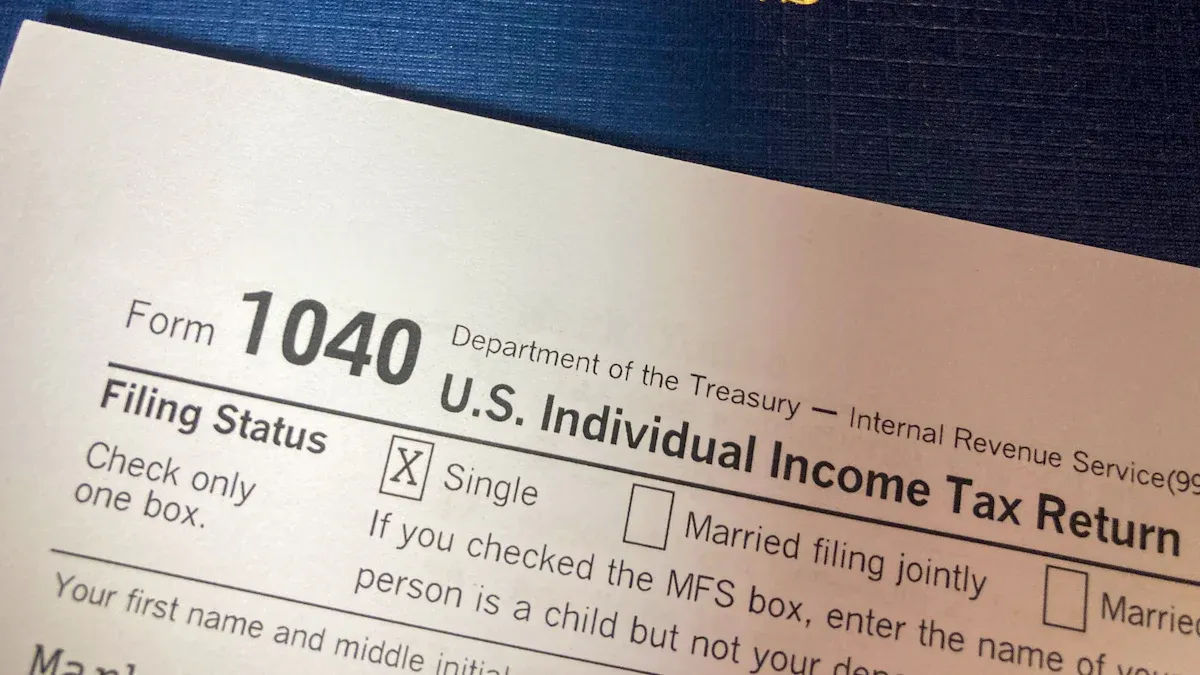
Image Source: pexels
After determining your tax status, the next step is to formally enter the tax filing process. This process can be broken down into several clear steps: preparing documents, calculating taxes, and choosing a filing method. Let’s break it down step by step—you’ll find it’s simpler than imagined.
Key Document Preparation: Understanding W-2, 1099, and 1040 Forms
From late January to mid-February each year, you will receive a series of tax forms. These are the cornerstone of your tax filing; keep them safe.
💡 Important Tip After receiving tax forms, carefully verify the personal information on them, such as name, Social Security Number (SSN), or Individual Taxpayer Identification Number (ITIN). Errors in information may delay filing or cause rejection.
Here are some of the most common forms you will encounter:
- Form W-2 (Wage and Tax Statement): If you are an employee of a company, your employer will send you a W-2 form early in the year. It summarizes your total income for the previous year and the various taxes withheld.
- Box 1: Total federal taxable wages you need to report.
- Box 2: Amount of federal income tax withheld by the employer.
- Box 3 & 4: Wages subject to Social Security tax and the amount withheld.
- Box 5 & 6: Wages subject to Medicare tax and the amount withheld.
- Box 12: Records various types of compensation and benefits, such as 401(k) retirement plan contributions.
- Box 16 & 17: Your state taxable wages and withheld state income tax.
- Form 1099 Series (Information Returns): If you have income beyond wages, you will receive 1099 forms. Common types include:
Form Type Purpose 1099-NEC Reports non-employee compensation over $600 earned as an independent contractor or freelancer. 1099-MISC Reports other miscellaneous income, such as rent or prizes (over $600). 1099-INT Reports interest income from banks or brokers (over $10). 1099-DIV Reports dividends from stocks or funds. 1099-B Reports stock, fund, or other securities transaction information through brokers. - Form 1098 Series: These forms are mainly related to your expenses and can help you get tax relief.
- 1098-T: If you paid university tuition, the school will provide this form for applying education-related tax credits.
- 1098-E: If you repaid student loans, the lender will provide this form; the loan interest can be used for tax deduction.
- Form 1040 (U.S. Individual Income Tax Return): This is the core tax filing form; you need to summarize information from all the above forms on the 1040 to calculate the final tax owed or refund amount.
- 1040-SR: This is a version designed for seniors 65 and older, with larger fonts for easier reading.
- Schedule C: If you have self-employment income (corresponding to 1099-NEC), you need to fill out Schedule C to report your business income and expenses.
Tax Calculation Basics: Income, Deductions, and Credits
Understanding how taxes are calculated can help you better plan your finances. The basic formula is very simple:
Taxable Income × Tax Rate = Tax Owed
The key is how to determine your “taxable income”.
- Calculate Adjusted Gross Income (AGI) Adjusted Gross Income is the starting point for tax calculations. The method is:
Total Income - Specific Adjustments = Adjusted Gross Income (AGI)- Total Income: Includes your wages (W-2), self-employment income (1099-NEC), interest, dividends, and all other income.
- Specific Adjustments: Items that can be directly subtracted from total income, such as student loan interest, traditional IRA contributions, HSA contributions, etc. These can be found on Form 1040 Schedule 1.
- Distinguish Between Tax Deductions and Tax Credits These are two concepts that are easily confused but crucial. Both can help you save money, but in completely different ways.
Simply put, tax credits are more valuable than tax deductions. For example, a $1,000 tax credit directly reduces your tax by $1,000. A $1,000 deduction, if you’re in the 22% bracket, only saves you $220 ($1,000 × 22%).Feature Tax Deduction Tax Credit How It Works Reduces your taxable income Directly reduces your tax owed Money-Saving Effect Depends on your tax rate $1 credit = $1 less tax
Filing Method Choices: Tax Software, Accountant (CPA), or Mailing
After preparing documents, you need to choose a method to complete the filing. There are mainly three options:
- Using Tax Software (DIY): This is the most popular method. Software like TurboTax, H&R Block, and FreeTaxUSA guide you through Q&A to complete filing—simple and low-cost. Suitable for those with uncomplicated tax situations.
- Hiring a Certified Public Accountant (CPA): If your tax situation is complex (e.g., owning a business, multi-state income, large investments), or you want to maximize tax savings and get professional advice, hiring a CPA is wise. Though more expensive, it ensures accuracy and saves time.
- Mailing Paper Forms: You can download forms from the IRS website, fill them manually, and mail them. Completely free but time-consuming and error-prone; now uncommon.
CPA Fee Reference CPA fees vary by region and complexity. According to surveys, preparing a basic 1040 without itemized deductions averages $220, while one with self-employment income (Schedule C) averages $323.
When receiving a refund, you can choose direct deposit to your bank account or use platforms like Biyapay to manage funds.
Popular Tax Software Comparison: TurboTax, H&R Block, FreeTaxUSA
For most people, tax software offers the best value. This US tax guide compares three mainstream software options to help you decide.
| Feature | TurboTax | H&R Block | FreeTaxUSA |
|---|---|---|---|
| Federal Filing Fee | $0 - $120+ | $0 - $115+ | Free |
| State Filing Fee | $0 or $50+/state | $0 or $49+/state | $15.99/state |
| Free Version Scope | Only very simple filings (W-2 income, no complex deductions) | Broader, supports student loan interest, some retirement income | Supports almost all forms, including self-employment, investments, rental income |
| NRA Support | No (redirects to partner Sprintax) | No (redirects to Expat service) | No |
| Best For | Ultimate user experience, RA not minding fees | Online/offline combo, medium-complexity RA | Best value, more complex RA |
💡 Note for Non-Tax Residents! Mainstream online tax software like TurboTax and H&R Block generally do not directly support non-tax residents (NRA) filing
1040-NR. Use software designed for NRA, like Sprintax, or seek professional accountant help.
Choosing the filing method that suits you best is one of the core tips this US tax filing guide hopes to provide. It allows you to maximize time and money savings while ensuring accuracy.
Federal Tax vs. State Tax: Differences and Filing Tips
In US tax filing, you face two “bosses”: the federal government and the state government. Though both tax you, the rules are completely different. Understanding the differences is a key step in this US tax filing guide.
Federal Tax: Nationwide Uniform 1040 Form
Federal tax is paid to the US federal government and applies to all residents nationwide. No matter which state you live in, use the uniform Form 1040 series for filing.
The US federal tax uses a “progressive tax rate” system, meaning higher income faces higher rates. But note that not all income is taxed at the highest rate.
💡 Marginal Tax Rate Tip Your income is taxed in brackets. For example, if single with 2024 taxable income of $15,000, only the amount over $11,925 (i.e., $3,075) is taxed at 12%, while $11,925 and below is at 10%.
The following is the federal tax rate table for the 2024 tax year (filed in 2025):
| Tax Rate | Single | Married Filing Jointly | Head of Household |
|---|---|---|---|
| 10% | $0 – $11,600 | $0 – $23,200 | $0 – $16,550 |
| 12% | $11,601 – $47,150 | $23,201 – $94,300 | $16,551 – $63,100 |
| 22% | $47,151 – $100,525 | $94,301 – $201,050 | $63,101 – $100,500 |
| 24% | $100,526 – $191,950 | $201,051 – $383,900 | $100,501 – $191,950 |
| 32% | $191,951 – $243,725 | $383,901 – $487,450 | $191,951 – $243,700 |
| 35% | $243,726 – $609,350 | $487,451 – $731,200 | $243,701 – $609,350 |
| 37% | $609,351+ | $731,201+ | $609,351+ |
State Tax: Independent Laws and Rates by State
Unlike uniform federal tax, state tax is entirely decided by each state. Each has its own tax laws, rates, deduction standards, and filing forms. Rules in California and New York may differ greatly.
Which States Have No Personal Income Tax?
Good news: not all states levy personal income tax. If you live in the following states, you only file federal tax:
- Alaska
- Florida
- Nevada
- New Hampshire
- South Dakota
- Tennessee
- Texas
- Washington
- Wyoming
How to File Federal and State Taxes Simultaneously
Manually filing federal and state separately is tedious. Fortunately, mainstream tax software simplifies this.
When using tax software, you usually complete federal filing first. The software collects all income and expenses via Q&A. After federal forms, it automatically imports data to state modules, pre-filling most state forms. You just supplement state-specific info as prompted.
Many software companies partner with the IRS for IRS Free File; eligible taxpayers file federal free, some offer free state filing.
Legal Tax Savings: Understanding Tax Credits and Deductions
Tax filing is not just an obligation but a chance to legally plan finances and maximize savings. To do this, understand two core tools: Tax Deductions and Tax Credits.
Many confuse them, but their savings effects differ greatly.
💡 Key Difference
- Tax Deduction: Reduces your taxable income. Savings depend on your tax bracket.
- Tax Credit: Directly reduces your tax owed. $1 credit = $1 less tax.
Simply, tax credits are more valuable. Now, let’s explore how to use them for savings.
Standard Deduction vs. Itemized Deduction: Which Saves More?
When calculating taxable income, the IRS allows subtracting an amount from AGI. Choose: Standard Deduction or Itemized Deduction. Pick the one saving more.
1. What is the Standard Deduction?
A fixed amount varying by filing status, age, and blindness. For most with simple situations, it’s convenient.
Here are the standard deduction amounts for the 2024 tax year (filed in 2025):
| Filing Status | Standard Deduction |
|---|---|
| Single | $14,600 |
| Married Filing Jointly | $29,200 |
| Married Filing Separately | $14,600 |
| Head of Household | $21,900 |
Additional if you or spouse were 65 or older or blind by end of 2024.
| Filing Status | Additional Amount |
|---|---|
| Single or Head of Household: Blind or 65+ | $1,950 |
| Single or Head of Household: Blind and 65+ | $3,900 |
| Married Joint or Separate: Blind or 65+ | $1,550 (per qualifying person) |
| Married Joint or Separate: Blind and 65+ | $3,100 (per qualifying person) |
2. What is Itemized Deduction?
Allows totaling qualifying expenses to subtract from income. Common items:
- State and Local Taxes (SALT): State income/sales tax and property tax. Capped at $10,000 annually.
- Mortgage Interest: Interest on primary and second home loans, generally up to $750,000 loan amount.
- Charitable Contributions: Cash or property to qualified charities.
- High Medical Expenses: Expenses exceeding 7.5% of AGI.
How to Choose?
Simple:
Guideline Add all itemized amounts. If higher than your standard deduction, choose itemized for more savings. Otherwise, standard.
Most software automatically compares and recommends.
Common Tax Credits: Child Tax Credit, Education Credits
Tax credits directly reduce your tax bill. Here are two common ones.
1. Child Tax Credit
If you have qualifying children, this can save a lot.
- Credit Amount: For 2024 tax year, up to $2,000 per qualifying child under 17.
- Partially Refundable: Even if tax owed drops to zero, up to $1,700 per child is refundable—IRS pays you.
- Eligibility: Child under 17 at year-end, your child/stepchild/sibling/grandchild, lived with you over half year, has SSN.
2. Education Credits
If you or dependents are in higher education, these reduce tuition burden. Main two:
- American Opportunity Tax Credit (AOTC): For first four years of undergraduate.
- Lifetime Learning Credit (LLC): Broader, including undergrad, grad, vocational.
Significant differences; choose based on situation.
| Feature | American Opportunity Tax Credit (AOTC) | Lifetime Learning Credit (LLC) |
|---|---|---|
| Annual Max Credit | $2,500 per student | $2,000 per return |
| Refundable | Yes, 40% (up to $1,000) | No |
| Education Stage | First four undergraduate years | Undergrad, grad, vocational |
| Years Available | Max 4 years | Unlimited |
Note: Cannot claim both AOTC and LLC for same student in same year. Choose based on stage and expenses.
Common Tax Deductions: Student Loan Interest, Traditional IRA Contributions
Beyond standard/itemized, some adjustments reduce AGI regardless of choice.
1. Student Loan Interest Deduction
If repaying loans for yourself/spouse/dependent, interest may qualify.
- Limit: Up to $2,500 or actual paid interest, lesser.
- Eligibility: Loan for higher education expenses.
Reduces taxable income, eases repayment.
2. Traditional IRA Contributions
Save for future while saving taxes now.
- How: Contributions usually deductible from total income, reducing taxable income.
- Benefits: Less tax now, retirement savings grow tax-deferred until withdrawal.
By using these deductions and credits wisely, you legally reduce obligations and keep more money.
Key Dates: Tax Deadlines and Extensions

Image Source: pexels
Mastering key tax dates avoids penalties and interest. Know the cycle: when it starts and ends.
Annual Tax Year: January 1 to December 31
US tax year aligns with calendar year: January 1 to December 31. You report that 12 months’ income.
Though tax year ends December 31, filing season starts later. IRS usually activates in late January. For example, IRS announced 2025 filing season starts January 27, 2025, then accepting 2024 returns.
Tax Deadline: Remember April 15 Each Year
For most, deadline to submit individual return and pay owed tax is April 15 each year.
Date not fixed. If April 15 weekend/holiday, extends to next business day. IRS auto-extends for federally declared disaster areas.
What If You Miss the Deadline?
Missing may incur penalties and interest. IRS has two main:
- Failure-to-File Penalty: If owe tax and late file, usually 5% per month of unpaid tax, up to 25%.
- Failure-to-Pay Penalty: Even if file on time but late pay, 0.5% per month of unpaid, up to 25%.
First-Time Relief! If good filing record past three years, apply for “First-Time Abatement (FTA)”. Useful policy to waive late filing/payment penalties.
How to Apply for Extension
If can’t file by April 15, apply extension. Submit Form 4868 to extend to October 15.
Important Reminder: Extension to file ≠ Extension to pay Extension only for submitting forms, not paying tax. Still estimate and pay owed by April 15, or face late payment penalties/interest.
Mainstream software offers easy electronic extension filing.
Congratulations! You’ve mastered the four core US tax steps:
- Confirm filing eligibility
- Prepare documents
- Choose filing method
- Submit on time
Remember, accurate filing and using credits/deductions protects your finances. No need to fear—choose suitable software or professional based on situation.
Hope this US tax filing guide helps you handle this year’s taxes easily and get your deserved refund!
FAQ
What if I don’t receive W-2 or 1099 forms?
First contact employer or payer. If still unavailable, use Form 4852 to estimate and report income. It substitutes W-2/1099 to file on time.
Can I file taxes without a Social Security Number?
Yes. If no SSN but filing obligation, apply for Individual Taxpayer Identification Number (ITIN). Submit Form W-7 with your return. ITIN for those ineligible for SSN.
What is a refund vs. owed tax?
These reflect difference between prepaid tax and actual owed.
- Refund: Prepaid exceeds actual; IRS returns excess.
- Owed: Prepaid insufficient; pay difference.
What if I find an error after submitting?
If error on submitted return, file amended return. Fill and mail Form 1040-X to correct. Applies to residents and non-residents.
*This article is provided for general information purposes and does not constitute legal, tax or other professional advice from BiyaPay or its subsidiaries and its affiliates, and it is not intended as a substitute for obtaining advice from a financial advisor or any other professional.
We make no representations, warranties or warranties, express or implied, as to the accuracy, completeness or timeliness of the contents of this publication.
Related Blogs of

Want to Save Money with Wise? Keep This Guide for Sending, Receiving, and Using the Debit Card


Comprehensive Guide to Zelle Transfers: Why It Cannot Be Used for International Remittances


Complete Guide to Alipay Recharge Overseas: Credit Cards and Third-Party Platforms Explained


How Long Does It Take to Cash a US Check? Time and Fee Comparison for Different Cashing Methods
Choose Country or Region to Read Local Blog
 Australia
 Austria
 Belgium
 Canada
 Cyprus
 Czech Republic
 Denmark
 Estonia
 Finland
 France
 Germany
 Greece
 Hong Kong
 India
India Indonesia
 Ireland
 Italy
Italy Japan
Japan Latvia
 Lithuania
 Luxembourg
 Malaysia
 Malta
Malta Morocco
 Nepal
Nepal Netherlands
 New Zealand
 Norway
 Pakistan
 Philippines
 Poland
 Portugal
 Romania
 Singapore
 Slovakia
 Slovenia
 South Africa
 South Korea
 Spain
Spain Sweden
 Thailand
 The United States
 Turkey
 United Arab Emirates
 United Kingdom
 Vietnam
Contact Us




BIYA GLOBAL LLC is a licensed entity registered with the U.S. Securities and Exchange Commission (SEC No.: 802-127417); a certified member of the Financial Industry Regulatory Authority (FINRA) (Central Registration Depository CRD No.: 325027); regulated by the Financial Industry Regulatory Authority (FINRA) and the U.S. Securities and Exchange Commission (SEC).
BIYA GLOBAL LLC is registered with the Financial Crimes Enforcement Network (FinCEN), an agency under the U.S. Department of the Treasury, as a Money Services Business (MSB), with registration number 31000218637349, and regulated by the Financial Crimes Enforcement Network (FinCEN).
BIYA GLOBAL LIMITED is a registered Financial Service Provider (FSP) in New Zealand, with registration number FSP1007221, and is also a registered member of the Financial Services Complaints Limited (FSCL), an independent dispute resolution scheme in New Zealand.