How Long Does It Take to Cash a US Check? Time and Fee Comparison for Different Cashing Methods




Image Source: unsplash
Have you received a US check and want to know how long it takes to get the money? Funds usually become available in 1 to 2 business days.
Tip: According to federal law, the first $225 of any check deposit must be available on the next business day.
Nowadays, over half of Americans choose to deposit via mobile apps. Electronic processing technology has made check clearing faster. Before cashing, you need to understand how to write a US bank check and how to endorse it properly. This article will help you compare the pros and cons of different methods, allowing you to choose the fastest and most cost-effective option.
Key Highlights
- Before cashing a US check, you must correctly fill out the check and endorse it to ensure funds arrive safely.
- Mobile app and ATM deposits are most convenient, with funds usually available in 1 to 2 business days, but have daily and monthly limits.
- Bank counter cashing is suitable for large checks; you can do it for free at your own bank, but going to the issuing bank may incur service fees.
- Non-bank channels like retail stores offer instant cashing services, but handling fees are higher, suitable for those without bank accounts or needing cash urgently.
- Check type, bank policy, and deposit time affect fund availability; cashier’s checks are faster and safer than personal checks.
Preparation Before Cashing: How to Write and Endorse a US Bank Check
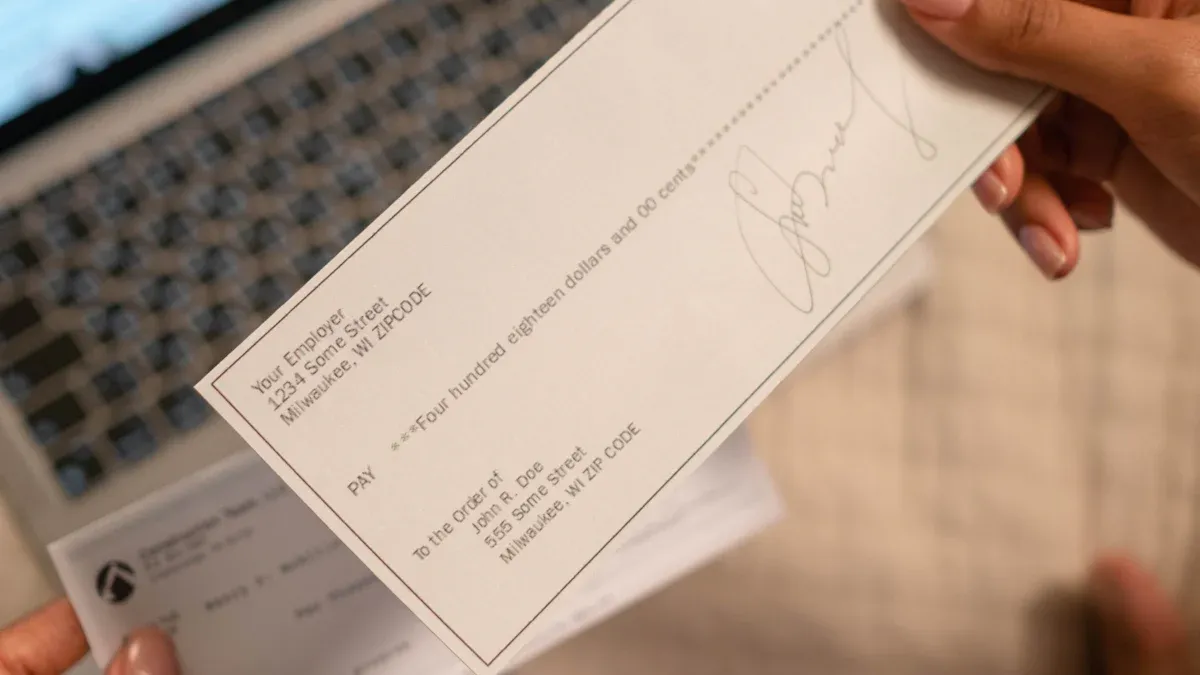
Image Source: pexels
Before cashing a check, the most important step is ensuring the check itself is valid. An improperly filled check may be rejected by the bank. Therefore, understanding how to write a US bank check is the first step to successful cashing.
How to Correctly Fill Out a Check
If you are the one issuing the check, following the correct format is crucial. If you are the recipient, checking these items can help you avoid unnecessary trouble. Learning how to write a US bank check is not complicated; just focus on the following key parts:
- Date: Fill in the current date in the top right corner. You can use numeric format (e.g.,
10/31/2024) or text with numbers (e.g.,Oct. 31, 2024). - Payee: Clearly fill in the full name of the payee or company.
- Numeric Amount: Accurately fill in the amount in Arabic numerals in the box on the right with the
$symbol. Write numbers as left as possible and precise to cents, e.g.,$520.55. - Written Amount: Below the payee line, spell out the full amount in English. This step prevents amount tampering. For example,
$520.55should be written as “Five hundred twenty dollars and 55/100.” After writing, draw a line in the remaining blank space until “Dollars” to prevent others from adding content.
Important Tip: When filling a check, you must use non-erasable blue or black ink pen. Banks will not accept pencil-filled checks. Correct filling is the core of mastering how to write a US bank check.
Key Step: Check Endorsement
Before going to cash, there is one last and most key step: endorsement.
Endorsement is signing your name on the back of the check. You need to sign in the designated “Endorse Here” or “Endorse Check Here” area on the back. This signature must match the payee name on the front.
Why is endorsement so important?
- Authorize Cashing: Without your signature, the bank cannot process the check. The signature authorizes the bank to deposit the money into your account or exchange it for cash.
- Prevent Theft: Once endorsed, the check can only be deposited into an account matching the signature. This effectively prevents theft if the check is lost.
If you’re endorsing a check and want the funds to become usable as soon as possible, it helps to clarify two practical points upfront: which currency you’ll actually spend in, and how much “speed premium” you’re willing to pay. Many people focus on the bank’s availability window but overlook potential holds during clearing, plus the hidden spread that can show up later when converting currency or paying cross-border.
A more controlled approach is to estimate the FX impact before you deposit by using BiyaPay’s fiat FX rate converter & comparison tool to model the real cost and expected net amount. If you plan to use the balance for cross-border payments or online spending afterward, you can review BiyaPay’s multi-asset wallet positioning on the official site, check interfaces via the trading portal, or assess whether a transfer flow is more suitable through the send money page. For entry points and any related instructions, you can also refer to the event center.
Remember, whether via mobile app, ATM, or bank counter, endorsement is essential. This is the final safeguard for fund safety after learning how to write a US bank check.
Bank Channels for Cashing: Mainstream Choices
Depositing the check into a bank is your most common and reliable choice. Through bank channels, you can directly deposit funds into your account or, in some cases, exchange for cash. The following are three mainstream bank cashing methods; you can choose based on your needs.
Mobile App Deposit
Nowadays, depositing via bank mobile app is the most convenient and fast method. You only need a smartphone to complete deposits anytime, anywhere without visiting a physical bank.
The operation process is very simple:
- Open your bank’s mobile app and find the “Deposit” or “Deposit Check” function.
- Enter the check amount.
- Take photos of the front and back of the check as prompted.
- Confirm information and submit.
Availability Reminder Mobile deposit availability depends on your deposit time. Banks have a daily “cutoff time.” For example, many banks set Eastern Time 6 PM or Central Time 10 PM as cutoff. Deposits submitted before this are processed that day; otherwise, considered next business day deposit.
The table below clearly shows usual fund availability:
| Deposit Submission Time | Up to $275 Availability | Remaining Funds Availability |
|---|---|---|
| Business Day Before 6 PM (ET) | Next Business Day | Second Business Day After Approval |
| Business Day After 6 PM & Weekends | Second Business Day After Approval | Third Business Day After Approval |
| Federal Holidays | Second Business Day After Approval | Third Business Day After Approval |
For example, if you deposit a $2,500 check via mobile on Monday noon, you can usually use $275 on Tuesday, with the remaining $2,225 available on Wednesday.
Additionally, you need to note banks set daily and monthly limits for mobile deposits. These limits vary by bank and account type.
| Bank Name | Customer Type | Daily Limit | Monthly Limit |
|---|---|---|---|
| Bank of America | Account Open 3 Months or Longer | N/A | $10,000 |
| Bank of America | Account Open Less Than 3 Months | N/A | $2,500 |
| Chase | All Customers | $2,000 | $5,000 |
| Wells Fargo | All Customers | $2,500 | $5,000 |
ATM Deposit
If you are not accustomed to mobile apps or the check amount exceeds mobile deposit limits, ATMs are another convenient choice. Most bank ATMs support 24/7 check deposit services.
ATM deposit fund availability is similar to mobile deposits:
- First Funds: Next business day after deposit, you can usually use the first $275 of the deposit.
- Remaining Funds: Most remaining amounts available on the second business day.
Note: Funds May Be Held In some cases, the bank has the right to extend fund hold periods. Common reasons include:
- Your bank account is newly opened or has frequent overdraft records.
- You deposit checks totaling over $6,725 in one day; the bank may hold the excess.
- The bank has reason to believe the check may not clear.
Bank Counter Cashing
Going to a bank counter is the most traditional method, especially suitable for large checks or when you need cash immediately. You can choose to go to your own bank or the bank that issued the check.
1. Cash at Your Own Bank
This is the simplest and most direct way. You just need to bring the check and your debit card or ID, tell the teller you want to deposit the check. This method usually has no fees, with fund availability similar to ATM deposits.
2. Cash at Issuing Bank (You Are Not a Customer There)
If you urgently need cash, you can try going directly to the bank that issued the check (bank name printed on the check) to cash it.
- Fees: Since you are not a customer, the bank usually charges a service fee. For example, Bank of America and Chase charge about $8 for non-customers cashing checks, Wells Fargo charges $7.50.
- Requirements: The bank will verify the check’s authenticity and sufficient funds in the payer’s account. You need to provide:
- Government-issued photo ID, such as driver’s license or passport.
- Properly endorsed check.
Important Note There is no federal law requiring banks to cash checks for non-customers. Banks do this to protect themselves and customers from fraud risks. Therefore, if the payer’s account has insufficient funds or check issues, the bank has the right to refuse cashing for you.
Non-Bank Channels for Cashing: Instant but High Cost

Image Source: pexels
If you do not have a bank account or urgently need cash turnover, bank channels may not be the best choice. Then, you can consider non-bank channels. The biggest advantage of these services is “instant”; you can usually get cash on the spot. However, this convenience comes at a price; their handling fees are far higher than banks.
Check Cashing Services
Check cashing service points are widespread across the US, specifically for people without bank accounts or unable to wait for bank processing time. You walk into the store; they verify your check and identity, then give you cash immediately.
The biggest disadvantage of this method is high fees. These services usually charge a percentage of the check amount, and fees are substantial.
- Payroll Checks: Average fee 2.34% of check amount.
- Government Checks (like Social Security): Average fee 2.21% of check amount.
- Personal Checks: Highest fees, average 9.36% of check amount. Cashing a $150 personal check may cost over $14 in fees.
What to Prepare Before Cashing?
You must bring government-issued photo ID. The service point needs it to verify your identity. Common valid IDs include:
- Driver’s license
- Passport
- State ID
- US military or veteran ID
- Permanent resident card (green card)
Large Retail Store Cashing (e.g., Walmart)
Large retail stores like Walmart also provide check cashing services, usually cheaper and more convenient than dedicated check cashing points.
If you plan to cash a check at Walmart, the process is very simple. Just go to its “Money Center” or customer service desk.
Cashing Requirements and Fees
Walmart’s cashing requirements are clear, with relatively fixed fees.
| Item | Specific Requirements |
|---|---|
| Required Documents | 1. Unendorsed check (you need to endorse in front of teller)2. Government-issued photo ID |
| Handling Fee | Checks up to $1,000, maximum fee $4. Checks $1,001 to $5,000, maximum fee $8. |
| Cashing Limit | Single check amount limit $5,000. Special note: During January to April tax refund season, limit temporarily raised to $7,500. |
| Daily Limit | Maximum 3 checks per day. |
What Types of Checks Does Walmart Accept?
Walmart accepts various pre-printed checks, but not handwritten personal checks. You can cash the following types:
- Payroll checks
- Government checks
- Tax refund checks
- Insurance settlement checks
- 401(k) or retirement account withdrawal checks
Quick Decision Guide
If you have no bank account and urgently need money, Walmart is a relatively low-cost instant cashing choice. But if you receive a personal check or amount over $5,000, you may need to find dedicated check cashing services and prepare to pay higher fees.
Key Factors Affecting Availability Time
You have learned different cashing methods, but why do funds sometimes arrive fast and sometimes slow? This mainly depends on three key factors: check type, bank policy, and your deposit time. Understanding these factors helps you better estimate when funds will be available.
Check Type: Personal Check vs. Cashier’s Check
The type of check you receive directly affects availability speed. Personal checks and cashier’s checks are processed completely differently.
- Personal Check: Funds come from the payer’s personal bank account. The bank needs time to verify sufficient balance in the other account, so higher risk and slower availability.
- Cashier’s Check: Funds directly guaranteed by the bank. The bank deducts the amount from the payer’s account when issuing. This makes it almost no bounce risk, safer and faster availability.
Tip: If handling a large or important transaction, you can request the other party pay with a cashier’s check. Although the issuer usually pays about $10 fee, you get money faster and safer.
The table below clearly compares fund availability for both:
| Check Type | Fund Availability | Safety |
|---|---|---|
| Cashier’s Check | Usually fully available next business day | Higher, bank guaranteed |
| Personal Check | First funds next day, balance may be held | Lower, depends on personal account |
Bank Processing Policy: Fund Availability and Holds
Sometimes, even after depositing a check, the bank may temporarily “hold” the funds, meaning you cannot immediately use the full amount. This is a protective measure banks take to prevent fraud and bad checks.
Banks may hold your check for the following reasons:
- Your bank account is newly opened (usually less than 30 days).
- You deposit checks totaling over $6,725 in one day; the bank may hold the excess.
- Your account recently had overdrafts.
- The bank has reason to suspect the check’s authenticity.
According to federal regulations, bank hold periods usually cannot exceed 7 business days. If your check is held, the bank must notify you and inform when funds will be available.
Deposit Time: Bank Cutoff Time
The specific time you deposit the check is also crucial. Every bank has a “cutoff time,” the deadline for processing same-day transactions.
Example Assume your bank’s cutoff time is 5 PM on business days. If you deposit a check at 3 PM Monday, the bank processes it that day. But if at 6 PM Monday, the bank treats it as received next business day (Tuesday), delaying fund availability by one day.
This rule also applies to weekends and federal holidays. Any deposits on these non-business days are treated by the bank as received next business day. Therefore, if you want money as soon as possible, complete deposits before the bank’s cutoff time.
Choosing a cashing method depends on your needs. For non-urgent small checks, using your bank’s mobile app or ATM is most convenient and cost-saving. If you urgently need cash, retail stores are instant choices, but costs higher; cashing a $500 check may cost $15. For large transactions, requesting the other party use a cashier’s check cashier’s check ensures faster and safer funds arrival.
Final Reminder: No matter which method you choose, do not forget to properly endorse on the check back first.
FAQ
Do Checks Expire?
Yes, checks usually have validity periods. Personal checks are generally valid within 6 months from issuance date. US government-issued checks valid for 1 year. It is best to cash received checks as soon as possible to avoid bank rejection due to expiration.
What If I Receive a Bounced Check?
The bank will deduct the amount back from your account and may charge a returned check fee, usually $20 to $40. You should immediately contact the issuer, request payment by other means, and compensate your losses.
How to Cash a Check Without a US Bank Account?
You can go to the issuing bank to cash, but may pay about $8 service fee. Another choice is retail stores like Walmart; they accept payroll or government checks with lower fees.
After Depositing via Mobile App, What to Do with the Original Paper Check?
After confirming funds fully available, still keep the paper check for a period, usually recommended 60 days. Afterward, destroy with a shredder. Never discard or redeposit immediately after deposit.
*This article is provided for general information purposes and does not constitute legal, tax or other professional advice from BiyaPay or its subsidiaries and its affiliates, and it is not intended as a substitute for obtaining advice from a financial advisor or any other professional.
We make no representations, warranties or warranties, express or implied, as to the accuracy, completeness or timeliness of the contents of this publication.
Related Blogs of
Enterprise Overseas Payroll Compliance and Tax Planning: How to Use Multi-Asset Payroll Platforms to Reduce Cross-Border Employment Costs?

OpenAI Card Frequently Declined (Card Declined)? Virtual Card Tested Solutions

Capital Preparation in Early Stages of Cross-Border M&A: How Enterprises Safely Transfer Millions in USD Deposits to Overseas Trust Escrow Accounts?

Patreon/OnlyFans and Other Overseas Creator Platforms Payout: Ultimate Tricks to Bypass Domestic Bank Forex Review for Withdrawal

Choose Country or Region to Read Local Blog
 Australia
 Austria
 Belgium
 Canada
 Cyprus
 Czech Republic
 Denmark
 Estonia
 Finland
 France
 Germany
 Greece
 Hong Kong
 India
India Indonesia
 Ireland
 Italy
Italy Japan
Japan Latvia
 Lithuania
 Luxembourg
 Malaysia
 Malta
Malta Morocco
 Nepal
Nepal Netherlands
 New Zealand
 Norway
 Pakistan
 Philippines
 Poland
 Portugal
 Romania
 Singapore
 Slovakia
 Slovenia
 South Africa
 South Korea
 Spain
Spain Sweden
 Thailand
 The United States
 Turkey
 United Arab Emirates
 United Kingdom
 Vietnam
Contact Us




BIYA GLOBAL LLC is registered with the Financial Crimes Enforcement Network (FinCEN), an agency under the U.S. Department of the Treasury, as a Money Services Business (MSB), with registration number 31000218637349, and regulated by the Financial Crimes Enforcement Network (FinCEN).
BIYA GLOBAL LIMITED is a registered Financial Service Provider (FSP) in New Zealand, with registration number FSP1007221, and is also a registered member of the Financial Services Complaints Limited (FSCL), an independent dispute resolution scheme in New Zealand.